
What does it take to transform a seasonal retirement destination into a thriving center for business, finance, technology, and innovation?
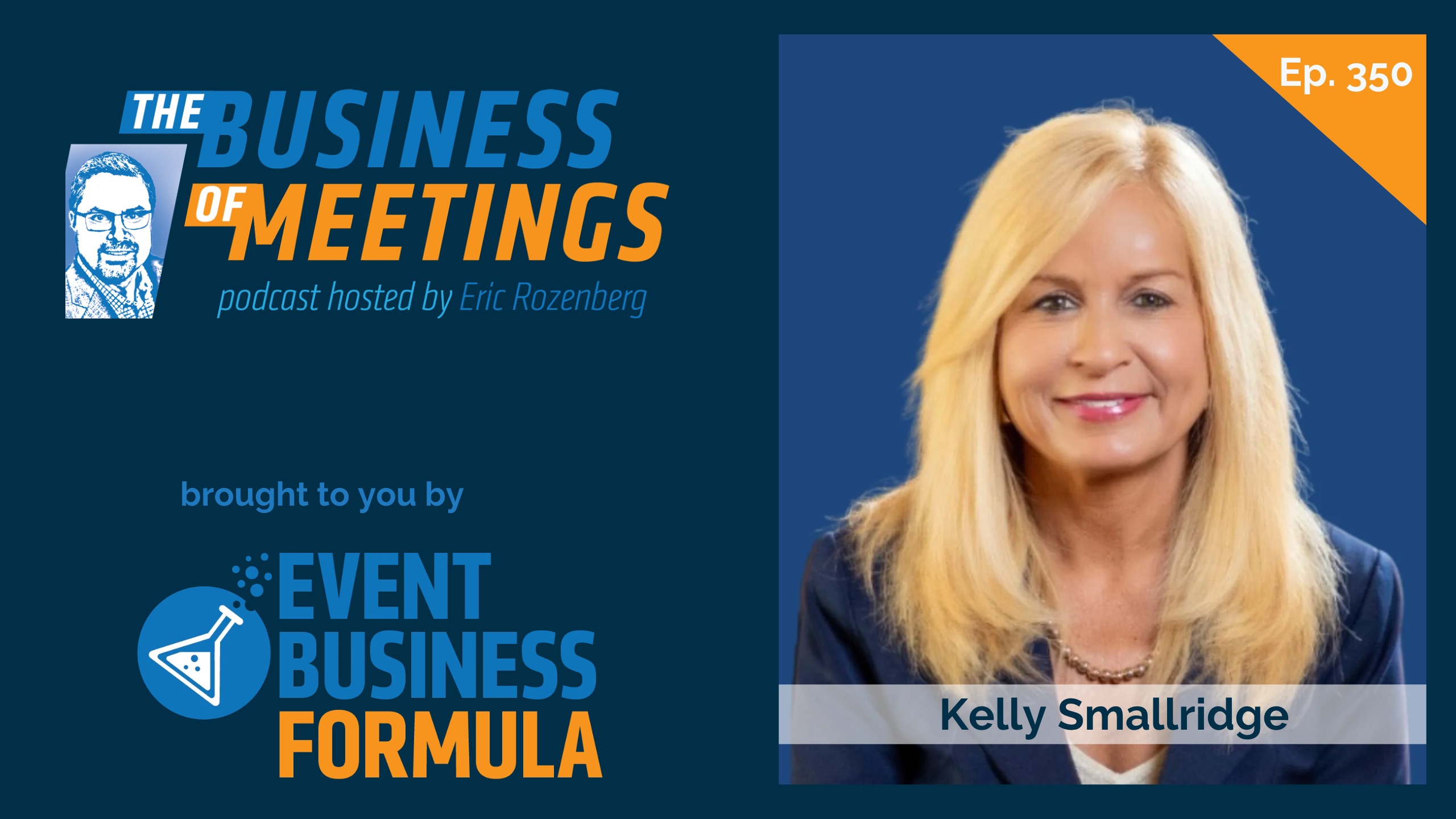
In today’s episode, Eric Rozenberg speaks with Kelly Smallridge, President and CEO of the Business Development Board of Palm Beach County, FL, about the vision, relationships, and leadership strategies behind the region’s remarkable economic transformation.
A Palm Beach County native who joined the organization after graduating from the University of Florida, Kelly has spent her career attracting businesses, creating high-quality jobs, and diversifying the local economy. In 2004, she became the organization’s first female president.
Kelly shares how Palm Beach County became a destination for major financial firms, corporate headquarters, and emerging technology companies. She also explains why personal relationships, strategic partnerships, and a clear understanding of customer needs remain essential to successful business development.
Eric and Kelly explore the connection between economic development and the meetings and events industry, opportunities for small businesses, the importance of resilience in leadership, and the ways artificial intelligence is transforming organizational efficiency.
Tune in to discover how long-term vision, relentless improvement, and a commitment to building relationships can create extraordinary opportunities for businesses and communities.
From a Retirement Destination to a Thriving Business Hub
Kelly grew up in West Palm Beach when the region’s economy depended heavily on tourism, agriculture, and seasonal residents. After graduating from the University of Florida in 1988, she joined the Business Development Board and began working to attract and retain companies that could provide stable, high-paying jobs.
She explains how the organization developed an industry cluster strategy focused on aviation, aerospace, financial services, technology, life sciences, healthcare, and corporate headquarters. By building on the region’s existing talent, infrastructure, and business relationships, Palm Beach County established a foundation for sustained economic growth.
Today, the organization is expanding its focus to emerging industries, including artificial intelligence, cybersecurity, quantum technologies, robotics, and defense technology.
The Strategy Behind Wall Street South
Kelly discusses the growth of Palm Beach County’s financial services sector, noting that more than 250 financial companies have established a presence in the region.
While Florida’s business environment and quality of life are attractive, she explains that companies also prioritize access to capital, professional relationships, educational opportunities, healthcare, and efficient permitting when relocating.
Rather than relying primarily on financial incentives, the Business Development Board offers personalized concierge services that help executives and their employees navigate the relocation process.
Kelly emphasizes that understanding each company’s priorities and removing obstacles can be more valuable than offering traditional economic incentives.
Building an Entrepreneurial Ecosystem
Major corporations and financial firms have created new opportunities for universities, startups, and entrepreneurs.
Kelly highlights the role of Florida Atlantic University, Palm Beach State College, and other educational institutions in developing the region’s workforce. She also discusses Vanderbilt University’s planned expansion into downtown West Palm Beach, with graduate programs aligned with the area’s growing business, finance, and technology sectors.
Entrepreneurial organizations, incubators, and innovation centers are helping connect emerging businesses with expertise, resources, and capital.
Kelly explains how these developments are strengthening the region’s entrepreneurial ecosystem while supporting its next phase of economic growth.
Winning Business Through Relationships and a Clear Sales Strategy
Drawing on decades of experience recruiting companies, Kelly explains that successful economic development requires more than an attractive presentation.
Her approach starts with understanding the customer’s priorities, building trust, and showing how the region can meet specific business needs.
She shares a question that has become central to her sales strategy: asking prospective companies to identify the five things necessary to win their business.
By addressing those requirements early, her team can provide targeted solutions, establish meaningful connections, and compete more effectively against other destinations.
Kelly also emphasizes the value of knowing your market, building strong professional networks, and delivering on promises.
Why Meetings and Events Matter to Economic Development
Eric and Kelly explore the essential role of face-to-face meetings in attracting companies and developing long-term business relationships.
Kelly explains how the Business Development Board partners with Discover The Palm Beaches to align tourism, conventions, and business recruitment with the region’s economic development priorities.
The two organizations collaborate to attract industry-specific conferences, introduce prospective executives to the community, and encourage relocating companies to host their corporate meetings and events locally.
Kelly believes that an exceptional first visit can influence a company’s decision to establish operations in the region.
Their partnership shows how destination marketing and economic development can work together to create business opportunities, strengthen professional relationships, and deliver lasting economic impact.
Creating Opportunities for Small Businesses
Although major corporate relocations often attract the most attention, Kelly emphasizes that small businesses are essential to Palm Beach County’s economy.
The Business Development Board works with chambers of commerce, educational institutions, and entrepreneurial organizations to share information about incoming companies and potential business opportunities.
Kelly encourages small business owners to monitor corporate relocations, pursue relevant certifications, and proactively introduce their services to new businesses entering the market.
She shares the example of a small downtown sandwich shop that expanded its catering business by identifying newly relocated companies and offering meals for their corporate meetings.
Her message is that entrepreneurs do not have to wait for opportunities to come to them. Taking initiative and building relationships can lead to meaningful growth.
Leadership, Resilience, and Continuous Improvement
Kelly approaches her leadership role with an entrepreneurial mindset, emphasizing competitiveness, accountability, and the determination to improve every day.
She explains that setbacks are inevitable, whether a company chooses another location or an initiative fails to deliver the expected results.
Rather than accepting defeat, she encourages business leaders to evaluate what went wrong, seek feedback, study their competition, and refine their approach.
Kelly describes how her organization continuously reviews its performance and looks for ways to better serve its customers.
She believes that complacency is one of the greatest threats to long-term success and that leaders must remain committed to improving their products, services, and organizations.
Embracing Artificial Intelligence Without Losing the Human Connection
Kelly shares how the Business Development Board uses artificial intelligence to increase efficiency, strengthen competitive research, and provide more sophisticated business intelligence.
Her team uses AI to compare Palm Beach County with competing destinations, analyze workforce availability, evaluate costs, and prepare data-driven presentations for prospective companies.
She also discusses using an AI assistant named Spark to help manage scheduling, reservations, and administrative responsibilities.
Kelly encourages business leaders to empower teams to explore emerging technologies rather than letting uncertainty or resistance prevent innovation.
While AI can automate tasks and improve decision-making, she believes that personal relationships, face-to-face interactions, and understanding customer needs remain irreplaceable.
Looking ahead, Kelly hopes to attract more innovative technology companies while preserving the character, balance, and quality of life that make Palm Beach County an exceptional place to live and work.
Connect with Eric Rozenberg
Connect with Kelly Smallridge
Other Resource Mentioned
Listen on: Apple Podcasts · Spotify · YouTube
“Give me five things that I need to do to win your business.”
Kelly Smallridge
Full transcript of episode 350 of The Business of Meetings podcast, Eric Rozenberg with Kelly Smallridge. Lightly edited for readability.
Eric Rozenberg: Hello and welcome to a new episode of the Business of Meetings podcast. Today I am delighted to speak with an amazing entrepreneur in what she’s done. She is the first reason why Palm Beach County is developing so incredibly. Her name is Kelly Smallridge. She is the president and CEO of the Business Development Board of Palm Beach County, and she has been with the organization as soon as she left college, the amazing University of Florida. So not only is she getting amazing results, but the longevity in one organization is something that we don’t see much these days. There’s a lot to learn about relationships, a lot to learn about strategy, a lot to learn about being focused on your goal and getting results. Kelly, I’m so glad you’re taking the time to speak with me, because I know that you have an agenda which is probably even more important than the president.
Kelly Smallridge: Well, thank you for having me. It’s always a great opportunity to tell the story about the Palm Beaches and the transformation of this economy. We’re gonna have a…
Eric Rozenberg: Yes. Yeah, you’ve seen that transformation.
Kelly Smallridge: It’s growing.
Eric Rozenberg: You grow up here. I listened to your presentation and I was even more excited to be living in Palm Beach County. Obviously, I didn’t wait for your presentation to love living here, but the opportunities are just amazing. We’re going to get to that, but first of all, please take us through your journey, from you graduating and looking, like any young graduate, at what is next for you. How did you get into what you’re doing today?
Kelly Smallridge: Well, you can imagine it’s a long story, so I’ll give you a very reduced version of my journey. What most people don’t know about the economic development president for the Palm Beaches is that I was born and raised right down the street from where I’m sitting right now, in downtown West Palm Beach. I graduated in 1988 from the University of Florida, as you mentioned, and I was raised by an engineer at Pratt & Whitney, and my mother owned a private preschool in West Palm Beach. I bring that up because it was a major employer, an opportunity at the largest employer in the Palm Beaches, that brought my two young parents over after they graduated from San Diego State to West Palm Beach for job opportunities. And therein lies how I was born here in this area.
I’m a product of the public school system in the Palm Beaches, and while I don’t think that our school system gets the credit that it deserves, I did go on to the University of Florida. I graduated and started working here in economic development. I really didn’t know exactly what I was going to do when I graduated with a business degree, because there really were minimal business opportunities in the Palm Beaches in the early 90s when I graduated. There were three major employers: Pratt & Whitney, where my dad worked, Florida Power & Light, and IBM. And I really was not interested in any of those jobs.
I applied for a job here in this organization, and you can imagine I’m all of maybe 21 years old, coming in with very, very little corporate experience. I quickly learned that the role of this organization was one that was very, very close to my heart, in that its purpose was to diversify Palm Beach County’s economy, because this really was the place where you came to retire. They call it God’s waiting room. It was a senior population, and it had agriculture and tourism. Therefore, the economy of the Palm Beaches was very, very cyclical. There was really just an economy that was robust from, say, October to Easter, and the summers were very, very hot and certainly had no business activity.
When this board was created, they said that we want this organization to bring in high-quality jobs, innovation, technology, diversify the economy. And that was really my role when I came in: to go out there and work with existing companies to expand their operations, because competition is fierce and other states come in and try to take our companies away. I then moved on to other senior roles where they put me on the road to grow and market Palm Beach County, and I spent a lot of time in New York, Chicago and Boston bringing companies here. I held almost every position in this company, and then in 2004 became the first female president. After holding almost every role here, I began to lead the operations.
So simply put, our role is to recruit, retain and expand companies to this area, diversify the economy, bring in tech and innovation, and create good, high-paying jobs for the residents of Palm Beach County. I cover all 39 cities, and I cover all 2,000 square miles that make up this county. And it is a public-private partnership, now almost 45 years old.
Eric Rozenberg: That’s absolutely fascinating. And you’ve been with the organization, you’ve seen the changes. In the background, for those watching on YouTube, there’s a stunning building behind the boats. I’m sure you’ve seen this grow. Take us back to when you started. How do you select the companies that you want to target to bring them to Palm Beach County?
Kelly Smallridge: So the way that we select them is, number one, what is and was the talent that we currently have in this area. We knew that we had a very strong aviation, aerospace, engineering group of companies, so that was a cluster. So, looking number one at the talent, looking at the infrastructure. We’re close to Fort Lauderdale and Miami, so we have not only three airports, three ports, we have very strong rail connectivity, road connectivity.
And so back in 1995, we created an industry cluster strategy to go after the following: aviation, aerospace and engineering; financial services, because there’s a lot of wealth here; technology and communications, because we are the birthplace of the IBM PC; life sciences and research and health care, because of our aging population; and corporate headquarters, because this usually is the place where CEOs want to live. So those five to six industries drove the strategy for this organization.
Subsequent to establishing that strategy, we most recently added in the entire Wall Street South initiative, and now we’ve got enough of a track record to get a little bit riskier and start recruiting more tech and innovation. And when I say tech and innovation, I’m talking about quantum technologies, cybersecurity, artificial intelligence, defense tech and robotics. That’s the piece that I really like, in that for 35 years we worked on establishing a great success record. We transformed the economy. You can see the buildings in the background, which gave us really great credibility and a lot of experience to now jump off the diving board and go bring in some technologies that are not really as fully developed as the ones that we were after back in the 1990s. Quantum, AI, cybersecurity, robotics and defense tech: those are the industries of today.
So, we’ve put a stake in the ground, again taking a look at the assets of this area, the money that is here, the talent that’s here, and the means by which we are developing all of South Florida. And that’s how we have worked on developing a cluster strategy that makes sense for this county. We do not do things like recruit automobile manufacturers, for example, because we don’t have that ecosystem here that would support that type of blue-collar manufacturing. It’s too expensive. Land and buildings are too expensive. So that gives you the background on how we select the clusters that we go after.
Eric Rozenberg: Brilliant. I know you’re talking about an ecosystem with Wall Street South. If I’m not mistaken, you managed to convince over 100 companies, financial firms, to move south or at least to have an office here. What are those companies looking at, in terms of not only quality of life but also education for the children of the employees, and financial incentives, for instance?
Kelly Smallridge: Yes. So actually, it’s grown so much it’s now over 250 companies in the financial services sector that have made their way to the Palm Beaches, which means that this is now one of the fastest-growing wealth hubs in the world. We have 69 billionaires and 71,000 millionaire households in the Palm Beaches, and that wealth has led to the attraction of many of the industries that I previously mentioned.
What are they looking for? Number one is they like to know that it is easy to form business connections and relationships. They want access to the people who have money, because they’re in the business of raising money. So of course the proximity of going over the bridge and into areas like the island of Palm Beach, or the money that is in Delray, Manalapan, Boca Raton, Wellington and the town of Jupiter, is pretty easy to access. They want to know what are the private schools for their children, and they want to access the concierge service that we have to get their children into private schools. What are the public schools that their employees will send their children to? Introduce them to the gated communities where they can live. Introductions to CEOs of the key hospitals that are in our area that will take care of their families and their children.
And incentives. Incentives are really at the bottom of the list. We really are not paying these companies to move here, because what they also view as an incentive is certainty. In other words, if they’re going to take 20,000 square feet and move into a beautiful high-rise office building, class A, overlooking the water, they want to know that they can get a permit and be in their building in a short amount of time. So rather than take a cash incentive, they want an expedited process, and we are delivering on that. But we have learned to create a concierge service and a whole portfolio of offerings, because the Wall Street companies require something completely different than a blue-collar industrial client.
Eric Rozenberg: And I met you when you did a presentation at FAU, and I was also fascinated to hear about the entrepreneurship program at FAU and all those different divisions that they have. I’m sure you’ve seen the growth in the past, from not having so many colleges or schools, and now you have an amazing ecosystem as well, right?
Kelly Smallridge: Yes. So, not only do we have six colleges and universities, including Florida Atlantic University being the largest, and Palm Beach State College, those are two public universities and colleges, but we also have Nova Southeastern, Keiser, Palm Beach Atlantic University, Lynn University, and we most recently recruited Vanderbilt University. And Vanderbilt is going to build in the center of downtown West Palm. This is actually very fascinating, because they are out of Nashville, Tennessee, but they’ve decided to come into our area and focus on an MBA program, graduate-level programs in primarily business and finance, but they’re also getting into AI, defense and robotics. So their graduate degrees are going to mirror the very industries which we are growing here or looking to attract here.
So yes, we are going to have a lot of college graduates that are looking to be entrepreneurs, that create their own small companies. We are seeing incubators pop up, whether it’s one that we expect will happen with Vanderbilt, or the Quantum Incubator at Palm Beach State College, or the one at Florida Atlantic University, 1909, Venture X, several others. So while we have big business coming in and medium business already here, we also see a very large entrepreneur ecosystem that I would say is maturing more rapidly because of all of the wealth that’s moving into this area and the access to capital.
Eric Rozenberg: That’s awesome. And as you might know, I’m helping small businesses in the meetings and events industry, so I’m very interested in the opportunity for that in terms of positioning and sales, and I think that will also interest my listeners. I mean, what you have today is what I would call an overnight success 30 years in the making.
Kelly Smallridge: Exactly.
Eric Rozenberg: And so in the first years of starting the organization and growing the organization, how did you manage to convince people? I’m sure the companies you’re talking about, the entire country wants them to come. So especially when all this infrastructure was not there, how did you manage to convince them, and what was your sales approach to convincing those CEOs?
Kelly Smallridge: So the sales approach was, I wouldn’t say easy for me, but one that was very familiar, because I was selling the very community in which I was born and raised. Most economic development board presidents are brought in from another state or another community, and they have to learn the assets of that area. For me, it was like the back of my hand.
So number one is I had to clearly articulate: this is the product today. And then I had to clearly articulate: this is the vision for the next 5 to 10 years. In other words, I’m going to paint this picture of where I know that we will go, and we surpassed all of that. But the most important part was having the relationships to open the doors for these companies who were looking to gain a location in this market, and making the introductions. So if you have no relationships and you’re trying to convince an aircraft manufacturer to come in, and you don’t know anybody at Pratt & Whitney, Sikorsky or L3Harris, it’s very, very difficult. But because I had established all of those relationships already, I made that a part of my sales efforts. And when we could open the doors and show potential business for these new companies coming in, it clearly showed them that this could be a very lucrative environment, and that there was going to be a business organization like ours standing by their side, free of charge, offering all of our services confidentially, that would hold their hand along the way until they really got stable and up and running. That was number one.
Number two is that everything would be done in an expedited manner. And when you can promise that you know the area, you can open the doors, and you can get them in their building ASAP, you automatically beat out the competition.
Fast forward to today, the sales pitch has been sharpened. From the get-go, rather than do a song and dance and a fluffy presentation, what I ask companies today, and I think that this is the most important thing no matter what industry you are in and no matter what you are trying to sell, is to ask the question: give me five things that I need to do to win your business. So, I’ll walk in and say, “Tell me five things that I need to do or show you to prove that Palm Beach County is the best business location.”
Eric Rozenberg: Love it.
Kelly Smallridge: And when I get that, I can hit the target as opposed to dancing around a circle. And that has helped us significantly land more deals, as we do that on the front end so that we win them along the way, as opposed to finding out three years later that we lost the deal because we didn’t ask the right questions.
Eric Rozenberg: Oh, I love that. “What are the five things I need to do to win your business?” I just love it.
Kelly Smallridge: Exactly. Yes. And any organization can use that.
Eric Rozenberg: That’s phenomenal. Let’s talk a little bit about meetings and events. Obviously I’m biased there, but I know the stat, and you probably know, that in terms of economic impact, when a company comes and has a meeting, the people attending are usually spending three to five times more than a regular visitor, if you were a tourist, in terms of spending when they come to a destination. I’ve seen for years my friends at Discover The Palm Beaches, and especially my good friend Kelly Cavers, who’s doing an amazing representation for you when you have those companies coming. What do you think about this approach to meetings and events, and the fact that if you take any business challenge, if you want to be successful, at the end of the day you need it in person? You need the relationship and you need face-to-face meetings to convince people.
Kelly Smallridge: Yes. So artificial intelligence and robotics is not going to replace us. The face-to-face, like you said, is absolutely critical. If I offered all of my prospects a Zoom meeting versus in person, 90% are going to choose in person, even though I’d be flexible either way, which tells me that face-to-face for our business is absolutely critical.
Now, back to Discover The Palm Beaches. We have a formal partnership with Discover The Palm Beaches, and we are like sister companies, because we understand that in order to get a business here, the first impression is usually a stay at a local hotel or a visit with their family. And so that first impression has to be absolutely critical, and I think they do a wonderful job with our hotels, really putting on a first-class impression.
What the Business Development Board does with Discover The Palm Beaches is, they are entirely aligned with the key six clusters of industries that we are looking to bring here. We partner together, whether it’s in life science or tech or health care or Wall Street South. We go after meetings and conventions. We work on the experience once they come here. We work on how do we get some stage time for any events, symposiums or conferences coming here? How do we get a booth? And then we’ve actually traveled most recently to New York to go out on the road to tell the story of how economic development and tourism go hand in hand, and that every visitor that comes to Palm Beach County could end up being a CEO that makes the decision to bring their operations and jobs to this area.
So whether it’s trying to get the company here through a company visit, or trying to then land their board of directors meeting. So if a big corporate headquarters comes here, how do we get their bigger events? How do we get their board to now have the meetings here, and not to have those in New York or Chicago or Boston anymore? And then how do we go out on the road and convince more and more companies to come here and set up shop, by partnering with Discover The Palm Beaches on the overall first visit? And that has been a wonderful, wonderful partnership between our two organizations.
In addition, we wanted to make sure that the way that we brand and the way that we look as companies is very similar. And so we changed our branding to look very similar to Discover The Palm Beaches. We are now called the Business Development Board of the Palm Beaches, and they’re called Discover The Palm Beaches, and our colors are very much similar. So we work very, very closely, and I’m extremely appreciative of the hard work of Milton and Kelly. And I don’t think that many communities throughout the US really take advantage of an economic development and tourism marketing partnership. So we’re blessed to have that relationship here.
Eric Rozenberg: Absolutely. And I have to tell you, having been 30 years in the meetings and events industry, hearing you speak like that about business development and the whole meetings and events industry is very inspiring. So I’m very happy to hear that.
In terms of small business, I always said the large organizations obviously bring a lot of jobs, but if you take small businesses together, they probably provide more jobs than any other structure in the country. But because it’s so fragmented, there is not really a representation and any type of link between them. How do you see small business opportunities with all those major companies coming to Palm Beach County?
Kelly Smallridge: So, we love our small businesses in Palm Beach County, and you’re right, they are the fabric of this community. So we have formed partnerships with our eight chambers of commerce, primarily the eight large chambers of commerce, to ensure that every time that we bring a big company into town, the entire public knows about it. And we work on a public strategy to ensure that we are hitting the newspaper, social media and going on TV, so that everybody in Palm Beach County understands. I’ll give you examples. ServiceNow is coming here with 856 jobs. coming here with 800 jobs. Wells Fargo is coming here with a couple hundred jobs. And rather than keep that a secret and only give that opportunity to a handful of companies, we’re making sure that everybody has that.
In addition, we are encouraging companies to become small business certified through our county department, to ensure that when these large companies have requirements to hire a certain number of small businesses, the small businesses have the right credentials to hit the ground running and be able to get business from these larger companies. We also partner with the FAU Small Business Development Center, 1909, and Venture X, and we hold a couple of small business seminars with our chambers to go on stage and tell them exactly what’s coming in. So we’re very vocal about it.
It’s funny, because sometimes small businesses feel left out, or people think that we’re only about big business, but the reality is the average size of a firm that comes in here is about 30 to 50 employees. It’s nice when you get those that are 800, but that’s not the majority of the projects coming in. They still are what I call medium-sized, 30 to 50. And all of the information on these companies is on our website as well.
So, I also know a small sandwich shop located in downtown West Palm with three employees. They grew significantly just by going on our website, looking at the new companies that were coming into downtown West Palm, and offering them catered meals for all of their corporate meetings within a stone’s throw of where they are. And so they have grown their sales, they’ve grown their staff, and it’s all because of just taking that extra initiative to get outside of their business and start to go to the right resources to find out who’s coming in brand new to this area. You got to take a little bit of initiative.
Eric Rozenberg: Yeah, absolutely. I’m sure that there have been moments where the outcome was not necessarily the one that you were expecting. For any small business owner, first of all, nobody does it alone, and for any small business owner, it’s the solitude of the entrepreneur, and it’s something that anyone will have to face, because it’s a roller coaster, it’s a cycle, an economic cycle, whatever you want to call it. How does Kelly Smallridge fight when the outcome is not the one you wanted to have? Who do you talk to, and what is your advice for small business owners that are facing outcomes that are not necessarily the ones they were hoping for?
Kelly Smallridge: So I think you mentioned a very, very critical word in your question, and that word is where I see a lot of entrepreneurs fail. And just for clarity for your listeners, I am not a government employee, and I run this organization like I am an entrepreneur, like I own this company, even though I report to a board. The word that you used was fight. And I think that unfortunately a lot of entrepreneurs feel defeated after losing a lot of times, and want to go into a cave and not come out and fight.
So first of all, you’ve got to pick yourself up every single time and every single day. And you have to fight, and you have to have within you a competitive spirit to win. When I wake up every day, I say to myself, “Kelly, if you’re going to leave the comfort of your home to go to work, you better be leaving to be the absolute greatest in your industry, greatest in the state of Florida, and greatest in the United States.” There is no value in being mediocre or just coasting along in life. So I use those as my guiding principles.
And then when I hit failure, when I lose that company, when I fail on an initiative, I evaluate. I ask questions of my team, of my board. What did we do wrong? What could we have done better? After every initiative that we launch, we go back to the drawing board and we say, what did we like? What did we not like? How do we make it better? Did you get any feedback from the customer on what they didn’t like? And when we take that, we’re able to sharpen our pencil. Not, Eric, every single year. We sharpen our pencil every single day. I ask the question of my staff: What can we do better? What customer is not satisfied, and how do we please them? Where did we fail that we can do better? Eventually, your failures get less and less, because you’re sharpening that pencil every single day.
But another guiding principle is that what we did yesterday is not good enough for today, and we can’t be complacent. I don’t care if I own a sandwich shop. The sandwich I made yesterday is not good today. What extra sauce am I going to add to that sandwich today so I have record sales for the future? And I think that entrepreneurs have to, number one, make sure their product is the best. They have to understand and study their competition. And they have to wake up every day with a fire in their belly.
Eric Rozenberg: I think that what you just said, I’m going to transcribe it and send it to all business schools all over the world. Yeah, I totally concur with you on that. Now, you’re talking about AI and all the change that we have. You have your team, you have a certain way of doing business, even if every day you’re trying to be a little bit better. How do you see the impact? And by the way, I fully agree with you that AI will not replace meetings and events, for sure. Human beings want to come in person. Human beings want to have the in-person relationship. But how do you see your work changing and your team changing with the use of AI to leverage everything you’re doing? Because I’m sure there’s a lot of things that can be automated, but there’s a lot of things as well that cannot be replaced by a machine.
Kelly Smallridge: Yes. And some other really good advice: my organization is about a $6 million not-for-profit corporation. I have talked to companies in this county that run $300 million private companies, whether it be real estate development, construction, whatever it is, who do not know how to use technology at the pace of what we are using in our very, very small not-for-profit. And I think that is based on, number one, surrounding yourself with the right people, trusting them, and empowering them to go out there and seek the most powerful AI tools in order to produce the best bottom line for your company.
And the stumbling blocks that I’ve seen with companies that are very large is, number one, they don’t trust technology. They don’t know how to use it. They’re at an age where they’ve almost forced themselves out, and don’t have an open mind about learning technology, and so they’ve not brought it into their company. They’re spinning their wheels, spending days and days reviewing contracts that AI could do in a millisecond.
So all of that is what I’ve embraced here in this organization. I’ve used it to our advantage by taking AI and allowing it to churn out intelligence that paints a better picture of our county against the county which I know I’m going up against in order to win that out-of-state company. Okay? So if the company says, “I’m looking at Nashville, Austin, Dallas and Virginia,” when they walk in this door, I’m going to have a competitive analysis of how Palm Beach is better than my competition by using AI. I’m going to be able to analyze the talent. I’m going to have a cost comparison with line graphs and pie charts going. I could never do that in 10 minutes the way that I’m able to do it now.
I think establishing ourselves as a data engine, and serving as the data intelligence hub for everybody in Palm Beach County, so that you come here to get your stats in order to run your business, is a niche market that we’ve recently stepped into. So if I had to put this economic development board up against any other economic development board in the state of Florida and say, “Let’s do a side-by-side comparison of the AI and technology tools that this board is using versus others,” I bet we would place first in the state of Florida. I have given my staff full rope to use them, and empowered them to go out there and tell me who has the best tools and what it’s going to cost to bring every single one of those tools into this company, as though we are running a $300 million private company, and not be afraid to go and delve into those areas.
So, I don’t even have an assistant anymore. I’ve got an AI assistant. Her name is Spark, and she coordinates my calendar. She makes reservations for me. She orders tickets for me. Things that I would have had assistants do for years, all of that is done and automated right now. If I need to go to New York tomorrow, they’ll come back and tell me the cheapest price, the seat I can sit in, and what airlines fly non-stop. And you have to know how to figure that out. It takes time, right? But when you use technology, that takes a second, versus me spending 30 minutes on Expedia trying to book that.
Eric Rozenberg: I love it. And by the way, true serendipity, and with people I’ve met here in Palm Beach County, I now have my own AI that is coaching business owners in the meetings and events industry, and they feel like they’re talking to me.
Kelly Smallridge: Exactly.
Eric Rozenberg: It’s absolutely fascinating. Now, how do people go through Spark to get on your calendar, then?
Kelly Smallridge: So, when you email me, it automatically gets in there right now, and my Spark picks it up and lets me see what dates I have available, and allows me to approve the dates before sending it back.
Eric Rozenberg: Amazing.
Kelly Smallridge: I’ve got Claude built in. So it is absolutely amazing. And I don’t think it’s taking my place. It’s just allowing me to work more efficiently and have more time to focus on the relationship and understanding the customer needs.
Eric Rozenberg: Right. Absolutely. I’m listening to you and I said, no wonder you’ve had so much success over the decades, because you’re inspiring, your intelligence and the energy and the way you focus. I think it’s something that anyone in business can learn from. So I’m really very happy you’re taking the time today. I have two more questions, if you don’t mind.
Kelly Smallridge: Sure. Go ahead.
Eric Rozenberg: The first one is, how do people get in touch with you, and the website and the data and everything?
Kelly Smallridge: Yes. So, like I said, we put all of our resources as a gift to the world on our website. Our website is bdb.org. We have loaded all of our data intelligence reports there for everyone to see how to grow their business in Palm Beach County. And my email address is ksmallridge@bdb.org.
We have a private investment program here for anyone that wants to get very, very involved, and all of that is available on our website as well. We have 350 companies that participate in 35 programs that we organize throughout the year, in order to allow private companies to get even closer to this organization. Our next event is on November 18th, where we will announce some new corporations moving in, introduce the new person at Vanderbilt, as well as have a representative for the new Wells Fargo relocation. So, like I said, we’re very open, very public about what’s coming in, because we believe that everybody benefits, from the one-person operation to the 10,000-person operation.
Eric Rozenberg: Amazing. And my last question for today, Kelly: when we meet again in one year with a bottle of champagne, what are we going to celebrate?
Kelly Smallridge: So, I hope that we are celebrating some of the greatest tech and innovation companies that have decided for the first time to plant a flag in the Palm Beaches, and that we continue to maintain something that is absolutely critical to me personally and professionally. And that is, while we encourage growth, economic growth and good-quality jobs, that we do that keeping the character and balance and the charm of this beautiful place that we call the Palm Beaches. And we don’t let the economic growth overshadow the main reason why all of us call the Palm Beaches home, and that is the wonderful quality of life.
Eric Rozenberg: And I can only concur with that. I love living here. Kelly Smallridge, thank you so much.
Kelly Smallridge: Thank you for having me. Have a wonderful week.
Eric Rozenberg: Thank you for tuning in to the Business of Meetings podcast. I hope you found today’s episode valuable. If you enjoy the show, the most important thing you can do is leave a review and share it with your colleagues. It really helps spread the word. I truly appreciate your support. And if you’re ready to take your business to the next level, don’t forget to visit eventbusinessformula.com to learn more about how we are helping event business owners like you. Thanks again for listening, and I’ll see you next time.