
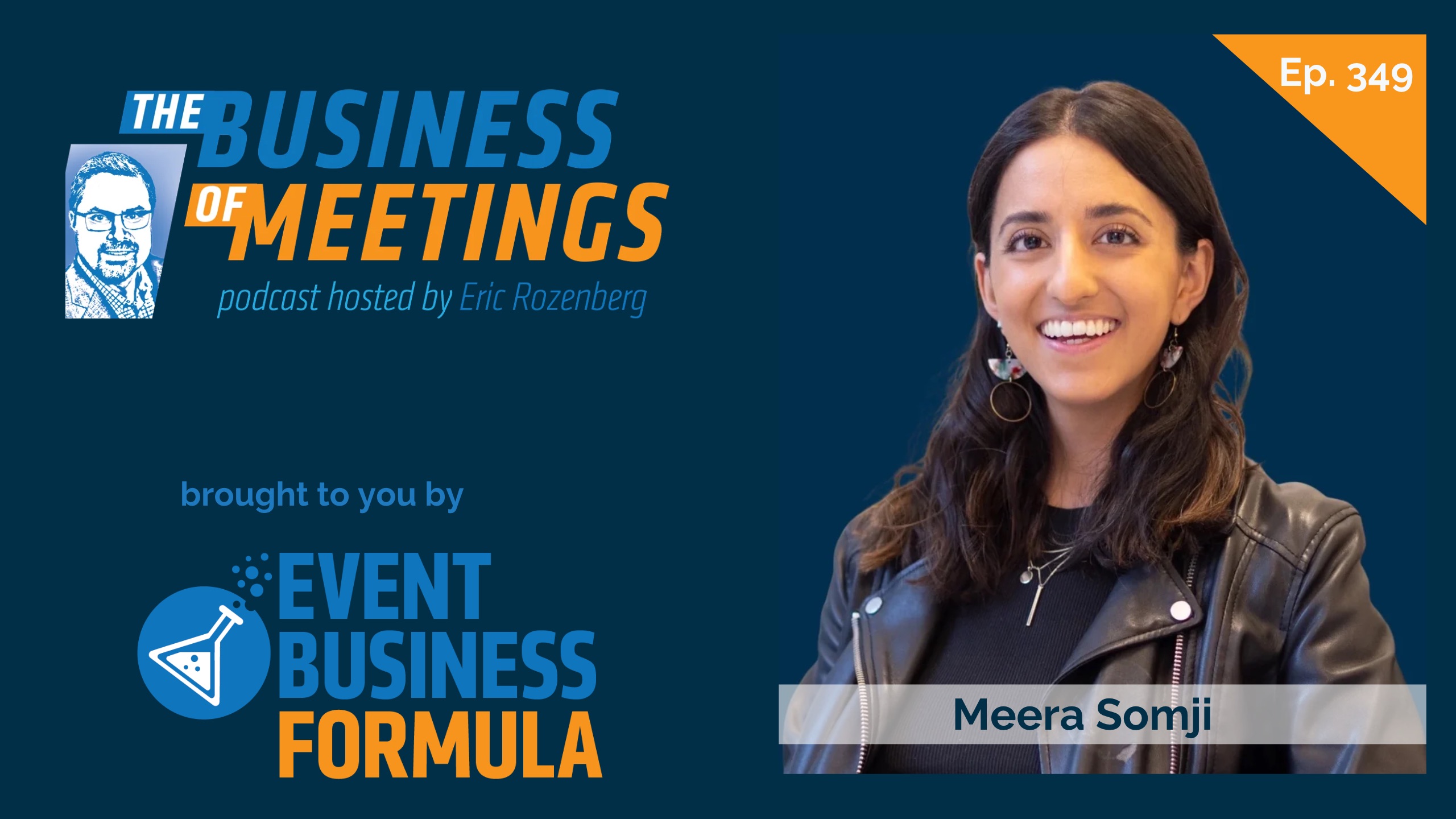
Trade shows create tremendous opportunities for exhibitors, sponsors, and attendees, but how can organizers demonstrate their true value and turn those connections into measurable revenue? In today’s episode, Eric Rozenberg speaks with Meera Somji, co-founder of Ezna, an AI-powered event concierge designed to connect visitors with the right exhibitors, facilitate valuable meetings, and help organizers uncover new revenue opportunities.
Drawing on her background in event industry consulting, mergers and acquisitions, and entrepreneurship, Meera shares how she and co-founder Andrew Carney developed Ezna to address one of the industry’s biggest challenges: proving the business value of face-to-face events.
They explore the importance of customer relationships when preparing an events business for sale, strategies for monetizing AI-powered matchmaking, and how visitor intent data can help organizers make smarter decisions.
Tune in to discover how AI can strengthen exhibitor relationships, improve attendee experiences, and create sustainable growth for event businesses.
From Consulting to Entrepreneurship
Meera began her career at Plural Strategy Group, where she worked alongside experienced industry leaders on event growth strategies, launches, geographic expansion, and acquisitions. Her experience gave her valuable insight into what makes an events business successful and attractive to investors. After working with Andrew Carney at Smart Expo, she recognized an opportunity to combine their industry knowledge with technology. Their complementary strengths in product development, business development, and sales became the foundation for Ezna. Meera emphasizes the importance of choosing a business partner you trust, especially when navigating the challenges of entrepreneurship.
What Makes an Events Business Attractive to Buyers?
Having worked on the buyer’s side of event industry acquisitions, Meera explains that investors look beyond revenue and average retention rates. Strong relationships with major exhibitors and sponsors are particularly important. During due diligence, buyers often interview key customers to see whether an event consistently delivers value and remains essential to their marketing strategy. A history of returning exhibitors can demonstrate strong customer relationships, even without multiyear contracts. Investors also examine competitive positioning, market conditions, and future growth opportunities.
Solving the Trade Show ROI Challenge
Ezna was developed around a fundamental problem: events often deliver more value than organizers can effectively measure or communicate. The platform uses AI to understand exhibitor offerings, identify visitor needs, recommend relevant suppliers, and facilitate meetings during events. By helping attendees connect with exhibitors who match their interests, Ezna aims to improve the visitor experience while giving organizers a clearer picture of the sales opportunities their events generate.
Building AI Technology That Generates Revenue
Rather than developing technology simply because AI makes something possible, Meera and Andrew focused on creating a product that event organizers could monetize. Ezna operates primarily through a licensing model, with fees based on event size. Organizers can then choose how to generate additional revenue through exhibitor participation. Some offer paid concierge access, while others include a set number of meetings in exhibitor packages and charge for additional opportunities. Organizers can also incorporate meeting allocations into sponsorship tiers. Others prioritize exhibitor retention, using better business connections to encourage customers to return to future events. Meera explains why successful AI products should solve meaningful customer problems and have a clear path to sustainable revenue.
Turning Visitor Intent Data Into Actionable Insights
One of Ezna’s most valuable features is its ability to collect information directly from visitors about their interests, budgets, and purchasing intentions. Instead of overwhelming organizers with raw data, the platform produces actionable recommendations. These insights can reveal unmet demand for particular exhibitors, gaps in educational programming, and opportunities to improve marketing and sales strategies. For example, if visitors consistently search for products or services that are underrepresented on the show floor, organizers can use that information to guide future exhibitor recruitment.
Giving Visitors Control Over Their Event Experience
Meera explains that one of the biggest obstacles to event technology adoption is convincing attendees to use another platform. Ezna approaches the problem differently by letting visitors contact exhibitors without receiving unsolicited sales messages. Visitors can identify their interests, receive personalized recommendations, and decide which suppliers they want to meet. Meera shares that attendees at a life sciences conference appreciated this approach because it let them discover relevant exhibitors without being inundated with outreach.
Measuring the Value of Every Meeting
Ezna also helps exhibitors document the business opportunities created through their meetings. Rather than relying solely on traditional post-event surveys, the platform encourages exhibitors to record meeting notes, follow-up actions, and potential sales value. Visitors can also indicate their preferred next steps, giving additional insight into each connection’s quality. These records help exhibitors evaluate their return on investment while giving organizers stronger evidence of the value their events deliver.
Growing Through Relationships and Partnerships
Meera credits Ezna’s early success to relationships built throughout her consulting career. She explains that winning a first customer is considerably easier when that customer already knows and trusts the founders. Those early partnerships also provide opportunities to refine the product, explore new applications, and adapt the technology to different event formats. Although Ezna initially focused on large trade shows, the company is expanding into smaller conferences and hosted buyer programs, with an emphasis on serving event organizers across the United States and Europe. Meera hopes that Ezna will eventually become an essential contributor to the long-term revenue and value of its clients’ businesses.
Connect with Eric Rozenberg
Connect with Meera Somji
Listen on: Apple Podcasts · Spotify · YouTube
“You only get participation if there’s something in it for them.”
Meera Somji
Full transcript of episode 349 of The Business of Meetings podcast, Eric Rozenberg with Meera Somji. Lightly edited for readability.
Eric Rozenberg: Hello and welcome to a new episode of the Business of Meetings podcast. Today I’m delighted to speak with an entrepreneur, a pioneer. We’re talking about events. We’re talking about trade show. We’re talking about the buyer supplier journey and we’re talking about AI. She and her co-founder started Ezna, which is the AI event concierge, with my accent, whatever it is. But she is really a leader in our field. The one and only Meera Somji. Meera, I’m so happy to be speaking with you today.
Meera Somji: Thank you, Eric. It is my pleasure. It is my honor. I love the business podcast and I love what you do. So, thank you.
Eric Rozenberg: Wonderful. Thanks a lot. So you are the classical pioneer that is traveling, that is talking with different investors and client, and you live between New York and London. So tell us a little bit about your journey. How did you get to do what you’re doing today?
Meera Somji: Oh, thank you for asking. And it started by accident, like all best journeys do, and how many of our careers in the events industry did. It started with my role at Plural Strategy Group, which some of your listeners will be very familiar with, really a leading consultancy in the industry, and I just joined at the perfect time. I was the 11th member of the team at this new consulting company with Jonny Baynes, Jim Easton, Phil, who were all so established in the B2B media and events industry.
And so immediately I was working directly with these leaders, with these pioneers, on events projects, all types of growth strategy events projects, new launches, geo-clones and a lot of acquisitions, working with both the investor side and the industry side. So basically, Eric, from day one, I was learning very rapidly how do you build and sell an events business, and everything has basically gone from there.
Eric Rozenberg: Wonderful. Do you have background as an engineer or business or tech or…
Meera Somji: It was business. I mean, my degree was in history and politics, but I was always basically interested in business and entrepreneurship, and I was given the advice that the best place to learn would be a consulting company, because you get to just see it from the outside and really learn about business more than if you actually joined just one business. So I followed that advice and that’s what led me into consulting.
Eric Rozenberg: Wonderful. And what really triggered the fact that you wanted to start your own business and be your own boss?
Meera Somji: Yes. And I think that’s what I love again about Plural and about consulting, is that they also recognize it is a training ground for entrepreneurs. So you know that after 3 to 5 years there will be people in your team who have to scratch that itch. And that’s how it felt for me. I had to scratch it. And the beauty is that I wanted to stay in this industry. I’d learned about it so much. I knew it so well, and I just wanted to keep partnering with events companies to help them grow, but this time with a technology instead of consulting.
Eric Rozenberg: Wonderful. When you decide to go on your own, what make you say, okay, this is the field I want to start my business in? And also, what motivates you to have a partner? When I started my first business, I had a business partner who was actually 15 years older than me, and gives me more confidence, although it’s not always going well in the end, but is different motivation to start your business and also to partner with people. So what’s your experience and advice there?
Meera Somji: Absolutely. And my answer to your two questions is the same, because how I chose what business to do was completely linked to who I wanted to do it with. When Andrew Carney and I sort of started just dreaming about going into business together, I thought I’d won the lottery. Honestly, he was also a consultant at Plural Strategy and at AMR before that. So we worked with each other. He had then set up a startup previously called, which was all about pricing analytics for the events industry.
And I joined him, and he really supported me to go on a product boot camp, develop my product management skills. If you’re going to transition, you need to do a bit of training in product development. And I just felt I’d won the lottery when he wanted to go into business with me. Eric, he is truly an incredible thinker and inventor and business person, and just incredibly trustworthy as a human. That is really what his reputation is and how he is. So I could go into much more, but my advice for anybody thinking of setting up something on their own, in my experience at least, having a partner was key and has been key to our success.
Eric Rozenberg: Wonderful. Did you have different responsibilities, roles in the business?
Meera Somji: And I think that has again really been in our favor. He is generally the technical lead. He has much more technical expertise and technical knowledge, and I generally lead on the business development, sales and marketing, but we can both also really support each other in those areas. I bring him into a lot of the sales and marketing and go-to-market, and he brings me into a lot of the product development and prioritization. So we have our fields, but, and you’ll know, having a partner, there’s no such thing as a clear split. As founders, you’ve got to be involved in everything.
Eric Rozenberg: Absolutely. Now, we got to get to Ezna, of course, but before that I do have a question, because your background has been with some sort of M&A in the industry. There are billions of dollar now that are being invested, and I’m helping a lot of business owners, and some of them want to prepare their business for sales. So what would be the advice, having been on the other side, on the buyer side? What would be your advice for business owner who want to prepare their business to be sold?
Meera Somji: Oh, great question, and if anybody’s listening, feel free to get in touch directly for more. But the main question we are answering is sort of the strength and sustainability of an events portfolio. So customer relationships: are your bellwethers, are your top sponsors, are they coming back? So it’s not always just the kind of average NPS, average retention figures that we’re really looking at. We’re really looking at those key accounts. Are they coming back? Are we really building a strong relationship with them? That would really then steer where the conversation and where the assessment would go.
And then forward-looking. They’re really paying attention to the market and the competitive environment that they’re in. It’s not a bad thing if there are competitors and there are other shows, so long as you know what your positioning is and you’re looking ahead at, therefore, what could the growth opportunities be in that position. So yes, strength of customer relationships, especially of your biggest, and then forward-looking to whether a growth opportunity, just being super aware of that. Anything else, get in touch and I’ll see if I can give you [laughter] more.
Eric Rozenberg: The point that I have in what you just said is, how do you evaluate the customer relationship? Because most of the time, yeah, you could have, if you’re talking about the show, you can have an exhibitor with two, three years contract, which is great. That’s the best thing. But most of the time what you have as well is people that are not committing for more than one year. So do you still valuate the customer relationship if, for instance, a customer has been coming back the last 5 years, but there’s no long-term contract?
Meera Somji: And of course, we all dream of those three-year contracts, and it’s very difficult to get exhibitors into a multi-year, but honestly, Eric, we have in-depth phone calls with as many of those top accounts as we can when we are running a due diligence. And so no, we’re not going to necessarily judge it based on multi-year, but we will make that judgment based on an in-depth conversation with that marketing director, with that event team, to understand: has this show delivered value? Is the return strong enough for you to believe that this will be a key part of your marketing budget next year and the years ahead? So I was surprised. I was surprised at how many interviews we would do, how insightful those interviews would be. Always alongside the quantitative data analysis.
Eric Rozenberg: Got it. One thing I always say to business owners is the less you are involved in the daily activities, the higher the value of your business. Now, on the buyer side, now you’re talking about trade shows, but let’s talk about corporate events. For instance, if you have an agency, you have a DMC or an AV production company, what would be for you, based on your experience, the minimum revenue or margin that people should have? Or is there investors that are doing roll-ups and that will just look at the additional business that it could bring?
Meera Somji: Interesting. And I’ll be very honest, I’m not actually so familiar with the corporate side. The nature of it is that I worked really predominantly on those big trade show M&A, so I don’t know the answer. But I had an interesting conversation with private equity, and actually a consultant at Plural right now who is still doing this work, and she told me about how many new investors have entered the landscape since events are the place to be. And so I think things are changing. And I think people’s rules on margins and what they’re looking for, I think things are in flux. I think things are changing. So we’ll see. Sorry I can’t give better answer than that.
Eric Rozenberg: I always prefer an honest answer than trying to make it up. So absolutely. Thank you. So you co-founded Ezna. How was the process with it? Did you see a niche in the market, a need, or were just like, oh, that’s a great idea, let’s see what we can do with it?
Meera Somji: It really came from especially Andrew. I have to give it to him. Especially Andrew’s deepest bugbear in the events industry, that the biggest challenge he knows, and which is, events have always delivered so much more value to exhibitors and sponsors than we have been able to really communicate and share and celebrate. And we started when AI made its leaps and jumps and suddenly became a tool that had so much opportunity.
Andrew was hellbent on solving the biggest challenges in this industry, which is how do we really celebrate and communicate how powerful an event can be, and how can we make sure that when a team has worked as hard as it’s worked to bring visitors in, we are helping those visitors to meet the right exhibitors on site. So those are the two things. How can we make sure that people win on site, so that a show can really highlight how much business it’s delivering, sales opportunities it’s delivering, how it’s changing the trajectories of the exhibitors who invest in it.
Eric Rozenberg: Amazing. So obviously what you’re just saying are the biggest needs of exhibitors and the shows organizer. How do you find the first clients you start a business like that?
Meera Somji: Great question. How do you find the first client? It’s a key question and it relates to our whole conversation so far. Your first client is somebody who already knows you and trusts you. It is impossible, and correct me if I’m wrong, if you’ve done an interview with an entrepreneur who’s managed it, I stand corrected, but it is really, really hard to get a first client over the line, especially if they have not worked with you before or trust you or you have a relationship with them. So that is what we’ve done. Fortunately, both Andrew and I have had plenty of clients in the exhibitions industry. So when we approached them with Ezna, they were excited and cautious, but willing to give us a go, and that’s the truth. Have you had that in other conversations you’ve had?
Eric Rozenberg: Most of the cases like that, and all the business I’ve launched in my life was always, you need people to trust you, to believe in you, to see the solution you’re bringing, but also to trust the fact that you’re going to deliver.
Meera Somji: Exactly, I think, but willing to trust you and then willing to learn with you. Not everything is going to be perfect out of the gate, but we’re in the business of partnerships. We’re in the business of let’s work together on this, and people like that. People recognize that, first of all, not all events are the same. Technology needs to adapt. It needs to grow. It needs to be refined. So yes, building those early adopter relationships is key.
Eric Rozenberg: Yeah. And I totally concur with that. I’ve launched Eric AI a few months ago, and the people we’re working with, and also the enterprise they’re working with, it’s really a partnership in looking at the question that are being asked, because it’s totally confidential. So I have no access to the question and answer, but the partnership makes it extremely effective.
Meera Somji: Absolutely.
Eric Rozenberg: Talking about AI, how do you move from the experimentation to basically having useful revenue-generating product, and not just because every week there’s a new thing that is coming up with AI, and you can spend days and night learning and automating things. Great, but you have to generate revenue.
Meera Somji: Exactly. And I think we have focused very kind of clearly on customer-facing tools. The concierge is something that your visitors use to help plan their day and book their meetings. Booking meetings immediately generates and creates a revenue stream for the organizer. So I think the way we’ve thought about that question is, what product will customers buy? They will buy meetings. They will buy access to high-value, high-intent buyers. So kind of starting with that problem, building a product that will enable that revenue stream, rather than starting from scratch, starting from “isn’t it cool that AI can do this thing,” and then only thinking about revenue generation sort of down the line. So we designed it from the beginning that we need monetization built in.
We will work with our partners to prove the value and then introduce revenue generation, so that it is strong, it is sustainable, it is truly meeting a need, and I think that’s how we’re thinking about it. Then of course there are sort of other automations and things, but we don’t really touch that area, actually. We’re really focused on kind of customer-facing tools that we don’t mention AI. It is powered by AI. Of course, it is. But when a visitor is using it, when an exhibitor is receiving those meeting requests, it is not.
Eric Rozenberg: Yeah, you can easily forget that the AI is there. It’s simply doing…
Meera Somji: Yeah, doing what we want it to do.
Eric Rozenberg: Yeah, I think that’s very clever. What is the business model of Ezna?
Meera Somji: Yeah. So slightly, but generally an event director will buy a license to Ezna that scales by the size of the event, and then we basically build the integrations that we need to, so that it is super straightforward for an event to switch on. We do all the heavy lifting. We do the build. All they need to do is include Ezna in their marketing, VisProm and ExProm, and we take care of all the rest.
What that means is that we go away and we build rich profiles for all of the exhibitors and sponsors at the event. That was a huge part of our R&D, and our, yeah, that’s our kind of secret sauce and core IP, is how we really learn about exhibitors and sponsors in a structured way that then can provide each visitor to the event a personalized set of recommendations and matches for which suppliers on the trade show floor meet their needs, and then arrange those meetings, make sure they happen, and capture feedback as well. But it’s really our core IP, is the power and the quality of the matches that we arrange on site.
Eric Rozenberg: So that’s a licensing to the show organizer.
Meera Somji: Exactly. Licensing to the show organizer, and then they can charge as they like to make money from it. Do you know what I mean? We’ve got recommendations. We’ll work with them to say, “Okay, would you like to set a flat fee for your exhibitors?” So they opt in to be featured into the concierge. We have a few teams who are doing that and immediately making hundreds of thousands of pounds.
Then we go a little bit more sophisticated and we say, “Okay, that flat fee covers their first three meetings.” After that, again, there’s an upsell opportunity. If an exhibitor wants to buy access to more meetings, they can. Teams are tiering it, so their platinum exhibitors get 10 Ezna meetings, silver get five, bronze get two. And others are not monetizing, and they’re simply targeting rebook. They know that having valuable sales meetings on site will improve their rebook, and they’re simply measuring the ROI there. So it varies.
Eric Rozenberg: In your experience, the real-world event deployments, what are you learning about the adoption, the data and measurable ROI? Especially data today is like the new gold rush, and you can have so much data. So what do you do with it?
Meera Somji: I agree. I totally agree. So the type of data then that we are gathering is obviously incredibly powerful. It is more first-party data about visitor intent intelligence. That’s how we are describing it. We have visitors who are actually telling Ezna what they’re looking for, telling Ezna what their budgets are, what exactly kind of partnership they’re looking for, and then we feed all of that back to the organizer. It’s their data to really use to make smarter programming decisions, smarter marketing decisions.
And I think that’s where Andrew and I put our consulting hats on, because consultants, that is what we do. We scoop up and we hoover up all the data and we make it actionable and clear. So instead of just “here’s all the visitor intent intelligence we’ve learned,” our clients get essentially a consulting report at the end saying, these are the unmet demand at your event. Visitors are all searching for these kinds of exhibitors, but they only represent 10% of your trade show floor, so your sales team should go after this. Visitors were looking for these sessions, and only two sessions covered those topics. Programming need to find speakers on this. So we make it really, really actionable.
Eric Rozenberg: Wow, that’s impressive. I understand how you’re collecting the data with the exhibitors, because they have obviously a vested interest in giving you answers to this question. Obviously the show organizer can use that. How do you get all the data from the visitors?
Meera Somji: Yeah. And actually we get more data from visitors, Eric, because what I just described, when I sort of said, it’s actually all on the visitor side. Ezna is a visitor concierge, and for the first time… Visitors are hard to get hold of. We would all agree. We all push apps on them. Sign up to this, do this, log in here, and it’s not easy to get visitors adopting a new tool. What we’ve designed Ezna to be is a tool that visitors actually want to use.
What do I mean by that? First of all, exhibitors can’t contact visitors through Ezna. There is no exhibitor outreach. If you’re attending a show, Eric, and you’re on Ezna, exhibitors can’t contact you and say, “Hey, Eric, I’m selling this and this. I really want to meet you on site.” It is a one-way communication, only from visitors to exhibitors.
Eric Rozenberg: Great.
Meera Somji: We worked on a life sciences conference in Barcelona last month. Life sciences. So the visitors to that show were quality assurance leads at Johnson & Johnson, huge bio, huge pharma companies, people that are really hard to get hold of. And they told us the one reason we use Ezna is because exhibitors and sponsors couldn’t reach out to us.
Eric Rozenberg: Of course. Yeah.
Meera Somji: That’s how we get data from them, Eric, by protecting them from unsolicited outreach and telling them, if you tell us what you’re interested in, we will match you with people you should meet. And it’s completely your choice. You can do it or you cannot. You’re in control.
Eric Rozenberg: That’s brilliant. Brilliant idea.
Meera Somji: Absolutely.
Eric Rozenberg: So you are between London and New York. There’s shows all over the world. What is your strategy and the positioning? And I guess I’m talking to the consultant there, in terms of growing the business and making sure that you can deliver what you’re selling.
Meera Somji: Yes. Yes. Yes. It’s busy, I’ll tell you that, especially this time of year. Monday I am off to Las Vegas for Protectors Vegas, a new launch by Jay Weintraub and, where we are supporting. Yep. We’re working with them. Then later I am off to London Build in London, a Nineteen Group show that is using Ezna. So yeah, in November we’ve got these two events that I’m going to. Naturally, I can’t go to all of the events that are using Ezna, but we’ve got a team that we send around the world.
So yeah, it’s busy. It’s busy. I think everybody in our industry knows that our families, they understand a big part of the job is going to the events that we’re working on, and then there are down periods, right? Come next summer, I’ll be home much more. So yeah, I love to go. I love going to the events that are using us.
Eric Rozenberg: Got it. And that’s something that, whether you are a young company or any business owners, have to focus on: the sales aspect. So are you looking per industry? And by the way, the reason I’m asking the question, that I think it’s working for anyone in our industry that has a business. But are you looking per location, geography? Are you looking per type of industry? Are you looking per number of exhibitors? Are you looking to new shows so that you can grow with them? Anyone?
Meera Somji: We know that right now the core ICP, the core event that we…
Eric Rozenberg: For people listening, ICP is ideal customer persona.
Meera Somji: Ideal customer persona and profile. We built this initially for the large trade shows, because that is where they’re super overwhelming. Let’s give visitors a tool that would help them navigate and plan a great day. Fine. We’re working with Nineteen Group and a few others on their massive trade shows.
But then, for example, with Jay, that’s a smaller ecosystem conference with a hosted buyer program, where they spotted the opportunity to use Ezna for their hosted buyers. Let’s give a small group, just 300 people, the chance to have a personalized experience when deciding what sessions to attend, what sponsors to meet. And that way we can track who’s done what to allocate the reimbursement.
So we are exploring new use cases. We are working more and more with the clients and the teams that we’ve started with. We’re landing and expanding to some of those larger companies, and generally US, Europe to start with. But if I’m talking to you again in a few months, I hope to be telling you we’re all over the place. We’re all over the globe, because, yeah, we want to be everywhere.
Eric Rozenberg: Well, the best I wish you. When you have all those different opportunities, when you’re looking at the visitor who will have more quality appointment and will not be harassed by exhibitors…
Meera Somji: Yes.
Eric Rozenberg: When you’re looking at exhibitors that will have better visitors…
Meera Somji: Yes.
Eric Rozenberg: How do you actually measure? And is there any way you can also have in your revenue model some sort of success fee with those two groups?
Meera Somji: I love that question, and we do offer a sort of shared success model, where you can take the Ezna license fee down if you choose to monetize, and then share in the success of the money that you generate. And we capture that. For every meeting that Ezna arranges, Ezna will get feedback on it: what is the sales opportunity here? And I think the reason that works, obviously it’s hard to get feedback from anybody. You’ll know the standard post-show survey response rate.
Eric Rozenberg: Yeah. For everything you get a post-show survey.
Meera Somji: Exactly. What’s key is that we have designed our process to benefit exhibitors. Exhibitors don’t get a “please rate your meeting out of five.” They get “immediately record the notes from this meeting, exactly what follow-up do you need to do, and what is the value, what is this?” And then imagine, at a trade show that’s just getting recorded, and then at the end, again in our classic consulting style, here is your return on investment from this show. Here are the follow-ups that you need to make. And we’ve also asked each visitor who met you what they would like the next step with you to be, and here is that data, too. And that’s how you get responses. You only get participation if there’s something in it for them. We know it. So that’s what we give them.
Eric Rozenberg: Amazing. Meera, I should have asked a question at the beginning, but where does the name Ezna comes from? I’m sure there’s a story there.
Meera Somji: I’ll tell you the full story, which is we wanted a fun, slightly unusual name that would get some attention and sound… We like that. Ezna sounded a little bit like event. It had the E, it had the N. I’ll tell you honestly, I regret the name.
Eric Rozenberg: Okay.
Meera Somji: I regret the name. I still love it, but Eric, everybody gets it wrong. I have exhibitors and clients calling it Esno, Edna, Anna. Nobody gets it right. And so between you and me, and now all of your listeners, I regret the name. It is too confusing.
Eric Rozenberg: Well, I’m not sure about that, but thanks for the honesty. [laughter]
Meera Somji: You’re welcome. You’re welcome. Every day I see Esme, Onzo. Yeah. Yeah. Yeah. It’s not what you want a name to be. You want a name to be easy to [laughter] remember.
Eric Rozenberg: Well, I keep telling everyone that Rozenberg is with a Z. So I don’t know how many times in my life I’ve said “with the Z.” So I even have friends calling me Z, Mr.. Now, [laughter] anyway, Meera, thank you so much for sharing that. I have two more questions.
Meera Somji: Great.
Eric Rozenberg: The first one, how do people get in touch with you?
Meera Somji: Great. Please find me on LinkedIn. I’m loud on LinkedIn. So just Meera Somji, search for me. I’ll be there. Or if anybody would like any more insider knowledge on M&A, or they’re interested in finding out more about Ezna, meera.somji@growthisevent.com. That’s the name of the consulting side of the business, growthisevent.com.
Eric Rozenberg: Wonderful. And my last question: when we meet in a year from now with a bottle of champagne, what are we going to celebrate?
Meera Somji: Oh, good question. Listen, I think Ezna delivering meaningful, sustainable revenue for all our clients. It’s the absolute. It’s our vision. It’s our goal that we want Ezna to be. For example, if they are then selling their business, consultants like me are looking at their P&L and looking at their finances and saying, “Wow, Ezna has really grown your company, and Ezna is really key to the sort of future-proofing this event.” So yeah, that’s what I want Ezna to be. That’s what I want the story of Ezna to be across our clients in a year’s time. And that means I’ll afford the best possible bottle of champagne for us to share.
Eric Rozenberg: Dom Pérignon. It will be Dom Pérignon. Nothing less. Meera Somji from Ezna, thank you very much.
Meera Somji: Thank you. Thank you. This was such fun. I’m so grateful to you for this conversation. Thank you.
Eric Rozenberg: Thank you for tuning in to the Business of Meetings podcast. I hope you found today’s episode valuable. If you enjoy the show, the most important thing you can do is leave a review and share it with your colleagues. It really helps spread the word. I truly appreciate your support. And if you’re ready to take your business to the next level, don’t forget to visit eventbusinessformula.com to learn more about how we are helping event business owners like you. Thanks again for listening, and I’ll see you next time.