
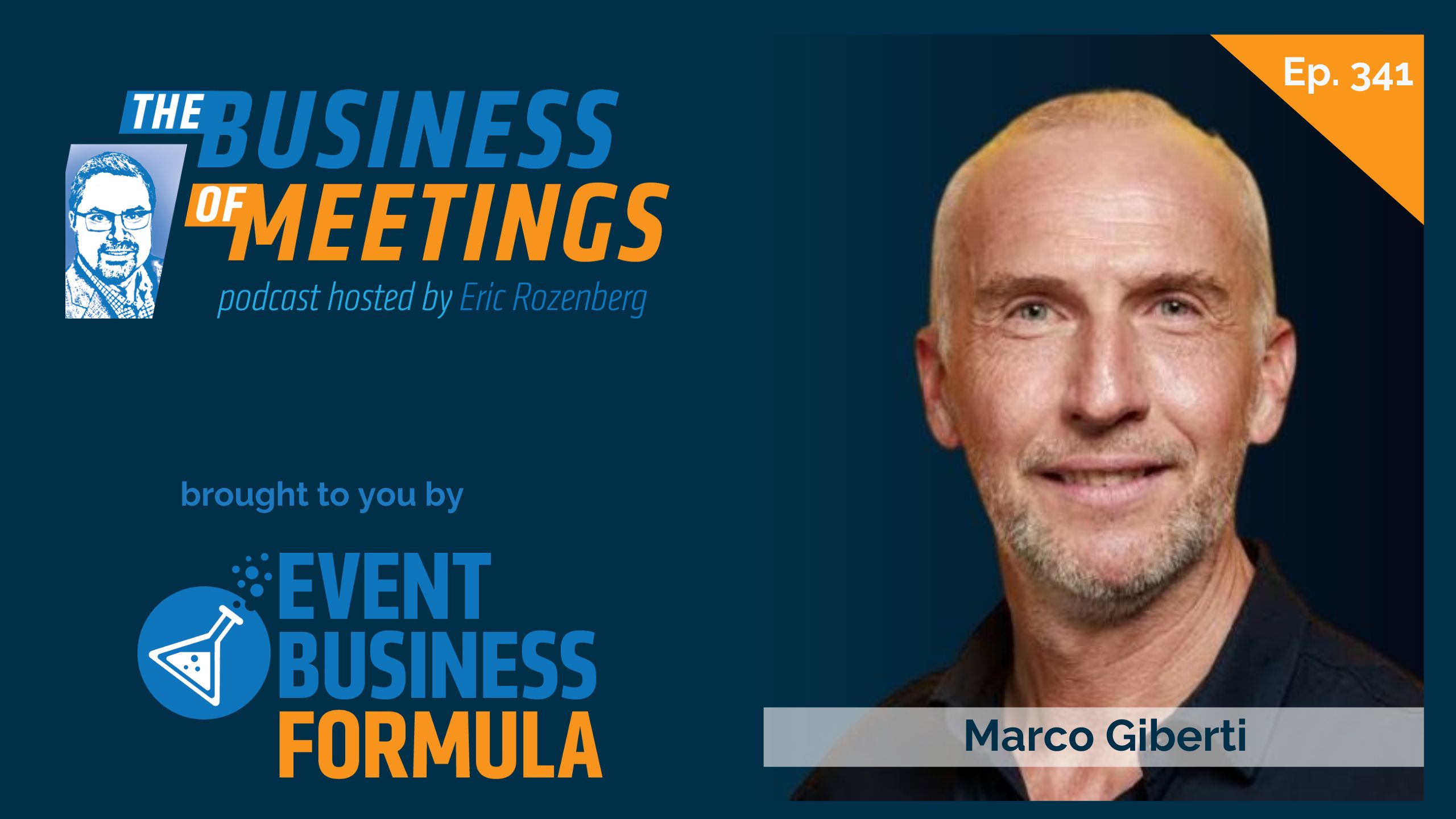
We’re excited to welcome Marco Giberti, the Founder and CEO of Vesuvio Adventures, as today’s guest.
Marco is well known within the events industry for his thought-provoking LinkedIn posts. He is incredibly smart, has a wealth of experience, and operates at the intersection of technology and events, making him the perfect person to discuss AI, private equity, and the industry’s future.
Stay tuned for more!
Marco’s Journey
Marco started in advertising and marketing, creating a small agency while he was in college. One customer was an Apple distributor in Argentina, which led Marco to pitch Apple and eventually be hired to run marketing for Latin America. After three years, he left Apple to start his own events company. His first show was Windows Expo, followed by partnerships with Comdex and other technology shows. He eventually built a business with 45–50 trade shows and conferences annually and sold it to Reed Exhibitions. After exiting that business in his early 40s, he started Vesuvio Ventures. Today, he invests in event and event technology companies, works with private equity as an advisor or board member, and focuses particularly on early-stage investments.
Building an Event Business
Building an event around a specific vertical with existing knowledge, a network, some validation, and a track record provides a strong foundation. Strategic partnerships can complement and accelerate a launch, while a niche approach, applied effectively, can help you build the right audience. Live events remain relevant in an AI economy because remote work and digital isolation are challenging human connection. They offer opportunities to connect, build trust, trade, have fun, and create other added value.
Private Equity and Building Value
Private equity has been involved in events for many decades, and more private equity firms are now entering the category because of its potential for growth and efficiencies through scale. An event generating $5 million-plus after two or three years, growing 20% or more, with a 25–30% EBITDA margin and clear evidence that it is relevant to its community can be highly attractive for small M&A. Private equity also recognizes the importance of being founder-friendly and keeping the founder or founding team, while balancing margin efficiency with product health and growth. An honest conversation about product priorities and community can help align founders and private equity.
Qualities of a Successful Founder
A successful founder needs a killer instinct, resilience, self-confidence, and psychological resistance to failure. They need to be coachable while having strong opinions, listen while still making decisions, and execute. They also need to sell a dream and attract a dream team. So, if you want to build a valuable, sellable company, you need to think about scale because there is a massive difference between a one-event entrepreneur and a scalable company entrepreneur. Marco believes that founders need to own their decisions, make mistakes, learn quickly, and pivot.
Failure and Entrepreneurship
Entrepreneurship is not as easy as it sounds. The day-to-day reality is difficult and requires resilience. Marco considers failure an important asset because it is part of the learning cycle. As an immigrant, he was struck by how forgiving the U.S. is of failure and how willing people are to give entrepreneurs another chance.
AI and the Events Industry
Marco believes AI will replace or dramatically reduce every repetitive, low-added-value task. Customers will expect more from their event experience, and brands will expect better ROI measurement. New event technology companies are helping brands analyze their event ROI, increasing expectations for organizers. He is seeing AI-centric event founders building agents for critical parts of the business and hiring humans only when they deliver incremental value. So, fewer people may be needed to launch an event than in the past, but those people need to be AI-sophisticated and understand how to use agents. At the same time, events cannot run only using AI because trust is built through face-to-face interactions.
Where Marco Would Invest
If he had $10 million to invest in the meetings and events industry, Marco would put 25–30% into event technology solutions, particularly AI-centric companies solving problems the industry still needs to fix. He would spread those investments across five to seven companies and put most into building early-stage events. He would also consider launching two or three events to diversify risk, or buying a small event with potential to acquire, accelerate, restructure, and grow. Once an event is cash flow positive and profitable, a founder can decide whether to sell or receive dividends and keep growing.
How Marco Uses AI
Marco built his own agent, Marco Events Twin, using his books, events masterclass, and other content. He uses it to analyze deals and pre-launch plans, drawing on years of information that he might otherwise forget. But he doesn’t let the agent make investment decisions for him. It provides green, yellow, or red lights and offers guidance, but he still relies on his own feelings and judgment when assessing an opportunity.
External Validation
External validation is critical when building an event from scratch. Input from people who bring a different perspective, particularly experts in the specific vertical, can help establish whether there is a genuine need for the event. Event people are generalists, so expertise in the relevant industry can be as important as the event team’s own analysis.
Bio:
Marco is a successful entrepreneur, investor, and advisor with more than 25 years of intensive experience in media, technology, and the events industry. He is Founder and CEO of Vesuvio Ventures, providing early-stage entrepreneurs access to coaching, partnerships, advisory, capital, and advice from big corporations on innovation and digital strategies.
After several years in a successful career as a corporate executive at Apple, Marco pursued his entrepreneurial ambitions and became:
• Co-founder and Board Member of Mind Opener, a leading publishing group in Latin America that was later sold to British Pearson Media Group, and
• Co-founder and Board Member of e-mind, an internet and media communications company that was sold to Liberty Media.
• President, CEO and co-founder of Mind Trainer (later Reed Exhibitions), a firm specialized in the organization of major regional trade shows and events that was sold to Reed Elsevier after a successful long-term joint venture.
Under Marco’s leadership, Reed Exhibitions Latin America became the region’s leading company, with annual revenues over $150M, double-digit annual growth, industry-record profits, and 400+ employees across four countries in the Americas. Throughout his business career, Marco has earned several distinctions in his field, including the Entrepreneur of the Year Award and recognition as one of the top 100 most influential people in the global convention and exhibition business by Trade Show Week magazine.
Marco is a recognized leader in the media, technology, and event industries, has sat on various industry and company Boards, and led his companies to numerous industry awards and recognitions. He has lived and worked in the United States and Latin America, and done business in Europe and Asia as well. He is known for his entrepreneurial, business development, and innovation skills in building effective cross-cultural teams and companies achieving significant growth and profitability.
Through Vesuvio Ventures, Marco is investing in early-stage companies and complements many of these investments with his advisory services. In this area, he focuses particularly on digital media, edtech, marketing tech, and live events tech-related ventures. He co-wrote The Face of Digital and Reinventing Live and is recognized as a leader in digital innovation. He is the host and speaker at the Leaderpass Business of Events Masterclass program.
Marco is a Harvard Business School OPM Graduate, a member of YPO, the Young Presidents Organization, and a frequent speaker at industry conferences.
Connect with Eric Rozenberg
Listen to The Business of Meetings podcast
Subscribe to The Business of Meetings newsletter
Connect with Marco Giberti
Listen on: Apple Podcasts · Spotify · YouTube
“I saw the movie before. It’s not a love movie, it’s a horror movie.”
Marco Giberti
Full transcript of episode 332 of The Business of Meetings podcast, Eric Rozenberg with Marco Giberti. Lightly edited for readability.
Eric: Hello and welcome to a new episode of the Business of Meetings podcast. Today I’m particularly excited to speak with one of the most known persons, I would say, in our industry, because every time he is writing on LinkedIn, everybody’s commenting is extremely clever. He has a lot of experience. He’s really at the intersection of tech and events, and he’s the right person to speak today about AI, about private equity, about the future of our industry. Ladies and gentlemen, I’m extremely happy to speak with Marco Giberti, who is the founder and CEO of Vesuvio Ventures. Marco, thank you so much for taking the time today.
Marco: Thank you for having me. It’s a pleasure.
Eric: Let’s start. Let’s get into it straight and tell us a little bit about your journey. What did you do in your life and how did you get to do what you’re doing today?
Marco: Well, my journey started with advertising and marketing. I created a small agency during my college years, and one of my customers was a distributor of Apple in Argentina. I’m originally from Buenos Aires, Argentina, and I was always an Apple addict and fan, still today. I don’t know if you can see my Mac 84 on the back. That’s how old I am. Long story short, I was able to pitch Apple. They gave me a small gig with my agency, and after that they reorganized their marketing department for Latin America and they hired me to run that. I was in my early 20s. It was a dream job, and I spent three amazing years with Apple across the region. But I realized very early that I was not a corporate animal. I was always saying the wrong things in corporate America and always dreaming with my own ideas.
Part of my job was running Apple Expo during those days in Latin America, and I realized how powerful the marketing tool was, and I quit Apple to start my own small events company in partnership with a B2B publishing company, and funny enough, my first show was Windows Expo. I moved into the dark side of the force. [laughter] But it was a very successful show. During those days I was lucky to partner with Comdex. Comdex was the largest technology show in the world for Latin America, Expocom, and other tech shows. And that’s how I started my events journey.
Fast forward, I was able to build a pretty nice business with 45, 50 trade shows and conferences on an annual basis. I sold that business to Reed Exhibitions, which is one of the largest events players. And I was young and naive and I was thinking, okay, it’s going to be a three year earnout. It was a 12 year joint venture. But it was amazing. We were able to build a very nice portfolio of events across the Americas, and when I exited that deal, I was in my early 40s. I started Vesuvio Ventures as an excuse to do something. I was having the classic midlife crisis. What should I do? I sold my company and now what? And I took a sabbatical with the family. We did an around the world trip, and after six months my wife was strongly suggesting that I should do something with my life. And she was right. I was not ready for playing golf. Twenty years later, I’m still not ready to play golf. And I love what I do.
With Vesuvio, during the last 18, 20 years, what we do is basically we invest time, money, or both around events and events technology, to keep it simple. Sometimes media technology or marketing technology as well, but everything that connects visitors and exhibitors from a media or live events perspective. I do some early stage investments and some late stage investments, working with private equity, sometimes as an advisor or board member, and my real passion is early stage. I invested probably in 15 or 20 event technology or marketing technology companies, mostly as a user, as a customer frustrated with that specific problem, and I’m also co-building events with full-time founders and CEOs on areas that I believe we’re going to have a strong opportunity to build something different.
Eric: Amazing. I couldn’t help it when I saw your Apple over there. I wrote my thesis at the business school on an Apple 2X, which is this huge [laughter]
Marco: Yes, I remember that one.
Eric: Marco, I cannot help but I have to ask you. You say you’re from Argentina. I see this tennis racket behind you. Is that anything to do with Vitas Gerulaitis?
Marco: No, Vitas. No, that’s on the back, you can see some of my passions. Apple, Star Wars on the left or the right, I don’t know, and tennis, racket sports. And I also have a shoe from Messi as well, of course, from Argentina. I’m a big fan. But yeah, I love sports. I was playing tennis since my early days. I’m still playing. I was always and will be a mediocre player, but I love the sport. And yeah, I love technology as well, which means those are some of my passions. And by the way, I forgot the most important part. I’m a proud father of three kids. I’m married to my wife for 35 plus years. We live in Miami and we’re very happy as a family.
Eric: That’s awesome. I have a lot of things in common: Apple, tennis, Star Wars, the wife, three kids. That’s amazing. With all your experience, and obviously you’re an entrepreneur, you said you started your first business when you were still in college. If you had to start an events business today from scratch, knowing everything you know as an entrepreneur and investor, what would you build and what would you absolutely avoid?
Marco: Look, it’s funny, because when I speak with guys like us and I always ask why are you around events, nobody tells me because I went to college and studied for doing this. It’s always some sort of serendipity about why we’re here. In my case, I was running marketing for Apple. I love technology. I experienced events, and I did it. I will probably do the same again, which is starting an event around some specific vertical that I know, I understand, I have a network, I have some sort of validation and track record, and I can build that community.
Thirty years later, it’s dramatically different building an event from scratch. During those days it was a little bit easier in some way, because there was less competition, strategic feats were easier. Now there is a ton of competition, and technology gave us a lot of opportunities but also challenges. But today I will probably build something that I understand from an events perspective. Think of the strategic partnerships that can complement and accelerate my launch, and I will try to be as niche as possible and as effective as possible for my audience. I think that events today are dramatically different, as I said before, but they’re as relevant as always. And if you see the stuff that I’m publishing on LinkedIn, I honestly believe that the live events industry will survive AI and grow, probably like never before, during the AI economy.
Eric: Absolutely. And no later than yesterday I was reading your last post on LinkedIn, where you were mentioning that creating unique experiences, serendipity, trust, all those elements are not built online, you have to be in person, and quite frankly I’ve been saying the same for years, but this is definitely now a great time to be in this industry.
Marco: No question about it. If you are in your 20s and you’re thinking, should I join the live events industry? My honest answer is yes, absolutely. It’s going to change, yes. It’s going to be bumpy, yes. It’s going to be easy, no. But it’s going to be as relevant as always, or even more. I think that young generations will need live events more than our generation. Remote work, digital isolation, and many other things are challenging human connection. And I think that live events, regardless if it’s B2B or B2C, or corporate events, will bring a very important opportunity for humans to connect, build trust, trade, have fun, and many other added values that events should bring to the table.
Eric: Absolutely. And if anyone had any doubt, I think looking at where private equity is going is a great sign. And I see, and you see, private equity and institutional capital just keep flowing into the events industry. What are investors seeing that many small and midsize event business owners still don’t see? You know, I’m helping specifically people who are doing under 10 million in revenue. Why is there so many private equity looking at our industry?
Marco: Private equity has been around events for many decades. It’s not new. What they like about events is fat margins, positive cash flow, recurring revenue, and some specific metrics that private equity loves. Private equity keeps building and integrating events and generating efficiencies because of scale, and that’s not new. What is new is that new private equity are joining the old school private equity. I’m having private equity conversations around events on a daily basis, with private equity asking me, okay, why should I join this category, tell me the economics, tell me the path to exit. And it’s getting better and better, which means I’m on both sides. I’m very early, launching from scratch, zero revenue idea, up to working with private equity on M&A efficiencies and stuff like that.
I’m excited as an entrepreneur building from scratch. I think that if you’re able to build an event that is generating 5 million plus after a couple of years, two, three years, growing 20% plus, having the 25, 30% EBITDA margin, and having some clear signals that your event is relevant for your community, if you want to sell it, you’re going to sell it, and there is endless appetite for small M&A. It’s not easy to build those assets, don’t get me wrong, but if you are one of those founders who are building that asset, looking for a path to exit, the opportunity is fantastic. And that is probably a category. We created a group of investors, Events Venture Group, a couple of years ago with a couple of friends. Now we’re 50 members, in order to support early stage founders. It’s extremely difficult to raise capital when you’re building from scratch. It’s very easy to sell when you are making real money. But we’re passionate about helping founders build their first one, year one to three, and moving from losing money to profits, and helping them accelerate that, which means we’re creating the venture capital category in our industry, or early stage angel, whatever you want to call it, because we know that if the event is making a couple of million dollars EBITDA and growing, there is endless appetite for acquisitions from the big guys, and that’s where I’m investing most of my time lately.
Eric: Wonderful. Now, you were talking about Reed Exhibitions earlier on. Actually, Alastair Gornall, which you might remember, was in my advisory board in Belgium, and I worked with Richard Mortimore in another life. But I remembered at that moment, if I’m not mistaken, they were the leader worldwide in exhibitions in general, multi-sector, and they only had 7% of the market share. So it’s extremely fragmented. Now I see two things right now, and I would love to have your opinion on that. First, there’s a lot of events, there’s a lot of communities, and there’s even some people that have been doing their events for years that are not stopping because there’s a lot of offering there. And parallel to that, my understanding of private equity is that they want to have all the efficiencies and the concentration. How do you combine both today?
Marco: It’s a great question. I did earnouts with public companies like Reed, but we also sold companies, events, to private equity owned companies like Clarion, Blackstone, or Hyve, which is another private equity-owned company. Private equity realized that being a founder-friendly company is very important. They want to keep the founder as long as they can, because the founder or the founding team for that event is critical. Of course, they want margin efficiency, but there is a combination between margin efficiency and product health and growth.
My experience is, if you are honest as a founder with the private equity or with the public company who will be buying control in your company, and they will be buying control, most likely they’re not going to be buying a minority stake, they’re not venture capital, you’ve got to be honest with them about which specific topics are critical for you across your product, across your community. And most likely they’re going to respect that, because their job is to keep the product healthy as long as possible and clone that product in Asia or Europe or the Middle East or Latin America, and keep the brand as the leading brand in that particular sector. They’re not stupid, they’re very smart people. And if you have a conversation with them, an honest conversation, an alignment with them, I don’t see why it shouldn’t be a win-win.
Eric: Interesting. You meet a lot of entrepreneurs. And if I’m not mistaken, you’re also involved with Endeavor here in Miami.
Marco: Yes, I advise Endeavor since the very early days, and mentorship with entrepreneurs is one of my passions.
Eric: That’s awesome. So what separates someone who has built a great event business from someone who has actually built a valuable, sellable company?
Marco: There is a massive difference between a one-event entrepreneur and a scalable company entrepreneur. I see sometimes amazing founders, but they’re not scalable, they’re not investable, it’s just one event, and they’re super focused on that particular event, and they’re not going to scale dramatically in order to be attractive for an investor. And there is nothing wrong with that. Some entrepreneurs are looking for high impact, Endeavor entrepreneurs, or scale, and you see that those entrepreneurs are thinking big, and because of that, as an investor, you can capture value with them. There are two different styles.
I wrote a LinkedIn post years ago, probably five or six years ago. The name is Building the Perfect Entrepreneur, and I was doing a little bit of catharsis about how you can build the perfect entrepreneur. The challenge that you have for a guy like me, an operator, an entrepreneur becoming investor, is that you still think as an entrepreneur or as an operator. It’s a traumatic experience, because you’re thinking, well, I will do this or that, and it’s not your job doing this or that. Your job is basically, hopefully, advising, but it’s not your job to execute anymore. And on that blog post, I remember a couple of friends telling me, yes, it’s amazing, but you forgot this or that. But in summary, successful entrepreneurs, they have some qualities that are very easy to understand, extremely difficult to execute. They have a killer instinct. What I know is when you see someone who really has that passion, he or she will make it, regardless of what happened with the market, whatever. You start seeing some signals. Resilience. As an entrepreneur, you hear no 99 times and yes one time. Unless you have self-confidence, a psychological resistance to failure, it’s brutal.
Entrepreneurship is sexy. When you read Forbes or TechCrunch, it’s not sexy in day-to-day. It’s brutal. You need that resilience. You need to be coachable, but you need to have your strong opinions, and you need to listen, but you need to take decisions and execute. There are specific signals, and I forgot the other things that I put in that article, but there are specific signals that you read with founders that are critical, and those signals are very important. The other thing is they need to sell a dream, because they’re building smoke and charging a lot of money for that smoke, which is the idea. They need to seduce the dream team and attract those employees who probably won’t make a lot of money, but they will have some equity, and if the dream works, they’re going to make a lot of money. All those elements are critical for identifying a good founder.
I don’t know, after 50 plus deals during the last 20 years, I did every single mistake that you can ever imagine. I read all the books about venture capital, angel investing, and I did the same mistakes, because again, when you’re coming from an operator perspective, you have a mindset that is not easy to change. Having said that, it’s not easy, but it’s super fulfilling and amazing helping a founder build, and helping that founder from idea to exit. It’s a long and painful journey, but it’s amazing when it happens, and I will not change it, honestly. It’s an amazing experience.
Eric: That’s awesome. By experience, that’s the mistake I made. The first two years, when I started my first business 30 years ago, gosh, this month, I was thinking it’s my brand, it’s my business, no one does it better. I wanted to be involved in everything, where at the end of the day that’s the biggest mistake, because no one does it alone, and you need to be able to delegate.
Marco: Yeah. If you have kids, you will probably understand. Sometimes it’s like raising a kid. You can tell them what you think, what you should do. I’m talking about young adults or teenagers, but they will do their own thing. Sometimes you know that it’s wrong, but there is a limit for your father or mother role. With founders, sometimes it’s pretty similar. You know that they’re going to make a mistake. You tell them, look, I did it in the past, blah, blah, blah, but they do it. If they’re smart, they learn fast, they pivot, they adjust. You need that, because if they don’t have that decisiveness, most likely they’re going to be an employee instead of a founder. And there is a massive difference between an employee and a founder. Those guys, they need to take their own decisions and own that decision, and it’s part of the job description.
Eric: Absolutely. Can the human being learn without mistake and without
Marco: No, I don’t think so. Honestly, failure is your most important asset. If you see, I have a Yoda thing over there. You learn here, here, and here. [laughter] Well, you learn from failure, and it’s the only way to learn. But failure is uncomfortable, it’s humbling, it’s tough, but you need to fail, and it’s part of the learning cycle, and it’s inevitable.
Eric: 300% agree with you. What I found interesting, as an immigrant to the US, is the culture here. You’re almost dying, people ask you how you’re doing, you go, “great.”
Marco: Yeah, this is an amazing country. I’m also an immigrant. I’m grateful to be a US citizen for now 20 plus years. But it’s still an amazing country for entrepreneurs. In this country, failure is accepted. In my part of the world, failure is bad and negative and sometimes toxic. Here, failure is part of the game. And for an entrepreneur, it’s amazing to have a second chance opportunity. Look, as an immigrant in this country, I was shocked to see the land of opportunity. When I moved here 25 years ago, 25 years later, I’m still in shock, honestly, about how generous this country is for entrepreneurs, how forgiving it is with failure, and how it’s part of our American culture to fail. It’s fine. If you do your job, if you work hard, if you are not stealing, and you’re honest, everyone will give you another chance. It’s amazing for your audience that is not in this country. It’s difficult to explain that. I keep talking with Europeans or Latins about this, but it’s one of the good things that we can experience here on a daily basis.
Eric: Absolutely. The only thing, I’m still trying, when people ask me where you’re from, I said South Florida. Then they pause, they go, “Yeah, but before that.” I cannot get rid of the accent. That’s terrible.
Marco: Same thing here. I have this exotic Latin American accent. But you know, the joke here is if you live in Miami, the good thing is that you’re really close to the US, which means everyone speaks different languages in South Florida, which helps us a little bit.
Eric: That’s true. And you’ll have to explain to me one day why my friends in Miami, it’s almost like they have to take their passport to come and visit in Boca, where the other way around is okay. But anyway, you’re talking about all the qualities that you need for an entrepreneur, and also the fact that starting a business or starting from scratch is a lot of repetitive work, administrative work, and now AI is going to make things much easier when you’re using it. But also the client will expect that you’re doing those things faster and cheaper. So where will event companies still have pricing power five years from now?
Marco: It really depends on which event category you’re playing in. If you are an agency organizing corporate events, for example, that’s one playbook. If you are a founder building for-profit events from scratch, it’s a different one. If you are a vendor servicing the industry, it’s a different one. But there is a common denominator with AI, which is AI will replace or kill every repetitive, low added value task dramatically, and customers, regardless if it’s an exhibitor, sponsor, or visitor, will be expecting more for their events experience. Going to events is expensive, it takes time, money, energy. The ROI, as you know, you’re around the industry for a while, was always difficult to measure. If brands are negative about events, it’s because they put millions of dollars in and they have a hard time measuring ROI in comparison with digital marketing or other marketing tools.
That is changing dramatically. If you see the new generation of event technology companies, some of those companies are helping brands analyze ROI at events like never before, which means the expectation from those brands about their event investment, regardless if it’s a corporate event, which is their own show, or they go to a third party show or conference, is higher than ever, because the BS time is over with AI. AI is really helping brands, in this case, to be very sophisticated about their event analysis. On the other side, as an organizer, that’s tremendous pressure to deliver results.
I think that AI, I’m talking about what I call the AI-centric event founders, which are young kids in their late 20s, early 30s, building events with an AI-centric mentality. They’re not building events like I did 30 years ago, thinking, okay, I need to build this marketing channel, I need to build this partnership. They’re really, really obsessed and focused on AI. Amazing to see those guys, because they’re building agents from scratch for every single critical part of the business, and they’re doing a pretty good job with almost no investment or marginal investment. And they’re hiring humans only when they honestly believe that those humans are going to deliver incremental value on their technology, which means this generation of event founders or planners, they’re thinking, I’m going to invest in AI first, and after that in humans. It could sound depressive, negative, toxic. It’s real business, and it’s happening, because those agents are delivering value.
Do I think that you can run events only with AI? Absolutely not, because again, you probably keep hearing from my side, I’m saying this for 20 years, you build trust face to face, which means part of that trust is going to be human centric. But if I’m launching a new event today, and in the past I needed five, seven, 10 people on my team, I’m probably needing three or four now. And those three or four team members, they’re going to be AI sophisticated. They really need to understand how to use agents in a way that one employee will generate 10x productivity in comparison with five or 10 years ago. And that is happening. Some people are still in denial mode and say, “No, it’s not going to happen, our industry is different.” I don’t agree with that. I saw the movie before. It’s not a love movie, it’s a horror movie. Sometimes at some point reality happens. And I don’t think that it’s age related. Honestly, I see people in their 60s using AI way better than people in their 30s or 20s. I think that’s again going back to Yoda: learn, and learn. It’s a Yoda phrase that I keep using. You have to unlearn and learn again in this industry if you want to survive.
Eric: Love it. I’ve been using Yoda for many, many, many years. I have to tell you a personal story. I don’t know how, somehow in all the moves, when I was a teenager, someone in my family lost all my toys, my Star Wars toys, the original ones. I’m still in therapy for that. Anyway, let’s say I’m giving you $10 million today, and I tell you you can invest it only in the meetings and events industry. Where do you put the money?
Marco: After 50 plus investments, between events and events tech, and I don’t want to sound negative about event tech, but it’s a very interesting time for event tech. It’s not going to disappear, but it’s going to change, which means I will probably allocate 25 or 30% of that capital into event solutions, of course AI-centric, trying to help problems that our industry still needs to fix. I invested in a company, the name is Grip. It’s an AI matchmaking technology for events. We invested in that company 10 years ago, again, way before AI was cool. They’re fixing a problem for one-to-one matchmaking meetings inside big shows. It’s a million times better than 10 years ago, but we still need to keep investing in that category in different aspects. There’s so many problems as an event organizer where technology should play a key role, which means probably 25, 30% of my capital will go into that category, and I will place different bets between five to seven companies on the right spots.
And I will allocate the rest, the majority of the capital, to building early stage events, because I think that the pipeline for that is better than ever. As I said before, if you’re able to build events, and those events are generating 5 million plus revenue, 2 million plus EBITDA after three years and still growing, I’ll sell them as fast as I want, honestly. And at that level, events are beautiful, because they’re cash flow positive and they’re profitable, which means you can decide as a founder, do I want to sell or do I want to receive dividends on an annual basis and keep growing? I think that if I said 70% is $7 million, you don’t need $7 million to launch an event today. At least with our playbook, you need less than that. I will probably diversify risk and build two or three events, or I could buy a small event where I see the potential to acquire and accelerate that. I did both, launch from scratch and buy and restructure and grow.
It’s a long conversation, it’s not as easy as it sounds. Sometimes when you’re buying, you’ve got to be fully aware of the event identity. And I did M&A with Reed for 15 years, and M&A is amazing for the big guys, but at the early stage category, it’s not as easy as it sounds. But that’s how I will probably invest my capital. And I think that if you see M&A reports from the industry during the last couple of years, the multiples are higher than ever. We used to pay 8 to 10x EBITDA for events, now it’s way better than that in some specific deals. And yes, I don’t think that’s because private equity are stupid, it’s because they see the efficiency and they see the growth and they see the opportunity, which means it’s an amazing time to be a founder across the industry in different categories.
Again, I’m not minimizing the challenges and the amazing amount of work that you need to allocate to this, but I will be very bullish. If you are a founder who really understands the opportunity, I built my own agent. I wrote two books, I did an events master class, I put all that content together inside an agent, and I call it Marco Events Twin. And when I receive deals, I send it to the agent. He’s way better than me, honestly, analyzing deals, because [clears throat] I’m emotional, I put a lot of passion into some analysis, but I see deals through that agent, and I honestly start to understand the path to potential growth. And events are still very, very attractive, which means I believe that, of course I’m biased, like you are biased, because we love this industry, but honestly I speak with private equity and VCs across many industries, and everyone is telling me, wow, if you have allocation on that deal, let me know, because I honestly believe that events are going to be a very attractive investment category during the next 10 years.
Eric: Absolutely. It’s funny you’re mentioning your AI. Thanks to Marco, I was telling you, I have now Eric AI, and when people ask the same question in ChatGPT and Claude, they see that and go like, “oh my god, industry specific.” And I’m using it myself because he knows everything that I’ve been doing the last 30 years, and to your point, it’s much better than I am. I forget a lot of things. My agent is not forgetting anything, he is capturing data that is relevant for me. It’s amazing, honestly.
Marco: But do I believe that my agent will take an investment decision for me? No, never. He’s giving me some green, yellow, or red lights. He’s giving me a lot of interesting feedback. He’s advising me on different things. But at some point I still need to invest a lot of time with my own feeling about that specific opportunity. I’m building a new show with a full-time founder now, on an industry that I’m passionate about, and I have an agent for pre-launch plan, which is the pre-launch analysis that you do when you’re launching an event. Again, he’s way better than me, because he has 20 years of pre-launch plans that I was involved in in the past. After the analysis, the competitive analysis, everything that you have to do when you’re launching an event, we are 100% convinced that it’s going to be an interesting event. But we are not launching unless we raise some capital from venture capital on that particular vertical. Do we need the capital? No, we don’t need the capital. But we want external validation on the fact that that event is necessary for that particular industry.
That’s a very important message for any founder or entrepreneur. Don’t believe your own story. You have to validate externally with people who will bring a different perspective to your opportunity. And we are events people, we should know how to organize an event, but we’re not experts in every single category at all, we are generalists. When I see that a venture capital firm will invest in my launch, when we launched the sports technology show, our first investor was a venture capital firm in the sports technology vertical, and I slept a little bit better at night, because those guys, that’s what they do. The only thing that they do is sports technology. We are events guys, which means I think that external validation is as critical as your own analysis when you’re launching or building from scratch.
Eric: That’s brilliant advice. And then you move forward, and then you have those stories about entrepreneurship where people think it’s easy, but it’s an overnight success that took 10 years in the making.
Marco: Yes. And if anyone is telling, I mentor some young kids, who are friends of my son or daughters, in their mid-20s, and sometimes I have to be careful, because I sound too negative about entrepreneurship, because I know how it is, and they come and they’re super naive and super excited, but they need a reality check, telling them, hey, be careful, unless you have these specific skills, as we discussed before, you’ll probably have a better life in corporate America, or doing something else, or being a doctor or an architect, because this entrepreneurship thing is not as easy as it sounds.
Eric: Not for everyone. And it is great. It is exciting for guys like us.
Marco: Yes.
Eric: For probably normal people, I don’t know.
Marco: You got to be a little bit crazy to do what we do.
Eric: Who wants to be normal? Anyway, do or do not, there is no try. So that’s it. Amen. Marco, I love listening to you. Obviously the format of the podcast, we’re coming to an end, but I still have two questions for you. The first one, I highly recommend anyone listening to follow you on LinkedIn, Marco Giberti. How do they get in touch with you if they have any questions or ideas?
Marco: LinkedIn is probably the easiest way. I have my newsletter over there, and yeah, that’s probably the easiest way. I have my website, Vesuvio Ventures, or marcogi.com as well, with a lot of information. That’s probably the easiest way to reach out.
Eric: Wonderful, thank you. And my last question, when we meet in person in one year and we drink a mate together, [laughter] what are we going to celebrate?
Marco: I’m not a mate guy, I’m half Italian, which means I’m an espresso guy. [clears throat] But hopefully we’re going to celebrate that our industry is alive and doing extremely well. That would be cool. And I’m an industry fan, and I believe that we should celebrate the fact that AI is not going to kill our industry, and just the opposite, it’s going to help our industry to thrive and keep growing.
Eric: Marco Giberti, thank you.
Marco: Eric, great seeing you.
Eric: Thank you for tuning in to the Business of Meetings podcast. I hope you found today’s episode valuable. If you enjoy the show, the most important thing you can do is leave a review and share it with your colleagues. It really helps spread the word. I truly appreciate your support. And if you’re ready to take your business to the next level, don’t forget to visit eventbusinessformula.com to learn more about how we are helping event business owners like you. Thanks again for listening, and I’ll see you next time.