
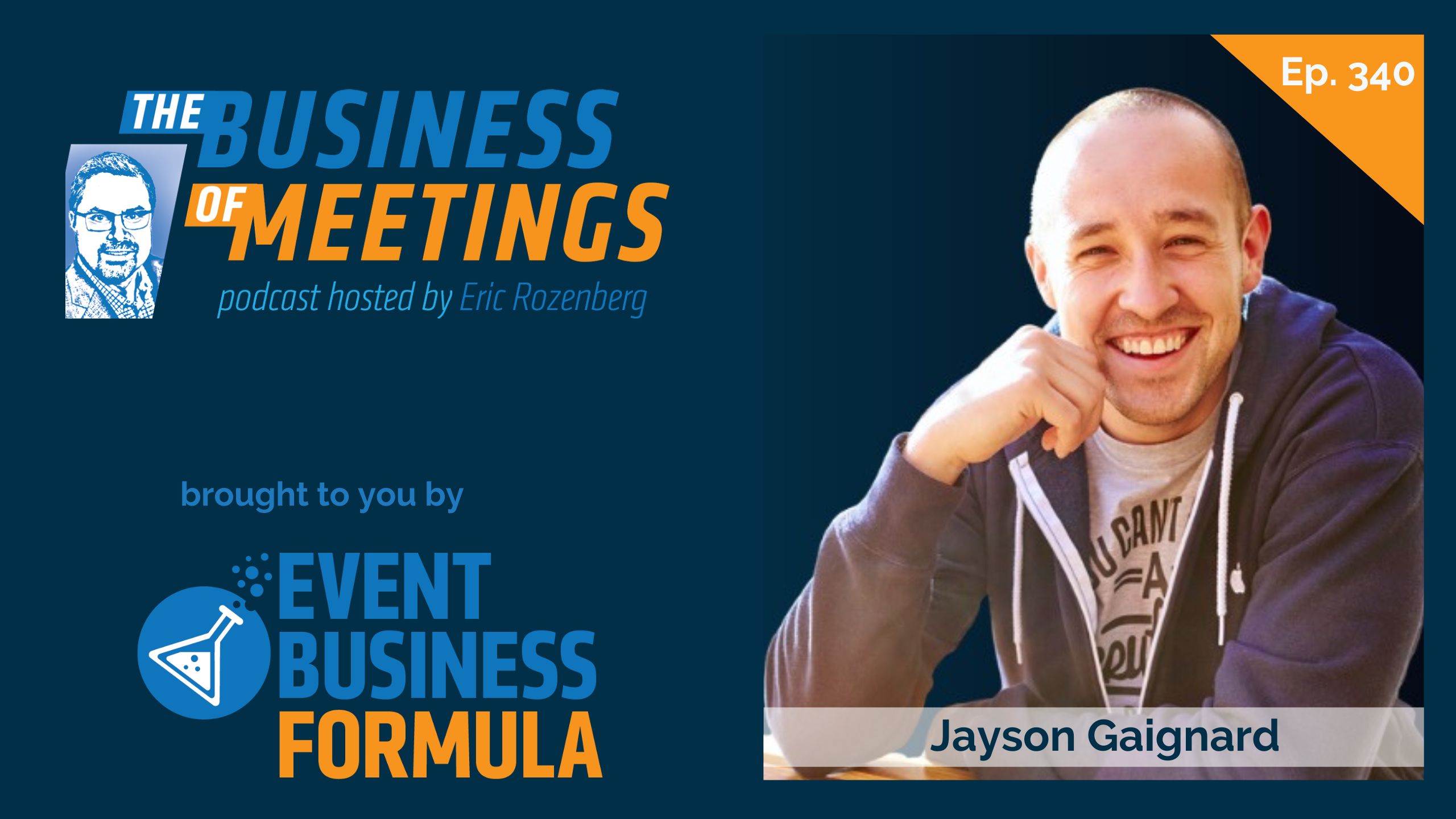
We’re delighted to have Jayson Gaignard back on the Business of Meetings podcast today.
Jayson is the founder of MMT and the author of Community Made: The Truth About Success and the Relationships That Create It. Eric had the privilege of reading Jayson’s book, which includes many of the lessons he learned about relationships, community, and success.
Stay tuned for more!
Jayson’s Journey
Jayson dropped out of high school and started a service-based business before pivoting to online e-commerce, which he grew to about $7 million a year over four years with no outside investments. After seven years, he realized he didn’t need to impress anyone, so he scaled it down to zero. In August 2012, things beyond his control left him in debt. So he began hosting dinners that brought fascinating people together, which eventually led to MMT and building communities. In 2023, he started putting his lessons in writing, which led to his book, Community Made.
Community Made
Jayson’s book, Community Made: The Truth About Success and the Relationships That Create It, centers on three areas: finding your people, investing in your people, and asking for help. Asking for help was pivotal to his personal growth, so he also explores why people avoid it.
Transactional and Transformational Relationships
Jayson explains the difference between transactional and transformational relationships. Transactional relationships can help you reach a specific goal, while transformational relationships are based more on shared values and wanting to spend time together. He believes you need to be intentional about the people you bring into your life and the energy you invest in those relationships.
Building Community
Jayson’s approach to community is based on careful curation and creating an environment where people can be authentic and vulnerable. The right people, shared values, trust, and confidentiality are essential to creating a community where members can support one another.
Success and Comparison
Jayson discusses how success can affect relationships and create comparison and envy. He believes you need to be genuinely happy for other people’s success while remaining focused on your own path rather than measuring your life against someone else’s.
Technology and Connection
Jayson believes technology and AI can strengthen communities by helping people find others with relevant experience and expertise. However, technology cannot replace the value of being together in person, which remains central to building meaningful relationships.
Preparation and Mentorship
Jayson also discusses the importance of preparation, especially when having meaningful conversations with other people. He credits mentors and friends who believed in his potential and encouraged him to think bigger.
Bio:
Jayson Gaignard is an author and community builder who has spent more than a decade creating high-trust communities and experiences for entrepreneurs. He is the Head Curator of MMT, one of the world’s most exclusive entrepreneur communities, and was named one of Forbes’ “Top Networkers to Watch.” His work explores what happens when you bring the right people into the right room—creating opportunities, ideas, and relationships that can transform businesses and lives. Jayson’s work has been featured in Forbes, Entrepreneur, Business Insider, and Tim Ferriss’ Tools of Titans.
Connect with Eric Rozenberg
Listen to The Business of Meetings podcast
Subscribe to The Business of Meetings newsletter
Connect with Jayson Gaignard
Listen on: Apple Podcasts · Spotify · YouTube
“I realized I built a business I hated to enable me to buy things I didn’t need to impress people I didn’t like.”
Jayson Gaignard
Full transcript of episode 340 of The Business of Meetings podcast, Eric Rozenberg with Jayson Gaignard. Lightly edited for readability.
Eric Rozenberg: Hello and welcome to a new episode of the Business of Meetings Podcast. Today is a phenomenal day because I got to interview someone I love and respect immensely. He was our 100th episode, but today I asked him to come back because he is publishing now the book that summarizes his career and what he’s done. The book is behind me. It’s called Community Made, the truth about success and the relationships that create it. Yes, it is the one and only Jayson Gaignard. And Jayson, before we start, I want this to be on the record. I had the privilege of being one of the people that read the book. I’ve already ordered 100 copies that I want to share with my family and my friends and the people I’m helping. But most importantly, I think I told you that and I do believe it. I believe that in the next 20 years, 30 years, 40 years, the same way that people have been offering the book from Dale Carnegie, How to Win Friends and Influence People, people will offer this book, Community Made, from Jayson Gaignard. Jayson, thank you so much for taking the time to speak with me today.
Jayson Gaignard: Well, if the book ever gets that kind of traction like Keith Ferrazzi’s book or How to Win Friends and Influence People, it’s because of the early supporters like you. So, I adore you, my friend. I am incredibly grateful. I mean, to be back on the podcast, but just selfishly to catch up and reconnect. And yeah, thank you again for the support.
Eric Rozenberg: Congratulations. Really amazing book. But before we get there, for those who have been hibernating the last 20 years and have never heard of Jayson Gaignard, what is your journey and how did you get to what you’re doing today?
Jayson Gaignard: Well, if you’ve never heard of me, don’t feel bad. I have 200 followers on Instagram as of today. So, I’m not big on the social platforms. And maybe that’ll change with time. I’m not too attached to it. But no, I mean, the short version is I dropped out of high school. I started a service-based business. I realized that service-based businesses can be a little hard to grow when you have limited skill sets, and I pivoted to an online e-commerce business which I grew to about $7 million a year over four years with no outside investments. I was traveling the world. I was making a ton of money. With all that money and all that free time, I started to ask myself questions like, why am I here? Will I be remembered? How many people show up to my funeral? And I was not happy with the answers I was giving myself. And ultimately, after doing that business for 7 years, I realized I built a business I hated to enable me to buy things I didn’t need to impress people I didn’t like. And I felt like I was very much stuck on this hamster wheel. And I became comfortable with scaling the business down to zero so that I could start something new. The almost the heaviness of success left me with a yearning to be a beginner again, one could say. And while I was scaling that business down, I thought I’d have a little bit of a cushion on the back end. It’ll give me a little bit of runway to find the next thing. Unfortunately, two things happened that were beyond my control that landed me a quarter million in debt in August of 2012. So that was, quote unquote, my rock bottom. But September 1st, I got married to my wife, and on September 1st, my daughter turned 6 months old. So I share that because it’s the same, when one door closes, another one opens. But it sucks to be stuck in the hallway. That was a very dark hallway for me at the time. There was a lot of transition going on, a lot of loss of identity and gain of new identities and all that kind of stuff, being a father and being a husband. And around that time, about 2, 3 months later after this rock bottom incident, I was inspired by Seth Godin to start hosting dinners. A friend of mine gave me a ticket to go see one of his workshops in New York. And I had no other obligations at the time. I stayed in a hostel for the first and only time in my life. I didn’t know they had shared bathrooms and twin beds. When you’re 6’3″, it’s not necessarily the most comfortable accommodations. But regardless, it turned out to be a life-changing experience because in that workshop Seth just shared the importance of being the catalyst, bringing people together. And at the time, I felt very alone and isolated. I built my business, not at the expense of my relationships per se, but I never focused any energy on forging relationships. I was just so focused on the business itself and I had blinders on. And when the business was gone, I just felt this huge level of loneliness and isolation. And as a result, I started hosting these dinners. And the first one I did, I almost canceled 2 hours prior because I’m like, nobody’s going to see value in this. They’re going to think I completely wasted their time. But conversation didn’t skip a beat for 4 and a half hours. And I just got clarity that being in proximity of fascinating people, not being even at the center of the conversation, being a fly on the wall of these conversations was something I wanted to do to some capacity for the rest of my life. And I continued on with these dinners, even though financially they made no sense. I didn’t know how I was going to make rent at the end of the month. But I was considering bankruptcy. And I rationalized paying for the dinners out of pocket through the lens of, the bank could take my car, they could take whatever measly assets I had left, but they couldn’t take my relationships. So, both investing in myself and investing in my relationships to me were the safest investments I could make. And then two months later, this is November of 2012, I had an opportunity to do an event with Tim Ferriss that kind of fell in my lap. He was coming out with a book called The 4-Hour Chef. And it turned out he was going to be banned from all retail distribution. So, Barnes & Noble, Walmart, Costco, everyone. And the reason for that is he was the first big-name author to publish through Amazon, and the traditional publishing world almost wanted to make an example out of him. And he did one of these brilliant things where he created these book bundle campaigns, that if you bought 10 books you get additional resources. If you bought 100 books you get something else. He had this long shot package he didn’t think anybody would take, that if you bought 4,000 books you get two speaking engagements. And I never thought I’d be in the event space, but there I was, like, Tim doesn’t speak that often. And if I can’t use these speaking engagements for any reason, I can probably try to find somebody to buy them. So, I sent him an email. I said, I’ll take the engagements. And I just saw it as a chance for me to do what I do in the dinners, but on a larger scale. So, instead of having eight people at a dinner, I could have 150 people at an event. And ultimately, if I could break even, I’d add 150 amazing people to my peer group. And that was really the draw. And yeah, we did our first event in May of 2013. And I always say ignorance and confidence can go a long way when you’re an entrepreneur. I had no clue what I was doing. It was much closer to a wedding than it was a conference. But yeah, for that reason, I mean, there’s a lot of really beautiful things that happened at that first gathering. So, we decided to do a second one, and then a third, and then a fourth. And then you joined us a couple of years later, and you’ve been a member of the community probably for 7, 8 years now if I’m not mistaken. So I’ve been blessed to have you in my life and just have MMT as this container that has brought so many beautiful relationships into my world.
As a result, one of the decision frameworks that really helps guide me is this idea of closing my eyes and fast forwarding to being on my deathbed and looking around and who is around me, around my deathbed, who are the people texting me, what are some of the regrets I may have, and how can I reverse engineer so that I can minimize those regrets and I can make sure that I invest in those relationships so they do show up when I’m in my final days. And I share that because one of the things that has been nagging me for so long is I’ve been blessed with so many different privileges in the context of relationships over the years that, if I were to die tomorrow and all these lessons and learnings weren’t packaged in a way to support other people on their journey, that’d be one of my greatest regrets. So in 2023, that’s when we made some space for me to focus on the creative process and start putting pen to paper, and that’s how Community Made came to be.
Eric Rozenberg: Wow. Wow. Wow. Wow. Wow. And I was telling you before we started recording, I’ve never experienced someone putting so much time in doing the revision, and you were just telling me that you’re on the fifth listening of the audiobook.
Jayson Gaignard: I mean, I’m very sick of my own voice. That’s for sure.
Eric Rozenberg: Just amazing. By the way, you said that it was the 1st of September when you got married, and which…
Jayson Gaignard: Yes. Yeah. And we’re recording the 1st of September. It’s my anniversary today. It’s 14 years with my wife. Usually, as a rule, we don’t schedule anything on that day, but we made an exception to do this podcast.
Eric Rozenberg: So, yes, it’s your anniversary today.
Jayson Gaignard: Good catch. [laughter]
Eric Rozenberg: You did it. Now the book is divided into three parts, correct? How to find your people, how to invest in your people, and how to ask for help. Why is it so difficult to ask for help? And I’m the first guilty of that. But why is it so difficult?
Jayson Gaignard: Well, I appreciate that honest omission, but I am also the first guilty of that. I mean, there’s a saying that the book that changes you isn’t the one you read, but the one you write. And the third section of the book is one I really wrote for myself. It started as a blank page and I knew that asking for help was very much my growth edge, and I really wanted to dig into what are some of the things that cause the resistance. How can you create forcing functions to ensure that you ask for help when you need it? What is the damage that having an inability to ask for help causes? Not only what is the potential upside that you’re shutting out, but what is the actual damage that can be caused to relationships by not making them reciprocal in nature. But the funny thing is, when I would talk to people about the book when I was writing it, I would say it’s all about finding the right relationships, investing in them with intention, and then mastering the vulnerable art of asking for help. And no matter how successful people were, when I said it was about asking for help, that third section, I could see it land in their body. I could see, like, the first two parts they’d be like, oh yeah, that sounds really cool. And then the third part they’re like, I need that, I struggle with that. So know that it is very much a challenge for many of us. And I think I’d appreciate your feedback because you’re a global citizen. You’ve lived all over the world and that kind of stuff. Culture plays a huge factor into people’s resistance in the context of asking for help. So the whole American dream is built around this notion of being self-made. So as a result of embracing this, you look at the cover of Forbes, that’s usually like a single headshot and all that kind of stuff. So much of the foundation of our business and entrepreneurship culture is around this idea of the self-made man or the self-made woman. When really, again, nobody achieves anything meaningful alone. No matter what you strive to, your success ultimately will have the fingerprints of others all over it, whether that is, you’re an entrepreneur and you have a team or mentors or investors or that kind of stuff. So the fact that people can stand on the quote unquote mountaintop and plant the flag and say I’m self-made, to me, it makes me sick to my stomach because it is one of the biggest lies out there. But there’s a lot of reasons for the resistance, including not wanting to be a burden to other people. Obviously being in a position where you’re asking for help is really almost like full vulnerability. There’s a saying, especially in the context of entrepreneurs, that entrepreneurship for some can be a trauma response. Meaning oftentimes entrepreneurs are known to be control freaks, and usually that’s rooted in potentially having childhood experiences where they didn’t feel like they had that level of control. So that serves them well to a point, but then there comes a point when you are in business or at a certain level of leadership where you need to let go of that semblance of control and ask for help and lean on others, and that’s very much a challenging thing for many. But I would love actually to know from you what are your thoughts on just how culture plays into this notion of being self-made or the resistance to asking for help, because obviously you’ve done business all over Europe and those kind of things, and that’s an area of ignorance for me and I’m just very curious.
Eric Rozenberg: That’s a great question. I actually had a conversation recently with a friend. I said in America everything is always great. You are about to die and people ask you, how you doing? I said great. And I think that’s, to your point, that’s the biggest lie that people say about success. No one does it alone, for sure not. Now culturally speaking, you go into most Asian countries, saving face is the most important, and also in the Middle East. So the way you’re presenting and the way you ask questions will probably not be like that. But I see it in the US, when I led SecuTix, the previous business, the ticketing platform that FIFA is using, it took me six months to basically have the team telling me what was not working for them when it comes to the platform and the interaction they had with our prospects and customers, because it’s almost like a taboo to say this is not working or this is not good, where I was genuinely asking, let me know what’s not working, and our daily was doing that. So I think that also with, thanks to the work of women like Brené Brown, it’s okay to show more vulnerability and authenticity, absolutely, without necessarily going to the other opposite. But that’s also what I like in the US, is that people are usually also more inclined to look at the positive side and be grateful. And just to give you a last example, because at the end of the day I want to talk about you and not about me, but you’re very good at asking. I’m trying to learn here. I’m trying to learn. I would say that to characterize between the education systems, where I think that’s where it starts as well in terms of positivity. If you are in a class in Belgium and you have 10 questions and you answer nine of them perfectly and one is bad, it’s likely the teacher will talk in front of everyone and say, “Eric, this is a very bad answer. How can you answer that? This is ridiculous.” And the opposite in the US, if you have the same 10 questions but you answer nine of them wrongly and one correctly, the teacher will praise you for that one only, and say, “Eric, this is a great answer. For the rest, we’ll need to work a little bit more on that.” So I think also from the education system, when you’re raised, everything is looking at the positive side, but everything is great and you’re not necessarily acknowledging the struggle, the hardship of what you’re doing, and leading to that, it’s difficult to ask for help.
Jayson Gaignard: Yeah. No, it’s a great observation. I mean, just hearing you speak, one of the things that’s kind of illuminating for me is just this idea that, at the end of the day, there are patterns, but we also have our own unique relationship to asking for help and our own form of resistance. And usually that’s rooted in some kind of childhood or adolescence experience. It could have been in the education system. You’re right, the North American education system is obviously very different than what you’ve probably experienced in Europe. Even a single teacher can completely shift your willingness to be vulnerable and be wrong and ask for help and all that kind of stuff. So I think that is one of the places, and in the book I outline a handful of different kinds of resistance that I’ve seen play out time and time again. But I think the responsibility that we all have, if this is an area that you want to overcome, and I make a strong argument that you should overcome this and should get better at asking for help, I think there is this examination of what is the source of this tension or this resistance that people feel, or that you would feel in theory when it comes to asking for help, because until you identify it, you really won’t be able to overcome it.
Eric Rozenberg: So, no, I appreciate that share. So you are amazing at building this community, MMT, and bringing people together. I would love to ask you, what was a moment where you actually felt alone, and what did it teach you about community that being successful would not have taught you at that time?
Jayson Gaignard: So share a moment where I felt alone, and this can be like, before MMT or just… before MMT?
Eric Rozenberg: Yeah.
Jayson Gaignard: Gosh, there’s so many. This is going down an uncomfortable trip down memory lane, which I wasn’t expecting on my anniversary. How dare you do this to me? I mean, in advance of getting married, I felt incredibly alone. I’m known to be, you know, I’ve seen by many now as this guy who’s great at relationships. I had two people show up to my bachelor party, my brother and brother-in-law. I knew nobody back then. All the relationships I’ve forged have been in the last decade using these principles. So I just reflect back, and it’s funny me sharing this on my anniversary, because to say that you feel alone in advance of getting married, one could say would almost be taboo to give voice to, but it truly was. I didn’t have any best friends, any peer group, any really people to lean on. And that’s a time of pretty significant transition. Again, I was going through a big transition with the business and trying to adjust, being a father and now being a husband. And that was definitely the darkest time of my life. I mean, it was only shortly after, a couple weeks later, I almost took my own life on a highway, driving into the city. I was in the car alone. Driving into Toronto, and there’s a split of the road. If you want to drive into the city, you can either stick to the left, which is the highway, or take the scenic route along the lake, which is on the right. And as I was driving, I had this, it wasn’t even a voice, it was just a directive, like, deep within, that I was going to drive my car into the fresh concrete median splitting the road. And it wasn’t even up for debate, that was what I was going to do. And as I started heading towards this concrete median, I remember looking down and seeing the distinct six-letter word “airbag” on the steering wheel. And I was like, well, my shitty luck, not only have I failed as a husband, as a father, as an entrepreneur, but I’ve also would have failed at killing myself because these stupid airbags are going to save my life. And as a result, I veered left and then I pulled over. And that was, one could say, my lowest of the lows. And it wasn’t until, yeah, I started hosting dinners, and that became MMT, that I started to almost move beyond those demons, because those were some demons that felt like they were chasing me around everywhere I went and I couldn’t escape them. So that was definitely a time of deep loneliness and isolation. Even though one could say from externally I was getting married and expanding my family and all that kind of stuff, you wouldn’t think that someone would feel alone and isolated in a period like that. But yeah, it was a really hard time. And in contrast, I hit rock bottom again in 2020 with the pandemic, because our business went down to zero. And I had so many beautiful friendships and relationships that showed up for me incredibly powerfully. It was such a stark difference to where I was only a decade prior, on the side of that highway. So yeah, we often overestimate what we can accomplish in a day but underestimate what we can accomplish in a year or a decade, and my relationships and the quality of my life are unrecognizable from where they were, again, on the side of that road.
Eric Rozenberg: Thank you very much for sharing that. And I know you wrote about it in the book as well, and we have in common that situation, that dark thought, and writing it in the book.
Jayson Gaignard: Yeah, that’s something people can resonate with.
Eric Rozenberg: Well, you’re talking about building the relationship, and it sounds to me, at least for many, many years, that people will start building those relationships when they need something, if they need money, [laughter] production. How do you build those relationships when you need absolutely nothing from the other person?
Jayson Gaignard: Yeah. Yeah. Well, we’ve all had those friends who reach out out of the blue and then they’re checking in on you, and then you’re just waiting for the shoe to drop, of, oh, by the way. Nothing feels worse. It feels very transactional and icky. And even if you may comply with that person’s request one time, you’re going to naturally distance yourself from them, because it doesn’t feel good to feel used, effectively. For me, my philosophy is just, I want to plant a lot of seeds of relationships and bring people into my orbit, especially when there’s nothing transactional I can get from them at that time. Maybe I’ll never be able to get something from this relationship outside of friendship, which is more than enough. But for me, just as a philosophy, if I go to an event, I’m not thinking about how many interactions I can have, but how many meaningful interactions I can have with folks that I can then bring into my world, and then how can I continue to nurture those relationships at scale and again have them as friends. So there’s definitely a handful of things I do. The first, I think, is it’s important for most people to get clear on what they are optimizing for. There’s a lot of books in the relationship-building space. When you look at relationship books, kind of in the business space specifically, they fall within two categories. There’s the networking books, which feel very transactional and very icky. And then there’s books that talk about the epidemic of loneliness, but so they talk about the importance of relationships, but they don’t give anything tangible as far as how do you actually forge these relationships. And for me, there’s really two questions that help me almost decide who I want to bring into my life, one could say. The first is the transactional question. Now, know that I share this through the lens of transactional relationships and transformational relationships, but I see them almost as a spectrum. And at different stages of your life, you need more potentially transactional ones, and at other stages, when you meet a lot of your goals and that kind of stuff, you probably want more companions on the path, which is really what I’m pursuing a lot more at this stage of my life. But I think it’s really important for people to take a step back and ask, what are they optimizing for? If they are optimizing their life to achieve a certain goal, like building a company, needing to raise capital, whatever the case may be, then one of the questions to consider is, does this person shorten the path? So when you meet somebody, does this person effectively help you bridge the gap from where you are to where you want to go? And that is very much the lens of transactional relationships. In truth, when I started writing the book, I originally was going to vilify transactional relationships. I was like, I don’t approach the world transactionally, I’m all about abundant relationships and all this kind of stuff, that was where I was going to plant my flag. But when I started putting pen to paper, I just was honest with myself and realized there are some relationships in my life that are transactional in nature. But we both go into those relationships, like, I know how they can serve me and they know how I can serve them, and there’s this beautiful reciprocity around it. And that’s totally fine. But that is the first way to look at relationships, is, what are your goals, and can this individual shorten the path? And then the second one, which is what I call transformational relationships, for me, when I started MMT, I belonged to organizations before, like EO, YPO, which are fantastic groups. They’re professional organizations and they’re based on criteria. As long as you build a business and you hit a certain revenue threshold, you’re in. And that’s great, their model works for scale. But you and I have also probably surrounded ourselves with people at different points in time who are very successful on paper but are just dreadful to be around. So for me, when I was considering somebody for MMT, I struggled really hard to figure out how am I going to pick the right people. And ultimately what I landed on, I’d ask the question, would I want to have dinner with this person? And I didn’t care how successful they were on paper. If I didn’t feel like a gut yes, I would want to have dinner with this person and I’d want to spend time with them, then I wouldn’t extend an invitation. And that to me ultimately is a question around, is there shared values? It’s a really quick gut check. And as a result, at this stage of my life, I’m looking for more transformational relationships, relationships with companions on the path, people where there’s not tangible ROI. But the ironic thing is, investing heavily in these relationships, these relationships are often the ones that open the biggest doors further down the road, when you can’t predict how they’ll go, they’re going to open doors. So to me it’s understanding, what are you optimizing for? Are you optimizing for goals or are you optimizing for companions on the path? If you’re optimizing for goals, can this person shorten the path? And if you’re optimizing for companions on the path, then ask yourself, would you want to have dinner with this person? And mind you, you already have existing relationships. That is a tension that we all struggle with, is that sometimes you feel like every step forward, it feels like you’re leaving somebody behind. So for me, when it comes to existing relationships and evaluating existing relationships, I look at it through the lens of Marie Kondo, where she would say, does this spark joy, or what have you. I ask myself, does this person give me energy or do they sap it away? So I use an energetic question, and those are the three questions that really guide how I continue to curate where I allocate my energy and who I bring into my world.
Eric Rozenberg: Love it. I also like, when I’m having dinner with people, to see how they’re treating the waiters, the servers. Do they look at them? Do they consider them?
Jayson Gaignard: Yeah, it’s a great way to see somebody’s character in a very short period of time.
Eric Rozenberg: So, yeah. And on that note, I was recently in a group with different entrepreneurs, and very successful, and I didn’t feel well, and it just hit me, they were lacking humility. There was one of them that was probably the most successful in the room that was very humble, and I could tell the difference. It’s like people say, it’s a sentence that I love and hate, and I would love to have your opinion on that: my network is my net worth. I hear that all the time, and somehow I like it and it’s true, [laughter] and then somehow I hate it.
Jayson Gaignard: Yeah, I feel the same. Forbes called me one of the top networkers to watch probably like six, seven years ago, and I laugh because I hate the term networking. The only redeemable feature of the word networking, it has “work” in the middle of the word. And I was like, that is redeemable, because relationships do take work, they take effort, they take energy. I think I like the sentiment for sure of this notion that your net worth is your network. Because to me, at least the way I internalize it, it helps you orient that relationships are the main value in life, and that everything, like finances, can be taken away, and those kind of things. But ultimately, the real cash value, one could say, of a good life is having great relationships. So, to me, I like it. I have an aversion to the term networking, which I try to keep at bay, but I know it has some kind of redeeming features as well. I don’t know how that lands for you or what you think, but again, I feel that same tension.
Eric Rozenberg: Yeah, I cannot add to that. I agree [laughter] with this type of stand.
Jayson Gaignard: Yeah. Makes sense.
Eric Rozenberg: And yeah. Exactly. Yeah. One thing that I also admire in the way you have created MMT is the curation part.
Jayson Gaignard: Yeah.
Eric Rozenberg: And so you’ve spent really years creating rooms, how many people wanted to join the last 10 years?
Jayson Gaignard: So we’ve had over 20,000, 21,000 entrepreneurs apply for a community that’s capped at 150 people annually. Now, mind you, just for disclosure, it’s a big sexy number to throw around, however it is truly hard to find the right people for the community. So the acceptance rate on people who apply cold is like 0.4%. And, yeah, so I mean, the quality of a community really comes down to the quality of the curation on the front end, and that is one of the things that we pride ourselves on. We don’t talk enough about it, as far as, like, how many people we turn away or how many people we kick out of the community. I was on a podcast a couple days ago and somebody pointed out that I’ve had four mentors in my life and all four I’ve had to kick out of MMT at different periods of time, which was incredibly challenging because I’m a people pleaser, I’m not good at confrontation. But for me, to protect the integrity of the container, that is paramount to me, that is my number one role. And if you have somebody that is not a good culture fit, just like in any big organization, if left unchecked, it will just be a cancer that just takes everything down. So yeah, curation, and keeping the quality of that container intact, is, to me, my biggest role.
Eric Rozenberg: So what have you learned about that, or about who should not be in the room?
Jayson Gaignard: Yeah, I mean, there’s definitely a couple different things. Relationships move at the speed of trust and vulnerability. So if you’re building a community to really help people foster relationships in record time, it needs to be a safe space. Now, I know “safe space” gets kind of thrown around and all that kind of stuff, but you want a space where people feel comfortable enough to remove the mask and just show up authentically, and again show up vulnerably, and lean into those early conversations with trust that the other person is not going to hurt them or harm them. I share that because, one of the rules, and we got this from EO as well, and YPO, is the importance of confidentiality. So whatever is shared in that room stays in that room. So if somebody removes the mask and talks about a business partnership that’s not going well, or struggles in their business, they don’t have to worry about it biting them in the butt further down the road. So keeping that at the forefront is really critical. And also, no pitching. To create a space, we want to create a space where people can share their wins and also their struggles. And you don’t want somebody who just had a $100 million exit to share that, and this would be one of the few places they can actually celebrate amongst peers, because posting about that on Facebook, there’s going to be jealousy, it’s something that a lot of people can’t relate to. I understand it, so even spaces for entrepreneurs to actually celebrate their wins are rare, and we suck at celebrating our wins. But you don’t want to create a space like that where somebody shares something like that and then they have to worry about getting pitched about a new business idea, or whatever the case may be. So those are two of the main things, from the outset, the rules of engagement. And then, outside of that, when we’re considering somebody for MMT, there’s demographics, we only serve entrepreneurs who have a certain kind of track record. Then there’s value-graphics, which are ultimately our core values. And then we assess synergy. We want to ensure that those we bring into the community can be a value-add based on their experience and expertise, and then also the community can support them based on where they are and where they want to go. So if they check all three of those boxes, and then they pass our reference check process, then we extend them an invitation.
Eric Rozenberg: It made me think that it’s also somehow cultural about, when people are successful, there’s jealousy or not. I remember being a student in Brussels, and in the building in front of me there was a guy who owned a Porsche 944, red, and every time I could hear the car I was opening the window just to listen to the melody of the engine and thinking, one day I’ll have one. And, I was going to say some of my friends, but they’re not friends for sure, some of the people I knew, one day they looked at the car and said, oh, look, this rich guy, it’s probably his parents who paid for it. How do you see that, when you have people, friends that you have, that become so successful, that there’s some people that are happy for you, but there’s also some people that somehow, jealousy, and start badmouthing those people?
Jayson Gaignard: Yeah. No, I mean, definitely success changes relationships, for sure. I had a conversation with a friend of mine named Andrew Wilkinson, who’s a billionaire in Canada, three, four weeks ago, and we talked openly, or he talked openly, about how success has very much changed his relationships. And even the friends of his that truly support his success and want to see him win, he would often share that they would almost other him. They’re like, “Oh, I don’t want to invite him to this because I know he’s too busy,” or, “I don’t want to invite him to our house because our house is not nice enough.” And he’s like, “I’m rich and I’m not getting invited to anything, and I’m lonely as a result.” And it’s so funny, because I shared with him that is one of my challenges that I have with certain friends. As they start to get more successful, I start to distance myself from them because I don’t want to be a burden, because I feel like there’s a lot going on on their plate and that kind of stuff. But, competition stands in relationships, against relationships, one could say. I think we all have a competitive nature to us, and entrepreneurship makes the scoreboards very visible. How much capital was raised, what’s your revenue, what’s your headcount, how many locations you have, all that kind of stuff. So it becomes very easy to compare. And I mean, I don’t want to shame it too much, because there was a time in my life, early in my journey, where that fueled me. However, when you do approach relationships with this lens of competition or scarcity, you can’t forge anything meaningful as a result, you need to genuinely be happy for people’s success. The challenge I had, or I tend to have sometimes, with relationships with friends of mine who are more successful, is I will cheer for them, publicly, privately. Like, I’m so happy, the people in my world that achieve whatever success measures you want to, whatever lens you want to look at, I fundamentally believe they deserve all the success in the world, because when you get to understand people’s backstory and their origin story and what they overcame to get to where they are, there’s very few people in my world that don’t deserve all the success. And the thing is also, the people in my world, I live in a bit of a bubble, when they are successful they just, money amplifies who you are, so these are good people that money amplifies that, and they are more giving. When they sell their business, they give a huge portion of that to their staff and all that kind of stuff. But the one challenge I’ve had historically is, I would celebrate them, but then I also felt like, oh, I must be screwing up, because I’m not having a $100 million exit. And again, it wasn’t to take anything away from them, I genuinely was celebrating them, but also their wins made me feel like I was doing something wrong. Not realizing that I’m on my own path. If you want to be rich, don’t write a book. It’s a horrible investment of time, but it’s deeply meaningful work. And that was the decision I made. Instead of raising capital and trying to start the next AI tech business, I took 3 years of my time to write a book instead. So that is the one tension, so to speak. But generally, in Australian culture, they have something called the tall poppy syndrome, where, and I have never lived in Australia, but I know some Australians, and apparently it’s a pretty prevalent thing, that when you achieve success, culturally there’s this thing of wanting to cut people down. And to thrive in an environment like that is incredibly challenging, which is why, somewhere like United States, it really does celebrate success, and you still will run into people who will cut you down, but at the same time, just culturally, we do tend to celebrate those who achieve financial success or different kinds of success. So I think culture plays a huge part of it. But if you do find yourself in a position where you are a little scarcity-minded, and if you hear somebody have a win and you feel envious, know that that is something you’re going to need to examine and overcome if you want to build actual deep and meaningful relationships.
Eric Rozenberg: Absolutely. I had that feeling when, actually, I’m driving by Palm Beach County Airport, actually Donald J. Trump Now Airport, because they changed the name, and I [laughter] see all those private jets and I’m thinking, I’m happy for them, but what did I do wrong?
Jayson Gaignard: Exactly. [laughter] Exactly. It can be tough. I mean, comparison is, the comparison is the thief of joy. It’s very easy to compare ourselves now to other people on Instagram and all that kind of stuff. And yeah, in those moments I feel envy coming up. Again, not trying to take those people down, but again, look through the lens of, what decisions did I make that steered me in the wrong path. And then I have to just be honest with myself and say that I’m playing a different game. Like, anytime I think about, oh, it would be nice to have this or have that, or have this amount of money, I also look at, because I know so many entrepreneurs intimately, I can ask myself, would I be, am I willing to put in the work? [laughter] Like, am I willing to put in the work to build a $100 million business? No. So, end of story, stop ruminating about it. You’re not going to do it. Instead, you’re going to live on a farm and feed cows and write books, and it’s not, I’m not going to have the private jet. But that is, if I wanted the private jet, I’d have to work for it, I have to make those sacrifices for the next decade, and even that, it’s not guaranteed. And I just need to be honest with myself. So, I usually reel myself back in pretty quickly, that I’m not willing to make the sacrifices to achieve those things, and then try to anchor into, well, this is the life I chose, and it’s a pretty damn good life.
Eric Rozenberg: Not too bad. It’s not too bad. Get to talk to you at 10:00 a.m. on my anniversary, it’s a great day, and I’m going out for a nice dinner with my wife on the weekend. I support a charity. It’s been a great week.
Jayson Gaignard: I saw that. And I also, actually, when talking about private planes and everything, I do enjoy very much when my friends who own the plane, they post the images of their journey above the clouds and everything. I think it’s absolutely beautiful. But to your point, there is so many overnight successes that took 10 years and so much work that people don’t see.
Eric Rozenberg: It’s crazy. Nobody does it alone, but nobody does it in a straight line to success in a few months, it doesn’t happen like that.
Jayson Gaignard: No, it’s, like I said, I can think about almost every friend of mine that has the private jet. None of these were trust fund kids. None of them inherited their business. The way that they grew their business, oftentimes, very much in integrity, no shortcuts. I’m thinking of one guy right now who’s just very top of mind, who’s in MMT and has been a friend for 15 years. He’s one of the most beautiful, generous humans I know, and he’s successful, he deserves it. I would fight to the death for anybody who challenges that, because he’s such a beautiful human and does so much good in the world. So, but I mean, that’s also, that is a perspective of somebody who’s had a front row seat to a lot of these people and their journeys and their growth. I totally understand why sometimes the general public would be on the outside and look at somebody with a private jet and vilify them and think that it was quick money or whatever the case may be, when obviously it could be in certain cases, but I think that’s very much the minority.
Eric Rozenberg: Absolutely. We’re talking about tech, and then the Instagram that you’re mentioning, I’m looking at [unclear], my third one. One day she was on her phone, and I said, “What are you doing, darling?” And she said, “I’m speaking with my friend.” I said, “No, you’re not speaking, you’re texting.” And she looked at me and said, “No, I’m [clears throat] speaking with my friends.” When you see the use of tech today, when you take events, I’m very excited to be in the meetings and events industry, because I believe that the more people use AI and tech, the more they will want to come in person, for trust, for experience, things like that. When it comes to community, what is the impact of tech? And can you build a community without any type of publicity, social media, tech use, that people can hear about it or see about it?
Jayson Gaignard: Yeah. I mean, I think it depends really on what your goals are. Community generally grows best through word of mouth. You can [snorts] obviously run Facebook ads and that kind of stuff and get a lot of people in the door, or on your consideration list, but I’m a firm believer that amazing people know other amazing people. So when you have one person in the community that is stellar from a core values perspective, and that kind of stuff, they most likely know another two or three people that, again, if you wow them, they will tell others. So that has kind of been our principle, or our premise, behind MMT for many years. So you can definitely grow a community organically without the presence of social media. One could say, our website is brutal, I am embarrassed by it, our social media is also brutal and I’m embarrassed by it, and we have a very comfortable business. So I guess, on some level, we’re an example of that. And in the context of tech and community, I think there is no substitute for in-person. And especially, I’ve seen very much a wave of excitement around people who’ve maybe created courses or created products and now want to integrate an in-person community component into the work that they do. I felt like after the pandemic there would be this influx of people wanting to do in-person stuff, and that actually wasn’t the case, I was kind of disheartened by that, because I was like, we just got to wait this out and then in 2022, 2023, everybody’s going to be so excited to see each other again. That wasn’t the case. But I feel like in the last 12 to 18 months, there’s been a bit of a shift, and I think that’s probably driven by AI. So there is very much this appetite to see each other and to be amongst companions on the path. Now, that can be done digitally, and I’m not saying that you can’t build a community digitally and leverage these tools and all that kind of stuff, but there is no substitution for in-person, whether that’s hosting a dinner or a retreat or an event, because, by closing the doors, you create the room, as Priya Parker says, and that’s something you actually physically do in person, which can’t be done digitally. But there’s definitely a lot of really unique use cases for AI to amplify the value, one could say, of community, whether it be really creating comprehensive profiles on those in the community based on their areas of experience, their expertise, how they can be of service to others, because a community has to be synergistic in nature. People have to come to the table with some form of value or expertise, and then also they’ll have challenges that they’re trying to navigate or obstacles they’re trying to overcome, and you want to ideally solve those through other members of the community. So I think, with a layer of AI and some of these tools, there’s definitely some things that you can do to help amplify that pretty significantly. So I think it’s an exciting time, but there’s no substitute for in-person.
Eric Rozenberg: Like analyzing the intake form.
Jayson Gaignard: Yeah. Well, I mean, I’ve done some cool things there with AI that I’ve gotten to completion, but I’m historically the bottleneck when it comes to the community. The MMT community is kind of small and intimate by nature, and I’m trying to figure out what are some of those things that I do that can be amplified, and, more importantly, that I can remove myself from, so that people don’t have to come to me necessarily and be like, hey, who do you know who has experience in X, Y, Z? I can be like, you can definitely come to me, but I may lean on this tool, or maybe you can just bypass me and lean on this tool directly. So yeah, I think again, there’s a bunch of cool things on the horizon, but intake forms for our live experiences, there’s definitely a bit of an art to it, and I do think it’s what we’re known for. Our intake forms in advance of an event, because then we shape the event based on the needs of the group. And for me, when I’m on stage getting people to fly in formation, and I’m calling on people and all that kind of stuff, AI is not going to save me in those moments. I have to do the hard work, the heavy lifting of being in the weeds, understanding what are the needs of our members, and how I can best support them.
Eric Rozenberg: And to your credit, I know when I’m sitting next to someone, I don’t know what, but I know you’ve identified from the intake form there’s a common point. I’m also extremely impressed, and so is everyone that was in the room, by your presentation and your preparation. I remember when you were interviewing Will Guidara, he came with his book, Unreasonable Hospitality, and you had prepared so well that he was saying something, the next slide he was like, oh my god, I was going to talk about that. How do you prepare that? What do you read? It’s just fascinating when you’re introducing someone, how much work you’ve put into it.
Jayson Gaignard: Yeah, I guess to loop back, I did a Q&A with Will Guidara, who wrote Unreasonable Hospitality. He was the co-owner of the number one restaurant in the world, called Eleven Madison Park. His whole thesis of the book is really around making people feel seen, and approaching business through a lens of hospitality, one could say. And I shared that because I did a Q&A with him, and I’ve done many Q&As, and I always told myself I was not good at Q&As, but this was the one where I was like, I’m really going to lean into it and see if I can get better. And truth be told, there’s a saying that you are rewarded in public for what you practice in private. I probably spent 80, 100 hours preparing for that conversation. I think we talked for 90 minutes and I probably could have talked for 4 hours, I had so much prepared. So, really, it just came down to preparation. And I also am at a stage in my life where I don’t interview anybody, or even have conversations with people that I don’t genuinely enjoy, full stop. And if I’m going to interview somebody, there has to be some level of curiosity and a deep appetite to know more about them and how they navigate the world, because if I don’t have that, and I’ve done that in the past, where I did a Q&A with somebody because I knew the audience would like it, but I was disconnected from it and I never fully leaned in. So I think that, to me, was a rather important factor, and actually, to give a bit of a different perspective, I didn’t know a ton about Will when I secured him to do a Q&A. I actually learned a lot about him in that interview process, more so. So there is an argument that you can also learn to love almost anyone if you dig deep enough. So I’m sitting with both of those, that tension, but him specifically, yeah, it was just a tremendous amount of prep. And I really strive, especially in a Q&A, to make the person, I’m also known for these pretty extensive introductions, and the spirit of those introductions is not only to bring the listeners up to speed as far as who that person is and why they’re there and all that kind of stuff, it’s to make them feel seen in the process, so that when we go into the Q&A, they realize that this is something very different and they’re willing to remove the mask and share things, most likely in that space, that you wouldn’t hear on other podcasts or on other stages. So that is one of the things I do, I put a tremendous amount of preparation in the beginning. And I think maybe what has driven that a little bit, it was said that Larry King, when he would prepare for an interview, he would just prepare the first question. And the first question was super thoughtful, but that was the only question he would prepare, what is that first question? And for me, you could say maybe I’m spending 80% of my energy on the first 20% of the Q&A. I want to hit it out of the park with that introduction. I want the audience to be wowed by this person, I want them to feel seen. And then, if I do that well, then the rest of the conversation will kind of flow.
Eric Rozenberg: You just mentioned my idol, Larry King.
Jayson Gaignard: Oh, really? [laughter]
Eric Rozenberg: I loved him. And yes, that actually, listening to him and reading his books and the way he was preparing, that gave me the desire to have a podcast, and hopefully one day have a talk show, because exactly that, and listen intensely to the person.
Jayson Gaignard: You should interview, do you know who Cal Fussman is?
Eric Rozenberg: Yes.
Jayson Gaignard: Cal Fussman, he was, for like 12, 13 years, he met weekly with Larry King at a Jewish deli in LA. So yeah, you should interview him.
Eric Rozenberg: I’d love that. And I actually listen to him [clears throat] talking about Larry King.
Jayson Gaignard: Oh, really?
Eric Rozenberg: Yes. Absolutely. Jayson, I’d love to discuss for hours. Obviously it’s a podcast, and you have other things to do, like celebrating your anniversary, [laughter] and I’m not Joe Rogan, so we’re not going to go for 3 hours. But one question I always ask at the end of the podcast is the champagne question, because I’ve heard it from you, [laughter] which is why I am not going to ask you that question. But I have one question I want to ask you in that sense. Who are you today, because someone believed in you before you had earned the right to be believed in, and have you told that person?
Jayson Gaignard: Yeah, I mean, there’s definitely, I’ve been super lucky, we kind of touched on some mentors I had earlier in my journey that were truly critical in my, quote unquote, success, or landing me to where I am today, who saw something in me that I didn’t see in myself at the time. And the first individual that comes to mind, it was a little bit of a funny story how we connected. Ultimately, this gentleman was in a magazine locally for helping entrepreneurs get grants from the government. So they did this one-page spread, a profile on this guy. And I was 18 at the time, and I was like, well, I’m 18 and I’m a young entrepreneur, there has to be some kind of grant out there, and this is the guy to help me find it. So I reached out to him, and he’s like, “Unfortunately, I can’t help you, I don’t serve businesses like yours.” And I was like, “All right, fine.” And then, two months later, that same magazine did a three-page spread on me and my upcoming business, one could say. And he reached out to me via that same email thread and said, “Hey, let’s grab dinner.” And we went for a sushi dinner, which I think was the first time I ever had sushi before. And I remember my business was doing like $3,000 to $5,000 a month at the time. [snorts] It was a one-man show, and it was a service-based business. And he said, “Imagine one day when you’re doing $80,000 a month.” And I was like, “There’s no way.” Like, intellectually I was like, “Yeah, yeah, for sure, I can visualize that.” Absolutely not, like, emotionally, I was like, “That’s not for me, I’ll never do $80,000 a month.” 3 years later, we had our first $800,000 month. And he forced me, or invited me, one could say, to think bigger. And I’ve had a handful of friends continue to do that. I think I can undersell myself a little bit. I mean, with my book, my friend Dan Martell asked me, “How many copies are you looking to sell?” And I said, “I’m not attached to a timeline, but if I get 10,000 copies into the hands of the right readers, that is my goal, that could take 3 months, could take 3 years.” And he’s like, “I want you to sell 100,000 copies in year one.” And I was like, “Dude, there’s no way.” And then we did the Kickstarter and we sold 21,000 copies 3 months before the book ever came out. So it really goes to show the importance of surrounding yourself with people who, again, potentially see your greatness before you see it in yourself, see your potential, or challenge you to really stretch and grow. So I’ve been lucky enough to have a lot of those relationships in my life at very pivotal times, and I still surround myself with those types of people, because again, they oftentimes think bigger of myself than I do. So it’s helpful.
Eric Rozenberg: Community Made, right?
Jayson Gaignard: Yes. The truth about success and the relationships that created it.
Eric Rozenberg: Jayson, thank you so much for taking the time. Good luck with the book. It’s available now on Amazon and other platforms, I’m sure. How do people get in touch with you if they want to invite you to speak, if they want to…
Jayson Gaignard: Yeah. Well, as I said on the front end of this conversation, I don’t have a lot of followers on social media, so if you find me on social media, whether it be Instagram, LinkedIn, I am pretty accessible, so if you follow me, DM me, we can have a conversation. But, is the domain for the book, and I’ll have speaking details on there and all that kind of stuff. But, especially if somebody reads the book, I’d love to hear your thoughts, so feel free, please reach out to me. I actually include my personal email address at the end of the book because I want to hear from people. So, I’m easy to find.
Eric Rozenberg: I’ve read the book, I love the book. Very honored to have you today. And most importantly, besides everything we’ve been discussing today, I would end with two words. Happy anniversary. [laughter]
Jayson Gaignard: Thank you, my friend. I will relay that to my wife, and I appreciate you immensely. Thank you for the talk.
Eric Rozenberg: Thank you for tuning in to the Business of Meetings Podcast. I hope you found today’s episode valuable. If you enjoyed the show, the most important thing you can do is leave a review and share it with your colleagues. It really helps spread the word, I truly appreciate your support. And if you’re ready to take your business to the next level, don’t forget to visit eventbusinessformula.com to learn more about how we are helping event business owners like you. Thanks again for listening, and I’ll see you next.