
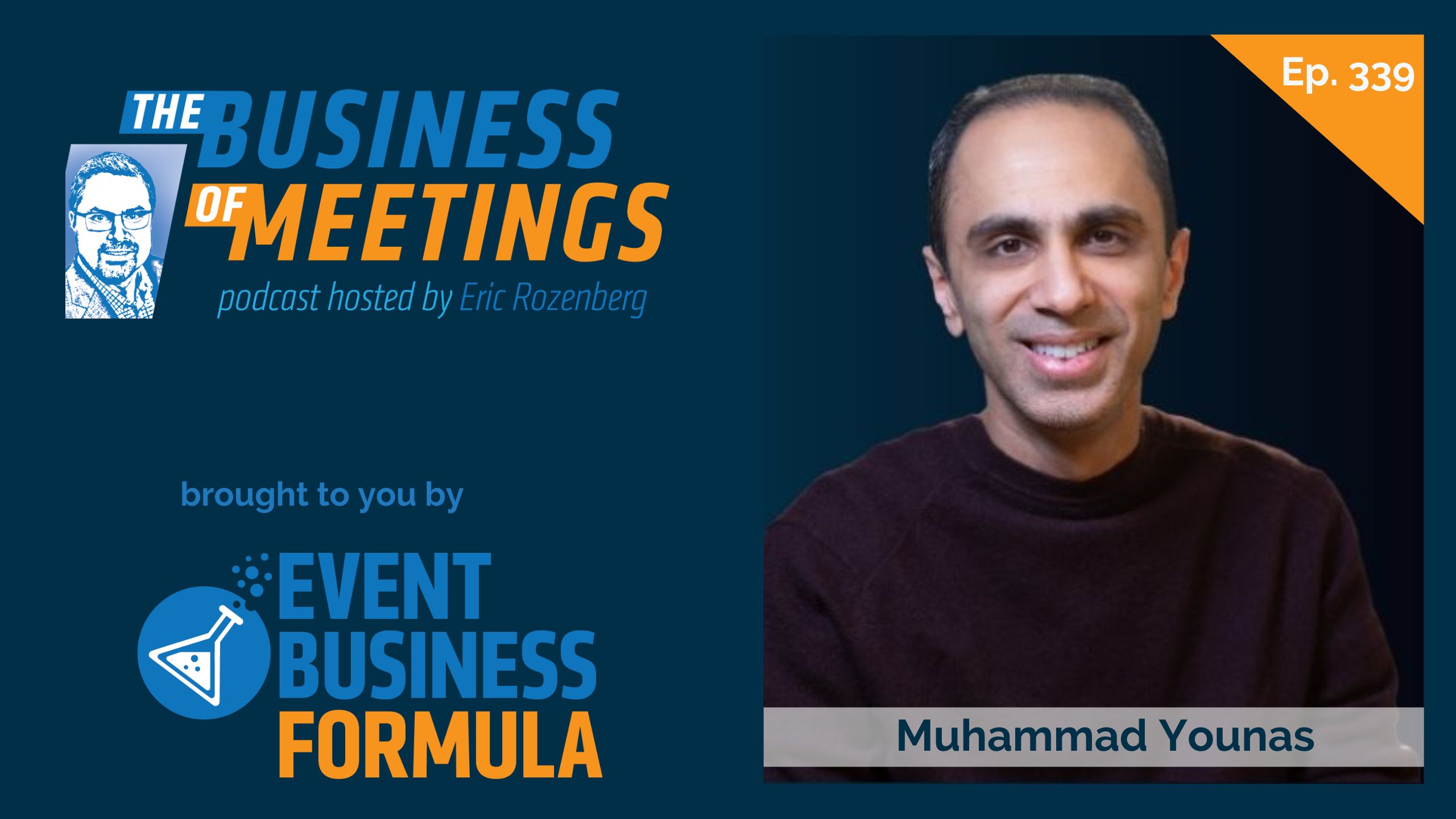
Today, we’re thrilled to welcome Muhammad Younas, the founder and CEO of vFairs.
Muhammad is a true North American tech entrepreneur. He developed the award-winning event technology platform, vFairs, which has powered over 50,000 and reached more than 100 million attendees worldwide.
Stay tuned to hear about Muhammad’s entrepreneurial journey and the invaluable insights he shares today.
Mohammad’s Journey
Mohammad started at IBM before moving into a role involving virtual events. Frustrated by the limited technology and support available, he built his own platform and used it to run more than 100 events. When an exhibitor asked to use his technology, he saw the opportunity to license it, and vFairs was born.
COVID
COVID created hockey stick growth for vFairs because the company already had hundreds of customers, case studies, testimonials, and references. Customers also helped shape what came next, asking for tools such as a mobile app, badge printing, exhibitor management, and a speaker portal as they prepared to return to in-person events.
Event Technology
Event technology can do far more than support an event. Sponsor banners, sponsored notifications, different booth tiers, enhanced profiles, and meetings can create new revenue opportunities while giving sponsors and exhibitors more value.
Using AI
Mohammad sees AI as a way to remove repetitive tasks from the event process so that people can focus on what technology cannot replace. That includes designing the event experience and creating meaningful connections between attendees, exhibitors, and speakers. The aim is not to automate the human side of events, but to give people more time to focus on it.
Automation
Before introducing automation, Mohammad recommends mapping out the workflow and deciding which parts genuinely need human involvement. AI can handle repetitive, time-consuming tasks, freeing event professionals to focus on decisions, relationships, and experiences where their involvement adds the most value.
Keep the Customer at the Center
For Mohammad, building a sustainable business starts with making customers genuinely happy. He sees events as part of the hospitality industry, where the quality of the experience matters because satisfied clients become advocates, generate word of mouth, and create opportunities for future business. The goal is not simply to deliver an event, but to build a company that can continue serving customers well over the long term.
An Opportunity for Small Businesses
Mohammad believes smaller companies can use AI to rethink problems that were traditionally solved with complex, established software. AI-native technology creates opportunities to build new approaches from the ground up rather than simply adding AI to existing systems. But because events involve so many different use cases and edge cases, that opportunity depends on first understanding how the industry actually works.
Perfect It Manually First
Mohammad’s advice is to understand a process before trying to automate it. That means going through the entire customer journey manually, identifying the real pain points, and learning what prospects and customers actually need. Once the process works and you’ve built trust with customers, you can use AI to automate the parts that it will genuinely benefit.
The Event Planner’s Role Is Changing
Mohammad expects events to claim a larger share of marketing budgets, but that will come with greater pressure to demonstrate results. Event planners therefore need to move beyond simply executing events and become more involved in the strategic side of the business. Their role is increasingly about showing how an event supports broader business goals and delivers measurable value.
Bio:
Muhammad Younas is the Founder and CEO of vFairs, an award-winning event technology platform that has powered more than 50,000 events and reached over 100 million attendees worldwide.
Over the past decade, Muhammad has helped grow vFairs into a global, all-in-one platform for in-person, hybrid, and virtual events, serving organizations across 50+ countries.
Through his work with thousands of event organizers worldwide, he has developed a unique perspective on how technology is reshaping attendee expectations, event engagement, personalization, and the way event teams operate.
Under his leadership, vFairs has grown to more than 270 team members and has been recognized as a Leader in the Gartner Magic Quadrant for Event Technology Platforms, while earning a 4.9/5 rating on G2.
Muhammad regularly shares practical insights on event technology, AI, attendee experience, and the future of the events industry, drawing on lessons learned from building event technology at global scale.
Connect with Eric Rozenberg
Listen to The Business of Meetings podcast
Subscribe to The Business of Meetings newsletter
Connect with Muhammad Younas
Listen on: Apple Podcasts · Spotify · YouTube
“The future of event reporting is not telling clients what happened at the event. It’s showing them what happened because of the event.”
Muhammad Younas
Full transcript of episode 339 of The Business of Meetings podcast, Eric Rozenberg with Muhammad Younas. Lightly edited for readability.
Eric Rozenberg: Hello and welcome to a new episode of the Business of Meeting Podcast. One of the reasons I love doing this podcast is it gives me the opportunity to have conversations with absolutely amazing individuals, and today is certainly no different in that sense. He is a true tech entrepreneur, a true North American — I would say Canadian — entrepreneur, because he’s also the chapter chair of YPO. But most importantly, he’s been living all his life in tech. He’s developed a company called vFairs, and when people say they have an award-winning event technology platform, I actually never heard of anyone not saying that — but in his case, he’s got over 50,000 events that have been powered in the last 10 years, over 100 million attendees worldwide, and over 50 countries in the world. So he really knows what he’s talking about. Ladies and gentlemen, the one and only Muhammad Younas, the CEO and founder of vFairs.
Muhammad Younas: Muhammad, I’m so happy to see you again, Eric. Thanks for having me on the podcast, and great to see you again.
Eric Rozenberg: Absolutely. Every time I speak with you, I learn, and you’re so well positioned with what you do to give us ideas, to give us feedback on where we’re going with all this tech, with this AI. But before anything else, what is your journey to becoming an entrepreneur? I think that you started with IBM.
Muhammad Younas: I did start with IBM. I worked there for a couple of years, then went into another job, and part of the task that I was doing in that job was to actually connect attendees and exhibitors in an online event, in a virtual event. So I went out there trying to look for tools that would allow me to run a virtual event. I didn’t like some of the vendors that existed out there back then. Some of them were okay, but the worst thing was the support and the service that I was getting — as a technology person myself, I decided to just build the technology to run my own events. That was always the goal. And over the next four or five years, I just used my own technology to run over 100-plus events, to a point where one of the sponsors/exhibitors came to me and said, “We love being — we love participating in your event, but can we use your technology to run an event of our own?” And I was like, “Maybe I’m in the wrong business.” Rather than being an event planner, let me license my software to help companies run their own events. So that’s the journey of me founding vFairs.
Eric Rozenberg: That’s awesome. And that was in 2016?
Muhammad Younas: 2016, exactly. Yeah. So again, picked up the domain vFairs even a couple of years back, built a website, and very luckily, one of the very few leads I got was from this global brand called Nestlé. They signed up with us — the technology itself was also good, but when we were having that discussion, they were like, “Okay, you know how to run successful online events, so if you work with us with the technology, but more importantly, if you can guide us on how to run that first successful virtual event, that would be amazing.” So they used the technology, they ran that first event — it was one small department from one of the countries — and then they spread the word across the entire organization. Then, the rest is — they shared that great success story with a lot of other event planners, and then a lot of incoming leads started coming from there.
Eric Rozenberg: And you have this dual experience of planning conferences and, in the meantime, tech. And one question comes to mind — because you started in 2016, and now it’s 2026 — what happened for you and for the company around March 2020 and the following years?
Muhammad Younas: Yeah. So again, I think we were very lucky at that point, because by the time COVID came, we were only one of the few players that had a successful track record of doing online events. Everyone kind of started figuring out online events just during 2020. We already had hundreds of customers, with hundreds of case studies and hundreds of testimonials, and more importantly, hundreds of references who wanted to talk to prospects and share their success story that they’ve had with vFairs very openly with the prospective customer that we were getting. So I always say that we had that hockey-stick growth during COVID, and it was not because of the technology — it was because our customers went above and beyond, talked to a lot of prospective customers, just telling them how amazing our product is and how amazing vFairs support is.
But then, a lot of companies did grow a lot using their online event technology during COVID, but almost none of them survived after COVID. We know the names — there are many companies that had billions of dollars of valuation and then pretty much died after that. And even the companies that existed before COVID, that were within our competitive landscape — they almost either got acquired or have shut down, because they increased their expenses so much during COVID that after that it became almost impossible for them to maintain that growth. So, whatever we owe it to is that during COVID we got a lot of customers who used to do in-person events — now they were doing virtual events, they didn’t have any choice — but they loved vFairs so much, and they were like, “You know what, in a year or two we’ll go back to in-person events, and we want you to build now the mobile app, the badge printing, the exhibitor management, the speaker portal.” So they gave us all the insights for vFairs to become a truly end-to-end event management platform. So the initial set of customers helped us grow a lot during COVID, but the customers that we captured during COVID helped us get into this all-in-one event technology that otherwise we wouldn’t have tapped into.
Eric Rozenberg: That’s awesome. And you’re talking about all-in-one — as a matter of fact, later this week I have a special meeting dedicated with my head of marketing to review our tech stack. If you can put yourself in the shoes of an event planner, which I know for you is very easy because that’s what you were and that’s also the people you’re talking to regularly — there is so much technology, from using a link for a calendar to Zoom, Teams, Google Meet, to different AI tools, to registration, to badges — what is the opportunity for event planners, and especially small business owners, to look at our industry and, on one hand, be able to be up to date with the new tech to serve their clients better, but on the other hand also be practical? I’m not only talking about financing here and the cost of all the tech, but practically speaking, how can we bring all this tech together to serve our clients better?
Muhammad Younas: Yeah, you’re right. Event planners have reached a point where they simply have too many tools. Historically, as you mentioned, there’s one platform for registration, another one for the mobile app, another one for badge printing, another one for lead capture, another one for meetings, another one for exhibitor management. Each individual tool might work perfectly, but somebody — and that’s an event planner’s job — someone has to stitch all of that together, and usually that somebody is the event team. And we know that event teams are becoming thinner and thinner moving forward, because of the budget. And you’re right, the hidden cost here is not just software spending — it’s the operational complexity, moving data between systems, managing integrations, training teams on different platforms. And if something goes wrong, someone has to troubleshoot which part of this entire picture is not working anymore.
So consolidation, over the years, has been becoming really attractive. What I typically say is that if registration, the event app, check-in, badge printing, exhibitor management, meetings, reporting — if they can all live within one ecosystem, planners then spend less time managing technology and more time actually designing the event experience. And as you mentioned, the biggest cost of this fragmented technology right now is not the software license — it’s the human time required to make all of these systems behave like one platform. So I’m of the opinion that if you have fewer vendors and less technology to worry about, and if somehow you can have things within one ecosystem, it just gives you more time to spend where that’s more valuable, as compared to just being an event planner that’s managing vendors and not the event itself.
Eric Rozenberg: I know that one of your mantras is that event tech is not a cost center, it’s a revenue driver. Can you elaborate on that?
Muhammad Younas: I’ll elaborate, but I’ll just tell you — I was involved in a demo last week, and I was just walking our customer through how, within the mobile app, they can have these sponsored banners, they can have these sponsored notifications, they can have these different tiers of booths. And they were like, “Oh wow, I wish I had all of those things before,” because in their own head they were like, “Okay, I can make X amount of dollars with this and Y amount of dollars with that,” and so forth.
For a long time, event technology has always been treated just as infrastructure — it’s there to capture data and those kinds of things. But if the technology now allows sponsors to get leads, sponsored push notifications, enhanced profiles, meetings — we were discussing how we, as a company, go and participate in a lot of these hosted-buyer meetings, and we pay a lot of money for those premium meetings, right? I just feel that event planners are now figuring out how one can make use of the event technology — the exhibitor portal, the meetings, the push notifications, the different tiers of packages — actually to make a lot of money. So that’s where the conversation goes, from “how much does this cost” to “how much money can I make using all of this technology,” where I can provide a lot of value to my sponsors, to my exhibitors, to my attendees — I can match them, I can help them achieve their business objectives, and then in return, of course, you get value based on that. So I’m of the opinion that event planners should now really go from “what revenue can this technology create” and “what work can it eliminate” — how much time it can save for me — that’s cost saving — and then how much money I can make, how much revenue I can make from this technology. This is the shift that’s happening in the market.
Eric Rozenberg: To elaborate on what you just said — how do you combine, on one hand, this automation that is saving you time and helping the sponsor, the vendor, everyone you’re working with, and on the other hand, the need for human interaction, because people buy from people even with all the tech?
Muhammad Younas: 100%. And that’s where AI should be helping automate any repetitive task, so that the event planner can actually spend a lot of time trying to create those experiences that really matter in an event, which is absolutely human-to-human matchmaking. Think of an event planner — historically, even when they were working with sponsors and exhibitors, they have to send them an email to get the logo, they have to send them an email to get the profile of the speakers, they have to send an email to ask for who will need lead licenses, they will have to email them for the booth material — and again, multiply that by 50 to 100. The job of the planner is literally following up.
But when you have a proper sponsor portal, exhibitor portal, where the sponsors and exhibitors can see all of the tasks that they’re responsible for, the system can follow up on behalf of the event planner. Then the event planner can spend that much time trying to create the best event experience that allows for that human-to-human matchmaking. Even for that human-to-human matchmaking — historically, an event planner has to match the attendees and the exhibitors, attendees and speakers, by themselves, using some technology, but now AI exists, and AI can do a lot of that matchmaking, which means the event planner can think a lot more about the experience that both of these people should feel when they’re out there — the décor, the theme, and all those kinds of things. So AI should help automate a lot of those manual tasks, so that the event planner can really create that experience that will be unique for all of the people who are attending that particular event.
Eric Rozenberg: So if I understand what you’re saying, then coming back to the basics — you have to define your workflow, and then where you’re going to have automation and where you’re going to have human intervention.
Muhammad Younas: Absolutely. I think you have summed it up really well. You pick the items that should be automated, and then you pick the items where your involvement is required and just double down on that one, and you let the AI, let the technology, save you time where the human involvement is not required.
Eric Rozenberg: Let’s shift a little bit and talk about data. I know that vFairs has a prestigious place on the famous Gartner Magic Quadrant — congrats on that. I was stunned — when I had my corporate events agency, I would go to a sales director, for instance, and I would ask him, “Why do you do a sales meeting?” And too often the answer would be, “Oh, because we do it every year.” And it was like — how do they justify the investment with their exec committee? It doesn’t make sense to me. So today we can measure everything and anything, and I would say the risk is — okay, you have so much measured, what do you do with the information? So how do event organizers, event planners, small business owners, use the data, leverage the tech, in order to provide more service to their client and help them as well justify the investment?
Muhammad Younas: Yeah, I think first of all, it has to be a mindset change. And the line I typically use nowadays is that the future of event reporting is not telling clients what happened at the event, it’s showing them what happened because of the event. Because the moment you go towards the end goal and the outcome that has happened because of the event, you’re trying to prove the ROI — that’s where the value is for the stakeholders. Just knowing that, by the way, X amount of people registered, Y amount of people attended the event, Z amount of people attended the session — that’s not where the fun is. The fun is that all of these things have happened, and hence, as a result of that, here is the pipeline growth in the particular business. Here is the sale for this particular product. Here is X number of more meetings that have been scheduled because someone attended this session. This is the amount of growth that the sponsor has got because X number of people went to their booth, Y amount of people interacted with their products, and so forth.
So event technology allows you to capture all of this data. This data now needs to be pushed into your CRM. The CRM should be able to see the journey of that particular prospect and client moving forward with your products and services, and you should be able to see what has happened after the event as a result of that particular event as you follow up with all of those stakeholders. So expect all of these things now from pretty much any event technology partner — with us, vFairs, or anyone else — because the data exists in most cases. It’s just really how you’re making use of that data with a proper follow-up with all the relevant stakeholders.
Eric Rozenberg: I love what you’re saying — not what happened at the events, but what’s going to help afterwards, the execution, the strategy of your client. You have a lot of tech today that is available, and you were just mentioning CRM. I’ve read some experiences shared from other entrepreneurs, like, “Oh, I don’t need my CRM anymore, AI can do it.” And I’m thinking, yeah, well, maybe for the basics, but there’s so much to be done afterwards — so many interactions, so many connections that need to be made — that you’re going to end up basically almost becoming a tech specialist instead of focusing on your business. What’s your advice for people thinking like that?
Muhammad Younas: Yeah, see, I’m of the opinion that this is not the time, and it doesn’t save cost even — so you shouldn’t be cutting spend on any of the software vendors. Right now, the reality is that at this point, anyone can think about AI in two different ways. One of them is to make yourself more productive, or to save cost in some of the places. I believe that the first focus should be how can I be a lot more productive, and once you have seen that productivity, go back and look into the cost saving as well — there’s nothing wrong with that.
But coming back to the CRM, and then we’ll discuss some of the other software — a CRM software seat license costs, like, it’s 100 bucks, 200 bucks per user. The reality is that you need to save all of the data somewhere. It has to be a CRM. Building your own CRM will take you, I don’t know, months, if not more, and then to manage it, and to have integrations that any CRM software provides, whether it’s HubSpot or Salesforce, etc. — your job will actually become building the CRM and maintaining it, as compared to, for example, being an event planner or whatever business you are running.
So the challenge with AI is that we all get excited that now we can build things, because we were not developers before, and we kind of start distracting ourselves, making this our job, as compared to something else, and showing everyone, “Look at this fancy dashboard, look at the CRM, look at this website that I’ve created.” That’s not where the value is. The value is you becoming a lot more productive in your job, in the industry, in the role that you are already expert at. If you distract yourself trying to do someone else’s job — it’s good for fun, it’s good as a side hobby, but trust me, it cannot be your main business. So I’m always of the opinion that don’t try to replace any of this software, whether it’s a CRM or an event platform, etc. It won’t help you. It will actually cost you more money in the midterm — forget about long term, long term you’ll lose big time — but midterm you’ll realize, “No, I’ve made a big mistake by distracting myself doing this.”
Eric Rozenberg: Very wise advice, thanks for sharing that. Muhammad, what’s your take on all those big VCs and private equities that are now, it seems, for the past few months, targeting our industry?
Muhammad Younas: I’m not someone who has ever raised money with a VC — I run my business in a very traditional way, where I only care about two things. First of all, and the most important one, I want to make my customers really, really happy, because all of the business in our industry in particular — I always say this to our entire company — we’re not just in the technology industry, we’re in the hospitality industry, which means that if I serve my clientele really well, the word of mouth takes its effect, and that’s where you generate future business. That’s one. And two, just running the company in a way that you can keep on running it, which means you always have to make a bit more money than what you’re spending.
Now, from a VC perspective — this is a golden era for events, these next five to ten years are the best years for this industry, and VCs know that. They will come after a lot of companies, and every company has to make a decision on what’s best for them. Some of them might need money, because that’s the only way for them to grow and add more value. Others might want to run away from that money because then it distracts them from serving their customers really well — whatever their DNA is. So for VCs, my suggestion is you’re doing absolutely right — events are the future of marketing. Every marketing team sees events as an absolute must to generate more business and to retain existing customers. We, even as a very medium-sized company, are doubling down, tripling down on our own events budget, just because with all this AI, we want to have more face-to-face interaction. So we’re doing more dinners, we’re participating in more exhibitions, and so forth. So for VCs, it’s — they should have their focus on our industry, and for our industry it’s really about whether it makes sense for them or not, and take it with a bit of caution.
Eric Rozenberg: I fully agree with your analysis. I do have one question I haven’t gotten an answer to yet — the model of the VC or PE is to basically consolidate and do a roll-up and systematize. When you look at our industry, which is extremely fragmented — you have some big players, but the rest, it’s almost like there’s no middle, it’s extremely fragmented — where do you see the opportunities for investors to consolidate and to leverage all the human relation aspect, but also how the small businesses are evolving?
Muhammad Younas: Yeah, see, I believe that a small business has a lot of opportunity within our industry, because in every industry, what’s happening is that they’re reimagining how the same thing can be done with an AI-native platform, as compared to whatever the digital platform was — traditional platforms, of course, are also going back and reimagining their technology with AI first. So in that regard, consolidation will happen, and the reason it will happen primarily is because I’m also of the opinion that for an event planner to sign up for five, six, seven, eight different things to run that one event — it won’t make sense moving forward. They will have to have a lot of those things with one vendor rather than five different vendors, because just managing relationships with five different vendors becomes a cost — not because of the cost of the software, because of the cost of the time of the event planner itself. Consolidation is about to come. That will happen whether we like it or not.
But smaller companies have this very unique advantage where they’re not inundated with existing operations, so they can reimagine how to solve the same problem in a better way, if a better way exists — because the challenge with our industry is that events are of very different natures. Building a CRM software, theoretically speaking, is easier than building an event platform, because you have so many of these edge cases, use cases, etc., that sometimes building them from the ground up requires you to be in the industry for a decade to really understand the ifs and elses and the buts of what happens in an event tech landscape.
Eric Rozenberg: Yeah, absolutely. What is your advice then, in that sense, for event planners, where they are allocating their time? You started the business — nobody does it on their own — so how do you manage your time, what are you focusing on, and what would be your advice for small business owners?
Muhammad Younas: I always say that you have to perfect things in a manual way first, before you can go back and automate it using AI. Nowadays, what’s happening is that we all can chat with ChatGPT and Claude or Copilot, and we can just literally go back and forth for days and weeks and build things on our own with dozens of prompts, and we feel that we have achieved something — and there might be something in it — but the reality is that you need to do the complete opposite. You need to go and meet with people, event planners, manually go through the entire journey, experience it yourself, and then come back and build it the way you would want.
Event planners have this edge because they have run those events, they have seen that journey so many times, that in their head they know exactly where the pain points are, and if they are absolutely very clear on those, build it. But the thing that people should know is that building technology is a very small piece of it. It’s actually the trust that you have to build with prospects and customers that actually helps you get the business. Technology will only take you so far. It’s the execution of the events, it’s the execution of marketing, it’s execution of the sales team, it’s execution of operations — which the cloud is not going to do for you, no one is going to — you will have to do the operations yourself, you’ll have to do marketing yourself, you have to do sales yourself. You have to do that a lot yourself first before you go back and automate that. So in the end, success comes with hard work — if it’s purely, if AI could help you do it, everyone would do it. You have to be on the ground yourself, running the show, and event planners are absolutely great at it. I was an event planner for five years, I have been the CEO of vFairs for almost ten years now — and again, vFairs is a very big organization, running events for thousands of companies — but that’s still an easier job. An event planner’s job is a far more tougher job, because you have so many of these bosses — you have to do marketing, you have to do sales, you have to handle attendees, you have to do speakers. That’s the toughest job I’ve ever had, and I have been a technology guy, a marketing guy, a sales guy, a CEO, and an event planner. I always say an event planner has the toughest job in this industry.
Eric Rozenberg: I agree. And something you say that resonates a lot with me is you talk about trust, which is one of the reasons why I believe that the more people use AI, the more they will want to come in person, because that’s how you build the trust.
Muhammad Younas: 100%, absolutely agree.
Eric Rozenberg: So when you’re looking at the future of our industry, what are two or three main ideas that you think small business owners and event planners should consider, looking at the next 10 years?
Muhammad Younas: Again, as I mentioned, what’s going to happen at a corporation level is that events are going to get far more budget from the marketing dollars than ever before. People typically used to spend a lot of money on Google, on social media, on a lot of other channels, but events, whether in-person events, are going to get the largest market share. As an event planner, the goal should be, how can I prove value, which is the ROI from the money being spent on events. And that’s where I just mentioned that it has to be less about what happened in the event, but more about what happened as a result of the event I have run. So the more event planners can go from that operational zone — which is “run a successful event” — to more of an ROI zone, where “my end goal should be to prove the business value from this particular event,” the more they will earn trust to get even bigger budgets, bigger teams, and to execute even more amazing events. So that’s a mindset change that one needs to have, because for years, for decades, event planners were execution people, and that’s a tougher job, as I mentioned — they have to become the strategy people now, which is to see events as a core pillar that runs the business, and not something that happens just once or twice a year, like someone is doing a user conference, and so forth. So for me, that’s the biggest mindset change, and I believe that event planners are seeing it, they’re ready, and that’s where they have to free their time. And to free their time, that’s why I say event tech consolidation will happen, rather than you managing five different vendors and saying, “Oh, by the way, look how amazingly I have managed these five vendors” — you have to see where you can save time, make use of AI to manage a lot of your repetitive tasks, and then focus a lot more on the strategy, focus a lot more on the ROI. That’s where you will see that events has to be the biggest piece of the marketing budget in the next 10 years. It shouldn’t go down from this point onward.
Eric Rozenberg: Absolutely. That’s an exciting industry to be in. You’re operating in over 50 countries in the world — where do you see the growth opportunities?
Muhammad Younas: Eric, the US will continue to grow, and that’s where our biggest operation is. And again, the market, the economy, it always allows for — first of all, every region will grow, because events themselves are growing, so every region will grow. The US, just because of the economy, will grow very, very quickly. Same thing with Canada, same thing with the UK and Europe, same thing with Australia. But if you would have asked me a year back, I would have said Saudi Arabia and Dubai, because they’re spending a lot of money, a lot of money over there, and it’s starting from a very, very small base, and hence the growth over there would look really, really good. I’m not sure if I can say that now, because of what’s happening out there, but I know that in general, that’s a market that’s starting from a very low base, and hence the growth in theory should be a lot more.
The great thing about the US, Canada, the UK, Europe, and Australia region is that they already have a very decent event space. But just because the marketing budgets are going to go significantly up for events, each one of those regions, particularly the US, will have a great future for the coming five years.
Eric Rozenberg: What about Asia?
Muhammad Younas: Asia — yes. I think that the challenge with Asia is that, as an event tech supplier, it’s still a place where people see — they go with local vendors a lot. They have that preference for a local vendor, for local languages. And in general, there’s a lot of growth over there from local events, but very little in terms of international events. So if you are running true international events, you really need to be in cities, in countries, where you can attract international audiences from all over the world. Asia is absolutely amazing and will grow, but I’m of the opinion that from an attendees perspective, it will always have this very limited set of people who would be traveling to that part of the world.
Eric Rozenberg: Got it. Muhammad, as usual, I love asking you questions and listening and benefiting from all your experience and knowledge. Let me ask two last questions for today. The first one — how do people get in touch with you and with vFairs?
Muhammad Younas: For vFairs, the best way to contact us is to go to vfairs.com — that’s V-F-A-I-R-S dot com. So, website, if you will — just fill up the form over there, or email us from there, and we’ll be in touch, you’ll get in touch in five minutes or less. That’s one — five minutes or less, though — again, you go ahead, you submit the inquiry at any point during the day, over the weekend, any time — typically it’s five minutes or less, we are in touch with you. And then for me, I’m active on LinkedIn, so if you go and look for me, Muhammad Younas, on LinkedIn — I’m really pretty proactive replying to any of the messages I receive there.
Eric Rozenberg: Wonderful. And my last question — when we meet again in person, in one year, what are we going to celebrate?
Muhammad Younas: We’re going to celebrate how we have allowed event planners to save a lot of time using AI. We are betting big on AI, and again, the idea is that we want to give event planners a lot of time that allows them — that they’re saving from these manual tasks — and they can spend a lot more time on the strategy, on actually allowing for that human-to-human meeting in a much better way. So if an event planner is spending right now, let’s say, 10 hours building an event, it should be 10 minutes rather than 10 hours — that’s the goal.
Eric Rozenberg: Wonderful, Muhammad Younas, thank you so much, and I look forward to seeing you soon.
Muhammad Younas: Thanks, Eric. Thanks for having me.
Eric Rozenberg: Thank you for tuning in to the Business of Meeting Podcast. I hope you found today’s episode valuable. If you enjoy the show, the most important thing you can do is leave a review and share it with your colleagues — it really helps spread the word. I truly appreciate your support, and if you’re ready to take your business to the next level, don’t forget to visit eventbusinessformula.com to learn more about how we are helping event business owners like you. Thanks again for listening, and I’ll see you next time.