
Today, Eric explores why some of the world’s largest investment firms are investing billions of dollars in the meetings and events industry and explains what they are seeing that many small business owners may not yet recognize.
Stay tuned to discover how to build a business that captures the value investors seek.
Private Equity
Private equity is not buying event companies because they love events. They are investing in predictable cash flow, valuable customer communities, scalable business models, recurring revenue, EBITDA, market leadership, customer data, pricing power, growth opportunities, and businesses that can run without the founder. Looking at your business through this lens helps you understand what truly creates long-term value.
Face-to-Face Meetings
As AI continues to grow, face-to-face meetings are becoming even more valuable. People still buy from people, and trust is built through human relationships. Rather than replacing events, AI increases the value of in-person interactions, making face-to-face experiences an even stronger competitive advantage.
A Fragmented Industry
The meetings and events industry is fragmented, with a handful of dominant players and thousands of smaller businesses. This creates opportunities for consolidation, allowing investors to buy, improve, combine, and scale businesses. If you hope to benefit from this trend, you need to build a profitable business and allow it to mature to become valuable enough to attract potential buyers.
Technology Improves Profitability
AI, automation, better data, and better pricing are changing the industry. Technology is making event organization faster, cheaper, more structured, and more data-driven while lowering operating costs. Rather than replacing events, it is making event businesses more profitable.
Thinking Like an Investor
Instead of asking whether someone would buy your business today, consider what would make it attractive to a buyer. Investors look beyond size. They evaluate your people, your processes, your reputation, how long you have been in business, and how well your business can operate without you.
Build Assets, Not Just Income
Many entrepreneurs focus on building income, while private equity focuses on buying assets. Shifting your mindset toward building a valuable asset helps you create a stronger business, regardless of whether or not you decide to sell it.
Predictable Revenue
One of the biggest drivers of business value is predictable revenue. Long-term contracts, recurring revenue, membership models, subscription models, and repeat business reduce uncertainty and allow you to forecast revenue further into the future, making your business far more attractive.
Strong Systems and Leadership
The less your business depends on you personally, the more valuable it becomes. A valuable business does not rely on the owner to approve everything. Strong systems, a capable leadership team, and clear processes allow businesses to continue operating even when the owner is away.
Differentiation and Financial Discipline
Your business must offer something that others cannot easily replicate. Becoming a strategic partner, rather than simply a professional logistics expert, differentiates your business and strengthens client relationships. Knowing your numbers, tracking trends, and demonstrating financial discipline also makes your business more attractive to buyers.
Building a Sellable Business
Building a business that someone would want to buy creates a stronger, more resilient business, even if you have no intention of selling it. By focusing on value rather than remaining small, you can position your business to thrive as the industry continues to evolve.
Connect with Eric Rozenberg
Listen to The Business of Meetings podcast
Subscribe to The Business of Meetings newsletter
Listen on: Apple Podcasts · Spotify · YouTube
“You don’t have to sell your business, but you have to prepare your business to be sold, even if you don’t want to sell it.”
Eric Rozenberg
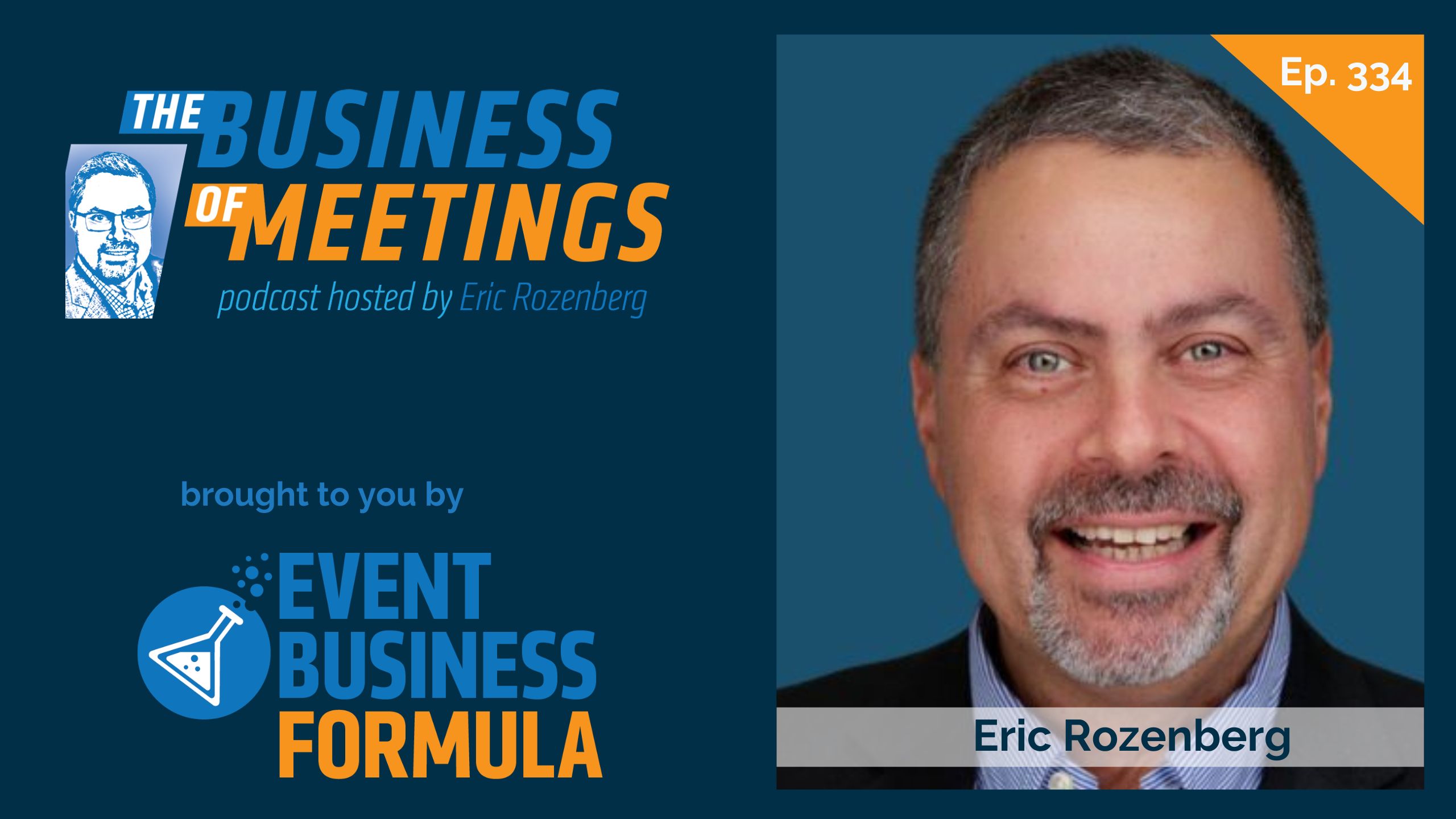
Full transcript of episode 334 of The Business of Meetings podcast, a solo episode with Eric Rozenberg. Lightly edited for readability.
Hello, and welcome to a new episode of The Business of Meetings podcast. For years, we’ve been talking about our industry, its economic impact of over 1.3 trillion dollars, but also the fact that many people view the meetings and events industry as a very fragmented industry, unpredictable, and difficult to scale.
Then, recently, there has been some news that is really mind-blowing. First, Cvent announced plans to invest $1 billion over the next three years. Hellman & Friedman acquired [inaudible] for approximately $1.8 billion. And Apollo acquired Questex and Emerald, and have created one of the largest B2B event platforms in North America, with a deal for a total of about $1.5 billion. So, we’re already over $4.3 billion invested, or at least announced, in the last months.
So, my question is: if some of the smartest investors in the world are literally pouring billions of dollars into our industry, what are they seeing that many small business owners might not be seeing yet?
The thing is, most people think that private equity is buying event companies. Actually, they are buying predictable cash flow, valuable customer communities, and scalable business models. Private equity does not fall in love with events. They fall in love with recurring revenue, EBITDA, market leadership, customer data, pricing power, growth opportunities, and, very important, businesses that can run without the founder. Which is a completely different lens. As I always say, you don’t have to sell your business, but you have to prepare your business to be sold, even if you don’t want to sell it.
So, the other part of the equation is to understand why suddenly they’re doing that. And there are obviously several reasons for that. I think the most important one, and the most exciting one for all of us, is that face-to-face is, and will be, more valuable than ever before. It’s a kind of irony, but the more AI will grow, the more we will use AI, the more people will value and trust the human relationship, the face-to-face, the in-real-life meetings. People are still buying from people, and people will always be buying from people. And the major investors have explicitly pointed to AI making in-person interaction even more valuable, not less. So, that’s the first reason.
The second reason is that the industry is still fragmented. We have thousands of companies in our industry and very few dominant players. I would even say, more interesting: you have some dominant players and a lot of small businesses, and quite frankly, it’s almost a no man’s land in between. But that’s actually what private equity loves. They love when they have a few dominant players and a very fragmented industry. They know they can buy, they know they can improve, they know they can combine them, and they know they can scale them, and sell, and repeat. Now, if you are looking at selling your business in the future, that’s obviously a great opportunity, but you need to reach a certain size.
Having said that, besides the fact that face-to-face is more valuable than ever, besides the fact that our industry is still fragmented, another reason is that the technology is completely changing the industry, and completely changing the margins. With AI, with automation, with better data, with better pricing, that implies as well having lower operating costs. And it’s not that technology is going to replace events, but it’s going to make their organization faster, cheaper, more structured, and provide more data. In other words, it’s going to make event businesses more profitable.
So, what can that mean for a small business owner? Would a private equity firm buy your company today? That’s a great question to ask. And yes, there is a minimum size that they’re not going to look under. But there are also the people, the processes, the reputation, how long you’ve been in business. Does the business run without you? Or at least, if you’re not there, can it run for several weeks or several months without you?
And so, we need, as small business owners, to really shift our minds. Because at the end of the day, most of us, as small business owners, most entrepreneurs, we’re building income. But private equity is buying assets. And there’s a huge difference.
So, what makes a business valuable? First of all, it’s predictable revenue. Not living proposal to proposal. Looking at long-term contracts, making sure that you have some sort of recurring revenue, and that you can predict, for the next two or three years, a part of your revenue. So, predictable revenue is very important.
The second element, which is also very important and makes a business very valuable, is the systems. As I just mentioned, could someone else run the business without you? Do you need to still approve everything? Are you, in other words, the bottleneck of your business? And I would offer that many business owners are the bottleneck of their own business.
So, besides predictable revenue and systems, what obviously is extremely important is the leadership. Does the company depend on you? Have you built a great team around you? What if you’re going on holidays for a quarter? Or what if, God forbid, you have a health scare? Can the business continue without you?
And then also, the other aspect is the differentiation. What makes your business impossible to replace? What type of value, what type of service, what type of something completely different are you bringing, that others are not bringing? And I won’t go into the details in this podcast, but there’s one of the sessions that I’m giving where, basically, I make the difference between being a professional logistical expert and being a strategic partner. And there’s a huge difference, and that has obviously a major impact on your business and the relationship you have with your client. So, differentiation, for sure.
Then also, you need to know your numbers. Can you explain your numbers in five minutes? Can you tell a potential buyer what you are measuring, how often you are measuring, see the trend in the last three years? Or do you just know what’s in your bank account?
And then, of course, the recurring customers. If you have repeat business, or if you have a membership or subscription model, long-term contracts, as I just mentioned, are obviously extremely important. It’s basically anything that would reduce the uncertainty of a buyer, knowing that when they buy the business from you, they will have the opportunity to look at revenue for the foreseeable future.
So, what makes a business valuable? One, predictable revenue. Two, systems. Three, leadership. Four, differentiation. Five, financial discipline. And six, recurring customers.
So, most of the people I’ve been talking to, and been coaching the last years, have told me, “Yeah, I’m planning to sell, maybe in five years. Maybe never, I don’t know.” Some, they know: “I don’t want to sell.” I say, wonderful. As one person in particular, I remember, told me: “I like the way my business is, and I don’t want to grow, and I want to be able to manage my time as I want.” Well, guess what? The more you have a team that you can rely on, the more you can manage your business, and you’re not dependent, or your clients are not depending on you. So that’s a kind of disagreement there. So even if they don’t want to sell, wonderful. Many founders, and I know one of them, don’t want to sell their business. But building a business that someone would buy is the best way to build a business you’ll enjoy owning. You’ll definitely have more profit, better systems, less stress for sure, higher valuation, more freedom, better succession. In other words, you will have a machine that is working without you, that is bringing you joy, and where you can decide to focus your time on what you do best, and where it’s bringing the highest value to your business. So, whether you sell, at that moment, is almost secondary, but you have to build a business that is sellable.
What I believe is going to happen in the next 10 years is that we’re going to see more and more consolidation. We’re going to see more acquisitions. We’re going to see larger platforms. We’re definitely going to see more AI, more and greater specialization, but also higher expectations from clients, which is probably no news, but it is not going to decrease. And that’s where I believe, in this environment, that small businesses can absolutely thrive. But not by remaining small-minded. Those who are going to win will not necessarily be the biggest, but they will be those who are the most focused, the most disciplined, and the most valuable, with the six elements that we mentioned earlier on.
So, my wish for you is to be able to ask yourself: if a private equity partner spent one day inside my business, would they walk away excited, or worried? And that your answer will be: they will be excited. So, if it’s not the case now, don’t be discouraged. Go to work. Any business is not built in a few weeks or in a few months. It takes time, and it’s a roller coaster, as we all know, to be a business owner. But there’s nothing more exciting than owning your own business.
So, this is not really a story about billion-dollar acquisitions. It’s a story about validation. That’s how I see those private equity firms coming into our industry. For decades, many people underestimated the meetings and events industry. Today, some of the world’s largest investment firms are betting billions that face-to-face experiences, trusted communities, and scalable event businesses will become even more valuable in the AI era. The question is no longer whether our industry has value. The question is whether you are building a company that captures the value.
Thank you for tuning in to The Business of Meetings podcast. I hope you found today’s episode valuable. If you enjoyed the show, the most important thing you can do is leave a review and share it with your colleagues. It really helps spread the word. I truly appreciate your support. And if you’re ready to take your business to the next level, don’t forget to visit eventbusinessformula.com to learn more about how we are helping event business owners like you. Thanks again for listening, and I’ll see you next time.