
Today, Eric explores one of the biggest misconceptions surrounding AI.
Stay tuned as he explains why AI will not build your business, and why building a successful business remains entirely your responsibility as an entrepreneur or business owner.
Your Vision
AI can help you brainstorm, improve your wording, and challenge your thinking, but it cannot define your vision. Only you can decide what kind of company you want to build, what type of freedom you want, and where you want your business to go.
Trust
As information becomes cheaper, trust becomes more valuable than ever. AI can write proposals, research prospects, and prepare you for meetings, but it cannot build trust, read body language, handle objections, or make someone feel understood.
Accountability
AI cannot hold you accountable. It can tell you what to do, but it cannot make you do it. It cannot make sales calls, follow up, delegate more, or have uncomfortable conversations.
Hard Decisions
AI can give you input and help you evaluate your options, but you are the one who must make difficult decisions. Whether you’re firing someone, walking away from a client, or making a major investment, leadership requires courage, not computation.
Consequences
Responsibility can never be outsourced. AI can provide advice, but as a business owner, you are responsible for the decisions you make and the consequences that follow.
The Value of AI
AI can help you brainstorm, research, create SOPs, write proposals, support your marketing, prepare meetings, role-play sales calls, and accelerate learning. It reduces the value of repetitive work and routine tasks, allowing you to focus on the work only you can do.
Summary
As AI becomes more capable, your vision, leadership, judgment, relationships, courage, and accountability become even more valuable. Your competitive advantage is not AI—it’s how you use it while continuing to lead your business.
Connect with Eric Rozenberg
On LinkedIn
Listen to The Business of Meetings podcast
Subscribe to The Business of Meetings newsletter
Listen on: Apple Podcasts · Spotify · YouTube
“AI is not your competition. Your competition is the entrepreneur who combines AI with vision, who builds deeper relationships than anyone else, and who executes relentlessly.”
Eric Rozenberg
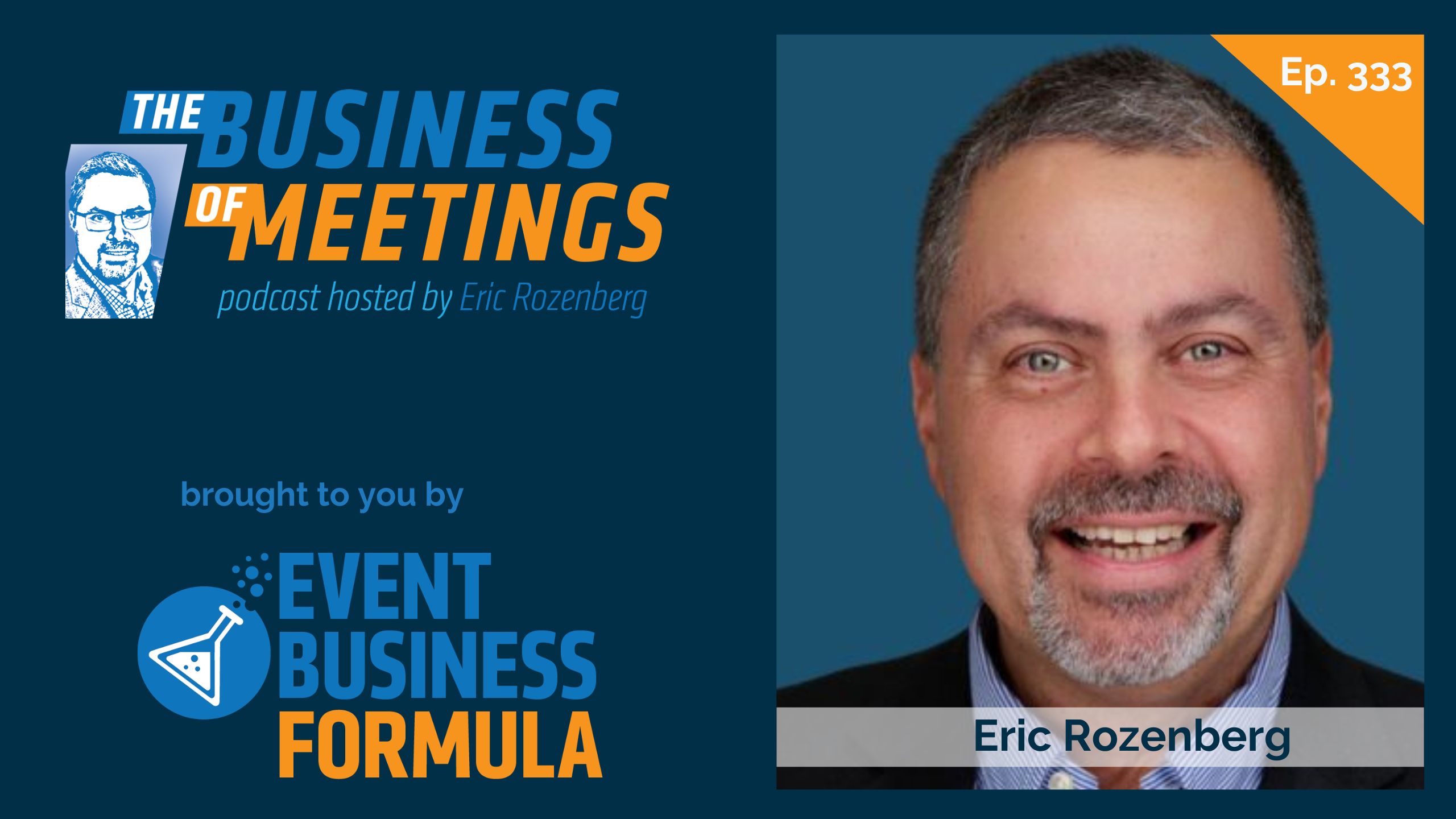
Full transcript of episode 333 of The Business of Meetings podcast, a solo episode with Eric Rozenberg. Lightly edited for readability.
Hello and welcome to a new episode of The Business of Meetings podcast. Today I want to talk not only about AI, but about the fact that AI will not build your business. You will.
Never before did we have access to so much information, so many tools, so much technology. And at the same time, never before have we wondered the same thing: will my business still exist in 10 years? AI is rewriting the rules faster than any technology we’ve seen in our lifetime. Every day there’s a new model, a new tool, a new prediction about which jobs will disappear, which industries will be transformed. I was hearing last weekend the CEO of Nvidia talking about radiologists that will be disappearing, because obviously AI is doing a better job, or a faster job. And today it was announced that OpenAI will move into the cloud, which is obviously going to be a big advantage, at least until next week.
But as business owners, we already have enough on our plate. We need to get new clients, we need to manage cash flow, we need to lead teams, and we need to deliver exceptional work all the time. But guess what? Now we have an additional question: how do I prepare for a future that nobody can clearly define, and where, by the way, all the data is changing every week?
So, AI is wonderful at helping us think, but there are fundamental things that it simply cannot do. And those are the five elements that I want to talk about today, because they are extremely important, and that’s where you’re going to make a difference building your business.
First of all, AI cannot define your vision. That is probably the biggest misconception. AI can help you brainstorm, and you can use every AI and ask a lot of questions. It’s phenomenal, trust me, and a number of people are using it already. It can also improve your wording. It can challenge the assumptions. But AI has no dreams. Those are your dreams. AI doesn’t have children, doesn’t have regrets, doesn’t have a legacy. So a question like, “What kind of company do I want in 10 years?” This is up to you to answer. What type of freedom do you want? Do you want to sell your business? Do you want a family business? Do you want to work three days a week? All those elements, AI can help you think about, but you have to make the decision yourself, because AI cannot answer that for you. So, AI can optimize your destination. It cannot choose it for you.
And let me give you the example of two agency owners. Let’s say that they have the same revenue, they have the same market, they have the same AI tools. One wants to build and sell, and the other one wants a lifestyle business. Guess what? Completely different decisions. And obviously, AI doesn’t know which one matters. It’s up to you. So, first and important thing to keep in mind: AI cannot define your vision.
The second element that I want to stress today is the fact that AI doesn’t build relationships. And that’s especially relevant for our industry, the meetings industry. Can AI write a proposal? Of course, absolutely. Can AI research a prospect? Yes, for sure. Can AI prepare you for a sales meeting better than most assistants? Yeah, absolutely. But can AI sit across from your client? Can it read the body language? Can it create trust? Can it handle objections? Can it make someone feel understood? Absolutely not.
People still buy from people. And especially when you’re talking about six-figure meetings, when we’re talking about incentive travel, when we’re talking about all this uncertainty. People don’t buy meetings. They don’t buy incentive trips. They don’t even buy strategy. They buy confidence. They buy trust. They buy certainty. They buy solutions to their challenges.
Another thing that AI cannot do is read the energy in the room. Can it notice the hesitation before a client says no? Can it build a relationship over years? Can it shake a hand after helping someone through a difficult project? No, absolutely not. But as information becomes cheaper, trust becomes more valuable than ever. That’s why relationship builders won’t become obsolete. That’s why we’re very bullish about our industry. And that’s why we will become more indispensable than ever before. In other words, the technology lowers the cost of information, but it also increases the value of trust.
So, the first point that I mentioned is: AI cannot define your vision. The second point is that AI doesn’t build relationships. And the third point is that AI cannot hold you accountable. And that’s a very uncomfortable truth. And trust me, I’m the first one to have been faced with that truth. Most entrepreneurs don’t suffer from a lack of information. We’re not suffering from that. We are suffering from a lack of execution. I mean, if you ask any professional, I would think that everyone knows what to do. The challenge is that very few people actually do it.
So, AI can tell you to make the sales call. It can tell you to follow up, to raise your price, to hire sooner, fire faster, to delegate more. AI can tell you to exercise, or AI can tell you to spend more time with your family. The advice is not the problem. The execution is the challenge. But tomorrow morning, who actually makes the call? Who has the uncomfortable conversation? Who follows through after three months of procrastination? You. Me. Not AI. That’s leadership. That’s ownership. That’s accountability. No AI model will ever feel the discomfort for you. And no prompt will replace courage, for sure.
The last two points I want to make about the difference between AI and the human aspect of it, and why I’m also extremely optimistic for the future: AI doesn’t make hard decisions. For instance, if you need to fire someone. If you need to walk away from a client. And yes, I’ve done that. I’ve fired clients in my career. AI will not tell you how to say no. Choosing one strategy over another: you can definitely ask questions, get input, but you will have to make the decision. How about investing $100,000? Who’s going to make that decision? Not the AI. How about acquiring another company? You can look at all the data, you can look at all the P&L, you can look at all the value. At the end of the day, it’s a question of the person, and your guts will tell you if you’re going to make that call or not. So, AI gives you input, but leaders make decisions. And leadership requires courage, not computation.
And the last point I want to make, which is also very important, is that AI doesn’t own the consequences. And that is extremely, extremely important. If AI gives bad advice, who loses the money? You. If a strategic decision fails, who lives with the consequences? You. Responsibility is never outsourced.
Now, don’t get me wrong. I am absolutely excited to be living in this day and age, with all the possibilities and what AI can do. Because yes, it can help us brainstorm, research, create SOPs, write proposals, do the marketing, financial analysis. It can help us prepare meetings. It can help us role-play to prepare some sales calls. It can summarize books. It can help you with coaching frameworks. It’s definitely helping you with learning. It’s basically reducing the value of repetitive work. It’s reducing the value of average knowledge. It’s reducing the value of routine tasks.
So, what becomes more valuable? What becomes more valuable is your vision. It’s your leadership. It’s the trust that you’re building. It’s your judgment. It’s the courage to make decisions. It’s the relationships you’re building. And the accountability. Those things, only humans can do. And it’s kind of an irony that the more intelligent technology becomes, the more valuable it is to be deeply human.
So, I want to leave you today with a challenge for this week. I want you to ask yourself two questions. The first one, a very simple one: what are you still doing that AI could help you do faster or better? Just pick one, and execute on it. And then ask yourself a second question: what responsibility have I been hoping someone, or something else, would take off my shoulders? Which responsibility? Because that’s probably the work only you can do.
And so, AI is not your competition. Your competition is the entrepreneur who combines AI with vision, who builds deeper relationships than anyone else, and who executes relentlessly. That’s the future, and that future belongs to leaders.
If you are interested to know more about it, reach out to me. I’ll be more than happy to show you what Eric AI can also help you with in your business, and give you a voucher for two weeks free. In any case, have fun, and I look forward to seeing you at the next industry conference.
Thank you for tuning in to The Business of Meetings podcast. I hope you found today’s episode valuable. If you enjoyed the show, the most important thing you can do is leave a review and share it with your colleagues. It really helps spread the word. I truly appreciate your support. And if you’re ready to take your business to the next level, don’t forget to visit eventbusinessformula.com to learn more about how we are helping event business owners like you. Thanks again for listening, and I’ll see you next time.