
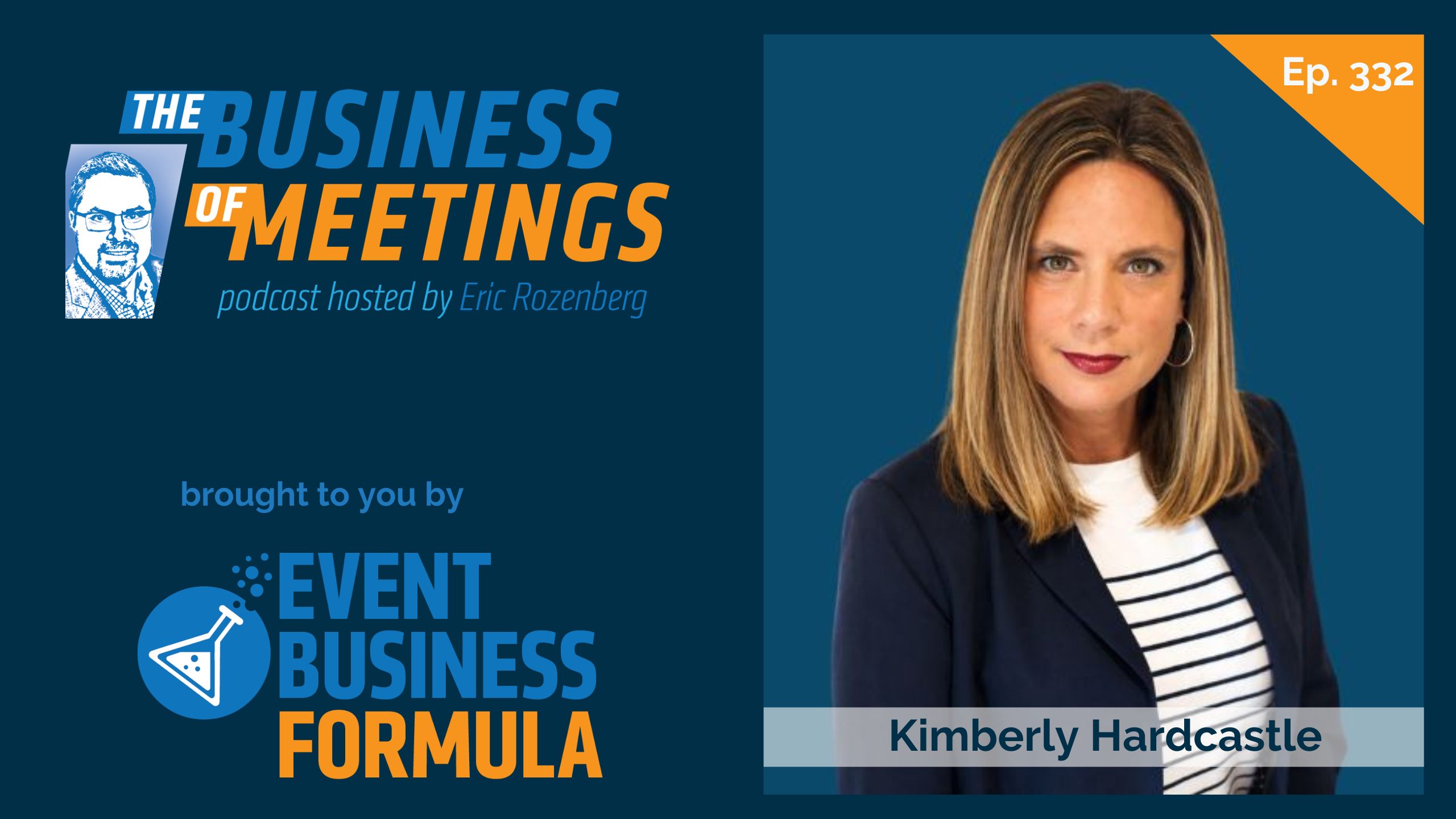
We are excited to welcome entrepreneur Kimberly Hardcastle, another icon in our industry, as today’s guest.
Kimberly is the Chief Strategist at Freeman and one of the industry’s most respected leaders in event marketing and strategy. Kimberly is a speaker, a writer for the PCMA Convention, and a leader recognized by IAEE with the Educator of the Year and Woman of Achievement awards.
Stay tuned for Kimberly’s practical insights on leadership, personalization, trust, AI, and the direction the meetings and events industry is headed.
Kimberly’s Journey
Kimberly originally studied Spanish with an emphasis in business, planning to facilitate international trade. After her husband’s military career took them to Maine and Scotland, she focused on marketing and eventually joined MDG, a marketing agency specializing in trade shows. When the founder began planning for retirement, Kimberly purchased the business, grew it twentyfold, expanded across the United States and internationally, acquired Tag Digital in the UK, and later became Chief Strategist at Freeman.
Noticing Potential
When Kimberly purchased MDG, she saw far more potential than the business had been built to pursue. The agency already had trust and a strong reputation, but she believed it had only scratched the surface. By expanding geographically, broadening its services, and investing in growth, the company scaled far beyond its original size.
Relevant Events
The meetings and events industry is changing too quickly to continue operating in default mode. AI, changing attendee expectations, and evolving buying behavior require organizers to question long-held assumptions and continually adapt their events so they remain relevant in the future.
The Trade Show Floor
Attendees now complete much of their research before arriving at an event. Instead of discovering companies for the first time, many arrive ready to compare options, ask detailed questions, test products, and determine whether a solution fits their company and timeline. The trade show floor has become a place where buying decisions are more likely to convert.
Reaching Attendees
Email remains important, but it should no longer be the primary marketing channel for events. Event organizers need to expand into additional channels, optimize their websites for answer engine optimization, and use tools such as LinkedIn collaborative posts to reach audiences where they are already searching for information.
Better Booth Experiences
Exhibitors should bring the right mix of people to their booths, including engaging salespeople and knowledgeable subject matter experts. Instead of simply scanning badges for follow-up, you should create hands-on experiences that allow attendees to explore products, ask difficult questions, and build confidence in their decisions.
Building Trust
You build trust by showing that you understand the challenges your audience is currently facing. Rather than relying on generic claims about event size or the number of sessions, your messaging should demonstrate that you understand changing regulations, rising costs, shifting customer expectations, and other issues affecting your industry.
Authentic Human Interaction
As AI-generated content becomes more common, authentic human interaction becomes even more valuable. Live events offer experiences that cannot be replicated at a desk, including human connection, trust, hands-on product demonstrations, spontaneous conversations, and opportunities to learn directly from other attendees and subject matter experts.
Personalization
Personalization is no longer about simply using someone’s name in an email. By using attendee data responsibly, organizers can recommend sessions, exhibitors, introductions, and experiences that align with each attendee’s specific objectives while still allowing room for unexpected discoveries throughout the event.
Understanding the Next Generation
Millennials and Gen Z are changing how products, companies, and events are discovered. Although they are digital natives, they value face-to-face events because they build confidence, professional relationships, mentoring opportunities, and interpersonal skills that cannot be developed through screens alone.
Focus Areas
As a business owner, you should focus on the areas where you create the greatest value and surround yourself with people whose strengths complement your own. Putting the right systems, processes, and people in place allows your business to grow without sacrificing quality or client experience.
The Future of the Industry
Kimberly believes AI will help event professionals accomplish more with fewer resources while creating increasingly personalized event experiences. She feels there is still significant opportunity to keep communities engaged throughout the year rather than limiting engagement to the days when the event takes place. She expects face-to-face events to become even more valuable as AI continues to reshape how people work and communicate.
Bio: Kimberly Hardcastle
As Chief Strategist at Freeman, Kimberly drives participation, elevates experiences, and future-proofs events for Freeman clients. With a Master of Science in Business Administration, over two decades of industry experience, and a unique ability to shift between analytical and creative thinking, she brings both discipline and imagination to solving complex challenges. Her expertise in event marketing, strategic planning, tactical execution, and organizational design was shaped during her 24-year tenure at mdg, the agency she helped build before eventually selling to Freeman. Kimberly is a CEM faculty member, a Krakoff Leadership Institute alumna, and has been named by IAEE as an Educator of the Year and a Woman of Achievement. She has a monthly column in PCMA’s Convene magazine and is a frequent presenter at SISO, PCMA Convening Leaders, Expo! Expo! and Lippman Connects events. She’s also the wife of a retired Navy pilot, mom of a recently graduated Horned Frog, Peloton addict, reader, runner and believer in civil rights.
Connect with Eric Rozenberg
On LinkedIn
Listen to The Business of Meetings podcast
Subscribe to The Business of Meetings newsletter
Connect with Kimberly Hardcastle
On LinkedIn
Listen on: Apple Podcasts · Spotify · YouTube
“We have to stop expecting that attendees are going to do all the work of finding the value that we build for them.”
Kimberly Hardcastle
Full transcript of episode 332 of The Business of Meetings podcast, Eric Rozenberg with Kimberly Hardcastle. Lightly edited for readability.
Eric Rozenberg: Hello and welcome to a new episode of The Business of Meetings podcast, and today I am delighted to speak with an icon in our industry. She has had a tremendous career as an entrepreneur, and now as the chief strategist at Freeman. She has been awarded numerous recognitions: Educator of the Year by IAEE, Woman of Achievement. She’s writing for PCMA’s Convene. She’s a speaker, she’s a writer, she’s a leader. She has so much to share with us today. Kimberly Hardcastle, thank you so much for taking the time to speak with me today.
Kimberly Hardcastle: Thank you for inviting me. I’m excited to be here and looking forward to our conversation.
Eric Rozenberg: Absolutely. Me too. And actually, I asked you after what you presented at WEC, which was extremely interesting, and we’re going to get to that. But first of all, can you share about your journey? I see on your LinkedIn that you studied not far from where I live in Florida. What is your journey, and how did you get into our industry?
Kimberly Hardcastle: Sure. I’m going to give you the condensed version of it. So, I majored in Spanish with an emphasis in business, thinking I would live in Miami and facilitate international trade. And I met my husband, and everything changed. He was in the military, so we lived in Maine for three years, and then Scotland for three years. So the Spanish degree did not come in very handy in either of those places. So I doubled down on business, the marketing side of it. I was in the oil and gas industry for a while. And then, when I came to Southern California, I ended up working at an agency called mdg. The founder hired me. We specialized in marketing and promoting trade shows. I fell in love with it. So much so that, as she started talking about retirement, I started talking about, how am I going to buy this business from her? I ended up convincing a client, Vinnie Polito, who now leads SISO, to invest with me. So we bought the agency together. We owned it for eight years. The timing sometimes escapes me, because I stayed on through an earnout period a little bit after that, before becoming chief strategist at Freeman. And through those years of owning mdg, I actually grew the agency by a factor of 20. In employees, I went from 11, and we’re now up to about 130 employees. We went from one office in Southern California to an office in DC, Chicago, and then, before transitioning out, we actually purchased a company called Tag Digital, out of the UK. So it was a crazy, exciting ride. So fun. I love this industry. About a year ago, I decided to transition into this new role as chief strategist at Freeman.
Eric Rozenberg: Awesome. So I have one question at the beginning and one question at the end of that part of your career. I studied business, just like you, and the first time I had my first invoice to put into the software, I was like, oh my god, what am I doing? So, you studied business. You studied how you evaluate companies, earnouts, things like that. How is it when you actually have to put that into practice, and really invest, and have all those questions? Because I know some of the people listening have been through that, and are thinking as well about doing that. What is the mindset? What is the right approach when you’re looking at investing in a business and becoming a shareholder?
Kimberly Hardcastle: Sure. So I think, for me, the thing that was so attractive about buying mdg: the previous owner had basically run it as a lifestyle business. She purposely kept it very small. She didn’t want to travel, she didn’t want to work long hours, that sort of thing. But we had an amazing reputation, and so much potential, in this niche. And so I felt like I bought it at a time where we had trust, a great reputation, but we had not even begun to scratch the surface of what was possible. And that’s why that growth was so quick in those succeeding years of owning the business. We really focused on expanding into the East Coast, international, going beyond just trade shows, helping associations do membership marketing, that sort of thing. So, I’ve only done it once, in terms of selling a business. I bought once, with Tag, and the circumstances were very unique. But I think it was just seeing the potential, and knowing what I could add to it, and knowing how we could grow it into something much bigger than what it was.
Eric Rozenberg: Awesome. And then, fast forward to the end of that period. How is it to be your own boss for so many years, I think 24 years, and then go to a large organization, which obviously is the largest in our industry? What is it, for you as a human being, as a leader, to be your own boss and then to go into a large organization?
Kimberly Hardcastle: So, I will tell you, very honestly, that I’m still trying to figure it out. It’s been a year in this role within Freeman, and I am used to moving very quickly. Our business was very agile. If I saw a change we needed to make, I could get all the pieces in place to make it. So I’m still learning how to be effective within a large organization. It is absolutely an adjustment.
Eric Rozenberg: Yeah. Thank you for that. Kimberly, you had an amazing presentation that I had the opportunity to listen to at MPI WEC. Can you tell us a little bit about what is changing now in the industry? I know you had a slide about the gap between what people do and what attendees expect. What is something that was considered normal in the past, but is not working anymore today? Can you share a little bit more information on that?
Kimberly Hardcastle: Sure. And just for the listeners who weren’t in that session, the premise of it was “by design or by default,” and sort of what types of leadership changes and choices are shaping what’s coming next. I think that, you know, we’re in this period of rapid change, especially with AI adoption, and too many organizations in our space, I think, are still kind of operating in default mode. Which, in reality, is easy to do in our space. I think it’s the cyclical nature of the event, and knowing we just have one chance to get it right if we have an annual meeting. But I think that, like I said, things are changing a little too fast, and we have to challenge some of our assumptions, and we have to think differently, and we have to make sure that we are evolving our events so that they’re relevant tomorrow.
So, I can give one example of something I think is changing in our industry, and that is how attendees are showing up. In the past, I think, typically what they did is they came to a trade show, walked up and down the aisles, and if something caught their interest, they would stop, ask questions of the exhibitor, learn more about it. Trade show floors were really a place of discovery. And discovery still happens; I’m not saying that doesn’t happen. But we’re finding that attendees, buyers in particular, are coming to trade shows having done a tremendous amount of research in advance. So the role that the trade show floor is playing in the buying process, while it’s still critically important, it’s important at a different phase. It’s really in that consideration phase, to conversion phase, where, you know, they might already know about the company, and they’re there to compare options, to actually get their hands on something, to talk to a subject-matter expert, to try it out. So it’s less about discovery, and it’s more about using the trade show floor, the exhibitors, to answer: is this product right for me? Is it right for my company, my timeline, et cetera?
Eric Rozenberg: Understood. So, I know you’re doing a lot of work on attendee acquisition and retention. To your point, people might be there just to discover, but they’ve done a lot of research before. Nevertheless, the touch point in person is something extremely powerful when it comes to a relationship with your customer. What is your advice for somebody who’s exhibiting, in terms of attendee acquisition and attendee retention, using the trade show as a vehicle?
Kimberly Hardcastle: So, I’ll answer it in two different ways. One, for the trade show organizer. I talked a lot in the session, and I talk a lot in general, about the changing dynamics of the workforce. By the end of 2030, 75% of our workforce are going to be millennials and Gen Z. So they are doing more research in advance, as I mentioned, but they’re also learning about events, experiences, companies, et cetera, in different ways. And I think a lot of legacy event marketers have relied too heavily on email in our industry. And it’s critically important that we start using other channels more innovatively. One of the things I’m talking about a lot right now is answer engine optimization: ensuring event websites are optimized to show up in the answers that search engines are providing in relation to queries. So I think that’s important. There’s a new feature that was just announced at Cannes Lions, on LinkedIn, called collaborative posts. I think that will be important for event organizers, to help amplify their messaging. So, thinking beyond email, I think, is key for organizers.
For exhibitors, the biggest pieces of advice I typically have for them is to make sure you’re bringing the right people to your booth. That you are staffing not just with the outgoing salespeople that draw people into your booth, but that you also have the subject-matter experts there, that can answer the really difficult questions, and that you provide hands-on experiences. So, Freeman research has shown that attendees get very frustrated at booths when exhibitors just want to scan their badge and follow up later, which sort of negates what face-to-face is for. They want the hands-on experience. So that would be my advice, both to organizers and to exhibitors.
Eric Rozenberg: Absolutely. In one of your slides, I remember you talking about what’s in now: the trust, and building the trust. How do you do that? And do you do that only at the moment when there’s a face-to-face, or is it something that is more along the way, always coming back to the relationship between the vendors and the clients?
Kimberly Hardcastle: Yeah. Again, I mean, in terms of organizers, what I’m recommending, as one way of building trust, is to make sure that the messaging that you’re putting out to the world about your event is anchored in the reality of today. And what I mean by that: I think a lot of times, event organizers default to, this is the biggest event, this is the most important, here’s how many sessions, here’s how many net square feet, what have you. But we’re not always saying: here are the issues that are impacting our industry right now. And I think sometimes we sound generic, and a little bit tone-deaf. So, instead of saying “come here to meet suppliers,” say something like, “meet suppliers that are helping companies respond to new regulations, or rising costs, shifting customer expectations.” I think there are ways you can use timeless value propositions to tap into FOMO and build trust, like you said, by saying: we’re paying attention, we understand what’s changing in your world, and we’re evolving with you. And that is especially important right now, when audiences are looking for relevance. And then, in terms of exhibitors, it’s just what I was saying: have those hands-on opportunities, and have those subject-matter experts in your booth, because those are ways that you’re going to build trust with the audience.
Eric Rozenberg: One thing, I have to be honest, when it comes to trust and LinkedIn: maybe what they presented at Cannes Lions, that you were mentioning, about collaborative posts, is the solution. But it seems to me that in the last months, it’s almost an AI who’s talking to another AI. If I make a post, the only way I’m using AI is to have real English, because obviously I’m not an English native. But I have the feeling that some of the comments I get on my posts are just AI-generated. Which is annoying, to a point that sometimes I don’t want to answer, but we know that the algorithm values the fact that there is an exchange. So, what is your view about this whole LinkedIn approach, the AI, but also the authenticity, and building the trust?
Kimberly Hardcastle: Yeah. I mean, there is a conversation about, does AI threaten live events? And I actually do think that it makes being together more valuable, for all the reasons you just said. You know, we don’t know if we’re talking to a real person or a robot. We don’t know if that video that we’re watching is real or not. And then we’re also living in this world where we have unlimited information and unlimited content at our fingertips. I can ask AI to teach me something, or summarize this PowerPoint deck, or create a learning plan for me, or whatever. And so I think that organizers, when we think about our events, our trade shows, or our conferences, or whatever, we have to really go in on answering the question: what can my event give attendees that they can’t get by sitting at their desk? And the answer is experience, and it’s human connection, and it’s serendipity, and it’s access, and it’s trust. And it’s the ability that an attendee has to see a product, and to touch it, and to ask an expert a question. And for an attendee to sit next to somebody at a session and hear how they’re solving a shared problem. And, you know, you can understand the nuance of an industry by walking a trade show floor and listening to the conversations that happen around you. And I just think, I guess, ironically, the more connected and AI-enabled our lives become, the more premium those human experiences become.
Eric Rozenberg: 150% agree.
Kimberly Hardcastle: I know. Can you tell I’m passionate about that one?
Eric Rozenberg: It’s good. And it’s very good for our industry, by the way.
Kimberly Hardcastle: I think so too.
Eric Rozenberg: And you mentioned that by 2030, the majority of the workforce will be composed of millennials and Gen Z. Now, I remember one of your posts on LinkedIn, and thanks to you, it’s the first time I saw a commencement speech where, as soon as the speaker started talking about AI, they were booed by the audience. And it was like, oh my god, what is going on? What’s your take on that?
Kimberly Hardcastle: Well, it’s so interesting, because, and I think I mentioned this in my LinkedIn post, I hadn’t even heard about that yet, but I was at my son’s, he just graduated from university in May, and we were having a nice graduation dinner with his girlfriend and his girlfriend’s family. And the girlfriend’s dad, who’s this very successful software entrepreneur, started talking about the importance of becoming proficient in AI. And I just looked around at the young people at the table and saw their eyes glazing over, and their body language shifting, and I was like, what’s happening here? And that’s when I started studying young people’s attitudes towards AI. And basically, what I found is that there is a lot of nuance. They’re worried that AI is going to replace sort of the entry-level jobs, that sort of thing. And also, I don’t think that we are always talking about the nuance in how to use AI in a way that doesn’t stifle creativity and original thought, but increases productivity, and that sort of thing.
And I would say, too, I think the important thing, in relation to this next-gen event-goer conversation, is that it isn’t exclusively about age. I think the reality is that technology has changed all of us. So we are all now used to things being intuitive, and frictionless, and personalized. And remember when we used to have those 200-page directories, or programs, or whatever, at trade shows? I don’t think people want to dig through those anymore, to figure out what exhibit they should visit, or whatever. We all sort of want help curating our experiences. But Gen Z definitely amplifies those expectations, and they are coming into events with different comfort levels, in many cases, with building relationships face to face. And I think that is a huge opportunity in events. I think that sometimes we assume younger generations are less interested in having in-person events because they’re digital natives, but the opposite is true. What I presented at the session you were at, Eric, was that, you know, they see events as a place to build professional relevance, and to develop confidence and interpersonal skills, and form the kinds of relationships that you can’t create on screen.
Eric Rozenberg: You were talking about directories. I remember the first time I went to my first EIBTM, I’m dating myself, and I came back with all those brochures. And then at the airport, I see everyone with no brochures; they asked for them to be sent. They looked at me and said, “First-timer.” I said, okay, I got the message. Next time, no one was carrying them. You’re talking about the younger generation going to live events and conferences and trade shows. I look at my third daughter, she’s 16, and I see her on her phone, and I said, “What are you doing?” And she said, “I’m speaking with my friends.” I said, “No, you’re not speaking. You’re texting.” “No, I’m speaking with my friends.” I don’t know what it’s going to be when they’re actually in real life. Those soft skills about interacting with people, is that something that you would train your workforce for, train people in the different organizations?
Kimberly Hardcastle: So, one of the things that I spoke a little bit about, and I write about on LinkedIn often, is remote work, and that there is research showing that the younger generations are feeling less connected and more isolated from others within their company or their career. And I do think that live events, as I was mentioning, are a really good place to meet with colleagues, to meet with industry professionals, to find mentors, et cetera. To practice some of those skills that we may have had more natural practice at, because we had to have face-to-face conversations. We weren’t texting. I don’t want to say you’re the same age as me, but I would assume, are you a Gen Xer?
Eric Rozenberg: What is Gen? I’m born in ’66.
Kimberly Hardcastle: Yeah, you’re, I know I’m not a boomer. After, Gen X. Yeah. So, you know, we grew up having to have more of these face-to-face conversations. But I don’t know, how are your daughters? Because my son is Gen Z as well, but he also does very well in face-to-face conversations. And I don’t know if that’s a product of his education, always having to give presentations, and that sort of thing. But are your daughters, they’re probably fine, aren’t they? Speaking to real-life humans, when they have to?
Eric Rozenberg: They’re very fine. And actually, it’s thanks to their mother, first, because she’s very extroverted. Believe it or not, I’m a recovering introvert. But I see them in contact. We always took them with us. They know how to have a conversation with adults. But it’s not necessarily the case, what I see with their friends. So I always wonder what is going to happen in those relationships. But I’m always optimistic. And again, coming back to that reaction about AI: I still cannot comprehend it. It’s progress, it’s the society we live in, and it’s almost rejecting that. So I was shocked. And it was not one, it was several that were booing.
Kimberly Hardcastle: Yeah, I know.
Eric Rozenberg: So, we’ll see about that. When it comes to the experience, I know one of your slides was talking about personal experiences. So, you’re going to the same conference, the same trade show. How can you design personal experiences when you have thousands of attendees at the conference?
Kimberly Hardcastle: Yeah. I mean, I think for so long, when we talked about personalization in events, as far as we ever got was putting somebody’s first name in an email, which is not really personalization. But, you know, now we’re starting to talk about personalization in the right way, which is basically about helping somebody get more value from a very complex, robust experience. Because you’re exactly right: you and I could attend the exact same conference, but we could have completely different objectives. You might be there because you need to find a new technology partner, or something. I might be there because I need education. I might be there because I need to strengthen my professional network. But, you know, we’re all going to the same event. But now that the event organizer has more data and better technology than they’ve ever had, including AI, you and I should be able to have curated journeys that meet both of our needs. So, if we both put what we’re trying to accomplish into, you know, some sort of an app or technology solution, that could mean we get different sessions recommended to us, different introductions, we might get different exhibitors recommended to us, we might get different marketing, that sort of thing. And I do want to just clarify: I don’t think that every moment at an event has to be programmed. I do still believe in the power of serendipity, and I think that’s a benefit of trade shows. But I think, kind of going back to the 200-page program: we have to stop expecting that attendees are going to do all the work of finding the value that we build for them.
Eric Rozenberg: Understood. So, if I understand you well, it’s thanks to the data: being able to understand individually their expectations, their needs, and then designing an agenda that is fitting their specific needs.
Kimberly Hardcastle: Correct. And I think it’s more than, because we’ve had tracks in the past. Like, you can say, I’m a world-famous podcast host, and I can say, I’m a strategist at Freeman, and it could recommend slightly different things. But now we’re at a level where I can say, I’m trying to achieve this very specific objective, and we should have curated recommendations based on that, not just job title or company type.
Eric Rozenberg: Now I just want to switch to small business owners. You’ve been one. Although, when I hear “small business” in America, compared to Belgium, I always laugh, because I think the definition of the SBA is up to $150 million of revenue. That’s a small business. Interesting. What trends do you see in the market? Because I remember, a few years ago, it seemed to be going there: the SBA predicted that there will be, in 2027, so next year, more 1099 freelancers, the gig economy, than W-2s. Is this something that you see? And if yes, what is your advice for someone who has their own business?
Kimberly Hardcastle: Yeah. I mean, I think there’s a real opportunity, and this might be a hot take, going back to attracting Gen Z and millennial talent. I look at my own son, and he’s doing a summer internship right now, but he’s really only looking at face-to-face opportunities right now. And I think that a lot of young professionals do want the benefits that come with being in an office. They want connection with their peers. They want in-the-moment mentorship opportunities. They want culture. They want the ability to have a network, to make friends, those sorts of things. The things that those of us who are at different points in our career gladly exchanged for the convenience of working at home. But I think, if I were starting a small business right now, I would lean into having physical office space. And I know that’s a hot take, but I think, in attracting the best next-gen talent, that’s what it’s going to take.
Eric Rozenberg: Again, I completely agree with you. The serendipity of the conversation that you have in person, it doesn’t happen on Zoom, Teams, or Google Meet. It’s really because you are in person. Do you see as well, in the market, a trend to have more outsourcing than insourcing from organizations?
Kimberly Hardcastle: It’s an interesting question, because I feel like the pendulum always swings back and forth. As an agency, that clients would call when they wanted to outsource, that was always the way that we wanted to see the pendulum swinging. In terms of event marketing, I still see it going that way. And the reason why is because marketing has gotten so much more sophisticated than it used to be. It is largely data-driven. A lot of it requires very sophisticated knowledge of digital platforms, being able to aggregate ad buys, those sorts of things. They’re harder to do, especially for our association clients, that may only have one large event and a few small events per year. So, being able to hire specialists in digital marketing, that understand the latest algorithms, and retargeting, and AEO, and all the things, it’s not necessarily realistic. mdg, I still say “we” sometimes, I’m still connected to it, but they have a team that specializes in international attendee acquisition. They have a team that just specializes in social media. And I think, as the tools get more complex and sophisticated, we see more things being outsourced to specialists.
Eric Rozenberg: Great. Thank you. You just mentioned AEO. To me, I hope that all the different LLMs are going to also recognize more the authentic content, because now the goal is to throw out content, and content, and content, so that the LLMs will rank you higher, whatever the content, not even thinking further. Again, as a small business, what is your advice, when you have to do everything, and obviously building a small team, where are the priorities? Let’s say that you are advising me. It’s July 2026. What should I be focusing on until the end of this year?
Kimberly Hardcastle: So, I would say, as somebody that ran a small business, it’s hard to generalize a statement that works for everyone. When I was running mdg, for example, my focus was really on business development, and I had an amazing team that could focus on the operations piece of it. My successor at mdg, her strength is really internal leadership: culture building, leadership and talent development, building people’s strengths. So she has somebody else that’s focusing on business development. And so I think the answer to, what should a leader be focusing on, is: there’s no one answer that’s right for everyone. Lean into your strengths, and find really strong people that can do the other things for you, to maximize the success of the business. But in terms of general advice: just keep an eye on the next generation, as I said previously. They’re going to be 75% of the workforce by 2030. So, understanding how they discover new products, new businesses, trade shows, conferences, experiences. It’s very different. Meet them where they are, and figure out how to communicate with them very authentically. But the purely promotional play of the past is over.
Eric Rozenberg: I agree. And I love what you said about focusing on your strengths. That’s always an example I’m sharing with the people I’m helping. My first two years as a business owner, my first two clients were J&J and Café de Colombia. And I said, those are my clients, it’s my brand, nobody does it better. And I was trying to do everything myself. And quite frankly, driving 150 miles an hour into a wall, until I started putting processes in place, hiring more people. So, focusing on what you do best is great.
Kimberly Hardcastle: I think that is so smart, and a lot of small business owners don’t figure that out. And that’s why, they say, small business is figuring out what processes you need to put in place that give you the ability to scale. And I think so many small agencies remain small, because as soon as the owner starts stepping away to run the business, the level of service to the client starts to go down. But when you hire the right people, and you have the right systems and processes in place, and you’re scaling with intention, that’s really what’s required for growth.
Eric Rozenberg: Thank you. I have two last questions, but before that, I have another topic that I want to share with you and have your opinion on. I read more and more that, between brackets, “finally,” the private equity firms are looking at our industry, which was not the case in the past. Is it a trend? Is it just now? What’s your take on it? And again, when it comes to having your own business, what should you be building for the future?
Kimberly Hardcastle: It’s definitely a trend, and to me, it makes perfect sense. I think that people who are following trends see that, with the proliferation of AI, as we were talking about earlier, these face-to-face experiences are becoming more and more treasured, and valued, and important. And I think private investors are seeing that. So it absolutely is a trend. I think that my wish for the industry is that, when private equity is acquiring businesses, they retain the core of what makes them special. I think, at the end of the day, we are serving communities, and we’re serving communities that expect authenticity. They want to trust us. They want to have a positive experience, and they want to understand that the people running their event care about them, and are connected to the space and the community that they’re serving. And I think it’s important, as we start to get an infusion of private equity money, that we keep what makes our events special, which is that focus on our communities. And that might be a little Pollyanna-ish, but that’s my wish for our space.
Eric Rozenberg: Hey, join the club. Absolutely. When you look at our industry, I look at Anthropic, I look at Apple, starting to hire now a lot of people for their events departments. I remember the different crises that we went through in our industry, and there’s first a trend: you need to focus on people, we’re hiring more people, and then things change. Where do you see our industry going in the next three years?
Kimberly Hardcastle: It’s a good question. I mean, because of all the things we’ve been talking about today, the rise of AI, the importance of human experiences, I see that we will continue to grow. I also think, because of the rise of AI, we will be doing more with less. I think we’re going to realize a lot of efficiencies that come with AI. I think our event experiences are going to get better, because we are going to be able to achieve that level of personalization that I talked about earlier, with new forms of AI-enhanced technology that allow attendees to curate very customized experiences. I think the one thing our industry hasn’t made great strides on just yet, for the most part, is keeping our communities engaged between the days of our show. So that’s sort of what I would like to see. And again, I think the data is there. I think we have the tools to be able to use it. I just don’t think we’ve fully maximized that opportunity yet.
Eric Rozenberg: Wonderful. Thank you. And my last question for today, and again, thank you so much for taking the time: when we meet in one year, with a bottle of champagne, what are we going to celebrate?
Kimberly Hardcastle: We are going to celebrate a wonderful year of events. New technology that allows personalization to create better event experiences. Just being in a thriving industry. How smart we were to make our careers out of face-to-face, in the day of AI and always-on technology.
Eric Rozenberg: Absolutely. Kimberly Hardcastle, thank you so much. And I strongly encourage everyone listening to follow you on LinkedIn. A lot of great insight. Thank you so much for taking the time today.
Kimberly Hardcastle: Thank you, Eric. It was a pleasure.
Eric Rozenberg: Thank you for tuning in to The Business of Meetings podcast. I hope you found today’s episode valuable. If you enjoy the show, the most important thing you can do is leave a review and share it with your colleagues. It really helps spread the word. I truly appreciate your support. And if you’re ready to take your business to the next level, don’t forget to visit eventbusinessformula.com to learn more about how we are helping event business owners like you. Thanks again for listening, and I’ll see you next time.