
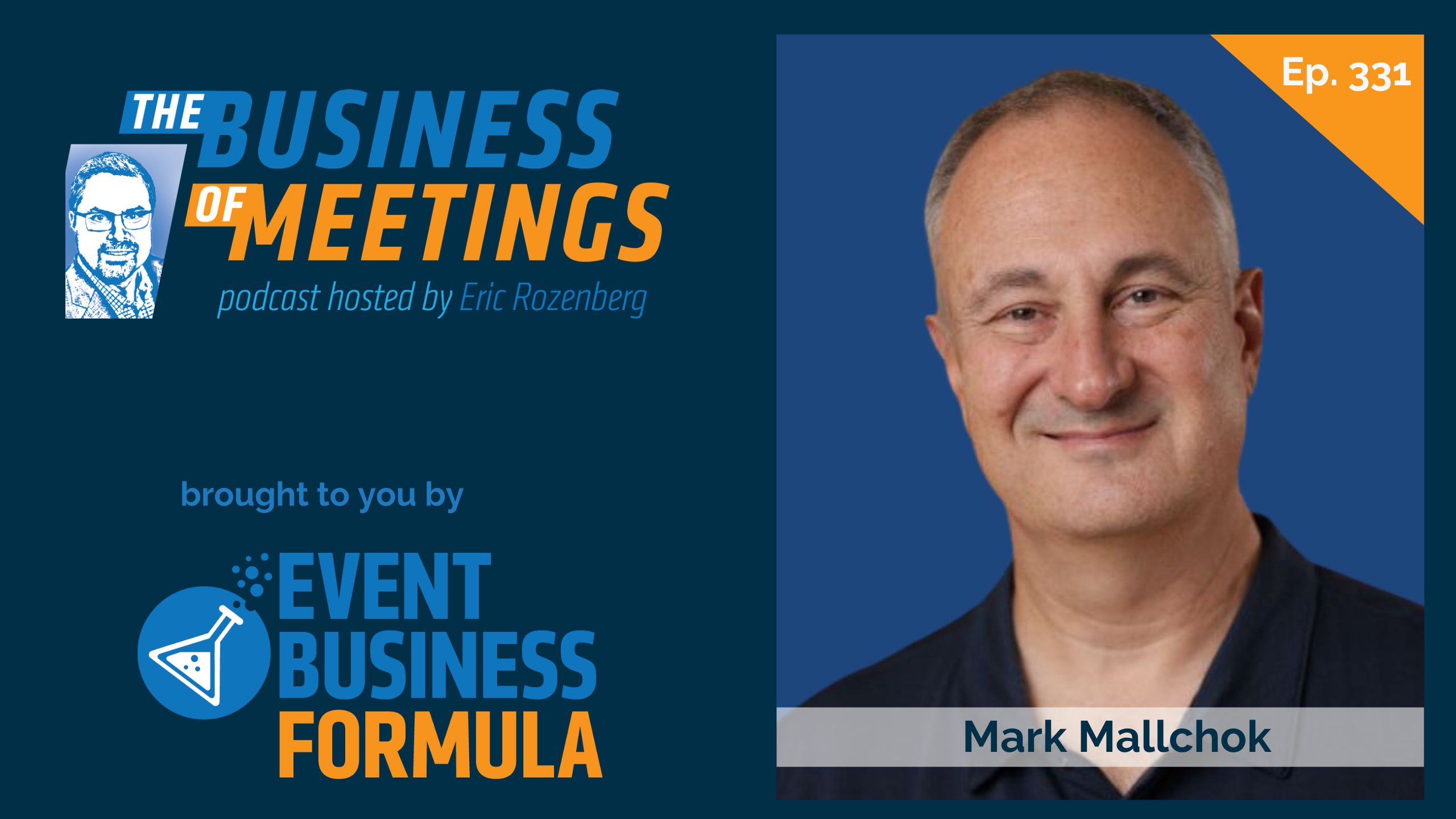
We’re thrilled to welcome Mark Mallchok, the Principal and Chief Event Strategist at Brella Productions, as today’s guest.
Mark has extensive experience within our industry. He joins us to share his entrepreneurial journey, explain how his company evolved over the years, and discuss why engagement, human connection, and clear event goals are becoming more important than ever.
Stay tuned for more!
Events and Storytelling
Mark grew up surrounded by theater, production, photography, and technology. Both his parents worked as librarians while also supporting technical theater, audiovisual production, and school events, giving him hands-on experience from an early age. Whether he was holding cameras, shooting football games, working on the yearbook, or teaching photography, he discovered early that he wanted a career built around events and storytelling.
Corporate Events
Although Mark originally planned to become an actor, he quickly realized he preferred directing stories rather than performing them. After studying theater and film, he chose corporate video and corporate events because every project was different. Working across different industries, clients, and countries meant he could continue learning and solving new challenges every day.
Continued Evolution
When Mark and his business partner started their company, they knew they wanted work that was constantly changing rather than repeating the same production every day. Corporate events gave them exactly that. More than 30 years later, they continue evolving with new technologies, different clients, and changing industry needs.
Delegating
As the business grew, Mark quickly realized they could not continue doing everything themselves. Bringing in specialists for administration, bookkeeping, sales, IT, and other areas allowed them to focus on the work they enjoyed most and did best. Even today, they regularly review what should stay on their plate and what should be delegated.
Learning from Mistakes
If you never allow people to make mistakes, they never develop the experience needed to become experts. Mark believes people need opportunities to practice, solve problems, and occasionally fail before they can grow. If you keep control of every task yourself, your team never develops, and you remain responsible for everything.
Problem Solving
Risk mitigation is an important part of event production, but problems will always come up. Mark creates training exercises in which team members step outside their normal roles and handle unexpected situations. He believes personality and strong problem-solving skills are two of the most valuable qualities when hiring people.
Peaks and Valleys
Every business experiences peaks and valleys. Rather than waiting for business to improve, Mark believes slower periods provide the best opportunity to rethink what your company does particularly well. After COVID, Brella shifted its focus from production services to strategic event optimization, helping clients create events that are more efficient, more economical, and more engaging.
Start With the Goal
Before discussing venues, production, or logistics, Mark believes you first need to understand what the event is trying to achieve. Too many organizations cannot clearly explain their objectives, making it impossible to measure success. Once the goals are clear, meaningful KPIs can be developed for both the business and the audience.
Measuring Outcomes
Mark believes event success should be measured by more than just attendance numbers or satisfaction surveys. Instead, you should evaluate whether people learned something valuable, made meaningful connections, improved their work, and achieved the intended business outcomes. He also tracks efficiencies, cost savings, and planning improvements throughout every project.
Human Connection
Content remains important, but Mark believes human connection is becoming even more valuable. Many events try to fit too much content into too little time, leaving almost no opportunity for people to talk, reflect, or build relationships. Longer breaks, less crowded agendas, and more opportunities for conversation create a more valuable event experience.
AI
While AI will continue improving work efficiency, Mark believes it will also increase the value of meeting people face-to-face. As technology makes it harder to know what is real, genuine human interaction becomes even more important. The time AI saves should ultimately allow people to spend more time building relationships, strengthening communities, and connecting.
Bio: Mark Mallchok
Mark Mallchok, CMM, is the Chief Event Strategist at Brella Productions. A veteran event producer and video director, he has created engaging corporate meeting and event experiences worldwide for notable clients in healthcare, financial services, and manufacturing. He draws on his theatrical and film background to find compelling stories that anchor client projects and support their business and learning goals. He specializes in audience and participant engagement, combining powerful technical tools with rock-solid narrative and performance techniques to deliver unparalleled face-to-face, virtual, and hybrid experiences.
Connect with Eric Rozenberg
On LinkedIn
Listen to The Business of Meetings podcast
Subscribe to The Business of Meetings newsletter
Connect with Mark Mallchok
On his website
Email: mark@brella.com
Listen on: Apple Podcasts · Spotify · YouTube
“If we don’t give people the opportunity to try something, to get that muscle memory, to practice it and to fail every now and then, they’re never going to learn.”
Mark Mallchok
Full transcript of episode 331 of The Business of Meetings podcast, Eric Rozenberg with Mark Mallchok of Brella Productions. Lightly edited for readability.
Eric Rozenberg: Hello and welcome to a new episode of The Business of Meetings podcast, and today I have the great pleasure of speaking with another entrepreneur from our industry, Mark Mallchok from Brella. He’s been, yeah, we’re not going to say exactly the number of years, but he knows the industry very well. We’re going to have this conversation about entrepreneurship. We’re going to talk about engagement, about optimizing event production, because that’s also what he’s doing. He has tremendous experience in our industry. Ladies and gentlemen, Mark. Thank you so much for taking the time to speak with me today.
Mark Mallchok: Hey Eric, thank you so much. I’m glad to be here. This is going to be a lot of fun.
Eric Rozenberg: Absolutely. We were discussing just before we started recording: we’re both talkers. I was telling you about a previous experience, when I was asking questions and the person would say “yes,” and then I would wait, and nothing would come out. But I know this is not going to be the case. But I have to tell you, before asking you how you came to the industry, I have to ask you: on your LinkedIn profile, it says that you studied in Hawaii.
Mark Mallchok: Yeah, we’ll start at the very beginning. So yes, I was very, very lucky. My parents were these traveling, gypsy-type people. My dad was in the military growing up; he was all over Europe. He came back, became a librarian, because that’s what you think of when you think of globe-trotting: librarian. He met my mom, also a librarian. They went off, and they did trips into Africa, and I have these great pictures of them spending a ton of time wandering around there. They came back, and they were on their way to Australia on a boat, and my mom got a little bit ill. They stopped in Hawaii. And there you go. So, you know, they found jobs, they moved there, and they raised my sister and me there. We were very lucky. They became librarians for a private school on the Big Island of Hawaii.
So, how I got into the industry is, I actually was growing up in it. My mom was into technical theater. There was a professional theater there. She was hanging lights, building sets, doing the audio side of things, while also being a librarian. My dad, for the upper school, was in charge of the AV club and all this stuff. So I grew up on the stage, backstage, holding cameras. I taught photography while I was still there. I did anything I possibly could that involved some sort of event, or gathering, or technology. I loved it, and so I was hooked from the very beginning.
Eric Rozenberg: Wow. Talk about training.
Mark Mallchok: Yeah, it was a blast. Every football game, I shot. If I’m not playing on the field, I was shooting. And I was in yearbook, taking pictures. So it helped me to go, wow, I know what I want to do. I want to be an actor. I want to be in events. I want to do film. So I went to Northwestern University, just north of Chicago, in Evanston. And I very quickly realized that theater is hard. Being an actor is difficult. It is a challenge, right? There are a lot of really talented people out there, and I made a very conscious decision early on that I like to eat and pay rent. So I was no longer going to be an actor. I became a director instead. I studied film, I got into corporate video, and that’s how we started.
Eric Rozenberg: So, you had no idea, when you were studying, that it was such an industry? Or did you know already about the industry?
Mark Mallchok: I knew it was a hearty industry, and there was still a passion there, and I loved doing it. But I met a lot of people, and I was self-conscious of this, that were much better than I. I was there during the time of Lookingglass Theatre. David Schwimmer was a couple of years older. Everybody that is now a well-known, respected, older actor, right? They were probably competition at that point. So yeah, I very quickly realized that I much preferred telling people what to do, and controlling the story and the narrative, versus just performing the story and the narrative.
Eric Rozenberg: And also the fact that, you know, I had my own agency for over 20 years, working in over 50 countries, and every time, I was partnering with a production company, because we’re always telling a story. That’s the best way to convey a message. Also to create an experience, to really have a script of what’s going to happen, like on a movie set, to surprise people, right?
Mark Mallchok: Yeah, I love storytelling as a way to engage your audience, because it does two things. One, obviously, it connects the audience, because we come from an oral tradition. Growing up through all of those generations that came before us, we had to tell stories in order to pass along history and all those things. So it’s baked into our DNA, and stories connect with us as individuals. We love to connect with somebody else through a shared narrative. The other thing is that, for presenters, stories are amazing, because they’re a way to trigger memories, instead of trying to just do rote memorization of a script, which I had a hard time doing, memorizing two-hour-long plays. But if I could put them into stories, and come up with a story, I could immediately remember all of those things, because there were these little touch points connecting in my brain, and I was able to remember all of that data.
So, we did a ton of training stuff over the last, and I’ll spill it, 34 years, right, that I’ve been in business. And we have done a ton of training, and retention is the holy grail. And I heard this thing once: the best way to remember something, and to avoid the Ebbinghaus forgetting curve, which is, people forget half of what you tell them in the first hour, and then 80% over the next month, is you tell them a story. And the story will connect the dots better for them. So, I’ll give you a quick one, if you want. I’m going to have you remember a couple of things for me. I want you to remember the following words for me: zebra, sunglasses, bandana, cart, sandwich, canoe. All right. Now, if I talked at you for another 20 minutes…
Eric Rozenberg: Glasses, cart… and I didn’t picture the rest.
Mark Mallchok: Right? So, I was trying to…
Eric Rozenberg: I was trying to picture a zebra wearing glasses.
Mark Mallchok: See, that is exactly it. So, I’m going to tell you the story. So, I was in Europe recently, and I was walking down the street, and I saw the most amazing thing, Eric. You’re never going to believe this. It was a zebra. But it wasn’t just any normal zebra. This thing was pimped out. It had sunglasses, it had a bandana, and it was hooked up to this cart. And I don’t know where it was going with this cart, but it was really weird, because the cart had a canoe in the back of it. And in the canoe, it was just jam-packed full of sandwiches. There were sandwiches everywhere in this cart. So I’m wondering, where is this zebra going? This incredible party on, like, this island, where they need to commute to haul the sandwiches over. He’s hauling the cart, so it must be this incredible thing. So, if I go back to you in, I don’t know, a month, and I’m like, hey Eric, what were those words again, with that zebra thing? How about you? And I apologize to everybody listening to this now: for the rest of your life, you will never be able to forget that you have a zebra with sunglasses, a bandana, a cart, a canoe, and sandwiches.
Eric Rozenberg: Brilliant. Brilliant. So, when did you tell yourself the story of, I’m going to be my own boss, I’m going to have my own business?
Mark Mallchok: Yeah. Well, my partner and I were young and naive. We came out of college. We had worked on some projects together. She and I, you know, were very complementary. We were very much Renaissance people. We loved to do absolutely everything. To give you some idea: I was in theater, minor in film. She was in film. She was an editor, a shooter. We both were computer programmers. We were animators. I was a photography teacher as well. We loved doing a lot of different things. And we realized that we had a choice coming out of college. We could go into film, and go to LA, and be on a movie that we would be on for, like, five years, and it would be the same thing over and over again. We could go to New York and get into TV, and we would be on a show for the rest of our lives, and that didn’t seem very exciting. Or we could go into corporate, industrial video and events, right? Which sounds so glamorous. But we decided that that fit our desire to do something new every day, because every project was new. Every project was different. Every day there’s something new, even now. I have projects that I’m working on: finance, pharma. There are ones in Europe. I’m working on stuff in Asia. It is so different. So we very quickly knew that, in addition to being able to pay rent and eat and have food, we wanted to do something different every single day. So we discovered this amazing niche, which was corporate events and corporate video, and just absolutely fell in love with it, and have been doing it for 34 years. It’s varied. We constantly are evolving and changing every day. So, not only do the projects change, but we, as an organization, and our industry, have changed dramatically. So we knew that immediately, coming right out, after the first project.
Eric Rozenberg: Interesting. You said something that triggered something in me, because I was also doing everything at the beginning. When you start a business, that’s what you do. Now, when you want to grow a business, that’s definitely not what you want to do. When did you have, I want to call it an epiphany, when did you realize: listen, the two of us, we cannot do everything all our lives. We need structure, and we need to have processes, we need to hire people. How did that happen?
Mark Mallchok: It was very quick. We knew right away that, in order to do the things that we loved doing, which was, at that time, the production side of things, we needed to find people to help with the bookkeeping, right? The administrative side of things, the IT side of things, even back then, some of the technical side of things. So we very quickly knew that we needed to bring people on, and within the first couple of years, we were already planning and mapping it out. It’s interesting, because as we grew, we needed to add in more of these administrative support positions, to keep the company running and performing smoothly. Everything from the sales side of things, to the admin, to the bookkeeping, et cetera. So we very quickly knew that we needed to add these specialists in, to continue doing what we did really well and loved doing. That continues even today. We have these conversations practically on a daily basis, where we’re looking at, what is it that we want to be doing, and what do we need to delegate off to somebody else, or offload to somebody else, so we can continue to do the things that we do particularly well, that are our special sauce, if you will. And that is a hard realization for most entrepreneurs, and most owners: to give up control of some of those things.
Eric Rozenberg: That’s the most challenging thing I experience with the people I’m helping: to change their mindset. Yes, but nobody’s going to do it exactly…
Mark Mallchok: No, that’s right.
Eric Rozenberg: Guess what? If the client is happy, that’s the most important thing. And if they do it at least 80% the way you’re doing it, it’s great, because it’s saving you time, to your point, to do what you like and what you are best at.
Mark Mallchok: Well, and at a certain point, if you don’t give somebody the opportunity to learn, and fail, and then correct and improve, they’re never going to get beyond that base level. You know, it’s interesting: our industry is very old-school. Going back to the theater roots, I see us much more as blacksmiths. And go with me here for a second. In the old days, to become an expert blacksmith, to be able to forge an incredible sword, for example, you had to start with horseshoes. You started as somebody shoveling coal, and then you suddenly got up to the anvil, and you were able to make a horseshoe, and then you kind of moved up into the journeyman, and you became a craftsman. We are, at our core, in what we do, both artists and craftsmen. And in order to do what we do really well, we need the practice. We need the time. We need the muscle memory, and the rote work-through of all of these things. And if we don’t give people the opportunity to try something, to get that muscle memory, to practice it and to fail every now and then, they’re never going to learn, and they’re never going to be great. And then you’re stuck, as the owner, doing absolutely everything, because you don’t trust anyone else to do it. And that’s no way to live. So, absolutely get out of your comfort zone. Embrace failure by somebody else. They have to do it. They have to get the practice, and then you’ll be able to do what you love.
Eric Rozenberg: Is there one specific example of something that you did, where you learned, and it didn’t go the way you wanted, but you learned from it and were able to share that experience afterwards?
Mark Mallchok: There are so many of those. I’m trying to think of just one.
Eric Rozenberg: Join the club.
Mark Mallchok: Yeah, I mean, it’s every day. There’s not one specific thing. But we treat failure as such a horrible thing. And again, in my line of work, risk mitigation is the holy grail. It’s the thing that we always try to find a way around, because we know that something’s going to go sideways, and something’s going to go wrong. It’s how we react to it, and how we prepared for it, that is what sets us apart. So, we will do training sessions with our team where we’ll have them switch positions, do something they’re not comfortable with, and we’ll run these mock shows all the time, because we want to create those instances where something goes wrong, because learning how to deal with it is the important thing. How quickly you embrace it, how quickly you can come up with solutions. I love problem-solving. When we hire people, we hire them for two main things: personality, and how quickly they have common sense about solving problems. Because that’s the key to what makes a successful event for a lot of our clients.
Eric Rozenberg: Absolutely. You know, it’s so interesting to me. We are sometimes afraid to make that decision, but if someone doesn’t react like that, if they’re not a solution-driven person, they probably should be doing something else.
Mark Mallchok: Right. Right. Yeah. Absolutely.
Eric Rozenberg: So, when you have this company that is growing, and then you’re looking at different industries: no one that I know goes from starting something straight to success. There’s always a roller coaster. And when you have that, and you and I, and everybody that’s an entrepreneur, have experienced that, what I wonder is: how do you react, in terms of your mindset? How do you keep the eyes on the long-term vision while you are in the middle of the trenches?
Mark Mallchok: And you took the words right out of my mouth: it’s the trenches, right? So, this roller coaster is peaks and valleys. Our industry is always peaks and valleys. And being around for as long as we have, we’ve seen a lot of change and evolution. Technology is a constant driver. Things are constantly changing. And if you can’t embrace both the peaks and the valleys, you’re doomed to fail. And in the valleys are the moments where you can look up, and look out, and go: all right, now is my opportunity to change, because I have nothing to lose, right?
And we had one of those coming out of COVID. Going into COVID, we were very lucky, because we had started to get into virtual meetings. We had developed some amazing relationships. We’d become known as experts for bolting on virtual meetings to in-person meetings. And then COVID hits, and suddenly we’re 100% virtual. We tripled our staff. We were almost 100 people. We were doing a massive number of virtual meetings. And when we were at our peaks during that time, it was amazing. We were very lucky, because we were able to hire on a lot of live event people that were doing in-person meetings before COVID, theater people, and all of their work had just shut down. They were in a valley, and we were able to lift them up to a peak, and train them in some new stuff, and give them some new things.
When we came out of that, this pendulum switched. Everyone was like, live, in-person, before COVID hits, it’s now all virtual. It comes back: no, virtual is dead to me, it is all about in-person. And the reality is, there’s something in the middle. But we took that low point, where we didn’t have a lot of work anymore, because everything went back to in-person, a lot of the agencies started to pull stuff back in, a lot of the AV companies started to pull stuff back in, because, again, they hadn’t worked for a couple of years, and it made perfect sense. And we took that as an opportunity to look around and go: what do we do really well? What are the things that we are particularly good at, and where do we have our uniqueness? And that was around something that nobody really talks about, which is strategic event optimization. And you mentioned in the intro what that is: looking at ways to make events much more efficient, more economical, and more engaging.
And the efficient part is, we love to work with competitors, with other companies, to put together this ensemble theater to put on an event. And what we do is, we break down all of those silos, and we facilitate communication. So it’s much more efficient. There are not a lot of dead ends, not a lot of waste. And when there’s not a lot of waste, it’s also more economical. You save money. You don’t have OT and overtime, and bad decisions, because you didn’t have enough time for planning, and you’re not suddenly rushing things in at the last minute. So it’s a much more affordable program, to start there and be part of the planning process. And invariably, a well-run show is an engaging show. You now have time for doing things like interactivity and audience engagement. You have a much more breathable agenda, so you have time for people to network. So, one of the things that happened for us is, when we were at that valley and we looked out, it was an opportunity to go: you know what? What is it we really like doing? What is it that we do really well? And what is it that’s unique, that we do, that nobody else does?
Eric Rozenberg: I like that. The question that comes to mind, listening to you, when it comes to strategic event optimization: what are the KPIs? How are you measuring it? And more importantly, I guess, for your business: how do you help your client understand the value of what you’re doing, and justify internally the investment that they’re making?
Mark Mallchok: Perfect question, because that is exactly the challenge the event industry faces: ROI, ROE, all flavors of the E, right? It’s very interesting, because we love to spend the time and energy to figure out the goals at the beginning. Nobody does this. This is the thing that blows my mind. We get into a meeting with the client, they come to us, we’ve either worked together before on different programs, or it’s a recurring project, whatever it is. And the first thing I ask them is: so, what are the goals for your meeting? What are the goals for your event? And most people cannot answer that simple question. And that just boggles my mind. Because how can you plan for what you want to achieve? How do you know if you have a KPI? How do you know if you’ve achieved success, if you don’t know what you’re trying to aim for? So, that first question is, you have to ask: what are the goals for the business? What are the goals for the audience? What are you trying to take away from this? How do you want your audience to change? How are they evolving during the program? Then you can start to put your KPIs in place and do the tracking.
And recently I had this conversation: it’s not about how good the food was on your surveys. It’s not about how comfy the beds are. We have to completely change our surveys and our tracking, to get into the depth of, like: did it financially improve your well-being? Did it make your job easier? What did you learn? Who did you connect with? Those are the KPIs that we need to be identifying. And nobody thinks that way. It’s very hard. So, the short version of your question, that I got to in a really long way, is: we track not just attendance, and not just participation, but we also look at things from each of those three E’s. So, the effectiveness of the communication: how much time and energy we spend on a particular project, how many hours, were there efficiencies that were achieved by connecting between the content agency, the creative agency, the AV partners, ourselves, the clients. So we’re tracking those. We are tracking, from the economic side of things, every cost saving. We have a massive spreadsheet that we go through. Every time we save something, whether it’s flights, or whether it’s F&B, in partnership with planners, or whether it is reduced hours, we’re tracking all of that. So we come back to procurement after every single project, and we can document: here’s what we saved, by coming in either under budget, or by not exceeding the budget, because we didn’t have OT, because we planned this in advance. We were able to save this money because we didn’t have to ship something at the last minute, because we already planned for having that there. So, we do that. And then, obviously, the engagement side is talking to the audience, and figuring out: how did they feel about this entire experience? What did they take away? And really getting granular into how it impacted their lives.
Eric Rozenberg: Amazing. And I like your approach of asking questions in the beginning. I have an anecdote: I was bidding for an incentive trip for Lidl, and they were doing it with P&G, Coca-Cola, and Kellogg’s. And I arrived there, I was one of the five agencies that had been called to present, and the brief was to prepare an incentive trip. I came there, I had three slides. The first slide was a summary of their brief, which was very short; it was precise about the destination, and that was it. And then, I remember, the guy from Coca-Cola said, “Eric, we didn’t bring you in just to tell us about our briefing.” I said, “I know, Carl, but I just want to set the context. Because if you want to really have something that is going to help you with your objective, I need answers to those questions.” And the next two slides were questions, and that was it. I was not presenting on a destination. I said, “I will, and you know I will do a great program, but I need the answers to those questions.” And that’s how we won the bid. So, asking those questions, to your point: I’m always amazed how quickly people in our industry go immediately to the tactical aspect, to the logistical aspect, instead of making sure that we understand the objective. Now, back to you, and I think this will be very interesting for those listening: how do you train your team to talk like that? Because it’s not only when you take the briefing; it’s when the client is interacting with your team. How do you train them for that?
Mark Mallchok: Yeah. Again, it comes back to experience, and doing. The more that I model, and they do, the better off it is. But it’s also just through that constant repetition of: what is important for this particular event, and how do we get there? And that training comes from them doing it over and over again. It’s that muscle memory. So, unless you let them ask those questions, unless you force them to speak up… I have this analogy that we use: when we are working in a meeting room, our goal is to be the captain of the ship. Our goal is to drive the bus. Our goal is to lead from inside that room, as producers, executive producers, whatever our role is. And the only way that you know where you’re going to navigate to, and how you’re going to get there, is to ask your passengers. And your passengers are not just the audience; it’s the business leaders that are there as well. So, you have to service them. You have to ask them the questions. And if you don’t ask them the questions, you’re just driving randomly around in circles. So, I always try to get them to start sitting in early in the meetings. The earlier we can be brought in, the easier it is to ask those questions. It’s very hard to ask those questions on site. So, what we do is, we bring our team in early on in the process. We’re there from day one, side by side with the clients, for a year, planning this out. And we bring in our project managers, we bring in our producers, as part of that ensemble, collaborative team, and they can hear things from the very beginning. But also, the goal is that I push them to ask the questions. I want to embrace that uncomfortable silence. As you can tell, it’s very hard for me, because I cannot stop talking. But I try very hard to let them ask the questions. And that’s the practice. That’s the training. That’s how we do it. And then it results in these incredible experiences.
Eric Rozenberg: You were talking earlier about your experience, and what you’ve seen in the industry. What are the changes that you’ve seen in the last years that people should be aware of, and that make you approach the way you run the business in a completely different way?
Mark Mallchok: So, we switched over from focusing on production to focusing on engagement and connection, and that sort of consultative strategy side of things, because we did see a big shift. There was this big push, coming out of the pandemic and virtual, into in-person, and it was all about human-to-human connection and community. And that’s probably the biggest shift right now, of everything. Content is very important. Content is king, right? But communication, connection, is queen. It is the thing that makes content work. And one of the things that I really see is that we are starting to have to find ways to be better about connecting with our audience, and giving our audience time to connect with each other. Human-to-human connections, in rooms together. And rooms don’t have to be physical rooms. I’m a big proponent of virtual meetings, and I think there’s a big benefit to virtual meetings, if done right, for communicating between people across the world, and to connect them.
But going back to the human-to-human: one of the things I think we do very poorly in the event industry, and we need to fix, is that we try to cram too much content into too little time. And we don’t give enough time for people to connect. And we don’t give enough time for people to absorb, and to refresh. So what happens is, we have people show up, non-stop, from 8:00 to 5:00, jam-packed content, speaker after speaker after speaker, going right to their one hour. And then, when we get into our breaks: optimistically, we start at 30 minutes, but then, you know that content is not going to fit, so let’s make it a 20-minute break. Oh, the presenter went long; let’s make it a 5-minute bio break. So people never have a chance to breathe, they never have a chance to talk, and they never have a chance to connect. So one of my big pushes is: find more time for connection. Make breaks a required 30 minutes. Make lunches a required 90 minutes. So that there’s time for people to connect with each other, not just in formal, structured networking, but in hallway conversations, getting to know each other. Because those connections are going to do as much as the content they learn, in furthering their careers and making them better at the jobs they do.
Eric Rozenberg: Great point. And I totally agree with you, in talking about the community and human-to-human. Why do you see, in your company, but also in the industry, when it comes to the need or not, I have a precise idea of that, so I don’t want to guide the question, but the need, or the increase or not, in face-to-face meetings, because of AI?
Mark Mallchok: Yeah, AI is an interesting thing, and we’re living in the world of AI now. But go back 10, 15 years, and you could have said the same thing about the World Wide Web, and AOL, and the internet, or maybe a little longer than that. But there will always be something out there that we are living in, and now is particularly prime time for this conversation, with AI. It is going to push us back to some of our core humanity. Because, in its ultimate role, it is supposed to save us time. It is supposed to make things more efficient. It is supposed to give us our time back. And in our ultimate goal, that time back is for human connection. It is for community. It is for family. It is for getting out in the world. Right now, we’re so early in the process that we’re all so hyper-focused on AI that it’s not living up to its eventual potential. And I see that happening, because there’s this huge pushback against AI, of: now we don’t trust what we see, hear, et cetera. So, the only way to truly trust if something is real is to do something that is in person, and is in real time. Because any recording can be fake. I could be completely AI-generated. Everything I say could be AI-generated, right? But the fact that we’re having this conversation in real time, or I’m meeting somebody in real time, all of that goes away, and you know that you’re back to a human connection again. And that is going to become even more valued, day after day after day. Not just as AI takes over our lives, but technology in general. We all have screens, and phones, and connections, and we’re going from virtual meeting to virtual meeting, and we’re always connected. Finding those breaks and opportunities to disconnect from all of that, and focus just on the person that’s in front of us, is going to be more and more valued.
Eric Rozenberg: Absolutely. I totally agree with that. We didn’t prepare that before, but I totally agree with what you just said. And that’s the same when I use the technology. So yes, I’m helping business owners, and I’m not there at 11:00 p.m. when they suddenly have a question, and that’s why I have Eric AI.
Mark Mallchok: Well, of course.
Eric Rozenberg: It’s amazing what technology can do, but it’s in person, and the need to come in person, that’s never going to go away. And that’s a good thing. Mark, my two last questions for today, because, yes, you and I could do this for hours. First of all, how do people get in touch with you?
Mark Mallchok: Yeah, I’m very open about this. So, there are three main ways. Obviously, LinkedIn. Look me up. I’m on there. You can find me. I will happily connect with you, and I have messages back and forth on things. You can go to our website, which is brella.com. You know, luckily, we’ve had Brella for all the years. So, brella.com has all sorts of ways to connect with me, and past blogs and messages and so forth. But I will give this out freely: mark@brella.com. As you can tell, I love talking to people. I love having conversations. Reach out to me with any questions you have, or challenges you’re facing. We were talking about this earlier: I love to give back, like you. I love to have conversations. I love mentoring people and answering questions. It’s what I was trained to do. I am a problem solver. I am a solution architect. I love to have things pop up and surprise me, and having to figure out how I find a solution to those. So, bring me your challenges, bring me your questions, bring me your issues. I love to talk about all of that stuff. So, reach out.
Eric Rozenberg: Great. And my last question: when we meet in a year from now, with a bottle of champagne, what are we going to celebrate?
Mark Mallchok: I think it’s going to be celebrating another amazing year of doing what we love to do. Every year that goes by, it is celebrating someplace new that I’ve been able to go visit, somebody new that I’ve been able to meet, a new relationship, a new hobby I’ve picked up, something that is new and different. So, it is about celebrating life. It’s about celebrating the new things that we have experienced over the last year, and looking forward to the new things that we get to do in the year following.
Eric Rozenberg: If only you were passionate, that would be easier, right?
Mark Mallchok: Yeah, I know, right? It’s such a hard thing. I absolutely love it.
Eric Rozenberg: Mark Mallchok, from Brella, thank you so much, and I look forward to meeting you in person in the future.
Mark Mallchok: I can’t wait, Eric. Thanks so much for having me on.
Eric Rozenberg: Thank you for tuning in to The Business of Meetings podcast. I hope you found today’s episode valuable. If you enjoyed the show, the most important thing you can do is leave a review and share it with your colleagues. It really helps spread the word. I truly appreciate your support. And if you’re ready to take your business to the next level, don’t forget to visit eventbusinessformula.com to learn more about how we are helping event business owners like you. Thanks again for listening, and I’ll see you next time.