
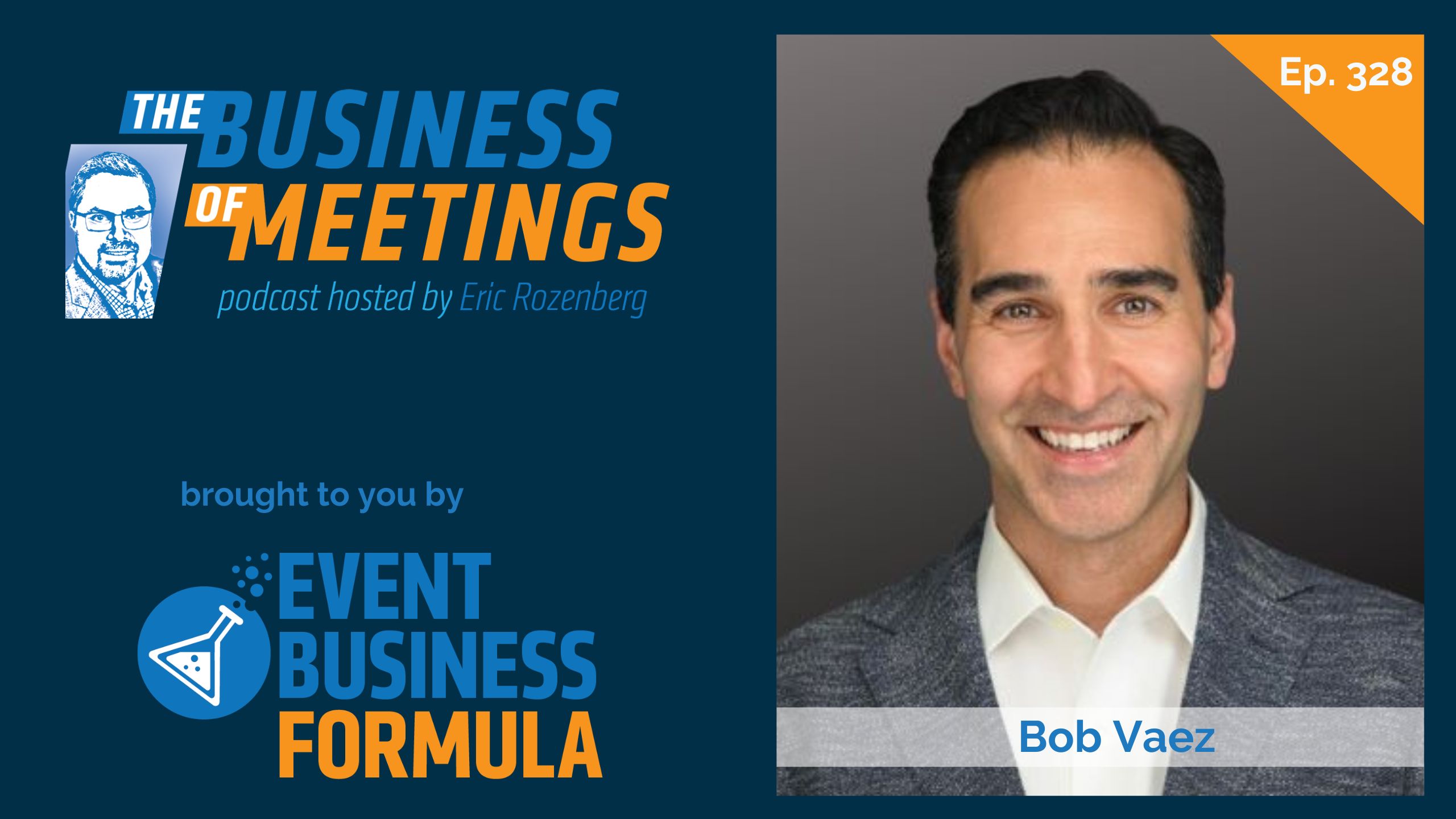
We are delighted to welcome another icon in our industry as today’s guest.
Bob Vaez, Founder and CEO of EventMobi, is a true entrepreneur, and his company is widely recognized throughout the events industry.
Stay tuned as Bob shares his entrepreneurial journey and the lessons he learned building a business through multiple periods of disruption. He also offers practical advice for business owners looking to compete with larger organizations while creating meaningful experiences for customers and attendees.
Bob’s Entrepreneurial Journey
After studying computer engineering, Bob spent nearly a decade in chip design, including a role at NVIDIA. Although he enjoyed the people and innovation, he wanted to build something of his own. A simple question—why conference information wasn’t available on a mobile device—led him to create EventMobi. What began as a side project quickly evolved into an international business serving customers across North America and Europe.
Launching EventMobi
Bob launched EventMobi during a recession, when organizations were looking for ways to reduce costs, improve attendee experiences, create new sponsorship opportunities, and reduce waste. At the same time, mobile technology and cloud software were gaining momentum. He believes periods of disruption often create opportunities for businesses that solve real problems.
Sponsorship
Sponsorship has evolved from simple logo placement and brand visibility to more targeted and meaningful engagement. Bob explains that organizers can create greater value by helping sponsors connect with specific audience segments and offering sponsorship opportunities that align with attendees’ interests and needs.
Shared Experiences
Sponsors often bring valuable expertise to an industry. Bob believes organizers can create stronger experiences by involving sponsors in educational content, especially when sponsors and customers connect through real-world experiences. That approach benefits attendees while helping sponsors build credibility and relationships.
Relationships
Strong business relationships are seldom built on a trade show floor. Bob explains that shared experiences, activities, and informal conversations often foster deeper trust and stronger long-term connections than brief meetings at a trade show booth.
Genuine Innovation
Many attendees visit exhibitors to learn what’s new. They are looking for new ideas, products, services, and approaches to take back to their organizations. Bob encourages exhibitors to focus on showcasing genuine innovation rather than simply increasing visibility.
Engaging Events
Bob believes engagement increases when attendees become active participants rather than passive listeners. Attendees want more than information. They want opportunities to ask questions, share ideas, participate in discussions, and connect with other people.
Face-to-Face Experiences
As AI generates more content and information becomes easier to access, live events offer something different: authentic conversations, trusted expertise, and direct interaction with other people. These experiences create stronger memories and greater long-term value for attendees.
AI
Bob sees AI as an opportunity to reduce administrative work and free up time for more meaningful activities. Instead of spending hours on repetitive tasks, planners can invest more time in working with speakers, sponsors, vendors, and attendees to create better event experiences.
Smaller Businesses
AI is helping smaller businesses access capabilities that once required large teams. Bob recommends focusing on the specific tasks that consume the most time or create the most frustration. By solving those challenges first, small businesses can operate more efficiently and make better use of their resources.
Powerful Small Agencies
While larger organizations often rely on established processes, smaller agencies can stand out through their insight, creativity, and perspective. Bob believes that an agency’s unique understanding of its clients and its ability to create distinctive experiences can be a powerful competitive advantage.
Connect with Eric Rozenberg
On LinkedIn
Listen to The Business of Meetings podcast
Subscribe to The Business of Meetings newsletter
Connect with Bob Vaez
On LinkedIn
Listen on: Apple Podcasts · Spotify · YouTube
“Your superpower is not really working Excel. Your superpower is your insight and understanding and your taste, of how you see the world and how you think this event can be different.”
Bob Vaez
Full transcript of episode 328 of The Business of Meetings podcast, Eric Rozenberg with Bob Vaez, founder and CEO of EventMobi. Lightly edited for readability.
Eric Rozenberg: Hello and welcome to a new episode of The Business of Meetings podcast. And today I’m delighted to speak with another icon in the industry, a true entrepreneur, who started his business, I believe, about 17 years ago. It’s a name that you all know. His company is EventMobi, he’s the founder and CEO. This is Bob Vaez. Bob, I’m so happy that we finally found the time to speak with each other.
Bob Vaez: Same here. I’m here to learn from you, Eric. Hopefully that makes sense.
Eric Rozenberg: That’s very kind. You know what? I’m going to show this recording to my kids. They will love it.
Bob Vaez: I love it. Thanks for saying that.
Eric Rozenberg: But no, your journey is absolutely amazing. So, I’m speaking for business owners and small business owners in our industry: EventMobi is definitely a brand that everybody knows about. But before we talk about EventMobi, what is Bob’s journey? I would love to hear what you did in your life, and how you became an entrepreneur and created EventMobi.
Bob Vaez: Oh boy. My journey is a journey of being a troublemaker since I was a kid, I guess you could call it that way. I loved science and math, and, by the way, soccer, the World Cup is happening, so I’ve got to make sure I make it to the game after this podcast. But that was kind of my passion: sport and computers. And I ended up going into computer engineering; that was kind of my starting point. But I think I’m a bit more of an extrovert than an introvert, and I love conferences. I spent about the first 10 years in chip design, believe it or not. It’s really hardcore computer hardware manufacturing. And as much as I loved it, I also hated it, because you’re in a lab, you’re working with these devices, and it was very intellectually stimulating. Very few people in life get to do that. I think we were talking about this before: actually, my last job was working for Nvidia. So I was helping them build their chips.
Eric Rozenberg: Which is a small company that nobody has ever heard of.
Bob Vaez: I have this conversation with everyone. It’s like, do you think you should have stayed there?
Eric Rozenberg: I have to tell you, that’s exactly the question I had in my mind when I was looking at your profile. I said, yeah. Then, no, he’s had his own business for 17 years.
Bob Vaez: It’s really funny how life works, because we all have our own path. And you should never go back in time. I’m so grateful for being here and doing what I do. There’s no regret in my life, and I think that’s the way I live. And starting a business, if you talk to any entrepreneur, I think that’s what they will tell you, why they started: I just didn’t want to have the regret of not doing it, because I would just not be able to live my life always thinking about that. So, yeah, if I stayed at Nvidia, I probably would be way richer financially than I am today. But I wasn’t happy. I was working with the best people. I honestly had one of the best managers. I had really good co-workers. I worked there from 2006 to 2009. They were obviously not as big as now, but the culture of the company was very forward, collaborative. They were risk takers, very systematic, innovative. I loved working there as a job, but I just didn’t like the job. And it’s like, why do you wake up every day and wait till it’s 5:00 p.m.? That’s the time you know you have to change your job. And that was kind of the point.
I was doing my MBA, this was in Santa Clara, while I was working. I was in my MBA in the evenings, working for Nvidia full-time. And, this is true, I love going to conferences. So, every time, because I was in manufacturing, there was an opportunity for me to go do a training, or to go explore new products, or whatever it is. And for any engineer who works in the Valley, they always have a side business going on, because that’s how it is in Silicon Valley. Everyone’s trying to start a business. I also had a bunch of what I call side businesses, but they were really side ideas; they’re not really businesses.
And one day I was like, I’m going to these conferences, and I have, back then, the Microsoft pad with a stylus, and a tote bag full of show guides and material, and I’m like, why is this not in this phone? And this was, I think it was 2009. And I was like, there’s an idea here. I don’t know why no one has thought about putting all this content in here. So I used my MBA class, because they’re all sales managers at different companies. I was like, what do you guys think about this? And one of them said, hey, we have a sales conference. Do you want to test your product? And I didn’t have a product. I just had a bunch of PowerPoints of ideas. So I teamed up with a friend of mine and my brother, he’s 10 years younger, he was also studying computer engineering back then, this is like 2009, and I was like, guys, let’s build something so we can demo.
So we built a product very fast. And we demoed it at their sales conference. And the feedback was amazing, and people were like, oh yeah, this is good, we want this. And the event manager was so helpful. He would sit down and be like, yeah, these are all the problems. Because I loved going to conferences as an attendee, and I knew what my challenges were as an attendee. I had no idea of the business of events. I don’t know what goes on behind the scenes. And, as an engineer, I was like, what? You get your speakers’ pictures from emails? Each of them emails you? That sounds crazy. How much time do you spend on this? He’s like, I don’t know, like 20 hours. And I look at his email and I’m like, we need to automate this. And this is way back then.
So that was kind of my starting point in the event business: hey, this business is so powerful in terms of bringing people together. Even in terms of education back then, this was when social media was just getting big, and conferences were critical for discovering new products, for education, for networking, finding jobs. And then I looked at the behind the scenes, and I’m like, this is such a huge opportunity for improvement. So that was my way into the conference business: as an attendee, but working with planners telling me what their pain points are, and then thinking about how I can help them.
I didn’t really know where the business was going to go. I think we were going to build a consulting business. I was telling you at the beginning, I love sports. So soccer was my number one pastime. Skiing was the second one. And the dream was, hey, let’s start our business for event planners, build custom apps. And I convinced my brother not to get a job after university, and let’s go move to Whistler. We become ski bums. We ski during the day and we build event apps at night. That was kind of the dream at the beginning. And, funny enough, I’m actually skiing way less than I did before I started the business, which is always the game.
But yeah, it was an interesting beginning, and I moved back home with my mom, back home in Canada. That’s where I was based out of, and she was very excited, because, great, my son is back, I can feed him. And I thought it was just going to be a quick stop in Toronto and then go back to the US. And I think what ended up happening, we realized that we can build the business in Canada and grow in the US and Europe. So we became a very, very quickly international company. I was traveling all the time. We hired people all over the place, in the US and Europe. So, our core is, I would say, a US-Canadian company, because I really started the idea and the business in California, then I moved back to Toronto to grow the business. And right now, about 80% of our business is in the US, 10% Canada, and the other 10% in Europe. It’s funny to think about the past, because the path has been really zigzaggy.
Eric Rozenberg: It’s never ever a straight line. Ever.
Bob Vaez: Yeah, and every entrepreneur has their own crazy stories, right? So, I think we lost the business three times, like every event business. You had the recession, and you had COVID. And now with AI, who knows what tomorrow’s going to bring, but I’m excited.
Eric Rozenberg: Absolutely. And we’re going to talk about that in a few minutes. But let’s go back to when you started the business. So, it’s 2009, you’re convincing your brother to come and work with you, and then there’s the subprime crisis. He wants to kill you.
Bob Vaez: Oh, you remember that.
Eric Rozenberg: I do.
Bob Vaez: Okay, here’s a funny story. Funny, but not funny. But they say the best businesses are born during a recession. And I had no idea. I had no business background. And I should share that this was my fourth business. The other three didn’t really make it out of product-market fit. I could never really make it into a profitable business. So it was just: idea, build a prototype, realize it’s not going to work, and I close it. I could never grow a business. This was the first time where it was like, hey, there are customers that are going to pay us.
So, during the recession, I think there are opportunities, because everyone is now looking at, and I think AI is the same thing, right? It’s not a recession, it’s actually the opposite, everything is growing, but massive changes are happening, and people are now questioning the status quo and how we do things. It was the same idea. If you remember, a lot of businesses were going bankrupt. Event businesses were going bankrupt. Conferences couldn’t really be supported. Businesses were cutting back on events and travel. And I had no idea, because I was not in the event business. I was an attendee, excited to be like, hey, I love going to conferences, this product can be better for me as an attendee.
And what ended up happening back then was, we realized people were looking for new ways to create sponsorship opportunities, and they saw this as another vehicle. They were trying to cut costs, and the print costs were pretty significant. And there was kind of the beginning of the echoes of sustainability, hey, we shouldn’t really have that much waste in the event business. And that, to be honest, wasn’t really the goal of building an event app. I mean, this is such a commodity now. Back then, even the name “event app” didn’t exist. We had to coin it. We called it “mobile event guide” at the beginning, then it changed to “event app.”
Eric Rozenberg: Yes, I remember that.
Bob Vaez: And I think at that time, the opportunity was: there is a problem, and there are people looking for a better way of doing it. And if no one has done it, then let’s go give it a try. Because it’s not that there’s no competition; there is competition, but there’s a better way of doing it. The challenge, I think, is finding the right timing. I don’t know if it depends on the economy, if you’re starting a business when the economy is growing and you’re riding that wave. But I think in a tech product, there’s also the tech wave. And we caught two waves, and I didn’t know this at the time. There were a lot of businesses, software businesses, that were on premise, and they were going to what we now know as cloud, right? Like Salesforce and all these tools. Even Salesforce, their biggest struggle in 2007, 8, 9 was, people were like, what? I’m going to give you all my sales data and it’s on the internet, on the cloud? I want it to be in my office, on my server. So, there was this shift in terms of cloud software, and there was a shift with mobile that was coming really fast. And we were really lucky that we started this at that time. And I think the recession was actually a catalyst, because people were like, hey, maybe we need to do something with our events. We need to cut costs. We need new sponsorship opportunities. We need to create better value for attendees. Engagement can be improved, networking. And the event app had all those promises, but you didn’t have it, it was a totally different experience. And I think we were just at the right time, with the right product and the right pricing. We won’t lie, we got lucky, right? It’s like 50% of any business is luck, and you’ve got to admit it, you know, it is what it is.
Eric Rozenberg: For every business, absolutely. You’re talking about sponsorship. How have you seen event sponsorship evolving over the years? And how do you see that the participants now are looking at sponsors? Is that anything different from when you started?
Bob Vaez: I think there are a lot of differences. I’m not an event planner by background, right? So I worked as a vendor, as a tech vendor. So I come at it from a different angle. I don’t sell sponsorship, but I build the tools to help conference organizers sell it. But at the same time, we go to a lot of conferences as sponsors. I think pre-pandemic we used to do 80 shows. Some of it was our own road shows. A significant portion of it was, we used to have a booth at every industry event, because that’s the way you want to make sure your brand is visible. You’re meeting your customers. You’re learning about competitors.
I think the traditional way of sponsorship is brand awareness and visibility. So, I have a conference. I bring the people. I set the schedule for the content and who the speakers are. And the sponsors are there to take advantage of my work as a planner. So you give me your logo, I’ll give you visibility. You don’t have any say in the program. That was kind of the traditional way of thinking about sponsorship. And in the old world of, I call them analog sponsorships, like billboards and so on, you just want to make sure you create more touch points anywhere your potential customers are. And conferences are just the most beautiful place, because it’s the right people. If you pick the right conference, the right people are in the same place, and they’re kind of captive. So they have to look at your logo. But how much can you generate interest and demand from a logo?
So, what I think has changed over the last 20 years, maybe even before I started, is there’s this movement around: can we actually create more opportunities for sponsors to be participants and have more active participation in the program? I think there are a lot of conferences that do a great job. It’s not easy. You have to have really, really deep relationships with your sponsors. You have to understand your market really well.
But my experience as a sponsor is: if I can get the list of the attendees before the conference, I think that’s the game changer for any conference. It’s good and bad, because the good part of it is, if I can tell people that I’m there, I’m kind of prepping people for their arrival. Now, the bad part of that is, if every sponsor does the same thing, you kind of create this mass spam pre-conference, right? So we do everything we can to make sure we can get the list. Sometimes a list is given, sometimes it’s not. We’ve got to go guerrilla tactic and do it. But we are very cognizant of our brand. We don’t spam people. We make sure we pick the right people, the right segment. We work really hard. I have two people on the team; they go through the list and segment this audience. And I kind of think about it as, why am I doing it? If the conference organizers, instead of saying here’s the list, or I’m not going to give you the list, gave me the 50 people I care about, right? Because really, that’s what I really need to go after. I’m doing so much work, weeks of work as a sponsor, to do it.
So I think a lot of conferences are getting much better in terms of creating this segmented audience, but there’s a huge opportunity that I think AI is helping to cover that gap, to help the organizers create these micro-groups so that they can sell sponsorship to multiple sponsors. I think the days of gold sponsor, silver sponsor, it still works for a small-medium conference, but I think there’s a lot of money left on the table, because you can have 100 different sponsorship options. You can sell your email list to every single exhibitor, but not the whole list. You can sell 20 emails here, 50 emails there.
Anyways, we can talk about this forever, but the other part of it, I think, is involving sponsors in the content, on the program. If you think of it, in any industry, not just the event industry, the sponsors are the vendors. The vendors are the providers of the tools in whatever category or industry they are. Without the vendors, there is no industry, right? So they’re a critical part of it. They’re inventing the future. So I sometimes find this fascinating, that in so many industries, conference organizers have this mentality of, sponsors, I love them for their money, but I hate them because their salespeople are ruining my event, they reach out, I don’t want them, don’t talk to these people. And I think that’s partially on the companies, because instead of sending their experts to educate and build relationships, they’re sending salespeople all the time. And as a salesperson, I’m just doing my job. I’m trying to go there and create awareness. I’m trying to build contacts. So, if the organizers learn more about their sponsors, and are able to involve the sponsors in the workshops and the content, and bring a customer, I think that’s the most untapped potential in our industry. ASAE does that really, really well.
Eric Rozenberg: American Society of Association Executives.
Bob Vaez: Yes, that’s right.
Eric Rozenberg: The one Mason is running. Yes.
Bob Vaez: That’s right. Since forever, I remember, to get a speaking slot as a speaker, your best chance is to team up with a customer. So they want an association, a customer, to come share that story. And I think very few organizations do that, and that has a double opportunity, because you bring another potential attendee, to create exposure, and that cost is sometimes covered by the sponsor. But then now you have both the sponsor, the buyer and the seller, in the same room, talking about the challenges in the industry. So again, I see that as the second part. So, the first part is the segmentation of the audience, enabling selling more sponsorship. It’s good for the organization. It’s good for the sponsors. Then the second part: involve them in the content.
And then the other part that I feel is, again, an untapped potential, but is very hard to do for a lot of events that don’t have a lot of staff. I mean, we were talking about this before the podcast: a lot of our customers are event teams of one, or two, or three. You know what I mean? There’s only so many things you can do. But I think, as a sponsor, the best way to build a relationship is not even the appointment at the show. It’s the activities. If I go back over my last 10, 15 years, the best experiences I’ve had as a sponsor is when there was a bus ride to an outside activity in the town, and I was hanging out with five or six other really cool people. And yeah, they were also potential customers, but the way I built a relationship was just as a human being. Like, oh, these people are really interesting. They have really interesting stories, and we share a couple of hours of experience together, and then there’s a level of bonding and trust that happens. And I think that’s missed, for a lot of organizations, to be able to create those activities. They are truly the best sponsorship opportunities for the sponsor, because that’s how they build relationships, not on a show floor. When we think about it, it’s like, oh, people are walking by the show floor, and then you just go there and try to grab them to scan their leads. I don’t think that’s how you generate business.
Eric Rozenberg: No. And actually, you remind me of two stories that I personally experienced. The first one is, when you go to a conference, and I remember one of the MPI World Education Congresses, a young member that was working for a hotel came and said, “What do you advise me to do? Because my boss told me that I need to bring back a piece of business.” And I said, “Go home right now.” And she said, “What do you mean?” I said, “You’re going to waste your time. I’m not saying it’s not going to happen, but that’s not how it works. If you’re looking long-term and building those relationships, it’s going to be much more effective, and long-term results are what you’re going to get.”
But the second story, to your point about vendors or sponsors sending just their salespeople and that’s it: the thing was EIBTM. At that time, for whatever reason, most of the hotel chains were measuring the impact of their salespeople at the trade show by the number of business cards they were bringing back. Which was crazy. And I quickly realized that, going to one brand’s booth, I had the person, I had Bob, with whom I had a meeting. And then, while we were speaking, Bob’s colleague would come interrupt us and ask for my business card. And I said, what is this? And so I developed a routine, where when I was speaking with Bob, I would take his business card and put it in the right pocket of my suit, and the others, I would take their business card and put it in the left pocket. And at the next booth, the person of that booth, I would take the business card and put it in my right pocket, and all the others that were coming, you see where this is going, I would go into my left pocket and give them the business card from the previous booth, that they were not even checking. So, you have the sponsors, the vendors, the relationships that are being built. But there’s the other side of it: it’s the attendees and the attendee engagement. And that has also evolved, right?
Bob Vaez: Yeah. One other thing about talking about attendees: let’s do a test here. Why do you think is the number one reason attendees go and check out trade show booths?
Eric Rozenberg: I hope it’s not for whatever gift they’re getting. I hope it’s not.
Bob Vaez: I hope it’s not the swag, yes. But we did a bit of an internal study, and we found out the best messaging for us, that resonates with our customers, is: they just want to know what’s new. Because they’re at an event, they need to go back to the office and tell people something really cool. I’m not saying it superficially, like, hey, I learned this thing, we didn’t know about this thing, this thing exists, maybe we should go explore it. Because, other than that, why are they there? They can check everything online, right? So they’re going there to meet the people, so they can ask those questions that are not possible otherwise, and actually figure out what is new, who is different, who has a different pitch, all in one place. And it’s a huge missed opportunity for both exhibitors and sponsors, not talking about what’s new. And I think it’s a missed opportunity for organizers to not squeeze out from the sponsors, tell us why you’re coming to this event, there’s a reason you’re here, tell us what’s new, so we can share your information pre-event and we can give you more publicity. There are all these little techniques that I think people can use that have massive impact both ways.
But yeah, engagement for attendees has always been the game. I think, since ever, if you think about it, if you’re a speaker, the first time that you spoke, if you generally ask people, does anyone have any questions, if no one raises their hand, you know you either did a phenomenal job, which is rare for any of us, or you were just completely off topic and people were just bored and no one knows what you’re talking about, right? So even the notion of asking a question at a session, we think of it as engagement. Engagement is so many different things to so many different people, but I kind of think about it as myself as an attendee: I engage when I’m not sitting there and just being fed information. So if there is a way for me to participate, there’s a workshop, I can ask a question, I can interact with other attendees. The most unengaging event, to me, is a seminar. I go there for one hour, they check me in, I go sit somewhere, someone speaks, and I leave. That’s the most unengaging. And stuff like that still happens, and actually, in some cases, they have some value to some degree. I mean, some people argue they’re not events, but okay, seminars are events. They’re just one hour about a topic. Webinars sometimes are the same way, right? The old way of webinars is like, a guy gets on a screen with a PowerPoint, and pre-pandemic there was not even a chat. You just talk for one hour.
So I think engagement has been rising and rising over the years, and now I think it’s a bit more significant because of AI. Because if you think about it, everyone is talking about this, this was kind of a new topic a couple of years ago, but there is so much content out there because of AI. There’s so much noise. Not only that, you don’t even know who to trust. Who wrote this content? Is this even real, or is it just made up by AI, right? So there is this notion of lack of trust, too much noise, too much information, no time, anxiety. And I think that’s driving a lot of people, when they go to an event, to look for something different than just content. They’re looking for the speaker bringing what is new and different, some original ideas. They’re looking to talk to people. They’re looking to ask that question live from the speaker, because they know that answer comes from the experience of that person, and the taste of that person, rather than AI just generating something.
So all this stuff kind of blends together: this authenticity of the events, interactiveness of the event, kind of leads to, I mean, you’re the expert at this, because you’ve been doing this for decades, the experience that people talk about leads to memory. And depending on the goal of the event, it’s either retention and education, or maybe it’s for making change, for sales, whatever the case. All those experiences lead into something that people remember, that causes, hopefully, a change after the conference. And I think the other thing that happens after that is that you end up sharing it. So if you have a good experience, which means you had good engagement, then you end up sharing it, and most likely you will come back again next year. So again, it’s all a loop connected together. And I’m speaking more as an attendee than an organizer, because I have so much respect for our customers, just running these massive 1,000, 2,000-person, three-day events, with a $1.5 million budget, that they run with a team of three people. How they create these experiences is just phenomenal. But I think, as an attendee, we kind of crave more engagement. We don’t want to go there, just sit there, and then just be told 60 minutes of session.
Eric Rozenberg: Absolutely. And to your point, going from event logistics to an experience-led strategy, that’s the point I’ve been hammering for years. Around the time that you started your business, I remember speaking with my business partner in Belgium and saying, “I don’t get it. When you go to a prospect and you ask the sales director, why do you run a sales meeting?” He says, “Oh, we do it every year.” I was like, oh my god. And then, how do they justify that to their board, or to the C-suite? But most importantly, as a vendor, and I’m talking about the business owner, the agencies, the small business owners, the solopreneurs in our industry, the best way to differentiate yourself is, instead of asking logistical questions, like how many people are coming, do you want a welcome cocktail or a farewell party, it’s going to, okay, I understand that in your industry these are the challenges, that your two competitors are this and that, that you’re trying to convey this message this year. Is that correct? Okay. So, what do you expect from this face-to-face, this sales meeting, this incentive, this product launch? How are you going to measure success? That’s where you’re making the difference.
Bob Vaez: Yeah. There was an AI demo that Julius Solaris ran a couple of weeks ago. He created a lot of buzz, and we became one of the main sponsors for that. And we had a keynote session, and at the end, we were doing prep work before the sessions to figure out what we want to talk about. And then, obviously, we were talking about AI and automation and all these things. And then he said, “Okay, Bob. If planners saved all this time, what do they do now?” And I was like, oh my god, that is such a good question. So, okay, we saved all this time, right? We don’t have to worry about logistics. We don’t have to worry about all these little details. What do we do with all this extra time? Do more logistics? Do more events?
And I thought about that for a whole week. Honestly, for a whole week. I asked people. I used AI to ask. And what is amazing, when you think about event budget and the timeline, and again, I come at this from a vendor side, is time. You have this project, and yes, you have a fixed budget, it could change based on your number of attendees and the tickets and the sponsors, but your time is very limited. And if you could get rid of some of that grunt work that can now be done with AI, and I hope there’s a whole session we can talk about this, because every event is so different, but the part that becomes so critical, and talking about logistics to experience, is the people. So, what if you could spend that time not on doing more events and doing more logistics, but actually talking to your vendors more? Understanding your sponsors. Talking to your speakers. Helping them create a better experience for attendees. Because usually event planners have a vision, an idea for their events, a theme, a vibe that they want, but it’s really hard, you can program it, but speakers are not computer bots, not yet. So you need to explain to them, and you need to walk them through. So you need to have a team. You need to train your speaker team to make sure they prep the speakers, to work in that, if there’s a theme going on. If it’s a sales conference, for example, everyone’s on cue. You want your vendors to behave in a particular way. You want your team to behave in that.
So I think there’s all this human time that is not available to a lot of event organizers. Because if I think about, you’ve probably worked with the same number of event planners over, we’re both really old, so we have a lot of experience, but I think there are two things that are very unique about conference organizers and event planners. One, they are so detail-oriented. And two, they are truly human connectors. They understand humans, they have really high emotional intelligence. And I think that’s not being used when you’re spending all your time on spreadsheets and trying to follow up on your emails. So I think that’s a really interesting topic of, how much logistics work should planners do? Because, even the name “planner” talks about, you think about it as planning for the event, it’s all about logistics. But you were just talking about it: a huge part of the planning is the planning for the strategy. And how do you turn that strategy into action? I think you turn that strategy into action by talking to people, right? It’s not about shipments.
Eric Rozenberg: You do. But it’s also, to me, to your question about what you do with the time that you save, especially for business owners, whether you’re one person or you have a small team, to me there are two things that are important. First, the time that you have more of, or that you’re getting back, if you want: think about yourself. Think about your personal well-being, think about hobbies, or things that you always wanted to do and never took the time for yourself. Because the more balanced and happy you are in your life, the better you will be as a professional. But the second thing is, especially today, block time, even an hour per day, or two hours per day, for two things. One, for studying and learning and reading. And the second one is to reach out to your clients and prospects. I’m always fascinated, when I have a room full of planners and business owners, and I ask them, how many of you have at least one hour blocked in your calendar to reach out to your customers and prospects every day?
Bob Vaez: That is such good advice, yeah.
Eric Rozenberg: It’s fascinating how few people have that. So that’s how I would go about it. But talking about those independent event businesses, how do you think that they can compete against larger brands or larger organizations? What would be your advice there?
Bob Vaez: Ooh. Again, I’m not running any of these businesses, so take my advice with a grain of salt. But at least as a supplier to a lot of event agencies, and I think we support a lot of small, mid-size event agencies at EventMobi, there are about 150 agencies that use EventMobi annually to run their clients’ events. There are a couple of challenges that I think they have, and now the gap between the large brands and the small teams is closing. One is staff and training. I think the training now, with better tools that are out there in terms of organizing the data, even our meetings are being recorded all the time. If you do that with your employees, then you don’t really need to even think about creating an onboarding guide. You just turn all those recordings, you just dump that 10 hours that you trained the last person, and then you basically ask Claude to create a training for your next person. It’s not going to be perfect, but it can kind of get you there.
So a lot of this stuff, if you think about it, the bigger brands have a lot of people to do it. They have a recruiting team. They have an onboarding team. They have a marketing team. And I think that’s where a lot of small businesses are gaining advantage, because the number of people and the size of the company that does a lot of this groundwork, I don’t think it’s going to be that significant anymore, because now everyone’s on equal footing, because a lot of it can be done with AI, right? So, following up with emails, automated emails, finding people, doing research. So, that’s one thing, and again, it’s very unique for every business.
Even for us, even though we’re not a very large business, we’re 100 people, maybe a larger tech company, but, you know, in the grand scheme of things, we’re not a large company in the tech world, we’re very small. But we are using a lot of these techniques and a lot of tools for marketing. Our marketing team is really empowered by automating research. We have a bunch of tools to know what our customers are saying. We don’t have to review calls hour by hour. We kind of use AI to do that. Our marketing team can be more connected with the customers.
But the one thing that I feel, and I’m also the CEO that doesn’t really do anything anymore, just going to meetings and hopefully I’m helping people, but usually I’m just bugging people these days, but I think it’s that level of insight. Because there used to be so much information, especially for a small business owner. You’ve got your QuickBooks with the cash flows. You’ve got all your expenses. You’ve got the employees that are having these problems, and then you’ve got these customer questions. And how do you know where you have to spend time? And you have all these tools, all these software tools, that all have their own dashboards, and then you have to go learn it, and you have to run queries and all these things to figure out what it is, and then next week you have to do it again. I find it really powerful, the way AI is helping us with insight, and just analyzing what we already have in front of us. It could be as simple as, what were the most common questions our customers asked us this week? What is my team’s excitement, so I can share that across the company as a CEO? If you have a CRM like HubSpot, or whatever it is, you can just use their own AI tool, or use Claude connected, and just ask about any sort of insight. You don’t even have to do reporting anymore. AI does that for you.
So, all these things that I think larger organizations have a team for, they have an expert in HubSpot and they have an expert in HR and they have this, you can do as a small business owner, absolutely, step by step. You may not be able to do all of it. But I think it has helped quite a few people use automated routines so that they just don’t feel lost, in that level of noise. I don’t run a small business. I know a lot of our customers, their agencies are 10 people, 15 people, or small associations we work with, they’re very small teams, like six people, or 15 people, and there’s one planner and a coordinator and an education director, and they have to do everything, right? I think that can be a huge advantage, to be able to use some of these tools to have less anxiety, hopefully. I know it also sometimes creates more anxiety, because you’re like, oh my god, now I have to do all these things. But it’s really hard, but I think everyone can kind of figure out: what is the one thing that, if I could do it, would save me time, would help reduce my anxiety, would help me do something better? Just focus on that, and you can figure it out step by step, right?
Eric Rozenberg: And to your point, but I think also, that’s what I’ve observed the last three decades, is that people are not necessarily investing in their own education and in their own structure. And that’s obviously what we’re providing, but also creating this environment where you have other people that you can talk to. No one built a business alone. That doesn’t exist.
Bob Vaez: Yeah, that’s a really good point. And I think that’s where talking with your potential colleagues and the community kind of helps you refine your focus on business, and your taste. So, we were talking about AI, and why people talk about taste as the differentiator. And I think, if I think about our own business, like event agencies, usually the top talent of a larger brand, after five, six years, kind of realizes, like, I can do this better on my own. You quit that job. You start your own business. Your superpower is not really working Excel. Your superpower is your insight and understanding, and your taste, right? Of how you see the world, and how you think this event can be different. And I think that taste can be the differentiator between small agencies and large brands. Because large brands are run by large teams. There is really no taste. They have a formula. They have a framework. Every event kind of goes through that. Copy-paste. Whereas the small agencies can really bring their unique experience and taste to life, especially when they’re spending less time on Excel and logistics.
Eric Rozenberg: Absolutely. Bob, this has been very insightful. Thank you so much for sharing all of that. I appreciate the fact that you’re focusing on bringing value to your customers, to the industry. But before we end this podcast, I still have two questions. The first one: give us the quick pitch about EventMobi, and how people can reach out to you, or the website, and about the company.
Bob Vaez: Sure. We are an event management platform. If you’re running an event, and it’s a serious event, and you don’t have a team of 10 people, we are the right tool to help you build your website, registration, badge printing, event app, with everything automated, all your data in one place. It’s basically one tool to help you take your event from idea to, hopefully, making a lot of money. That’s what we do at EventMobi, and you can learn about it on eventmobi.com. E-V-E-N-T-M-O-B-I dot com.
Eric Rozenberg: Thank you. And my last question, because when we were discussing before recording this episode, we spoke about our common friend, Jayson Gaignard. And I learned that question there, I mean, I heard that question there for the first time. I love it. It’s one of my favorite questions. I’m going to ask it to you now. In one year, when we meet with a bottle of champagne, what are we going to celebrate?
Bob Vaez: Oh boy. I was not prepared for that one. This is the problem with entrepreneurs: we have so many goals that we sometimes lose focus. But if I really have to think about celebrating, I would love to have a user conference for EventMobi. I mean, that sounds crazy, but I haven’t said that to my team in a long time, because I’m really worried they’re going to get stressed and be like, no, we don’t have time to do it. I would love for our customers to meet in person. We’ve been running this business for 17 years. We did a bunch of road shows a few years ago, in New York, San Francisco, Toronto, London. And I think it’s about time. We have enough customers that hopefully love us, and they’re willing to come hang out together for a couple of days. That would be awesome. Yeah, if you could have an EventMobi user conference, that would be pretty cool. And maybe I can reach out to you to get some tips, because I’ve never run a user conference.
Eric Rozenberg: With great pleasure. Bob Vaez, EventMobi, thank you so much for your time.
Bob Vaez: I appreciate it, Eric.
Eric Rozenberg: Thank you for tuning in to The Business of Meetings podcast. I hope you found today’s episode valuable. If you enjoyed the show, the most important thing you can do is leave a review and share it with your colleagues. It really helps spread the word. I truly appreciate your support. And if you’re ready to take your business to the next level, don’t forget to visit eventbusinessformula.com to learn more about how we are helping event business owners like you. Thanks again for listening, and I’ll see you next time.