
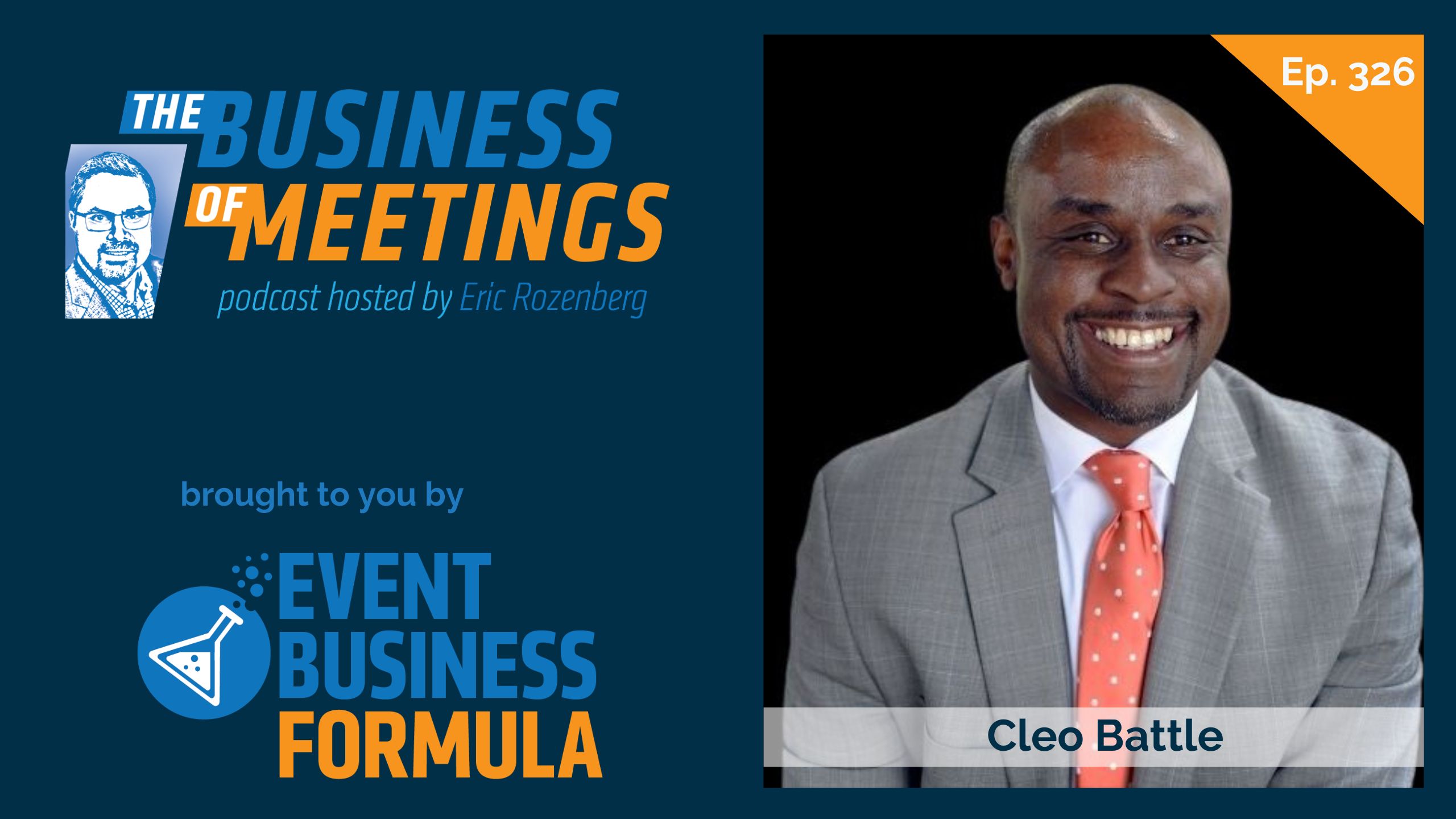
Today, we have the great pleasure of speaking with Cleo Battle, the President and CEO of Louisville Tourism and the new Chair of the International Board of MPI!
Cleo is an amazing person! He joins us today to share his inspiring journey and dive into what matters most for tourism and why every seat counts.
We hope you enjoy listening to today’s captivating conversation with Cleo Battle!
Cleo Battle Biography:
Cleo Battle, a hospitality industry veteran of nearly 35 years, currently serves as President & CEO of Louisville Tourism. Before coming to Louisville, he spent 12 years as Vice President of Sales & Services of the Richmond Convention & Visitors Bureau in Richmond, VA. He held the positions of Director of Sales and Sales Manager at the Richmond CVB.
Battle began his hospitality career in the hotel industry by working for Embassy Suites, Holiday Inn, and Sheraton Hotels. Battle is a native of Denver and a graduate of Metropolitan State University in Denver with a bachelor’s degree in Hotel/Restaurant Management. He earned his Master’s of Business Administration in 1997 from Averett University in Virginia. He is both a Certified Destination Management Executive (CDME) and Certified Association Sales Executive (CASE).
Battle’s most recent industry recognition includes the Events Industry Council 2020 Social Impact award winner, Business First Louisville’s
inaugural Power 50 as well as The Courier-Journal’s 12 People to Watch in 2021.
Battle currently serves on the Meeting Planners International Board of Directors, the Kentucky Derby Museum Board of Directors, the Louisville Sports Commission Executive Board, the LRAA Board, the Kentucky State Fair Board, the Louisville Zoo Foundation Board, the Funds for the Arts Board, and the Board of the Northeast YMCA of Louisville. He is the Past Chair of Destination & Travel Foundation, Destination International Sales & Services Committee, and the Virginia State University Hospitality Department Advisory Board.
Cleo’s journey
Cleo was a college track-and-field athlete. In his third year, he tore a leg muscle. He was still undecided about what he would major in at the time. So he spoke to a school counselor, and she suggested hotel restaurant management. He signed up for the course, started taking classes, and began working as an intern in a hotel. Hotel work came naturally to him, and he worked in many different positions. Then he got hired into the management training program for Promise Hotels, and his career took off!
How athletics set Cleo up for success
Learning how to run hurdles gave Cleo adaptability and flexibility. He also learned many other skills from athletics that he needed to grow and become successful in his career.
A strong team
Cleo truly understands the importance of having a strong team! He learned that you cannot do everything by yourself in business and that you are only as good as the people around you. His old boss from Richmond, Virginia, taught him that the key to any successful endeavor lies in hiring well. He used to tell Cleo to hire well, provide good resources, and then get the hell out of the way!
Trust
Trust is an essential ingredient for teamwork. People do much better when they work in a professional space where constructive criticism is valued, they can be honest about their thoughts, and they know that their opinions will be respected, regardless of what the leaders ultimately decide.
Every seat matters
At staff meetings, Cleo always tells his organization’s members that every seat matters. He wants them to understand that regardless of whether they are the Director of Sales, a marketing manager, or an administrative assistant, their seat in the organization still matters!
Enabling people
Whenever there is new subject matter, Cleo enables his team by inviting them to share their thoughts and opinions and offer ideas.
Cleo’s current position
Even though his current position as President and CEO of Louisville Tourism involves a lot of legislative work and more talk about politics than about customers, Cleo still feels it is vital to stay true to the core mission of Louisville Tourism and to bring visitors to the community.
MPI
Since the first of January, Cleo has been the Chair of MPI and serves on the International Board of Directors. He insists that his team has a growth mindset rather than a recovery mindset.
The cost of doing business has changed.
Since the pandemic, the cost of doing business has changed. So a lot of work has to be done on the industry brand to help those outside it see its value, what is being done, why it is important, and how the industry impacts people’s lives.
Getting more people to join the industry
Cleo points out that hotels, convention centers, museums and attractions, restaurants, and airports cannot work from home. So the industry will need to figure out the right balance between automated and personal services, going forward. He believes the industry must invest in its brand to make more people aware of why it is such an exciting industry to join.
Appreciation and acknowledgment
Cleo believes that openly acknowledging his staff members and appreciating their work is the best way to encourage them to provide customers with the best service!
Connect with Eric
On LinkedIn
Listen to The Business of Meetings podcast
Subscribe to The Business of Meetings newsletter
Connect with Cleo Battle
On LinkedIn
Books mentioned:
Team of Rivals: The Political Genius of Abraham Lincoln by Doris Kearns Goodwin
Listen on: Apple Podcasts · Spotify · YouTubeAs of January 1, Battle is chair of MPI’s international board of directors, and his focus for the year is “a mindset of growth, not recovery.”
“Hire well, provide good resources, get the hell out of the way.”
Cleo Battle
Full transcript of episode 328 of The Business of Meetings podcast, Eric Rozenberg with Cleo Battle, President and CEO of Louisville Tourism. Lightly edited for readability.
Eric Rozenberg: Hello and welcome to a new episode of the Business of Meetings podcast. Today is a special day because I’m recording this on Wednesday the 3rd of June 2026, and in one hour my friend Cleo Battle, who’s leading the DMO in Louisville, is going to be recognized by MPI with an industry leadership award. As he said himself, this is not a lifetime achievement award, but it’s a leadership award, and I thought it would be most appropriate to allow you, for those who haven’t listened to the episode that I recorded with Cleo in the past, to listen to him, to listen to his story, his inspiring and amazing story, in honor of Cleo. So please enjoy this episode with Cleo Battle, and congratulations again, my friend.
Hello and welcome to a new episode of the Business of Meetings podcast. Today I have the great pleasure of speaking with old friend Cleo. Cleo Battle is the President and CEO of Louisville Tourism, an amazing person in our industry, and I was just mentioning to him, I hear about Louisville everywhere now, since four or five years, but that’s not the purpose of the podcast. The podcast today is about Cleo. His journey is an amazing and inspiring journey. So Cleo, thank you so much for taking the time to speak with me today.
Cleo Battle: Thanks, Eric. Man, it’s good to be with you, my friend. Lot of years together.
Eric Rozenberg: Yep, that’s true, that’s true. And we won’t talk about cigars and bourbon, right?
Cleo Battle: No, no, no. We’ll save that for another time.
Eric Rozenberg: Very good. So the first question I always ask our guest is: what is your journey, and how did you get into this industry?
Cleo Battle: You know, the craziest part of my story is that I was a college track and field athlete. I ran hurdles. And so I was in my third year, and I was still undecided, as a typical athlete might be – I was still undecided as to what my major was going to be, and I got hurt.
Eric Rozenberg: I got hurt.
Cleo Battle: Tore the muscle in my leg.
Eric Rozenberg: Oh.
Cleo Battle: And they were very concerned about my ability to recover and run. Of course, I did recover, but they were concerned at the time. So I got very concerned. So now, all of a sudden, I’m like, “Okay, I’ve got to get focused in on what am I going to do with a college education?” And I went and talked to a counselor at the school, and we’re trying to figure out what direction I wanted to go, and she said, “Well, have you ever thought about hotel restaurant management?” And I said, “No, I don’t think I’ve ever done what a hotel is trashing.” So that’s all I got. And I signed up for it, started chipping away at the classes. I needed to do an internship, I took a bunch of classes, hadn’t even stepped foot in a hotel, and I needed to have, I think, 12 or 1,300 hours in the hotel to graduate as an intern. And that took off. I was a bellman, and then I was a front desk, and then I was an intern in the sales department, while I was all while I was in college, and I got hired into the management training program for Promise Hotels, which at the time was Embassy Suites, Hampton, Hilton, I think. And I really took off from there. I’m from Denver originally, and I went from Denver to Phoenix to LA, a little short stint in San Francisco, upstate New York, Richmond, Virginia, and now Kentucky. So I’ve had a great time in this industry, but that’s what I’ve been doing. I’m one of the few that actually have a degree in this industry, so it’s worked out really well.
Eric Rozenberg: Absolutely, absolutely. Most of the other people, including myself, just fell into it by coincidence.
Cleo Battle: Had I not gotten hurt running hurdles, maybe I would not have fallen into it. But listen, it’s been a blessing. I’ve had a fantastic career. I’ve made a lot of friends. I have absolutely enjoyed this industry, all the ups and downs that I have seen, from 9/11 to the financial crisis to the pandemic. I’ve learned something, I’ve grown. So it’s been a great industry.
Eric Rozenberg: You know, when I’m listening to you, about athletes – for me, whether it’s the athletes or the artist – you practice, you give everything. And when I say you practice, you practice more than anybody else. It’s hours and hours and hours, and then something in life can happen and suddenly the whole thing changes. In your case, you tore a muscle. Somebody playing piano can get into an accident and maybe lose a finger, and it’s over. There are so many instances where you’re just focusing on something and then life shoots at you, and okay, you have to find something else. What in your training as an athlete and your experience as an athlete are you using, or have you been using, in your career that you would advise anyone listening to do?
Cleo Battle: Yeah, it’s funny – I’ve said for a few years now the title of my book of life will be “Learning to Love the Hurdles,” because I ran hurdles. So, learning to love the hurdles. As an athlete, you have to learn technique, you have to learn speed, you have to train, as you said, and when you’re running hurdles I had plenty of times where I fell between hurdles, and you had to learn how to have better technique, how to be better at that. It reminds me a lot of what we just all went through with the pandemic – adaptability and flexibility. How do you adapt? How do you grow? How do you become more flexible? You can’t, when you’re an athlete, have a locked-in mindset. You have got to continue to grow. You have to continue to learn your body, your nutrition, your muscle groups, because your muscle groups and your nutrition are unlike anyone else’s, and you have to find the right formula for yourself. And it’s very similar to business. I’m in Louisville, Kentucky – while what I do is similar to Baltimore or to Austin, Texas, or to Dallas, it’s not the same, and I have to figure out how we’re going to be successful in Louisville. You learn the general skills of the industry, and then you adapt and you become flexible, and you learn how to apply that to what you’re doing in Louisville. But being an athlete, to me, it’s always about working hard for something that you think is important. People used to say, “I can’t believe you run hurdles”. It was just the craziest thing for people, but I wanted to do it, and I wanted to work hard at it, and I wanted to be really good at it. And that to me is a skill set that I believe any athlete or any musician, they take with them into whatever business they go through. You talked about being a piano player, it takes so much time and hours and practice to become good at it, you have that skill set inside you, it just doesn’t go away when you go to work or when you deal with your family. It stays with you. And so I think those are the things, when I think about being an athlete, how it helps me continue to fight for something that’s important in my day-to-day life.
Eric Rozenberg: Awesome. I don’t know which artist actually was asked, “Why do you keep practicing?” I don’t know if it was the violinist or somebody like that. “Why do you keep practicing at your age, so many hours?” And he answered, “I’m just getting started.”
Cleo Battle: Yeah, there you go. That’s the mindset of always learning.
Eric Rozenberg: Now, the other thing that, for any athlete, is probably comparable to working in our industry, is that nobody does it alone.
Cleo Battle: Yeah.
Eric Rozenberg: An athlete has a full staff of trainer, coach, doctors, nutritionist, and everything. So is this something similar that you realize when you start working in the hospitality industry?
Cleo Battle: Absolutely. You’re only as good as the people around you. And my old boss from Richmond, Virginia, he had this saying he’d always tell me, “Hire well, provide good resources, get the hell out of the way.” And he’d say, “Cleo, the key to that is hiring well. You can’t get to the other two if you don’t hire well.” And I’ve always hung on to that. And there’s another book, I don’t know if you know who Doris Kearns Goodwin is.
Eric Rozenberg: No.
Cleo Battle: But she wrote a book about Abraham Lincoln called Team of Rivals, and it basically talked about Abraham Lincoln’s presidency, how he surrounded himself with some of the best and the brightest minds. But there were some of those folks in his cabinet that weren’t aligned with his way of thinking, but they were really good at what they did, and he put them around him, he hired them anyway. And I think it’s always important, because you can’t get it done by yourself, and you can’t assume that you’re the alpha and the omega to everything that you’re trying to do. There are people that know more than you in particular spaces. As the old saying goes, if you’re the smartest person in the room, you’re probably in the wrong room. And so I’ve tried to surround myself, in every position I have, with talent – people who know their skill set — so much so that, as my old boss said, provide the resources and get the hell out of the way and let them do what they do well. And so you don’t do it by yourself. I don’t know anyone that is successful in this industry who’s done it alone. I love when folks come up to me and say, “Hey Cleo, you got a fantastic team at Louisville Tourism.” Thank you, it’s been, I’ve been very intentional about having a great team. And so, as you said about an athlete, you need a team, you need other folks to push you, and you need people to question you. Whatever experience I have, I may feel like this is the right thing to do, but I can tell you, when three or four of my executive team members say, “We don’t think that’s the right thing,” you have to question it, you have to think differently about it, no matter how I feel about it in my gut as the leader. I want my executive team, and they know that I want them to question me. I want them to push back on things, and we do that to each other, and hopefully the six, seven of us sitting around that table will come out with some great ideas once we’ve pushed back against each other. But you’ve definitely got to have a strong team.
Eric Rozenberg: Yeah, you and I are totally aligned on that. And as I always said to the teams I have led, I believe in something, but before I tell you what I believe, I want to hear from you. And as my grandfather would always say, if two people tell you that you’re drunk, go to bed. If three, four people start saying the same thing, you know what – maybe there’s something there to analyze. So when you have surrounded yourself with people like that, that are able to tell you what they think, which is extremely precious, by the way, everybody talks about “safe space.” To me that’s BS. It’s safe people that create the environment in which
Cleo Battle: Exactly.
Eric Rozenberg: Not safe space.
Cleo Battle: It’s a space where you can trust.
Eric Rozenberg: Yes. You can be honest with people. You know, if there’s anything and I know our society is a society today where everyone feels like they’ve got to agree with everyone, it’s like, I don’t want that. I can disagree with you, or well, I hope I can disagree with you, and you can disagree with me, and I can still go out and have a beer with you.
Cleo Battle: Yeah.
Eric Rozenberg: You know, and you got to have that kind of trust. Don’t know about a safe space, but a space where people can be honest about what they think and know that, ultimately, I may make a decision otherwise, but I respect your opinion on this, or vice versa.
Cleo Battle: But yeah, absolutely. It can be that, it’s not so much with my executive team, but you do, people have a hard time disagreeing. Constructive criticism is almost something you’re going to read in the history books someday. No one wants to be constructive with their criticism any longer, and I don’t know what that is, I don’t know why we’ve become so sensitive that if someone disagrees with you, everyone shrivels up and says, “Oh my god, I can’t believe you said that.” It’s professional, it’s business, it’s not personal.
Eric Rozenberg: Yeah, I fully agree with you there as well. It’s interesting to me, when I was living in Belgium, a friend of mine was extremely high ranked in the Socialist Party, and you know, and all my friends know what I think about the Socialist Party in Belgium, okay, I’m not going to go there. But the point I wanted to make is, him and I would have dinner once or twice a year, just one-on-one. Cleo, you would have passed by our table at that moment, you would have thought we’re going to kill each other. I was calling him names “you’re just a bunch of, you’re destroying this country” and then we had dinner. And to your point, I think it’s important, I actually love to be around people that don’t think the same way.
Cleo Battle: That’s right.
Eric Rozenberg: That can, that’s also where you get the best ideas, by the way, and where you can start thinking about your own self and the ideas. Now, being in the situation that we are now, as you describe which, I don’t know how we get there, but I know that we have to get out of there for sure do you see any difference, or what would you do to create such an environment where it’s okay to disagree, before COVID and today, where a lot of the things are happening online and people are not necessarily in the office five days a week anymore? How do you manage to create such an environment?
Cleo Battle: Yeah, and I certainly don’t think we’re perfect around here, but the one thing that I tell my team is that every seat matters. I say that almost every staff meeting, every seat matters. I want you to understand that if you’re an administrative assistant, or the director of sales, or a marketing manager, your seat matters in this organization. So I start with that, and then I try to enable folks, when we have some subject matter going on, I try to invite voices to say, “Hey, look” and I will start with talking to my administrative assistant or marketing manager, I’ll say, “Listen, here’s what I’m thinking about this, what are your thoughts?” And you hope that setting the table gives people an opportunity to say how they feel, to say what their opinion is. So, like you said, we may disagree, but between disagreeing we may find even a better idea. But I do try to help individuals in this organization understand that their seat matters, their voice matters, the work you do matters to what we’re trying to get done here. And so I try to start there and then set a table where folks feel like they can come in and say, “Be honest with me.” I’ll tell you, my door’s rarely ever shut, but it’s shut when I’m on something like this, but I can tell you there’s a lot of folks that lightly knock on my door, poke their head, and say, “Cleo, you got a minute?” And while sometimes I don’t have that minute
Eric Rozenberg: It’s important to hear people.
Cleo Battle: Come on in, I can give you a couple of minutes, what’s going on with you. I just give people a chance to say what’s on their mind and to give their opinion on things. And so, like I said, Eric, I don’t think we’re perfect around here, we’ve got a long ways to go to create the environment that we’d like to have, that I’d like to have, and that someone in my organization’s 35 would like to have, but we’re trying.
Eric Rozenberg: We are. Now, you became- was it like two years ago-President, CEO of Louis – July 21?
Cleo Battle: July 21.
Eric Rozenberg: Has your role changed dramatically? Now, before you were maybe busy with more customer[s], now you have to deal with people around the tourism in the city.
Cleo Battle: Yes, I’m much more political than I probably would want to be, as probably a lot of my peers would say the same. Legislators, just got a new mayor, I just had a meeting with the governor just on Saturday, and so yes, it’s a lot more of that than there are talking about customers day in and day out. But I keep myself pretty involved with what we have going on around here, so that I don’t get too far away, because the interesting thing with our business, when you’re at a destination marketing organization, we get pulled in a lot of different directions. But rest assured, your hotel industry, if you get too far off path and you’re not talking about meetings, conventions, and events that you’ve just booked, they will pull you back very quickly to remind you of what your core mission is. And it’s important that we never forget, despite all the other things we do in a community and certainly organizations like ours, tourism agencies for destinations, are being asked to lean a lot more into community, be a part of product development, and those things are all important, but we better never forget our core mission of bringing visitors to the community. That’s what our jobs are. So yes, while there’s a lot of legislative stuff in my calendar these days, I was at PCMA, I was talking to customers. You’ve got to stay true to core, and my team needs to see that from me as well, that we’re not too off path doing things that aren’t about rates, [dates] and space.
Eric Rozenberg: Yeah, no, totally. And you had IAEE last year.
Cleo Battle: We did, and we’ve gotten some really good feedback, and so, matter of fact, we got good feedback from the folks at IAEE. You and I are certainly good friends with David DuBois.
Eric Rozenberg: Yes.
Cleo Battle: He had good things to say, and I’ve heard some from some of my peers who said, “Man, you guys really knocked it out of the park while we were in Louisville.” So that always makes it special, to hear from your peers, to hear from the organization that you guys did a great job. So yeah, now we’ve got to book a little business from it.
Eric Rozenberg: It’s good to have, it’s good to have all the nice comments, let’s go book some business.
Cleo Battle: Awesome.
Eric Rozenberg: Yeah. And I know that you also volunteering is very important for you, including our industry, so can you tell a little bit more about the role now that you’re embracing?
Cleo Battle: Yes, as of January 1, I’m the chair of MPI, the international board of directors with MPI. And we talked a little bit before we got on, and I can just tell you, whether it’s the MPI team, whether it’s my team, the most important thing I’ve said to those folks is that we got to have a mindset of growth, not recovery. We have got to stop talking about recovery and let’s talk about growth. We have a tremendous amount of work to do, not only for MPI and that’s who I represent, but also for the industry. DEI is a big part of what’s going on in our industry now, sustainability is important to our industry clients, health and wellness are important to our industry clients. How do we deliver that? How do we make sure we’re meeting our meeting professionals where they’re at? And then you take those three things that are subject matter, and you say, well, on top of that, we’ve got the cost of doing business that we’ve got to all figure out today, because the cost of doing business has changed, whether you’re a destination or you’re a hotel or you’re a client.
Eric Rozenberg: Yep.
Cleo Battle: I think we all agree the cost of doing business has changed. And so we’ve got some work to do on the brand of our industry. I don’t think that’s an MPI thing, I think that’s an industry thing. After what we all went through with the pandemic, we need to put a little polish on our brand and help folks that are outside of our industry to see the value in what we do, why it’s important, how we impact your life even though you’re not in our industry. So I’m looking forward to my year with MPI, and we’ll see if we can continue to move this industry forward, as it’s heading in a good direction at the moment.
Eric Rozenberg: Yeah, and I’m sure that with you as a leader, I love what you say about we need to focus on growth and not recovery, this is so true. The other thing I’d like to have your opinion on, I think it was by 2027, I read that the statistics said the majority of the workforce in the US will be freelancers. So how does that apply to our industry, and what would be your recommendation to people starting in our industry or thinking about starting their own business?
Cleo Battle: Yeah, Eric, I don’t know the answer to that, but I’ll tell you what I do know. What I do know is that hotels, convention centers, museums and attractions, airports, and restaurants cannot work from home.
Eric Rozenberg: Mhm.
Cleo Battle: And so we will need to find that balance in our industry as to how we will do that. I don’t think you nor I want a fully automated hotel, we never talk to anyone, everything is a computer, my food comes through a computer. I don’t think that’s the experience we want when we go to a hotel, it’s not the experience you want when you go to a convention center. And that goes back to what I was saying a moment ago about our brand – we’ve got to invest more in our brand, and why it’s important, and why it’s exciting to be in our industry, because our folks can’t work from home. And so, while I’m sure there will be freelancers, I’m sure today’s Tuesday, in our office, Tuesdays and Fridays at Louisville Tourism are work-from-home days, if that’s an option, if that’s what you want to do. And so I do know and that’s new for us, I do know we’ll have to find a balance in our industry, but the thought that you’re just going to have everyone work from home in this industry, it’s not even possible. It’s just not possible because our facilities have to function with people. You’ve got to go to the airport, you need to talk to a person. You’ve got to check into that hotel, need a person. You want to get to the convention center, you want to have a great meal at a restaurant, you need people. So I don’t have an answer to your question about freelancers, all I can tell you is what I do know. And again, I think smart people like yourself and other leaders in this industry, we’re going to have to figure out what the balance is as we get to 2027 and figure out how to continue to be effective in our industry. If the Marriott, the Hilton, the Omni, they want to charge $400 a night for a Tuesday night stay in a hotel, you’re going to have a difficult time doing that with an automated system. You want some service, we’re built on that, people want service. You can say all the things that are cute in society as you want, but I know people love good service and they will pay for good service. I mean, that’s
Eric Rozenberg: Yeah.
Cleo Battle: or places like the Ritz-Carlton, I mean that was built on service.
Eric Rozenberg: Yeah, absolutely.
Cleo Battle: That’s – yeah, I don’t have an answer for you on that one though.
Eric Rozenberg: Thank you. Thanks for your honesty. I was picturing listening to you having the Derby with the automated horses, automated jockeys, automated people.
Cleo Battle: We have Churchill Downs, [it] seats 160,000 people, you can’t do that automating, you have to have people. And so, yeah, I don’t know what the answer is, but the one thing I do know, we’ve got to fix our brand. We’ve got to become, when you and I were kids, people had pride in working at a hotel and the positions they worked at a hotel and what they did for people. And somehow or another, somewhere in our society, saying “yes sir,” “no ma’am,” “how may I help you” has become something that is demeaning. And why should I have to say that, we should just be equals and we’ve got to find our way through that. And I don’t have the answers for it, but we’ve got to find our way through that, where there’s a pride in working in our industry again for all of us. Listen, the first job I had was a bellman now, I love taking people’s bags out of their car, telling them about the area, getting them up to the hotel, telling them about the hotel. Now, granted, I knew the friendlier I were, the bigger the tip was going to be, but I genuinely appreciated that job and interacting with people, and we’ve got to find our way back to that.
Eric Rozenberg: Absolutely. I remember working for Club Med as a GO, [for] two years, between the business school, and there was a little element of bellman when people arrive on the bus and you have to take all the luggage and everything although it was not in the culture of tipping over there but I worked there for a summer, and there was not one day of holiday per week, zero. The schedule was crazy in the day you were working, in the evening you’re rehearsing for the shows and everything.
Cleo Battle: Yeah.
Eric Rozenberg: And it was one of the greatest experiences I had in my life that helped me later on in the business. So today, when you look at people in the industry first of all, we spoke about that, and they don’t want to be offended by anything, or they don’t want to offend anybody with anything but how do you instill in the team this sense of helping others, of service, so that people appreciate that and make the difference and they want to come back? How do you do that?
Cleo Battle: Well, one of the things we start with is that appreciation and acknowledgement. Every staff meeting, every single letter, every single note I might get about a staff member from a customer or anyone, I will read it in the staff meetings so they’re acknowledged. Listen, you went out of the way for this customer, or and sometimes it’s the simplest things for folks, and they will take time to write a letter, and so I will take time to tell my full staff in a staff meeting what John or Judy or Jane did for this customer. And so I think it starts with acknowledgement, so that others know that those little things matter to people, and it matters to our organization. And everyone, I read that letter, and people will go, “Oh,” and they will clap at the end for that individual. And so, to me, it starts there, you have to acknowledge those moments, and not just, I mean, I could do it and just say something to that individual, but I think it’s good in a public forum, where people can be recognized by their peers around them, hear what they did for a customer.
Eric Rozenberg: Cool, love that. Cleo, I can listen to you for hours, and I can’t wait to do that again at WEC with a good cigar and a bourbon.
Cleo Battle: Sure.
Eric Rozenberg: Now, my last question for today, I love to ask, if we meet in one year with a bottle of champagne, what will we be celebrating? But in this case, if we meet in one, when we meet in one year with a glass of bourbon, what are we going to celebrate?
Cleo Battle: What are we going to celebrate? Well, I think for me it will be the celebration of really bringing our community together more here. We are – we’re working hard to, I’ll give you an example, Eric. We are Louisville Tourism, there’s a lot of art that’s painted on murals around the city, and one of the things a lot of the neighborhoods will say is that tourism doesn’t matter to us, we don’t have any hotels in our community. And so one of the thoughts we had when we did our destination strategic plan is, let’s create an art trail of the existing art that’s in our community. And so one of the things we want to do is tell a story of the art, the artist, and why is it in that neighborhood, with the hope that when we have leisure visitors or meeting/convention visitors here who are interested in art, they can get in a car and they can go out and they can go into these neighborhoods, it drives visitors into neighborhoods where they’ll eat, they’ll shop. And so when I think about having a bourbon with you in a year, my goal here is always to raise the elevation of tourism, it’s like what I was talking about, our brand nationally, I’ve got to do the same thing locally. I want to help our community to be able to understand why tourism matters. I just, we have a program called Leave a Legacy. So let’s say WEC is coming here in 2024, when WEC comes here, we have organizations that we go to, all the meetings, conventions we host, and we ask them, would you mind writing a check or putting a donation box in for an organization locally that ties into your community? And we want to be able to go and stand in front of that local organization with our tourism meeting commission and hold a big check, so that people know why tourism matters, how tourism can affect your communities. So that’s what I hope to toast when I see you over bourbon, is that we’ve raised the elevation or we’ve raised the attention of tourism in our community, so that people know how important it is to our community, what impact it can have in our community.
Eric Rozenberg: Cleo, thank you so much. I have no doubt you’re going to achieve that. I have no doubt that’s going to be an amazing year as well for MPI, thanks to your leadership. Thank you very much for taking the time, and I look forward to seeing you in person soon.
Cleo Battle: Absolutely, thanks Eric. I’m honored that you asked me to be on your show. All my best in 2023.
Eric Rozenberg: Thank you for tuning in to the Business of Meetings podcast. I hope you found today’s episode valuable. If you enjoyed the show, the most important thing you can do is leave a review and share it with your colleagues it really helps spread the word. I truly appreciate your support. And if you’re ready to take your business to the next level, don’t forget to visit eventbusinessformula.com to learn more about how we are helping event business owners like you. Thanks again for listening, and I’ll see you next time.