
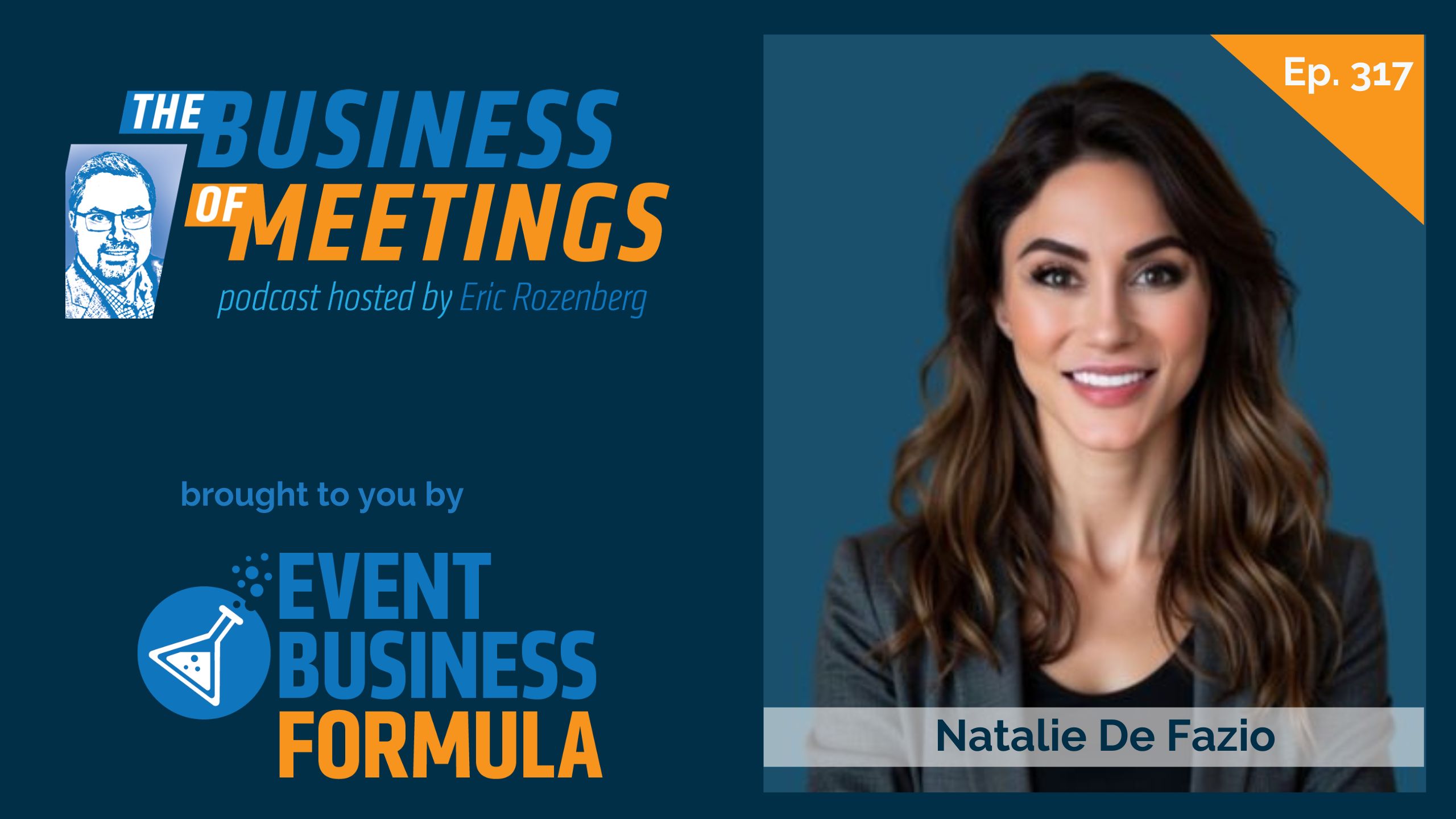
We are delighted to welcome Natalie De Fazio, Founder and CEO of Pinnacle Live, as today’s guest.
Natalie is a seasoned entrepreneur with a strong background in leadership and consulting, including roles at consulting firms such as KPMG. Over the years, she has collaborated with many leading names in AV production within the meetings and events industry and is now focused on building and growing her new brand.
Stay tuned to hear Natalie’s story and the insights she shares today.
Natalie’s Journey
Natalie began her career in consulting after studying business and economics, working across multiple industries and building expertise in strategy, analysis, and leadership. After working at several firms, including KPMG, she became an independent consultant and soon realized the value of bringing a fresh perspective to organizations. Her work with Freeman introduced her to the events space, where she fell in love with the people and the experiences they offered. She went on to co-found Pinnacle Live in 2021.
A Customized Experience
Pinnacle Live was created to fill a gap in the audiovisual services space within hotels. They focus on delivering a more customized, higher-touch experience rather than trying to be everything to everyone. This positioning enables the company to serve venues that require a more customized solution, while maintaining a strong emphasis on relationships, service quality, and consistency.
An Outside Perspective
Pinnacle Live’s key advantage comes from not being originally rooted in the events space. Questioning “why” and challenging the way things have always been done opens the door to new ways of thinking. Bringing in ideas from other industries helps avoid an echo chamber and encourages innovation, curiosity, and solutions more closely aligned with customer needs.
Innovation
Natalie believes that innovation is about trying new things that actually drive value, rather than simply changing for the sake of change. Creating a culture where people are willing to try and fail fast opens the door to better ideas. Maintaining a smaller-company feel while growing allows every voice to be heard and ideas to flow freely, regardless of role or title.
Data
Data highlights trends, indicators, and direction, but it does not tell the whole story. Combining data with anecdotes and opinions creates a far more complete picture. Clear KPIs across leadership, regular review, and accountability ensure alignment, while avoiding overreaction to short-term fluctuations.
Transparency
A high level of transparency around financials, performance, and goals helps employees understand the bigger picture and their role within it. Sharing both positive and bad results builds trust, encourages ownership, and creates a more engaged workforce. Natalie applies the same transparent philosophy to her customers.
Hiring
For Natalie, recruiting is about more than competencies and professional experience. She looks for people who believe in the vision, feel fulfilled by the work, and are excited to be part of building something. It has to be a match because even highly capable people won’t perform at their best if they’re not genuinely invested in the role and the company’s direction.
Creating Experiences
Events are no longer just about sitting in a room and watching presentations. People want immersion and a sense of belonging. The role of an AV and production partner is to understand the objectives and bring creative ideas to life through sound, light, and visuals, creating a feeling and environment that delivers on those goals.
Trust
Establishing trust is paramount for Natalie. Communication, proactive planning, and reliability are essential for delivering a seamless experience. The best feedback comes from being easy to work with, dependable, and consistently delivering on expectations, driven entirely by people who are both passionate and well-trained.
AI
Natalie feels that AI saves time and removes manual work. That gives teams more time to focus on more valuable work, such as working with customers, innovating, and developing better experiences. However, human input remains essential to ensure it is thoughtful, strategic, and correct.
In-Person Experiences Still Matter
Natalie believes that people still want to connect, collaborate, and share their experiences. Virtual and hybrid events have their place, but they are not quite the same. When people come together, their experience must feel intentional and immersive, and be something they are part of rather than just watching.
Maintaining Quality While Scaling
Natalie wants to ensure that Pinnacle Live continues to deliver high-touch services, tailored solutions, and real relationships. For her, that means constantly asking how to improve the experience and making sure her team fully understands the required standard.
Looking Ahead
Natalie wants Pinnacle Live to continue delivering consistently for clients and continue building strong relationships with hotel partners. She also sees growth in the broader production space, expanding beyond hotels into more complex production work. Her goal is to continue building the business while staying true to its founding goals.
BIO: Natalie De Fazio
Natalie De Fazio is the Chief Executive Officer of Pinnacle Live, a leading provider of premium event technology and production services. A seasoned executive with more than 20 years of experience in strategy consulting, operations, and corporate leadership, Natalie specializes in transforming organizations, building high-performing teams, and driving sustainable growth.
Before becoming CEO, Natalie served as Founding President of Pinnacle Live, where she played a central role in shaping the company’s strategic direction, expanding capabilities, and strengthening its people-first culture. Prior to founding Pinnacle Live, she served as Vice President of Corporate Strategy at Freeman Company and was a member of the Executive Committee at Encore Event Technologies.
Earlier in her career, Natalie held leadership and consulting roles at KPMG, Stax Inc., Aon Hewitt, and Accretive Health, and founded her own consulting firm, NMD Strategy. Known for her pragmatic, data-informed leadership style and passion for innovation, Natalie is committed to elevating live event experiences and advancing an industry built on meaningful human connection.
Connect with Eric Rozenberg
On LinkedIn
Listen to The Business of Meetings podcast
Subscribe to The Business of Meetings newsletter
Connect with Natalie De Fazio
On LinkedIn
Listen on: Apple Podcasts · Spotify · YouTube
“My general philosophy is more transparency is better, to a point.”
Natalie De Fazio
Full transcript of episode 317 of The Business of Meetings podcast, Eric Rozenberg with Natalie De Fazio. Lightly edited for readability.
Eric Rozenberg: Hello and welcome to the Business of Meetings podcast. I’m your host, Eric Rozenberg.
Over the years, I’ve had the privilege of helping businesses in the meetings and events industry grow and succeed. And I’m excited to share that experience with you. If you feel alone and overwhelmed, and if you’re looking to take your business to the next level, improve your strategy and sales, and connect with like-minded professionals, you are in the right place. I invite you to visit eventbusinessformula.com and join our community of event business owners dedicated to exponential growth.
Now let’s dive into today’s episode. Hello and welcome to a new episode of the Business of Meetings podcast, and today I am so happy to speak with an amazing entrepreneur. She has been working in a consulting firm like KPMG. She’s been working with every big brand name in AV production in our industry, and she’s building the new brand name in our industry. Ladies and gentlemen, it is none other than Natalie De Fazio, founder, CEO of Pinnacle Live. Natalie, thank you so much to take the time to speak with me today.
Natalie De Fazio: Eric, thank you. That was a very nice introduction, and thank you. I’m so happy to be here.
Eric Rozenberg: It’s not even nice. It’s half of everything you’ve done in your life, which is phenomenal. But I’m very curious. First of all, how did you get into our industry? What is your journey?
Natalie De Fazio: Yeah, it was not a direct journey into this industry. I’ll tell you that. And I am here because I love this space, the events space, the people, the impact, the experiences. It is by far the most enjoyable space I’ve worked in.
Now, as you mentioned, I came from a consulting background. So, coming out of school, I was a business and economics major, finance. I got into the world of consulting right out of school. In fact, my first job was with Arthur Andersen. Enron took that job from me right when I graduated. So, it was an interesting time because that was really kind of where I had my heart set on. That whole business unit dissolved and I kind of found my way in through some other boutique consulting firms. The longest stint that I had in consulting was at a company called STAX. That was about 10 years, and that company has done very well since I left. They were recently acquired by Grant Thornton, but they were very much specialized in the space of consulting for private equity companies, and they still are. That’s not the only thing they do. But so over those 10 years, I had a ton of exposure to all different types of industries, industry agnostic. So you name it, retail, tech, manufacturing, consumer good, all of it. I never really came across the events space though.
Interestingly, I came across many types of businesses. As a consultant, one of the things that’s fantastic about that career path is the very rapid learning curve to learn a new industry quickly, to get to know management teams quickly and what drives them, and then to quickly diagnose where there’s opportunity to improve. Now, as a consultant, you find the opportunity, you analyze it, you come up with a plan, you deliver the plan, and then you go to the next project for the most part. So in that I always kind of had a strong desire to also be the one to implement the plan, even though that’s a very different job and a much more challenging job. But so for many years I really enjoyed that work. I love problem solving. I really enjoy finding analysis with both data as well as qualitative input and opinions and kind of putting together all the inputs to come up with the best path forward. Also in that I really enjoyed leading people, leading teams regardless of the subject matter or the intention of that team. I find leadership is something that I’ve always really enjoyed and something that really fulfills me. So I think all of that are things that brought me to where I am now.
After I left STAX, I did spend some time at KPMG, fantastic, very large global accounting audit and consulting firm, and had some similar experience there as it relates to strategy and management consulting largely for private equity companies. So at some point though, in 2016, I decided, my father was ill and I was just kind of at a point in my career where I wanted to spend a bit more time with him. He did pass away that year. Thank you. Thank you. And in that same year I decided to leave the consulting company and just simply be an independent consultant. I started my own little shop and just service clients that I felt really good about that I knew I could have an impact, only pick the jobs I wanted to work on. So, that was a really interesting time for me to rediscover myself, and I quickly realized what an arsenal of tools that I had accumulated over the period of 15 years that I had been in consulting. And I quickly realized also how valuable it is to sometimes come in from the outside with a fresh perspective and drive change in an organization.
And so I was able to do that, to kind of fast forward to where I am today. I was able to do that as a consultant to a very large and successful company in the event space called Freeman, which many of us know. And I had the pleasure and privilege of working with Freeman for about five years. And that is how, as a consultant, I came in, fell in love with the industry and ended up staying, and I stayed to lead strategy initiatives for Freeman. Met amazing people in the event space, many of whom are still my friends and mentors today, and realized that this was an industry where I could bring all of my skills as a business person, everything that I had learned, frameworks and strategies and tactics and techniques to run a successful business and help management teams. But also, I fell in love with the people. This industry is filled with people with creative backgrounds, hospitality backgrounds, technical backgrounds, people who literally love coming to work every day to really invest in a craft that they feel passionate about and bringing people together.
There’s really no better thing in life than bringing people together for enjoying time together as whatever the subject, whether it’s to learn something or trade ideas or show a product, whatever it is. And so I felt so strongly that this was the place that I could see myself really flourishing. I didn’t know exactly what that looked like though. And a big part of me also just wanted to be the leader of a company. I knew that I wanted at some point to run something of my own. I didn’t know exactly what that looked like though at the time. So that’s kind of how I got into this industry as it relates to Pinnacle Live.
So Pinnacle Live was founded at the end of 2021. So we’re coming out of a pandemic which had obviously a very negative impact on our industry. And I realized that the space for audiovisual services is very vast, but the space for audiovisual services inside hotels is smaller. It’s a more nichy specific industry. And having worked very closely with many people in this industry and having many conversations coming out of the pandemic, my business partner Eddy Eisenberg and myself did a lot of talking over the summer of 2021. How can we add something back into this industry? Encore was a company that both Eddy and I had worked for. That company was sold and merged with PSAV. So many of our friends and colleagues were all working together there. Fantastic company, many friends still working there. We thought though, what if we come up with something that’s a little bit more nichy and more focused, a higher touch, more customized version of hotel AV services. And that was really the thesis in the beginning: this isn’t meant to be big. It’s just meant to be uniquely positioned for those hotels and venues that want a more tailored audiovisual solution in their property. So that was the thesis. That is what we decided to build, a business plan, and we ended up getting investors to help us make that come to light, and we went operational on March 1st of 2023. So it’s been just over three years.
Eric Rozenberg: Wow. And where are you today in terms of size and number of people working.
Natalie De Fazio: Yeah. Yeah. So, we are the in-house provider in about 200 venues. As far as number of people, we have, and it’s growing every day, but we have approximately 850 full-time people and almost 900 part-time and freelance individuals that we regularly bring in as needed for specific events. So, yeah, we’ve grown tremendously in these three years. It’s been really a blessing. It’s been such a fun ride.
Eric Rozenberg: That’s amazing. Congratulations. You said, among all the things you just said now that are fascinating to me, there’s one that you said is bringing expertise and information and point of view that are outside of industry, our industry, and that’s to me extremely important. I’m sometimes really not impressed by the fact that we’re always asking the same people internally. We try to copy what one is doing instead of looking, like this book, The Medici Effect, when they bring different profession together, that’s where you have new idea. By the way, and on a side note, I know because I was in the board of the Foundation, but in Belgium, and they had six out of the 10 most used molecule in the medical field at that time that were coming from there. And the reason is they bring different expertise and different domain together.
Natalie De Fazio: Yes. Same principle. You get in a little bit of a group think mentality or what they call an echo chamber. Sometimes when you stay within the same circle, and even unintentionally, there’s so many brilliant minds in this space. It’s very easy to stay within those same conversations with the same thought leaders, who again are brilliant. It does bring though a different dynamic when you’ve got someone who’s not used to the space necessarily asking why, why do we do this this way? Well, because we’ve always done it that way. Well, does it really make the most sense? Or there’s a way that this industry does pricing. No one’s ever done pricing that way in this industry, but it works there, there, and there. Maybe we should try that. So, it definitely opens up the mind. And if nothing else, it’s good curiosity and creative conversations and things that kind of make you think about things in a different way. And I found that to be really cool, that I saw myself being that voice for such brilliant leaders in my little corner of the world. I mean, there’s so many brilliant people in the space that I’ve never met yet. But for those that I was working alongside, I really do believe the value that I brought, or maybe still bring, is just questioning why and is there a better way and how can we really kind of get into the mentality of the customers and tailor things that way instead of sort of this internal ideology of how things have always worked and that’s made it successful. But by the way, the ideas are not always good. So you have to kind of have an appetite for trying new things and failing, failing fast, as they say, and then moving on. But you don’t really innovate until and unless you’re willing to try new things.
And that’s a real piece of the culture at Pinnacle Live, is just that notion of innovation, not just for the sake of change, like innovation that’s actually going to drive value, but let’s try new things. And that’s part of the advantage, frankly, of being a smaller company, relatively smaller company, which we still are. We’re not a tiny startup anymore, but we’re still small enough where every voice can be heard. And some of the best ideas come from the people you may not even expect are thinking about those things. But if you create a culture where those ideas can get floated up and sideways and there’s no real barriers for communication regardless of rank and title at Pinnacle Live, I love to hear from everyone. And that’s been really cool to get some of the ideas from the folks that you may not have necessarily tapped into if you’re just so big and you’re not able to hear every voice. We’re putting the right things in place to make sure that, to your point, the more voices that can be heard with the more points of view, background, this is why diversity is important. Diversity of background and points of view because it forces us to level up, think about things differently.
Eric Rozenberg: Absolutely. I can’t help but always smile when a CEO in America is telling me that we’re very small with 850 employees and 900 freelancers, especially coming from Belgium. Okay. This would be a huge company over there.
Natalie De Fazio: Yeah. No, that’s valid. You look at the space though, you’ve got companies a billion dollars plus, multi-billion dollars international footprint. So, when I look at things relative to that, it still feels small. But you’re absolutely right. And sometimes I just blink and look back and I can’t believe how quickly we’ve grown. It is so important to me though to maintain what I call that smaller company feel, which is again the ability for everybody to participate and the lack of barriers by level or department or the silos that can form naturally when you get many, many, many people. You kind of get fiefs that form, and the more that I can get in and break those things up and just create a collaborative environment regardless of size, I think is a big part of why we’ve been successful.
Eric Rozenberg: Absolutely. Now you said something about what you bring in terms of asking question. I think that, from what I’ve listened to you today, you bring something additional to me is absolutely essential. We were the first in Belgium to do an incentive impact survey with Sunny Music and really understand the data. And was fascinating, and I was using that data when I was speaking with a lot of other sales director or sales or marketing director in companies, and I would ask them why do you do a sales meeting? And too often I had the answer, oh because we do it every year. And he was like seriously. But you bring your experience of consulting, you bring your experience of finance counting numbers. What would you advise a business owner regardless of their size? What would you advise them to do in terms of numbers and dashboard for their KPIs and how much should they share with the people working in their company?
Natalie De Fazio: Data is invaluable because it gives us trends. It gives us indicators. It points us in a direction of something that needs to be looked at or discovered. It gives us orders of magnitude. It does not tell the whole story though. I mean, there is absolutely a need with data analytics to have the anecdotes and the opinions and the feelings, frankly, and like how things are landing are as important as the data. So, just to put that out there, I look at data very, very regularly to see that we’re on the right track or not, but I always try to get the full story, which does require some additional research and conversation.
With that said, as far as running a business with KPIs, you can’t improve what you can’t measure. Each one of my C-level officers has a handful of KPIs that they own. And so, each of them knows that they are responsible for driving those KPIs. Do whatever goals we’ve set. I try not to get too tripped up on a given week or a given month. We try to look at things in quarters or years. Trends are important. Anomalies are again indicative that something’s going on, but it doesn’t necessarily mean we need a fire drill about it. So, with each of my C-level officers of the company having a handful of KPIs that they own, we look at those on a weekly basis. We talk about where there are variances and where we need to be versus where we are. What do we need to course correct? What do we need to do differently? And so if everybody knows their number, if you will, if everybody knows what it is they’re shooting for, you have a lot less confusion about whose role is what or who’s accountable for what or like where is the responsibility in an organization. It sounds obvious, but a lot of times if folks are not exactly sure what their target is, it’s almost like if you don’t know exactly where you’re going, how do you know if you’re going the right way? So just having that, and that cascades down. So my C-level folks have their KPIs, that cascades down to their teams. What are the things that need to be in place to make sure those KPIs look good, and just regular review of it.
Now to the part of the question that is maybe less popular. I am extremely transparent with numbers as it relates to how the company is doing financially, how we are trending, how we’re tracking, what our forecasts are, what our margins look like, what our capital expenditures look like. Why? Because I want people to understand the bigger picture, see where their place in the organization fits into the whole and what they are doing is driving those numbers one way or the other. And I think it gives people more of a sense of ownership over what it is that they’re doing and responsibility to drive it one way or the other. The criticism comes when it’s like, well, you’ve got all these employees, they’re going to share this data with competitors or they’re going to share this data and it becomes something that now we don’t have enough privacy or those type of things. I get it, and we’re not a public company. We’re a privately held company and we have a lot of give in terms of what we’re allowed to talk about and what we’re allowed to highlight, and also in terms of how tightly we have to run towards a certain margin or a certain financial metric in a quarterly basis for a public company is very different than it is for a private company. So, we’ve got a little more flexibility there.
But my general philosophy is more transparency is better, to a point. And I think that people feel that their leadership trusts them when we include them in the good and the bad in terms of how we’re tracking. If it’s good, we love to celebrate, reward people. Incentives should be in place to reward people and we definitely do that. But at the same time, when things are not tracking well, we shouldn’t keep that from our folks. They should know that we are in a position where we’re not making the numbers that we need to be making and this is why we need to get more efficient on this cost or this is why we need to make sure we’re adding enough revenue over here to make things balanced. So that’s my general philosophy on it is more transparency is better with customers as well.
I think reporting for customers, we talk a lot, all industries talk a lot about data and data analytics and ROI and all of those things that are very much the buzz in any industry and have been for years now. I think in my particular space, it becomes tricky. There’s a lot of calculations that are done as it relates to how pricing works and commissions to hotels and how things kind of get discounted. And there’s an ability there to just kind of calculate things in a black box and just put the number out there or to show all the inputs, to show all the ways in which we got to these numbers, the good, the bad, and the ugly. And at least if we’re sharing that with our customers and they’re clear. So same thing with our employees as with our customers. I think people like to be informed. Whether they love what the numbers look like or not is a different thing, but I’d rather be clear and have those things visible so we can have conversations about how to be better. The goal is always to level up for me. The goal is always to be a little bit better, a little bit better, or a lot better. And so, the best way to do that is to get really scientific about what are we doing to get to this number? Okay, what do we need to do differently to drive things in a different direction?
What I will also say is it’s not easy to have your hands all over data. It’s taken us a few years to really get a data warehouse in place. So all of our systems and all of our data from operations, finance, people, all the things is in one place. So we can really perform analytics in a meaningful way, and very empowering once you have it.
Eric Rozenberg: I love the transparency and how you use data. To me, that’s also where we’re talking about motivating people. I always say the first thing that team members are interested in when something happened with the company is will I keep my job. That’s the first thing. And when you have this transparency, they understand their role. They understand what they should be doing and they understand also where the company is going. And that I think extremely valuable.
Now, in terms of experience, because I’d love to talk about, yeah, how do you recruit people that can create those experiences, what hotel and venues are looking into that, but I’m just thinking in our conversation, there was a time, the Club Med, the organization Club Med.
Natalie De Fazio: Of course. Yeah, of course.
Eric Rozenberg: I went on holidays there many times, but I also worked there one season taking care of kids, which was very interesting. But there was a story that was circulating at that time, and when I say at that time is the previous century. But there was two Club Med in Switzerland, in Leysin and Pontresina, and one of the general manager was called the chef du village of one of those two villages, one day rented two or three helicopters, brought people that were on holidays there in the helicopters. They flew to the other village. They went to the bar and stole all the alcohol and went back in the helicopter, which is an insane story. You wouldn’t hear about this today. But look, these are moments that people still remember. And even I was not there when that happened. I know the story and I’m telling you that 20, 30 years later. So memorable. How do you recruit people and how do you convince your client to create moments? Because that’s also what we’re doing in this industry, to create moment that people will remember and will talk about all their life.
Natalie De Fazio: Great question, because that’s what we’re in the business of doing. Two pieces there. One is recruiting the right people and then secondly how we create those experiences for our customers. Recruiting people is very much about the value proposition that I have for them. And so what do they get when they come to work for Pinnacle Live? I know what it is I’m trying to get from them. I have a job description. I know what the skill set that I’m trying to fill, the experience that I’m trying to fill. But they need to feel, in my opinion, to be great. They need to feel moved. Like they need to feel like this is something I believe in. This is something that I really want to be part of. So when we’re recruiting, I think a lot of it, a lot of the screening, is just trying to get a sense of what’s this person’s value system. What are they? A person that is very comfortable with being complacent and sort of average is good, mediocre is good, or is this a person who aspires to try new things and drive a new path and be great at what they do? So, there’s a difference there. And it’s, of course, we all want the best people. We all want A players in all the seats, but for me, I know very specifically what I’m looking for. Is that person going to feel rewarded by and fulfilled by the thing I’m asking them to do? Because they could be really smart and competent, but if I put them in a job that they’re not that interested in, I’m not going to get the best out of them. So, it has to be a match. They also have to know that if they do well, they’re going to move up. They’re going to have a career path. And a lot of these things, again, in an interviewing process or in a recruitment process, these things are not always at the top of the discussion. But if it’s a high enough position, I’m interviewing those people myself. And those are the things I’m looking for. The technical skills or the kind of the functional skills, I do believe those are important, but we need more than that. We need someone that believes in the vision, has the appetite, frankly, to work for a young company. I wouldn’t call us a startup anymore, but we are still a young company that is still building and forming and creating a brand. So it’s a certain type of person that wants to be involved with something like that. So making sure that we have that, and then the feeling of how I instinctually feel talking to people. I often think that that gives me a good indication of how I see them operating and I can kind of visualize where they belong in the organization.
So the recruiting processes, we’ve got a lot of positions that are open at a given time. I’m obviously not talking to all those people, but I am talking about my talent, talking to my talent acquisition team about we need to be talking not just about competencies and skill sets and professional experiences, but also, what values do you have, what excites you, what moves you, what’s going to make you feel fulfilled. That’s how I think you get the most out of people.
As far as how we create experiences for our customers, this is such a wide ranging question because it kind of depends on what is the outcome we’re looking for or the customer is looking for from a given event. And it could be any number of things. Oftentimes at a trade show, it’s just about showcasing product, getting business relationships formed, doing deals, those things are very important. Sometimes it’s just to inspire a bunch of employees. Sometimes it’s to get thought leaders together to innovate and convene on certain topics. I think in all cases though, and I’m sure you hear this all the time, we all talk about it, but events have become so much more than a transaction or a let’s sit in a room, watch a general session with a PowerPoint slide, and just take notes. I’m the audience, you’re the speaker, and we kind of have this relationship that is less interactive. That’s like those days are kind of gone. There’s some of that, but when people show up at an event, they want immersion in an experience. The experiential events are what people want because it’s a time where more people are still working remote post pandemic, where more people are engaged in their technology than they ever used to be, obviously. So, when we actually do have the chance to come together as humans and be in the same space and share ideas or have a good time or learn things there, it should feel like you’re immersed in something that’s very intentional that you are part of. You’re not the audience of. And so that’s oftentimes what meeting planners are asking for and looking for. That’s where the space has gone.
We’re an audiovisual and production company. So we are kind of one piece of creating the dream of whatever the event is and whatever the objectives of the event are. So our job is to understand the objectives and then go away and come up with their ideas and bring them back to the table versus just taking orders. If a meeting planner just dictating to us what they want, we’re not really adding a ton of value. They should dictate to us what they want and then we should come up with all the creative things that they’re not thinking of to make their event come to life. And it’s quite amazing what you can do with sound and light and images, and you can create an entire, you can create a feeling. You can create an ambiance. We’re the experts in that. So we should be the ones bringing those ideas to the table, and that adds a lot of value. A meeting planner or anybody, anybody hosting an event wants to have a kind of a stable of professionals who are really good at their craft so that they don’t have to think of everything. If I’ve got a meeting planner who’s thinking about AV on the day of the event, we haven’t done our job. Like that should not be something they have to worry about. So I guess what I could sum up by saying, establishing trust is paramount. Close communication is paramount. But giving those that are creating the event the assurance that we are here to think of the things you’re not thinking of. We’re here to kind of create a vision of something that you may or may not even have been thinking of before, but we’re here to be the experts on that.
And then just, this is so table stakes, but it’s so important, just being reliable. Like we are always there. We are on point. Those little things matter. And a lot of times when things get busy and it’s the show days are here and we’re moving in and not everybody’s clear on who’s standing where, that’s awful. Like we need to be proactive, well planned, just reliable. And that is the thing that everybody wants to have, that partner that they can trust again and again. Like wherever they go, I can rely on that group or that relationship and I know that they’re going to do their part. They’re going to carry their weight. So that’s what’s, I mean again, it sounds so simple, but that’s the thing that we’re getting the best feedback that we’re getting is that we’re just easier to work with and we are really, really reliable and trustworthy, and that goes back to the people. I mean, there’s no piece of equipment, there’s no technology, there’s no tool. It is the people have to be well-meaning, passionate about what they do, and trained up to know how to create a customer experience. And that’s what I’m striving to do.
Eric Rozenberg: Absolutely. And I love it. With the business owner I’m coaching in our industry, I always said, stop positioning yourself as the logistical expert, but go to a strategic partner. Understand the needs of the client, why they investing, who’s coming, what is success look like. And in doing that, it is essential to have the right AV production partner. When I had my corporate event agency, I was always working with the same AV production company and I was bringing them to the first briefing so that we can start brainstorming.
Natalie De Fazio: Great point. Yeah, from the discovery. I mean, from those initial conversations.
Eric Rozenberg: But you need trust that, and when the trust is gone, that’s it. But you’re talking about creating experiences, talking about people still working remote. What do you think when somebody like me will tell you the more we use AI, the more people will want to come in person?
Natalie De Fazio: I agree with you. I agree with you. That goes a little bit back to what I was saying. We’re in such a tech enabled world where tech is so front and center and it’s fantastic, like so cool, beyond like mind-blowing what it can do, but we’re still humans and we still like to be together and we still enjoy the coming together, especially when a lot of people are working remotely. It’s only a few times a year when they go to a big event that they actually get to collaborate and be in the same place and space. There’s nothing that can replace that. I think we learned that largely during the pandemic, which is virtual events can be a replacement, but they’re not going to be as good.
Still a lot of virtual, and there’s this place for it. Hybrid events are a thing. There’s a lot of room for that, but nothing replaces being together. And so for me, what I see, and I do not claim to be an AI expert at all, but it fascinates me and I’m learning about it for my own personal and professional application and then of course for my business and the customers and the employees that I work with every day. And what I see is AI is a fantastic efficiency driver. It can save time so that those minutes and hours that might have been doing something either really manual or administrative work or content building or editing or all these things that are always going to need a human touch, but a lot of the initial legwork can be done by AI and then you get a human in the loop to make sure that we’re on the right track, but that it saves time. And then those hours can be used for more value add activities like interfacing with the customer, coming up with good ideas, working internally with their fellow employees, fellow team members and growing, learning, developing. I mean those things are all much higher value than some administrative task.
So, for example, creating a proposal or a scope of work. There’s only so many configurations of what these different events look like. And so we can get a bunch of inputs and get a proposal generated that’s 80% of the way there. And then that other 20% needs to be very customized and thoughtful and the humans need to come in and make sure it’s right and it’s strategic and all those things. But sitting in a system and picking and putting together a proposal that would take two hours, now you can do in 30 minutes. So those type of things, content development is absolutely a fantastic use of AI in many different ways, but even if it’s just in streamlining things, the content’s there, but we want it more succinct or we want to mold it to a different audience. Great use of AI. Getting more personalized. We all experience that obviously on our phones and our computers. Everything is coming at us due to our purchasing behaviors, our conversations, what we are interested in. Same thing applies in events. Matchmaking and networking and attendee experience. All of those things can be tailored. And the AI just makes it so much easier and more efficient to hone in on those things. And once that’s dialed in, now we can deliver a different experience based on that. So again, I see it more behind the scenes, I guess, as an enabler than as actually replacing anything in a live event environment, at least based on what I’ve seen so far.
Eric Rozenberg: Absolutely. I totally agree with that, and I truly enjoy discussing with you, obviously the podcast format. One day I’ll have the Joe Rogan format with two and a half hours, but if I may, I still have two questions I’d like to ask you today.
Natalie De Fazio: Yeah.
Eric Rozenberg: So, thank you. When Jack Welch was the head of GE, one of the journalists asked him, “Mr. Welch, with all your responsibilities, how do you sleep at night?” And he said, “Like a baby. I’m waking up every three hours and start screaming.”
Natalie De Fazio: Yes, I know this quote.
Eric Rozenberg: Well, what does keep Natalie De Fazio awake at night?
Natalie De Fazio: First of all, the customer experience cannot get diluted. So as a company grows, and we are growing, the most important thing to me is that we preserve what makes us unique and we preserve what makes us a premium offering. It’s very easy for those things to get diluted as you grow. And it’s a point in time, we’re scaling at a good pace. I mean, not like crazy fast. But I feel like the last thing I want is to speak of a value proposition that talks about tailoring solutions, high touch service, genuine trust, authentic relationships, being able to rely on us, and then to have that not be real. In other words, I don’t ever want to be hypocritical about we say we’re this, but we’re delivering that. And clicked all the little ways in which I want our operation and delivery and our relationships to look, when we’re not on point, I’m not happy. I can’t sleep because what I want is to be, yes, the marketing and the branding and the messaging of what we’re doing is so important and we definitely need that. But if we’re not delivering on that every single day in every interaction, I’m not happy. I don’t like, I don’t want to be that leader. I don’t want to be that company. So those are the things I think about is just like what are all the ways in which I can make this experience better for my customers.
It really does start with the employees. And we kind of talked about that a little bit. Like customer experience starts with employee experience. It’s that old everyone says happy employees make happy customers and happy customers make happy owners and all of that. So I mean which is absolutely true. So if I can get the people that work in the organization to understand my standard and my value and my vision, then they can know very clearly if what they’re doing is or is not in alignment with that vision. And what I have learned a lot too, I’m in a couple of different kind of CEO peer groups and networks where we share ideas, not for my industry per se but just other CEOs. And one of the things that seems so obvious but that some companies lose as they grow is what exactly is our vision and what exactly are we trying to be? Because it can easily kind of go in different directions and you try to be all things to all people and you try to create a product that anybody can consume, but then it’s not just right for anybody because it’s built for too many customers. That’s a tricky thing to get into because as you grow and more opportunities come, you want to say yes. You want to be able to meet those needs and do it, serve everyone, but you have to know what it is, what is the brand identity, what is the value proposition, what is the vision for the company, and crystallizing that and making that clear to the people in the company so that they can go deliver on it is again like, am I doing enough to make sure everybody’s clear on that and that we’re delivering what we say we will.
Eric Rozenberg: That’s awesome. Thank you. And my last question for today, Natalie, when we meet in a year from now with a bowl of champagne,
Natalie De Fazio: Yes,
Eric Rozenberg: what are we going to celebrate?
Natalie De Fazio: I hope that we celebrate a Pinnacle Live that is successful in servicing clients consistently. Consistency is a big deal. That we are maintaining excellent relationships with our hotel partners. They are the ones we team up with to go and deliver great events. I’d like to see us grow more in the production space as well outside of partnering with hotels and venues, but I’d like to celebrate some potential growth, whether that’s organic or inorganic, in the broader production space so that Pinnacle Live can have a kind of extensive arm of higher end, like complex production service delivery. And hopefully if everything goes well, you and I both can be celebrating great health and enjoying life and having fun, which is ultimately I think what we’re all here for. So that’s probably the most important thing we can salute to.
Eric Rozenberg: Natalie De Fazio. Thank you very much.
Natalie De Fazio: Thank you, Eric, for having me on. Really, really cool. Really, really flattered to be here. And thank you.
Eric Rozenberg: Thank you for tuning in to the Business of Meetings podcast. I hope you found today’s episode valuable. If you enjoy the show, the most important thing you can do is leave a review and share it with your colleagues. It really helps spread the word. I truly appreciate your support. And if you’re ready to take your business to the next level, don’t forget to visit eventbusinessformula.com to learn more about how we are helping event business owners like you. Thanks again for listening and I’ll see you next time.