
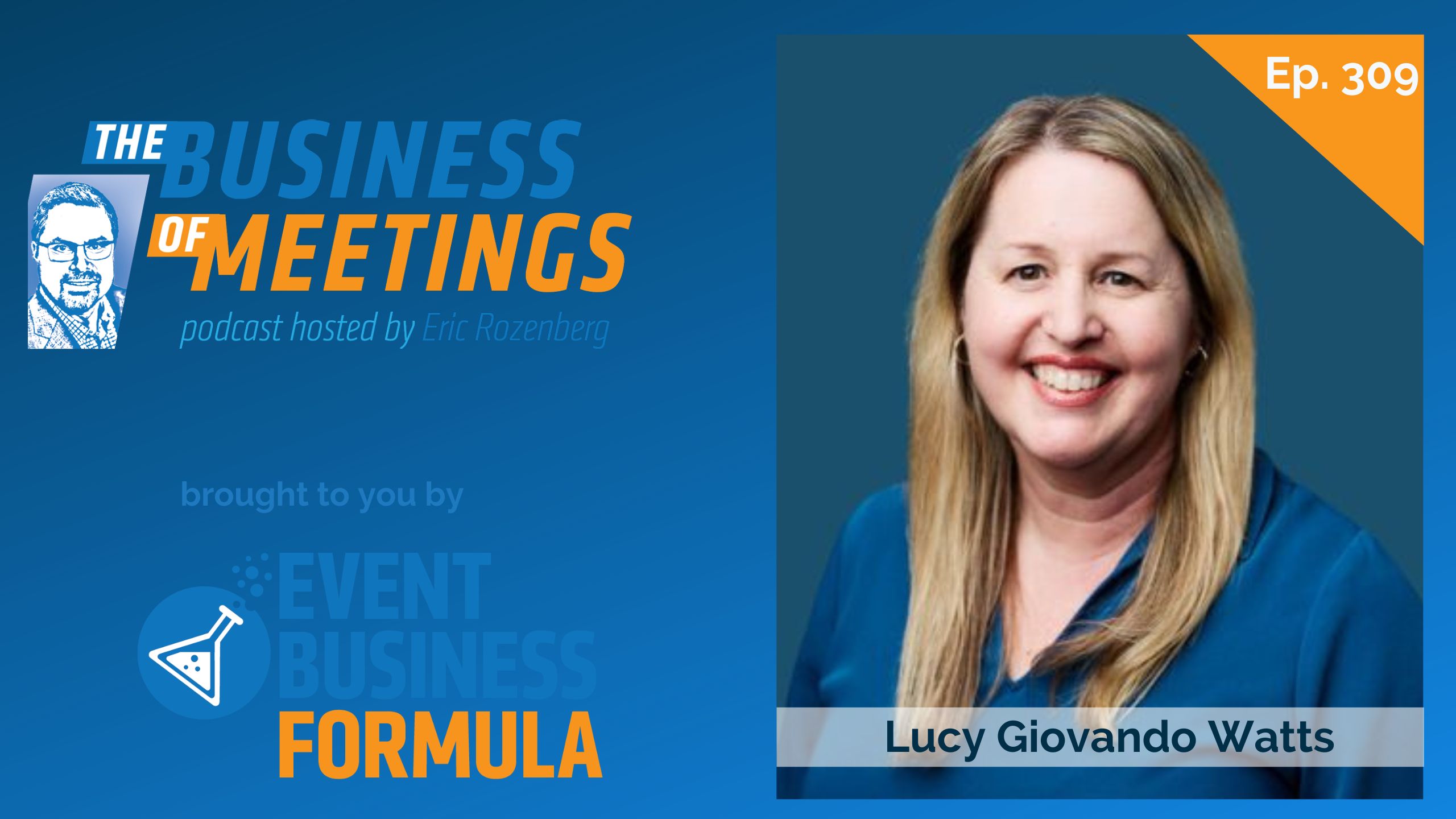
We are absolutely thrilled to welcome the remarkable Lucy Giovando Watts, Vice President of Sales and Marketing at Streamlinevents, as today’s guest.
Stay tuned as Lucy shares her journey, offers insights from her work at Streamlinevents, and tells us why serendipity often matters more than we realize.
Streamlinevents
Streamlinevents is a full-service corporate event agency in Emeryville, California, with over 24 years of industry experience. The team partners with corporate clients on sales kickoffs, incentive programs, user conferences, and complex meetings. The company is powered by the best-of-the-best event managers, technologists, creatives, and sourcing experts who thrive in an industry defined by constant motion.
Lucy’s Journey
Lucy began her career in politics, working for a member of Congress and supporting political events, where she discovered her passion for live experiences. She then joined the tech sector in Silicon Valley, rising from event manager to Global Events Director, where she produced worldwide events. After that, she founded her own boutique event management company, which she ran for over 13 years, and later co-founded an event technology startup. Lucy briefly worked in association management before joining Streamline Events as Vice President of Sales and Marketing.
Entrepreneurship and Getting Comfortable With Discomfort
Building businesses taught Lucy that growth occurs outside of our comfort zones. For her, launching a startup meant daily exposure to sales, pitching, demos, and investors, along with the risk of failure. Over time, discomfort became normal, and fear was no longer a signal to stop. Instead, it became proof of forward motion.
The Power of Saying Yes
Lucy’s decision to attend a reception she considered missing set off a chain reaction that led to pitch competitions, partnerships, press coverage, integrations, and ultimately an acquisition offer for her startup. That experience reinforced the value of openness and action, even when confidence lags behind opportunity, proving that even small yeses can unlock outcomes no amount of planning could ever predict.
Serendipity
Openness to chance encounters, conversations, and unplanned moments can play a role in one’s career and in a company’s growth. Serendipity does not replace preparation, but it rewards those who show up, engage, and are willing to act before they feel fully ready.
Imposter Syndrome
Lucy highlights how the perfectionistic mindset and people-pleasing culture in the hospitality industry can amplify imposter syndrome, particularly for women. Experience taught her that waiting to feel “ready enough” can become a barrier. Momentum comes from acting before you’re certain and recognizing that doubt does not disqualify your capability.
Creativity
Lucy reframed her identity by finding areas of creativity in problem-solving, strategy, leadership, and idea synthesis. Creativity blossoms when people allow time for mental space, pull inspiration from unexpected sources, and disconnect from constant digital noise.
Human Connection in an AI-Driven World
Technology and AI can enhance efficiency, but they cannot replace in-person connection. Conferences, incentives, and live events fulfill a fundamental human need for belonging, trust, and spontaneous interaction. As digital tools expand, the value of face-to-face experiences continues to strengthen rather than diminish.
Leadership, Safety Nets, and Being Bold
Strong leadership creates safety nets that empower teams to take risks. When people know their leaders have their backs, they are more willing to experiment, speak up, and innovate. At Streamline Events, leaders encourage bold thinking, creative exploration, and professional visibility through speaking, writing, and idea-sharing, while modeling that same courage themselves.
Bio: Lucy Giovando Watts
Lucy Giovando Watts is Vice President of Sales & Marketing at Streamlinevents, a woman-and minority-owned events agency delivering innovative, sustainable, and inclusive events worldwide. With over 20 years of experience leading global teams, managing event companies, and founding her own event tech startup, Lucy brings deep expertise in strategy, operations, and financial management.
Connect with Eric Rozenberg
On LinkedIn
Listen to The Business of Meetings podcast
Subscribe to The Business of Meetings newsletter
Connect with Lucy Giovando Watts
On LinkedIn
Email Lucy: Lucy.gw@streamlinevents.com
Listen on: Apple Podcasts · Spotify · YouTube
“I got really comfortable with being uncomfortable.”
Lucy Giovando Watts
Full transcript of episode 309 of The Business of Meetings podcast, Eric Rozenberg with Lucy Giovando Watts. Lightly edited for readability.
Eric: Hello and welcome to the Business of Meetings podcast. I’m your host, Eric Rozenberg. Over the years, I’ve had the privilege of helping businesses in the meetings and events industry grow and succeed, and I’m excited to share that experience with you. If you feel alone and overwhelmed, and if you’re looking to take your business to the next level, improve your strategy and sales, and connect with like-minded professionals, you are in the right place. I invite you to visit eventbusinessformula.com and join our community of event business owners dedicated to exponential growth.
Now let’s dive into today’s episode.
Hello and welcome to a new episode of the Business of Meetings podcast. Today I’m delighted to welcome an amazing person on this platform. We’re going to talk about ’26, but we’re going to talk about her journey, the importance of serendipity in life, and also what she’s doing. She is the vice president of sales and marketing of Streamline Events. Ladies and gentlemen, the one and only Lucy Giovando Watts. Lucy, how are you?
Lucy: I’m fine, Eric. Thank you for that great introduction. I have to take you everywhere with me. That’s a fantastic introduction, and I appreciate it. Thank you.
Eric: You told me that not everyone is pronouncing Giovando the right way. You’re going to get some sort of award. There are very few people that can do it. There’s a lot of vowels, people get hung up on that.
Lucy: So, I appreciate the correct pronunciation. That’s fantastic.
Eric: Wonderful. What great pleasure. Tell us briefly what you’re doing today, and then I’ll ask you my favorite question to start the show. But what is it that you’re doing? What does Streamline Events do today?
Lucy: Fantastic. Yes. So I get the honor of serving as vice president of sales and marketing for Streamline Events. We are an event agency headquartered out of Emeryville, California, and we’ve been around for over 24 years. It is a fantastic company. I am so happy I get the opportunity to work here. And as I like to say, every year on my anniversary on LinkedIn, I get to work with the best of the best. Not only the best event managers, event technology, our creative and sourcing department, but also our clients as well. It’s a fantastic company and I’m super happy to be working here.
Eric: Wonderful. And what does Streamline Events do exactly?
Lucy: We’re an event agency. So we work with corporate companies on anything from their sales kickoffs to their incentives to their user conferences and everything in between. We offer all those services, again, like event technology, housing, registration, all of our logistics. We also have a phenomenal creative department that goes above and beyond, and then an amazing sourcing department too.
Eric: Wonderful. For those watching on YouTube, they could see my smile because it reminds me of amazing memories when I had the corporate events agency for 20 years in Belgium. So I’m very familiar with incentive trips, sales meetings, product launches, and everything. So, and sometimes I feel for you. I know the capacity you need of handling stress to be able to do that.
Lucy: Right. Again, the best of the best. We have some great event managers and event technology managers. They just handle things, and an event is an ebb and flow. It’s a moving object, right? So it’s never the same thing every day. It’s never the same thing on site or in pre-planning or post. So we have some of the best in our company.
Eric: Wonderful. Now take us back to the starting point, if you want, of the line today. How did you join our industry? Was it always something that said, “I want to be working in the meetings and event industry,” or what happened?
Lucy: We’re about the same age. So the hospitality degree was not available back when I was in college, right? So I fell into it as a lot of us did. I actually got my start in politics. I worked, I know, isn’t that crazy? I worked for a member of Congress right out of college. I was a political science major, and during that time I worked on a lot of her political events, and I just fell in love. I fell in love with it and got this amazing opportunity to work for a tech company down in Silicon Valley where I started out as an event manager and worked my way up to the global events director. So I was able to put on these incredible events all over the world and got to work with colleagues in Europe, in Asia Pacific, down in South America. It was a great opportunity, and that’s where I really fell in love.
From there, I did what you did. I opened a small boutique, mine was probably smaller than yours, an event management company. And a lot of my clients, from a lot of the people I used to work with, left the company that we were at, and so a lot of them became my clients, which was fantastic. And then the company itself became my clients. So I did that for over 13 years.
Eric: Right. I know. So I understand, it’s amazing owning your own company. It’s a lot of stress, right? And all the buck stops with you.
Lucy: But during that time, I saw a need with one of our clients in terms of event technology, and I reached back out to one of the engineers I worked with at that technology company and said, “Hey, I have this idea.” We started working on this and we developed an app, and I got another co-founder. So there were three of us in total, and we launched an event technology company.
Eric: Wow.
Lucy: I know. So it was really amazing, and during that time, as a startup, I have to say I grew so much. Every day I was uncomfortable [laughter], so every day I was trying something new, whether it was sales or marketing or doing demos or pitching to investors, every single day was new and different, and I got really comfortable with being uncomfortable. And I’m sure you, as a former entrepreneur, know that, right?
Eric: I still am. Yeah, I totally agree with you, but I cannot do anything else than being an entrepreneur.
Lucy: Yeah, yeah. Yes, that’s fantastic. And so then, of course, COVID hit and I worked very briefly for an association management company where I learned a lot, and then I landed this fantastic job at Streamline Events.
Eric: That’s awesome. When you decided to start your own business, was it something that was always in you? Was it an opportunity because you saw something, or somebody said, “Why don’t you start your business,” or maybe, as I had guessed before, they were laid off and that was an amazing opportunity? Take us a little bit through what’s going on in your mind at that moment, and also the people that are closest to you, what was their reaction when you say, “I’m going to start my own business”?
Lucy: You know, it was interesting. I had a different reaction from when I did the event management company than I did with the startup, the event technology company. So the event management company, I started leaning into it as a consultant, and then from there I grew it into, several people were working for me at the time. I actually, oddly enough, did events but also I was doing a little bit of campaign management for some politicians, and I realized I didn’t like that. So it was great to know right out of the bat within a year that that’s not something I wanted to do for myself. But I loved the events part. So when I started it, I was more of a consultant and I leaned into it and didn’t jump into it. The startup was really different for me because I jumped right into it, and you get all sorts of feedback, right? You get some people telling you this is the most amazing thing and some people asking you, “How are you going to do this? Have you ever done this before? How much have you raised before?” Right. And so it took a harder shell for me to have when I did the event technology startup than the event management company.
Eric: Yeah. And I know that you are also a believer in serendipity, like I am. Can you share the story you have about the one that can change, that actually changed your life, and why people should always be open to something new?
Lucy: Sure. In our company right now at Streamline Events, we’re pushing for that opportunity to say yes. We are encouraging everyone in our company to speak on something that they’re an expert in, whether it’s budgets, whether it’s sourcing, whether it’s creativity. So we’re really opening that up for our whole company, and we’ve gotten a great response, and several of our employees have been able to speak at the WEC, for instance, for MPI. So that’s something we encourage at Streamline Events.
I actually just shared this story, it’s a crazy story, to be honest with you. Are you ready for a crazy story, because who isn’t ready, who doesn’t want to hear a crazy story? I just shared this with some students. I had the honor of being a guest speaker for a hospitality summit for San Jose State University here in California, so I shared the story with them. So it’s going to take a moment, so get your coffee and bear with me.
So it’s when we say the opportunity, say yes. Sometimes it starts very small with that yes, and again the chain reaction, it just goes on and on. So, one year I was at the MPI WEC and I was invited to a reception for the Thailand TCEB. And that evening I was with a group of friends and I was going back and forth, do I want to go, do I not want to go, and my friends are saying, “Hey, listen, we’ll meet up with you.” And I thought to myself, “No, you know what, I’m going to go.” I say yes. “I’m going to go in.”
So I walked in, grabbed a little plate of food, said hello to our host, and walked over and just joined a woman who was standing by herself eating at the table. And we started talking, and of course immediately then I recognized it was Carina from IMEX. Carina, of course. And so we started talking and she says, “What do you do?” And at that moment I just had launched our startup, and I said, “Well,” and I was really nervous to say anything, you know, we just launched it. And I said, “Well, to be honest with you, I just launched a startup in event technology.” And she goes, “Really?” And she asked me a little bit about it. And then she said, “You know, we have a pitch competition at IMEX for startups.” And I said, “Oh, you do?” And she goes, “Yes, and the deadline’s coming up, you should go online and check it out.”
And internally, I am dying. There is no way, we just launched this, our product’s still in beta, we just put up our website. There is no way I am going to do this. So I get home and I talk to our other co-founders and I mention this, and they said, “Oh, we should apply.” I was like, “You guys don’t understand, this is IMEX, this is a pitch competition, this is, I don’t know who this is going to be in front of, we’re not ready yet.” Well, the day before the application was due, I finally said, “Okay, just submit it.” What’s the worst thing that can happen?
Couple weeks later, I get an email. “Thank you to the 20 startups that applied, we have chosen four.” And our company was one of those four.
Eric: Amazing.
Lucy: And I immediately broke out in hives and said, “Oh my gosh, we can’t do this, we just have a beta.” All that impostor syndrome, all of the fears, everything rose.
Long story short, because this is just the middle of the story, we end up going to IMEX. I got up to pitch the product, it’s a three-minute pitch, and I recommend everyone pitch, do three-minute pitches. It’s incredible to be able to be concise because you’re going to time out if you’re not, and that doesn’t look good.
In the audience was Corbin Ball, godfather of event technology, right, like all of the important people. And I get up and pitch, and then they announce the winner and I was not the winner. But afterwards I was approached by two women in the audience from Meetings and they said, “Hey, listen, your product sounds super interesting, I know we have a colleague, I’m sure she’d be interested in talking to you more about it, here’s her card.” And I said, “Okay.” And then I looked across the room and there were my two co-founders who came with me speaking to the winner who actually won the pitch competition. Fast forward on that side, we end up partnering with them and doing an event where we integrated with their technology.
About a month later, I called the person at meeting set and I thought, “Oh, I’m just going to leave a voicemail message, she’ll call me back and then I’ll prepare and I’ll have all my answers all ready.” She answered the phone. “Hi.” I explained who I was, explained the story, and she goes, “Okay, great, let’s get going.” And she starts interviewing me right then and there. And I go, “Oh, we’re doing this now.” “Oh, okay, great.” So she starts interviewing me and we finished. And afterwards I went, “Oh my gosh, I can’t believe I did that.” Again, the uncomfortableness of being interviewed on the spot, all of those challenges.
So about a couple weeks later, this is the time when all the magazines were coming to your office, right, in print, the article came out, we posted it on social. I got a call from one of the larger event technology companies that had been around for a while, and the salesman said, “Hey, my boss told me to call you, you sound like an interesting product, you have an interesting product, we’d like to talk about it.” So a couple months later, we were integrated, our product had launched, we were integrated with this larger event technology company. And a year later, an acquisition offer was made.
Eric: Amazing.
Lucy: All going back to Thailand TCEB, going to that reception. So at any time, the whole time I wanted to say no. There were many moments, the fear was in me, the impostor, as you say, as everyone says, but it was that saying yes and it set off this chain of emotions and chain of experiences that ultimately resulted in our end goal.
Eric: That’s amazing. Any thoughts on that?
Lucy: Any thoughts on that?
Eric: Sure. I so much believe in serendipity that, you know, I graduated from business school after many years, it was a disaster for me in Belgium, but finally graduated extremely well, and I thought, “You know, for once I don’t have any exam to retake in the summer, so I’m just going to enjoy it,” and cancel the holidays. Went to a barbecue, met my first boss. Then I went on ski holidays and I met a couple, and then I joined this industry and so on and so forth up to last year in April. I had a friend coming for dinner and he said, “I can come that night but I have a friend visiting.” I said, “Bring your friend.” Right? And the guy I’ve never met before is now the reason why I just launched Eric AI and I’m able to mentor people all over the world in 77 languages just because of that dinner. So on serendipity, you bet.
Lucy: That’s fantastic. Right. And you could have easily said, “Oh, let’s do it another night,” right? You just leaned in. I think sometimes, especially in our industry, we overthink. We are planning for the worst possible scenario, and I think we have to remind ourselves that we also need to plan for the best possible scenario. So in saying yes sometimes without the guardrails, it could lead to something big and set off a chain of events.
Eric: Absolutely. And what do you say? I want to ask you a question, and then I’m going to tell you why I’m asking you.
Lucy: Okay. Perfect. Love this.
Eric: Your two co-founders, are they male or female?
Lucy: These both were male.
Eric: The reason I’m asking that, when you say, “We’re not ready for the pitch,” and they say, “We’re ready for the pitch,” that immediately, I’m the father of three daughters, okay? And so I have this conversation regularly with them, and I brainwashed them from day one, as they can read, there was this poster of Sheryl Sandberg on the fridge.
Lucy: Mm-hmm.
Eric: The next time somebody said, “You are bossy,” tell them, “You have executive leadership skill.”
Lucy: Love it.
Eric: But the thing is, I remember reading her book, Lean In.
Lucy: Mm-hmm.
Eric: And by reading her book, I learned that to apply for a job, to apply for a promotion, men, if they can already deliver 50%, will be totally okay to apply, and women will wait to be at least 80% to do it, right? And that makes me think of that, especially in our industry, you have 80% women.
Lucy: Correct.
Eric: And that, to me, I was so shocked. I bought the book and gave it to all my female friends that were in corporate in Belgium, right? Because it’s insane. But when you know it, then you can overcome it and basically have as many opportunities as anyone.
Lucy: Correct. Correct. And you know, both my co-founders were not from the industry, they were outside the industry, and there was something about, in Silicon Valley they say fail fast, fail forward, fail fast. The hospitality industry, we don’t like failure, right? That’s not, we don’t say the F-word.
Eric: Correct.
Lucy: So I had been in the hospitality industry 15, 16, 17 years by that point. I felt I did not want to fail in front of my peers at this, and so when you have that mentality, it, this entrepreneurship, taught me to jump in anyway, to do it anyway, and to feel uncomfortable and it’s okay, and you’re going to keep going, and you might fail. But oh my gosh, what if you don’t? What if you don’t fail? We think so much time about if we do fail and not, well, what if we don’t, what could happen, what are the possibilities? And so I do feel it was helpful for them not to be in the hospitality industry.
The winner of that pitch that year did not come from our industry. They were not solving a pain point, they came up with an idea, but they weren’t solving a pain point of their own. And I know a lot of times you want to solve a pain point of what you’d be a customer for, right? So that’s where I came up with the idea, but you know, you don’t have to necessarily come from the industry to know pain points, you can talk to people, you can read, I mean there’s just so much information you can glean. So it was interesting, at that point when I saw him win and he didn’t come from our industry, I thought, “Okay, hold on a second, it’s all going to be okay, we’re fine, you just need to calm down, relax, and move forward.”
Eric: Yeah. There’s so much in what you just said. The mentality, I think I would summarize it, for me it’s the less you care about what other people think, the more happier you are and the more entrepreneurial you are. I’m not saying that you have to be rude, but you know, they do them and we do us, and that’s it.
Lucy: Correct. Yes. Right. Being liked by everyone, that is a restrictive thing, right? That could prevent you from moving forward. I’m a former people pleaser. Moving beyond that and saying, you know, it’s fine, it’s fine if people aren’t going to like you, and quite frankly there will be people that don’t like you and you still move forward. So it’s that pleasing mentality that we have, we’re in the hospitality industry, we want to make sure we’re of service, right? But it doesn’t mean that everyone is going to like you, and that’s okay.
Eric: Absolutely. And the other point that you mentioned already twice, I think it’s the impostor syndrome. I still have it sometimes. I remember the first time I was sitting in my first board meeting as chair of MPI. I had on my left Chuck Bowling, who was president and CEO of Mandalay Bay, and on my right I had Ken Sanders from Freeman. And I’m thinking, what am I doing here? I have like a seven million dollar company in Brussels, and here I am with those two giants, right? And then you realize that you’re there because there’s a reason for it, and then you just follow the process and play the role you have to play, and that’s it, right?
Lucy: This sometimes is just doubts, which are normal, I believe.
Eric: But from the moment that you know what is your long-term vision, what are your values, why you’re doing what you’re doing, there’s no impostor syndrome that can prevent you from moving on, right?
Lucy: Right. Exactly. 100%. And that is a mentality, but also probably, as you say, I was also a people pleaser, probably still too much, but it’s going back to the why you’re doing something.
Eric: Mm-hmm.
Lucy: Right. 100%. Yes. And really taking away, I kind of, those roadblocks or that fencing that you put around yourself in order to move forward. It’s uncomfortable. Again, I talk about when I was doing the startup, every day, there was one day where I was like, gosh, I wish I could just sit in front of my computer and respond to emails today. I just want a normal day. And instead I’m pitching to an, like I said, pitching to an investor or doing a demo to a really big client, and I just wanted a normal day of responding to emails. But because of that, it started becoming the norm, that was my everyday, that was how I became comfortable.
Eric: Amazing. Absolutely amazing. You should write a book, seriously, sometime [laughter], some way down the line.
Lucy: I love that. Thank you, Eric.
Eric: And talking about skill set and mentality, I know something that you believe strongly is about creativity, and that, if I’m not mistaken, you believe that in every role you can be creative, and it’s not only for marketing or campaign. So how could somebody in operations, for instance, be creative when they have to deliver what needs to be done in the process?
Lucy: It’s a good question. I never thought of myself as a creative person until recently. It was not something that I deemed myself to be. And recently I thought, “Oh my god, wait, I am a creative person.” I have the opportunity to carpool a couple times a week with our creative director from Streamline Events, and let me tell you, she’s incredible. She comes up with the most amazing ideas, she’s constantly ideating. Her work-from-home studio is something that’s unbelievable, it’s just so creative, colors and all different fixtures in there, where I work off a white desk. I could not get become anymore. So I get the opportunity to carpool with her, and what I’ve noticed is she sees creativity in everyday life, and we talk a lot about our inspirations. And what I have found is two things. One, I have to allow myself time and space to be creative. So, you know how we’re constantly bombarded with emails and Slacks and notifications, I need to, if it’s not in my workday, it’s in my weekend or it’s in my morning or it’s in my evening, to just have some nothingness happening. And again, I have kids, you have kids, that’s very hard to do. But to find that time, whether I’m walking the dog or I’m driving on an errand, just to have that thinking time. But the thinking time is you’re not thinking, you’re just exploring in your mind different ideas.
And then I also pull inspiration differently from where she pulls inspiration. Everyone at Streamline Events knows this, I love TikTok, I love it, I’m on it every day in the evening, give myself a certain amount of time, and I will pull inspiration from, maybe there’s a brand that’s doing something different, maybe there’s an influencer that’s doing something interesting, and I’ll pull those ideas, and then I will email myself, and then the next day I’ll look through, these are good ideas, not good ideas, and sometimes we’ve run with them for clients, sometimes we haven’t. So those two things, pulling in, where do you pull your inspiration from? A lot of times it’s also movies, I’m a very visual, video type person. So we’ve been watching The Bear a lot lately, so maybe there’s something from there I’ve pulled, or other videos or movies. So that’s where I find my inspiration. So I really encourage people, one, give yourself this space, this non-thinking time, maybe call it exploring time, I’m just making that up as I’m talking to you. And pulling, where are you pulling inspiration from? Where do you pull inspiration from?
Eric: I read a lot.
Lucy: Really.
Eric: And really a lot. And by the way, when you were talking about it, reminding myself of the book, The Medici Effect. At the time of the Renaissance, the Medici brought people from different specialties, different worlds, together. And in that book, I remember an architect who was studying how ants are building their houses in Africa in order to have a building where the temperature would be constant but without air conditioning.
Lucy: Love it.
Eric: And so it’s all those things. But I have to say, when I had my corporate event agency, I would go to trade shows, conversations, watching movies, ideas in books, and then when I found something I was excited about, it’s like, you know what, now I have to find a client to sell it to, right? And we did that. We had one day, we’re doing an incentive trip in India, and we are in Jaipur, and then we go to Udaipur, and then we go to the lake palace, and I’m thinking, you know, we should do something. And so, unfortunately, we had to reduce the program so that never was executed, but it had been planned, it had been checked, and it was ready to be executed. Basically we were going to take small boats going to the lake palace, next to the lake palace, I forgot the name, it’s the place that was in the James Bond movie Octopussy.
[clears throat]
And so as we were on the small boats going to the lake palace, there would be divers going from the water, on the music of James Bond, getting on the boat, taking their diving gear off, being dressed in tuxedo with the keys of the hotel and giving the check-in.
We did that for the largest management consulting company at that time, and still is. We had a retreat for their entire team and spouses, and we were in Algarve, and we had one plane coming from one destination, another plane coming from another destination, landing almost at the same time, that’s what you can do when you’re chartering planes, right? And we put everyone on buses, they thought they were going to the hotel, we went to the port and they boarded a huge sailboat, and then we sail, and music and everything, and then we stop in front of the hotel, was the Pine Cliffs in Algarve, Portugal.
And then we had a little boat bringing people to the beach, and the reception of the hotel had arranged for all the check-in to be done on the beach, or people were receiving a cocktail. So you’re basically leaving the airport and you’re totally disconnected. And I can go on and on. It’s all ideas, it’s a mindset of what can you create that is, on one hand, totally in line with the strategy and the values of the organization, and on the other hand, that you’re creating experiences that people cannot duplicate if they go back with their family and friends at the location.
Lucy: 100%. Yep. You just defined incentives, right? It’s those memories that they take with them, the once-in-a-lifetime experiences.
Eric: Absolutely.
Lucy: You know, one time we were brainstorming on AI and how we can, as a company, work within the AI realm, we took, I took a couple people from our company, do you know what forest bathing is? Have you heard of that word, forest bathing?
Eric: Forest bathing.
Lucy: Like going through a forest, walking through a forest and really uncoupling your ideas and unconnecting to technology and really…
Eric: Okay. Yes.
Lucy: So we don’t have a forest around our office. So we were forest bathing in downtown Emeryville, so it’s a little different, but we got out that day. I talked to a handful of us, we got our tennis shoes on, and we walked and talked and brainstormed. And so it was our version of forest bathing, and it was fantastic just to get out of the office, to kind of keep movement, right, to open up the creative juices and just really come up with some fun, interesting ideas. And so we’ve done that a couple times and it was fantastic. I highly recommend pulling your colleagues out of the office and really walking. Our teams get together often, but to be able to do this walking and talking outside is just amazing.
Eric: Absolutely, out of the cubicles, the electronic cubicles, that’s how I call Slack. It’s like working in a cubicle and somebody can bother you every five minutes, right?
Lucy: Absolutely, absolutely. And it’s good, it’s good for getting quick answers, but sometimes you just need a disconnect, right?
Eric: Yeah, yeah, absolutely, absolutely. Now you’re in tech, you’re talking AI, you’re talking events. How do you combine that? What do you see coming up? I’m a strong believer that the more people use AI, the more they want to come in person. But what is your take on it?
Lucy: That’s a really good point. What we’re seeing is there is still that, there’s still the need for the human connection, right? And so, like you’re saying, AI is helpful and will, of course, take us bigger and beyond, but the human connection, that is these in-person events, it’s only becoming stronger, the need is there. I know a lot of people are coming back to the office, but to come together at a conference or an incentive or a sales kickoff, it’s hard to duplicate that on a Zoom, within Slack, within AI. I just think as humans we are just needing our connection, our peers, our colleagues, our network, learning, meeting new people. It will always be there. What are your thoughts on that?
Eric: I’m totally convinced the human connection, the DNA of that, the human species make us come in person. I remember years ago at a board meeting at the Hilton Anatole in Dallas, and we’re having a break, and in the adjacent ballroom, the doors open, and suddenly you have, I don’t know how many people dressed like Star Trek coming out, and I’m looking and it’s like, what is that? And it was like the ancestor of Comic-Con. And I understood that day that as much as you can go online, people then want to come in person, because that was a community, that was an online community, they want to come in person. It doesn’t replace the serendipity of conversation, it doesn’t replace the sense of belonging to a community. And when it comes to, for me, when it comes to business owners and mentoring and coaching people, it doesn’t replace the importance of accountability. You can have the greatest plan, you can have automated all your processes, you can have 50 different AI agents working for you, if you’re not accountable, nothing’s going to happen. And that accountability doesn’t happen on your own in front of a computer.
Lucy: 100%. It’s the way that the serendipitous, as you’re saying, conversations that you have in the hallway, right, as you’re getting your coffee and you’re striking up a conversation, that doesn’t happen online, it’s just harder, right? And then you’re seeing the person is right there, and we’re getting along and, oh, we have something in common, and then that conversation, especially for new business, right, it just moves on, but that trust is gained right from the onset because you’re seeing them in person. So I agree with you, community that starts online, there’s always a need for connection in person.
Eric: Absolutely. And I see it now with Eric AI, it doesn’t replace the cohort I’m doing, doesn’t replace the community of business owners that I’m helping, and it’s actually enhancing the support because now you have 24/7, right, but it’s never going to go away, so that’s the good thing.
And so what do you see now for this year in terms of teams, in terms of leaders, the change? I know that big tech, Amazon just laid off a lot of people a few months ago, it was Microsoft, and you know, all those big companies, which if you look on the long term, they’ve hired a lot of people and then they’re reducing, so net, I guess there’s a gain in terms of job, but still it’s extremely difficult when you’re in this position. So what do you see in terms of leaders and teams, what should people be doing, and how do you see this year coming up at Streamline Events, at our company?
Lucy: One of the things that we provide is, as leaders, we are the safety nets. When we are able to provide that safety net, our teams are able to be bolder, able to try out, have risks, if they know their leaders have their back and they’re there for support, and if they’re there for anything that they need. And so I do feel as leaders, if we can continue the safety net and continue to encourage our teams to try out new things, knowing that we are their backstop, we are there to provide that support. But we also have to lead by example too, right? So if we’re asking our teams to be bold, to come up with creative ideas, to take risks, we also have to be able to do that ourselves and have that. So that’s where the theme “be bold” is, our company is really moving forward with that. That’s where we’re coming up with, as leaders in the company and throughout the company, how can we do things a little differently, how can we take a little bit more risk, how can we be bold and do things that are future forward?
Eric: Do you have an example of how you create the safety net?
Lucy: You know, we have regular meetings, of course, with all of our, as most companies do, but during our one-on-ones, we like to dig in a little bit too, you know, are you achieving your goals, what are you working on this year besides just the day-to-day nitty-gritty of executing on the event? Right? So what are you doing that we can push you a little bit to be a little bit bolder, right? So when we offer, I think I talked at the beginning, is there a speaking opportunity that you’re interested in, everyone’s an expert, right, I work with the best of the best as I say, so everyone’s an expert in an area, so how, but of course public speaking is also not everyone’s favorite, we understand that, but is there something that you could write about instead, is there something that you’re an expert on that you would feel comfortable, so that’s where we are really pushing, but also encouraging. It’s more encouraging our teams to do things a little bit bolder, to try out new ideas, to be creative. It kind of all circles back, right, to say yes to opportunities, to come up with creative ideas, but we, as the leaders, have your back, we have that safety net for you.
Eric: That’s awesome. I strongly believe, and I know it’s a very common place to talk about a safe environment, I personally don’t really like the term, and I don’t believe there is a safe environment. I believe there are safe people. They say to you that it’s okay to try, to be bold, and that they have your back. It’s more about people, I think.
Lucy: Right. 100%. Yes. Exactly. And that’s, I think, encouraged throughout. And then for our clients too, they see that, right, we have your back, we have it, it just goes throughout the whole culture of the company.
Eric: Awesome. So let’s be bold in ’26.
[clears throat]
And my two last questions for today. First of all, how do people get in touch with you?
Lucy: Yes. So they can, my email address, I’m not going to do my whole last name, so it’s just lucy.g@streamlinevents.com.
Eric: Wonderful. And I know you’re on LinkedIn.
Lucy: Correct. Yes. LinkedIn with me.
Eric: And so you’re going to be bold the whole year. And next year, when we meet in January ’27 with a bottle of champagne, what are we going to celebrate?
Lucy: Oh, this is good, this is really good. Maybe some creative ideas that we’re working on right now, but I’m not at liberty to share some.
Eric: Okay. So I love it.
Lucy: Some creative ideas we’re doing internally, and just, you know, I think we toast to our health and happiness.
Eric: I concur 150% with that. Awesome, Eric.
Lucy: It’s so great talking with you. Before we forget though, I want to give you an appreciation. Five years, you’re amazing. Not everyone could continue doing something as consistent as you have done. That’s incredible. So congratulations. So we’ll toast to that as well.
Eric: Thank you. Yes, five years of podcast every Tuesday, but speaking with people like you, that’s why I love doing this podcast. So thank you so much.
Lucy: Thanks for asking, Eric. Good talking with you.Eric: Thank you for tuning in to the Business of Meetings podcast. I hope you found today’s episode valuable. If you enjoyed the show, the most important thing you can do is leave a review and share it with your colleagues. It really helps spread the word. I truly appreciate your support. And if you’re ready to take your business to the next level, don’t forget to visit eventbusinessformula.com to learn more about how we are helping event business owners like you. Thanks again for listening, and I’ll see you next time.