
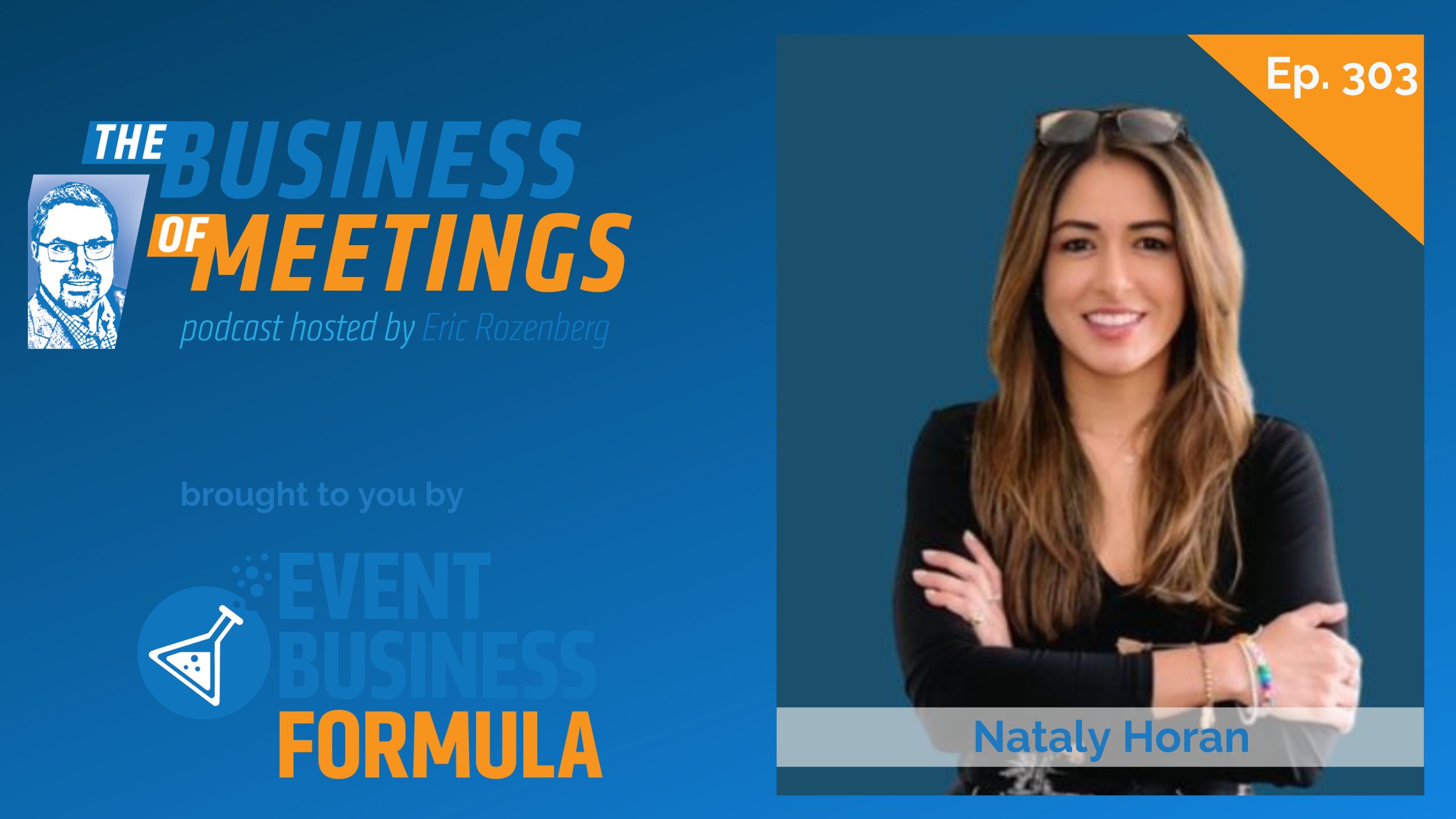
Today, we are thrilled to welcome another entrepreneur from our industry. Nataly Horan is the founder and CEO of Authentic Meetings and Incentives. With experience across several ventures, she joins us to share her journey, the challenges she has faced within the industry, and her hopes and dreams for what lies ahead.
Nataly’s Journey
Nataly entered the meetings and incentives industry quite unexpectedly. She trained as an interior designer at the University of Florida, then moved into the space after helping with graphic design, quickly connecting with the people and energy of live events. She eventually stepped away from interior design, moving entirely into conference planning and developing a unique perspective by working closely with both suppliers and buyers.
Building Authentic Meetings and Incentives
Authentic Meetings and Incentives focuses on sourcing and supplier visibility. Nataly supports planners with cruise and venue sourcing while helping suppliers, particularly cruise lines, reach North American planners through social media and email. Her growing online presence bridges the gap between limited in-person events and complete year-round visibility.
Choosing Entrepreneurship
Nataly reached a point where her growth within someone else’s company felt capped. Buyers were already coming to her for sourcing support, making the transition to her own business a natural step rather than a risky leap.
Early Focus and Mindset
In the early months, Nataly avoided long-term pressure by setting short-term, achievable goals. Focusing on weekly progress kept the business manageable and prevented overwhelm.
Vision and Personal Goals
Rather than focusing on rigid industry forecasts, Nataly prioritizes her personal goals, such as living in Italy and potentially pursuing a full-time career as an artist. With AI rapidly transforming the industry, staying adaptable is more important for her than long-term predictions.
Nataly built her LinkedIn following organically by sharing what she was learning as a newcomer. Her honest, behind-the-scenes insights resonated, turning LinkedIn into a powerful marketing tool with strong ROI.
Sourcing, Relationships, and Cruises
Nataly’s sourcing work emphasizes fit, reliability, and simplicity, particularly through cruise programs and charters. Nataly explains that in-person relationships remain critical for large-group events, where trust and quick problem-solving can make or break the experience.
AI, Delegation, and Sustainability
Nataly strongly believes in delegation, using a virtual assistant and systems like Canva to scale sustainably while avoiding burnout. AI acts as an assistant, streamlining RFPs and marketing content without replacing human judgment.
Creativity Beyond Business
Alongside running her company and raising two children, Nataly enjoys painting. Her personal goal for the year is to exhibit her art in a gallery, something she values as much as professional success.
Bio: Nataly Horan
Nataly Horan leads AUTHENTIC Meetings & Incentives® as its Founder and CEO, steering cruise lines and destinations toward the audiences that shape the North American MICE market. Her background from the University of Florida and her work across sourcing and brand storytelling inform AUTHENTIC’s signature point of view, seen in series such as MICE Bites® and In Good Company. She also serves as Vice President of SITE Florida & Caribbean. Away from the office, Nataly is a visual artist, creating work that echoes the themes she champions in travel: intention, culture, and human connection.
Connect with Eric Rozenberg
On LinkedIn
Listen to The Business of Meetings podcast
Subscribe to The Business of Meetings newsletter
Connect with Nataly Horan
On her website
Email Nataly: Nataly@authenticmice.com
Listen on: Apple Podcasts · Spotify · YouTube
“I don’t feel like it’s replacing my job at all. I just think it’s an assistant.”
Nataly Horan
Full transcript of episode 303 of The Business of Meetings podcast, Eric Rozenberg with Nataly Horan. Lightly edited for readability.
Eric Rozenberg: Hello and welcome to the Business of Meetings podcast. I’m your host, Eric Rozenberg. Over the years, I’ve had the privilege of helping businesses in the meetings and events industry grow and succeed. And I’m excited to share that experience with you. If you feel alone and overwhelmed, and if you’re looking to take your business to the next level, improve your strategy and sales, and connect with like-minded professionals, you are in the right place. I invite you to visit eventbusinessformula.com and join our community of event business owners dedicated to exponential growth. Now let’s dive into today’s episode.
Hello and welcome to a new episode of the Business of Meetings podcast. Today I have the great pleasure to speak with yet another entrepreneur in our industry, Nataly Horan. She’s with Authentic Meetings & Incentives. She’s a true entrepreneur already, if I’m not mistaken, looking at the LinkedIn, as the second or third business she’s involved in. We’re going to talk about her journey. We’re going to talk about the challenges in our industry and of course also about the future and the hope that we all have. Nataly, thank you so much for taking the time to speak with me today.
Nataly Horan: Thank you for having me, Eric. Hi.
Eric Rozenberg: Hi. My pleasure. I saw your post. It remind me when I had my corporate events agency and all the beautiful location you’re posting, but more importantly also what you’re trying to do and create unique experiences. But before we get there, my favorite question when I have a guest: what is your journey and how did you come to work in our industry?
Nataly Horan: I think a lot of people probably did not plan to end up here, and I’m definitely one of those people. I always wanted to be an interior designer, and that’s what I did. I studied interior design at the University of Florida, and that’s what I was doing, and I made the mistake of helping somebody in this industry with some graphic design just to be nice, and then one thing led to another and I just fell in love with the industry. I went to a couple of events and got to know the people and got involved a little more and a little more, and then eventually stepped away from interior design to full-time plan business conferences in the MICE industry specifically. So then I just got deeper and deeper into that on both sides, getting to know the suppliers and being able to support them, like on the marketing side, but then the buyers, kind of understanding what they needed to support them on the sourcing side of things. Yeah, I got a unique perspective that I’m really grateful for.
Eric Rozenberg: Is that the focus of the business today? The sourcing?
Nataly Horan: So yeah, today it’s both. It’s both the sourcing, but also because of the presence that I accidentally have on LinkedIn now, and I have a pretty decent email database. So now that I’m helping, especially cruise lines more than anything, but just suppliers in the MICE industry to get their message out to reach North American planners, because everybody wants to reach the North American planners, but it’s not easy, and they go to all these events and they meet with them at conferences, but that’s a few days out of the year. So by making noise on social, it definitely helps, but not everybody has time for that.
Eric Rozenberg: No, that’s true. And when you said you made a mistake with a big smile, obviously it was a great mistake, but when was the moment when you decided that you will go on your own, that you will have your own business rather than working from someone else?
Nataly Horan: Yeah, it was about a year ago when I just realized that you can only suggest so much with somebody else’s company, and you can do your very best, but at the end of the day, if it’s not your company, then it is what it is. So I just got to the point where I felt like I did everything I could do and I could handle it, and it was time for me to go off and do the things that I wanted to do that I was kind of holding back, I guess, where I was.
Eric Rozenberg: So you had this desire to be your own boss.
Nataly Horan: And there was definitely a demand, like there were buyers coming to me asking me to help them with sourcing. So I already was, but it was kind of a conflict of interest to charge or do anything with that. So it was kind of just helping, but yeah, if there wasn’t a demand, I probably wouldn’t have been so eager to go into it, but it was already kind of happening, so it was easy.
Eric Rozenberg: Got it. Well, it’s easy because that is the reason why people come always, for sure. But when you start, the first weeks, the first months, what is going on in your mind? What are the challenges you’re thinking about? Is there any stress in terms of longevity of the business, in terms of bringing clients, in terms of structuring yourself? What were the first months for you?
Nataly Horan: I think it was just setting short-term goals and not getting ahead of myself, and just figuring this week I need to reach this goal or get this many new clients or finish this task. And I knew that if I would just keep meeting these goals, that it’ll figure itself out. I don’t need to figure out the whole year. Like anybody knows, you can try to plan the year, but looking back, like it was nothing like you expected. So I can’t plan too far ahead. So yeah, I mean, otherwise it gets really overwhelming trying to plan the whole year out and think of big numbers. The smaller numbers are easier to manage.
Eric Rozenberg: I get it. No, my grandfather always say that men and women make plans and God laughs.
Nataly Horan: Yeah.
Eric Rozenberg: Now what I love to do for myself and the people I’m coaching is to look at 10 years down the road. And I got your point of having small numbers. It’s more attainable, it’s more realistic, and it’s more easy to focus on it. And in the same time, I always need to have, like, what is the dream, what is the end goal in the next 10 years, the big vision, which of course I will have to go back and have little elements in the short term. What is your big vision? How do you see yourself in 10 years?
Nataly Horan: Living in Italy.
Eric Rozenberg: Okay.
Nataly Horan: Definitely, in about 10 years the plan is to move to Italy, so that would be a really big change. But I mean, it’s hard to say as far as the travel industry goes, especially with AI and everything. I mean, AI is just changing things faster than I could ever say in 10 years. So yeah. I mean, in 10 years, I hope to probably be a full-time artist. I don’t know. As far as the industry goes, 10 years is a long time with the way AI is changing everything. So really, it’s just personal goals, I guess.
Eric Rozenberg: Absolutely. But when you say Italy, what attract you in Italy? And is there a reason with Venice is on your LinkedIn profile?
Nataly Horan: I just love Italy. I just think that’s like the perfect lifestyle. I don’t know what’s not to love, life there. You’ve got the architecture, the food, and the wine and the everything. The history, it’s near everything. It’s just perfect.
Eric Rozenberg: I don’t disagree with that. I love Italy. When you are looking at the social media, you say you accidentally had this following on LinkedIn. What happened exactly?
Nataly Horan: Yeah. So when I got into the industry about, I don’t know, six or seven years ago, like I said, I came from interior design, so I didn’t know anyone or anything. And a lot of the people, everyone who I was meeting, were higher-ups, like owners of the companies, VPs, like CEOs. So they very much knew each other. They had known each other for 20 years. So as I was being introduced to these people, which was really cool that I was being introduced to these people, I was just behind the scenes on LinkedIn looking them up and adding them and trying to remember their name and where they were before and that kind of thing. But little by little, next thing you know, I had a lot of LinkedIn connections, and I was just posting what I was learning as I was going because I was new to the industry. And I think that resonated with a lot of people who maybe were burnt out, and here I was just kind of talking about what I was learning, I guess. And then now I have, I don’t know, like over 15,000 followers, and I just enjoy posting, and it’s crazy, like the impressions that the posts get. I didn’t plan for it, but it really is a tool with this crazy ROI.
Eric Rozenberg: Yeah, absolutely. I love the way you’re mentioning it and posting about learning. When I started my first business in the industry, it was the same. Everybody knew each other. It was very new. But there’s something that I quickly realized is that a lot of people unfortunately are exclusively focus on the logistics part. And the client we talk to, they’re most of the time, especially the decision maker, they’re more interested about the ROI, about the unique experiences, about how you’re going to measure the impact. Is it also something that you saw yourself and that you’re providing for the clients on the event side?
Nataly Horan: Yes, on the event side. Yeah, I mean, I guess that’s where I’m just doing the sourcing part of things. So it’s really just making sure that they’re getting the best possible everything. Typically, it’s often with cruise lines. So it’s just making sure that they have a nice new ship with a great itinerary with all the best inclusion, so on and so forth, and good room block and all of that kind of thing, and then the event planner takes it from there.
Eric Rozenberg: One thing I observe as well is when you talk to people about their expectation, sometime different that what you think they would do. Some people, in terms of sourcing, they will just, between bracket, only look at the price. Other will look at a very smooth process with the contract and then hand it over to the event person. What is your advice as a business owner for somebody who’s starting in our industry, or they want to grow their business? What is the first thing that you advise them to do?
Nataly Horan: Is this somebody on like the planner side or on the supplier side?
Eric Rozenberg: On the planner side.
Nataly Horan: I mean, knowing which events, like which live events to attend. Like, whether I’m involved in SITE, the Society of Incentive Travel Excellence.
Eric Rozenberg: Executive? Okay, they change to Excellence.
Nataly Horan: I think, yes. I don’t know. And I think SITE is great. Other people are members of MPI, and I’ve heard MPI is really good, but I definitely think being a member of something really helps. And then attending events, like everybody goes to IMEX, but then there’s inVOYAGE and SITE Classic and all the smaller events, and just kind of going and informing yourself and actually meeting, like, the humans, like the salespeople behind the brands, I think really helps a lot. I mean, I don’t know how anybody would start without doing that, I think.
Eric Rozenberg: I love it. Absolutely. That’s, interestingly enough, a conversation I had last week, because last month at IMEX, I pre-launch my own AI. So it’s Eric AI, and you can have mentoring 24/7 in 17 different languages, and yes, they do my accent. So that’s phenomenal. But somebody was asking me, “But don’t you think that then people won’t be coming in person?” I say, “Absolutely not. At the contrary, the more you’re going to use AI, the more you would want to come in person to see people, to have the direct interaction.” And quite frankly, I mean, we can be on Zoom now and start have a conversation, but if you and I are at the trade show, then you’re going to meet somebody else, and then we going to see another conversation. Those things don’t happen online. What do you think about that?
Nataly Horan: Oh, yeah. And I mean, more and more, what you actually see online, you can’t even really believe and/or read, ’cause a lot of what’s written is just written by AI. It only gets you so far. But then also, I think in the MICE space, I mean, it’s different if it’s leisure, but when it’s large groups, it’s too risky not to meet people in person and know the person that is going to be vouching for you with the hotel or cruise line or whatever, and what is their idea of luxury versus yours. You can read about luxury all day long, but then you talk to the salesperson and you hear the details of how they describe what luxury is or not. And there’s just so many reasons why meeting the person who’s going to be the face to what you’re selling to the client, with large group of people, it matters so much. It could be disaster otherwise. It sounds so risky.
Eric Rozenberg: Absolutely. I have so many cases where something was happening and because of the relationship with the individual, it was saved. Just one example, we were working with a hotel chain back then in Belgium, and the person who was the head of sales and marketing for that chain in Europe, it happened that once or twice I called them and said, “Listen, I made a mistake.” In other words, my team made a mistake, but it’s me. “Can you help?” And so there was always this honesty to say it. But one day we had a major situation where one of the hotel we were working with for a major conference was actually not respecting its word, and because of the relationship, it took 30 minutes to solve.
Nataly Horan: Yeah.
Eric Rozenberg: That is not something that can be solved if you just know the person online, right?
Nataly Horan: Oh yeah. Especially if it’s, say, a big corporate company like a cruise line or a corporate hotel chain, things can get very corporate and you have to jump through a lot of hoops and go through a lot of people. But if you know the right person who’s higher up in sales and who can just say, “Yes, to whatever she wants, and we’ll handle it later, but her group needs to get dealt with.” So when it comes to groups, I cannot have my group waiting around for people to figure… I have to be able to talk to somebody and they handle it and we move on, or else it looks really bad.
Eric Rozenberg: Absolutely. You’re working a lot with cruise line. Are you sourcing with cruise line in the US, or are you sourcing all around the world?
Nataly Horan: All around the world. I didn’t mean to become such a cruise person, but because in my last role, we chartered river cruises and we would do groups on ocean ships, I just kind of got to know the cruise industry, and I’ve gotten to experience a lot of different cruise lines. So now people come to me for cruising.
Eric Rozenberg: That’s awesome. It’s a good positioning as well.
Nataly Horan: Yeah. I like it. I think it’s the easiest thing to do, like, for any planner. So it’s great.
Eric Rozenberg: Well, that we can debate, is that there’s always… I think in over 20 years planning meetings all over the world, I never had one, including cruises, that was executed the way it was planned. There’s always something.
Nataly Horan: Oh, well, there’s always something. I just think from the point of the leading up to it, the, what’s it called, like the contracts and the paperwork and everything is really simple with cruising, ’cause then once you’re on, it’s kind of done, and there are a lot less surprises, I think. Especially with charters. Especially with charters. I love a cruise charter. I think that’s the easiest.
Eric Rozenberg: What are the cruise that you… When you say charter, you charter the whole boat?
Nataly Horan: Yeah. Well, river cruises, really. I mean, you could do, there are some great yachts in the Caribbean and that sort of thing, but I haven’t actually done that. But I’ve done cruises. Yeah. Several different river cruises in Europe.
Eric Rozenberg: I remember chartering the Club Med 2.
Nataly Horan: Oh yeah.
Eric Rozenberg: Beautiful sailing boat, with the largest consulting firm was one of our client. But then again, what I love specifically in meetings on boats, people cannot get out.
Nataly Horan: Yeah.
Eric Rozenberg: Sometimes they’re captive. They’re there.
Nataly Horan: Yeah. They’re there and they do what you tell them to do.
Eric Rozenberg: And do you have corporations that are doing only cruises, or are they doing it like once every five, six years?
Nataly Horan: I mean, there are some people who are very loyal, especially like Royal Caribbean. Like, you have these, I think it’s called Crown and Anchor members, and they’re very loyal to Royal. I mean, it’s like a lot of these brands, even like with the hotel brands.
Eric Rozenberg: So I cannot end this conversation today without asking you about how you using AI, and how do you see your vendors in the cruise line and any venue you would be sourcing, how do they use AI? And if you can give us some concrete example of how you see it happening, and if it’s going to be simpler or what’s going to happen with it.
Nataly Horan: I mean, I think AI has been mostly great so far for our industry. I know everybody’s afraid of what’s going to happen, but so far so good. I think it helps a lot with the RFP process, as the proposals are coming in, to be able to streamline. All the proposals look different and are organized differently. So being able to put them all through AI and then have it organize it all similarly for myself and the client to compare helps a lot. But also on the other side, not on the sourcing side, but with marketing, it’s been really helpful to be able to do a webinar with a supplier and have them present, and then have AI actually get the transcript and take it apart into different ways that we can turn it into articles and things like that. And then from there, then you put the human part. But I don’t know, just having it kind of come in and enhance things as we go, like really, I don’t feel like it’s replacing my job at all. I just think it’s an assistant. It’s another set of hands to kind of take something and make it that much better, quicker.
Eric Rozenberg: In terms of assistant, yeah, definitely helping a lot. The challenge I’ve with a lot of people starting their business in our industry is that they want to do everything themselves, because it’s my brand, it’s my client, nobody’s going to touch it. And that’s the mistake I did. And after two years, I was almost like driving into a wall and being burned out. Does that sound familiar? What is your recommendation for people that would want to grow their business or that would want to start it, and basically be able to focus on what they do best?
Nataly Horan: So I really believe in paying for help. So whether it’s a cleaning lady so that you can work more and you’re not cleaning, that counts too, but also I have an assistant, a virtual assistant, and she helps me. But first I set up a lot of templates in Canva, knowing that I wanted to bring her in and then more people. So in general, I think anticipating, even the way I organize my files, knowing that when I bring on somebody, they’re going to have to be able to understand it, or whatever it may be. So from the beginning, keeping it in mind. But I mean, she charges either by the hour or retainer for the whole month. So there are a lot of ways that people can work with virtual assistants, and I think they’re a little nervous that it’s like a huge commitment and then now you have an employee, but somebody like her, it can be month-to-month, and some months are busier than others. So I don’t know. I mean, but I think I’m pretty good at letting go, and she kind of gets my aesthetic, and Canva helps. I mean, everything is so different these days, like from now to a year ago. Working together on Canva makes things infinitely easier than going back and forth with Adobe files with an assistant. I don’t know. It’s just, it’s easy.
Eric Rozenberg: Especially with your background. So you want to be involved in the design as well.
Nataly Horan: Yeah. How could you not when it’s your own company? You have to be somehow.
Eric Rozenberg: Yes. But trust me, that’s not my wheelhouse, and I have two left hands. So that better have somebody who can do it for me, for sure. Somebody was telling me one day, “If you don’t have an assistant, you are the assistant.” And I think it’s absolutely true. Making a list of all the things you can delegate.
Nataly Horan: Yeah, there’s so many hours in a day, and I also have two kids and everything else. So like, yeah, I mean, people need to know when to ask for help.
Eric Rozenberg: The juggling with the kids and the business. And how old are they?
Nataly Horan: My son is nine and my daughter is 12.
Eric Rozenberg: Like my friend Jim would say, 18 summers and then they’re gone. So yeah, you still have a lot of time. It’s cool.
Nataly Horan: Exactly.
Eric Rozenberg: Nataly, my two last questions for today. The first one, how do people get in touch with you?
Nataly Horan: They can find me on LinkedIn for sure, and I’m not too hard to find on LinkedIn, or they can email me, nataly@authenticmice.com, or on my website, authenticmice.com. I’m pretty easy.
Eric Rozenberg: Perfect.
Nataly Horan: Thank you.
Eric Rozenberg: And my last question, when we meet next year with a bottle of champagne, what are we going to celebrate?
Nataly Horan: There’s a lot of things. I’m trying to pick one. What are we going to celebrate next? This time next year?
Eric Rozenberg: Yes.
Nataly Horan: I guess having my art up in a gallery. I know it has nothing to do with the travel industry, but that’s probably my biggest goal this year.
Eric Rozenberg: I love it. Special. Tell us about that.
Nataly Horan: No, I’ve been painting and I’m just enjoying it. And I think it’s really great to get into your career and everything and give a big push for that, which I did at the beginning of the year, but then sometimes it’s good to kind of give some energy to something else, too. And I think they fuel each other. So it’s been nice kind of giving myself the time to create art, too. And I would love to get it put in a gallery. So if there’s something I’d want to cheers to a champagne, that would definitely be it.
Eric Rozenberg: That’s awesome. So I’ll drink to that to see your exhibition next year at Art Basel. How about that?
Nataly Horan: Sounds good.
Eric Rozenberg: Wonderful. Nataly, thank you very much. Good luck, and I look forward to meeting you in person in the future.
Nataly Horan: Sounds good. Thank you so much. Have a great day.
Eric Rozenberg: Thank you for tuning in to the Business of Meetings podcast. I hope you found today’s episode valuable. If you enjoy the show, the most important thing you can do is leave a review and share it with your colleagues. It really helps spread the word. I truly appreciate your support. And if you’re ready to take your business to the next level, don’t forget to visit eventbusinessformula.com to learn more about how we are helping event business owners like you. Thanks again for listening, and I’ll see you next time.