
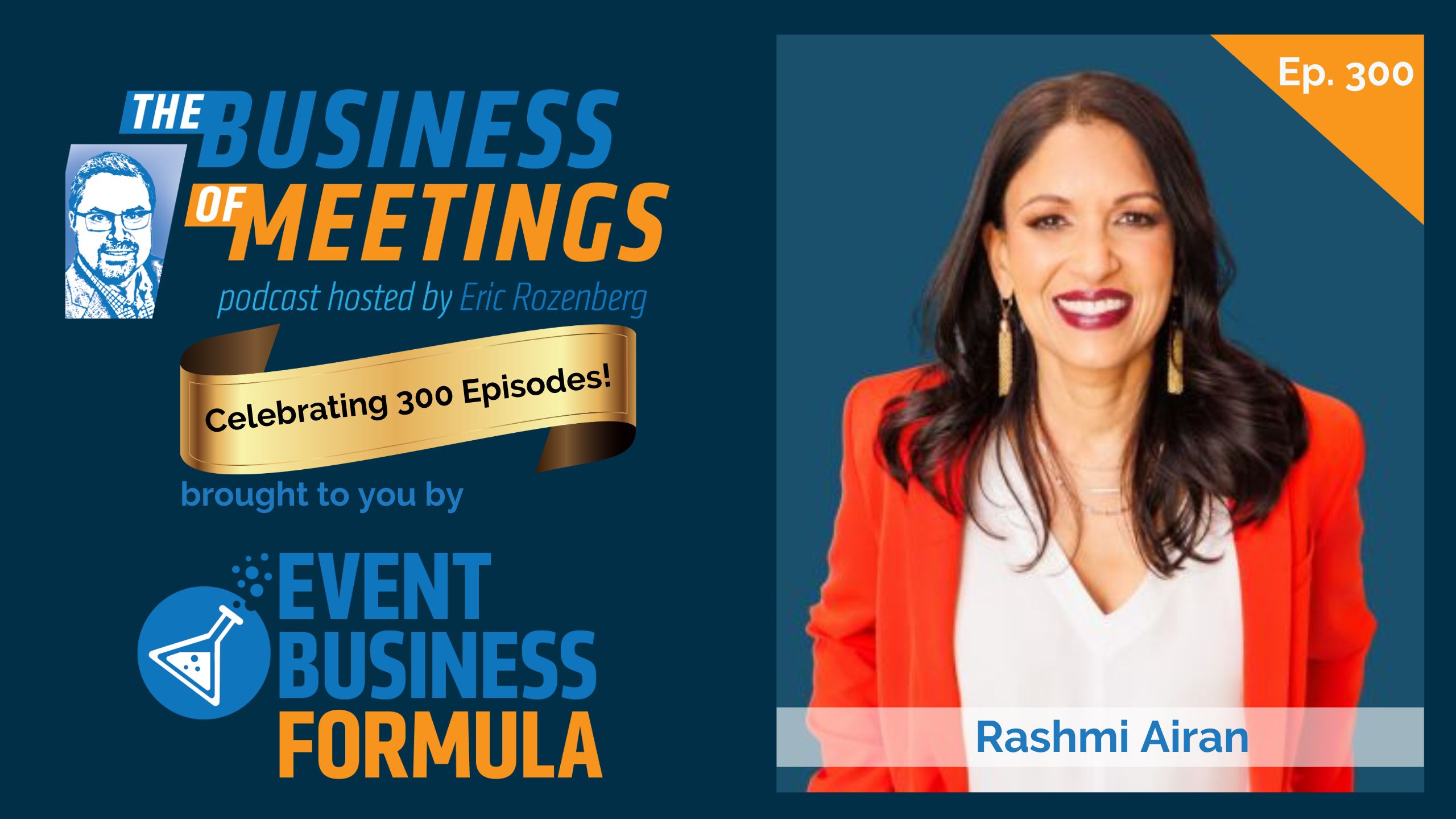
We are absolutely delighted to welcome Rashmi Airan as our guest today as we celebrate our 300th episode!
Rashmi is an extraordinary human being with remarkable depth of character, and as an ex-felon and former lawyer turned keynote speaker, her journey has been truly unique. She is an unapologetic truth-teller, prison chocolatier, and a champion of growth through struggle. She’s also a Bollywood dance aficionado, a singer, a corporate change leader, and an endurance athlete.
Tune in to hear Rashmi’s powerful story about ethics, accountability, and leadership forged through adversity.
Rashmi’s Early Journey and Identity
Growing up in South Florida as the daughter of Indian immigrants, Rashmi internalized the pressure to be the perfect little girl. Her identity became tied to her achievements, as she believed success meant making others proud through grades, elite schools, and financial stability. She built a strong academic and professional foundation, eventually opening her own real estate law practice while raising two young children.
Career Success, Overwork, and a Critical Decision
As the real estate market boomed in 2007, Rashmi hustled nonstop, juggling motherhood, a struggling marriage, and a solo legal practice. In that stressed state, she met a developer who presented “creative” buyer incentive deals. Although her gut signaled something was wrong, she convinced herself it would be fine because so many others were doing it. She moved forward without digging deeper, worked with the client for 15 months, and then moved on.
The FBI Investigation and Legal Fallout
Four years later, the FBI appeared at her door. Believing she had done nothing wrong, she spoke to them without legal counsel, answering aggressively from memory. Two years after that, she received a grand jury subpoena and was soon after indicted for conspiracy to commit bank fraud and 24 counts of bank fraud tied to transactions she handled. Seven years after she met the client, she faced the collapse of the entire identity she had built around perfection and achievement.
Owning Responsibility and Choosing Accountability
Rashmi’s attorney revealed the truth she had been avoiding, that she had a duty to ask herself hard questions, listen to her inner voice, and walk away when things felt wrong. Even though she had not intended to do anything wrong, she had failed to uphold that fiduciary responsibility. Pleading guilty was the hardest decision of her life, but she chose radical accountability, calling 200 people in her community to tell them personally before anything appeared publicly. Instead of rejection, she received compassion and forgiveness, which began her healing process.
Prison, Fear, and Inner Strength
Rashmi surrendered on August 17, 2015. Terrified of the unknown and heartbroken to leave her children, she walked into prison with no control over safety, environment, or routine. Processing, strip searches, and entering a floor of strangers amplified her fear. Yet she was sustained by her faith and the story of how her grandfather got imprisoned as a revolutionary alongside Gandhi in India. Remembering his strength reminded her that she could endure her own trial.
Healing, Forgiveness, and Spiritual Growth
While serving her sentence, Rashmi confronted her shame, fear, and anger. After forgiving herself, she eventually forgave the developer, who never got indicted. She realized that harboring anger was harming her more than the injustice itself, and she came to believe her experience served a larger spiritual purpose- to evolve into someone capable of helping others through struggle and uncertainty.
Emerging as a Speaker and Guide
After her release, people encouraged Rashmi to share her story due to the grace and integrity with which she had navigated her ordeal. She began speaking, hoping to help others avoid similar mistakes. Over time, her message expanded into resilience, values, integrity, and navigating uncertainty. Her work now focuses on keynotes, workshops, coaching, and leadership retreats that teach her methodology for moving through adversity.
A Framework for Navigating Uncertainty
Rashmi points out that everyone faces struggles, whether legal, medical, financial, emotional, or spiritual. Her core message is that you cannot rise above hardship by pushing harder. Growth comes from feeling the pain, reframing it, grounding yourself in values, surrendering ego and control, and evolving into a better version of yourself. This framework especially applies to solopreneurs and small business owners who juggle endless decisions and pressure.
Bio:
Rashmi Airan is a force of nature. A keynote speaker, consultant, and unapologetic truth-teller, she shakes up rooms with her raw, riveting story, one that challenges everything you think you know about leadership, ethics, and the hidden traps of ambition. She doesn’t just speak about resilience; she lives it, proving that even the most crushing failures can be transformed into a catalyst for growth, authenticity, and unshakable courage.
Rashmi’s family taught her to chase excellence as a first-generation Indian American. She did just that, graduating with honors from Columbia Law School, thriving in corporate America, and building her own law practice. But success has a dark side. During the housing boom, she made a decision that, at the time, seemed small but had devastating consequences. A single ethical blind spot, fueled by the pressure to provide for her children, led to a federal prison sentence for bank fraud.
Prison shattered everything she thought she knew about herself. And then? She rebuilt, stronger, bolder, and more awake than ever. Through six months behind bars, Rashmi stripped away the layers of ego, guilt, and fear that had defined her. She emerged with a powerful message: our worst mistakes don’t define us, our response to them does.
Now a “recovering government, corporate, and real estate lawyer,” Rashmi is a globally recognized speaker who fearlessly tackles the complexities of human behavior, decision-making, and ethical leadership. With 30+ years in business, law, and finance, she has a front-row seat to the pressures that push good people into bad decisions, and she’s on a mission to wake up individuals and organizations before they fall into the same traps.
Her insights are backed by cutting-edge research on resilience, growth, and leadership, and she’s partnered with global powerhouses like Coca-Cola, Cardinal Health, Merck, Comcast, Sotheby’s, and Hershey’s. Deloitte recognized her transformational impact, and ABC, PBS, The Washington Post, and The Wall Street Journal have featured her story.
Rashmi doesn’t do surface-level inspiration—she sparks deep, uncomfortable, necessary conversations. She challenges Fortune 100 leaders, financial firms, legal teams, and women’s groups to confront their blind spots, own their decisions, and rise through their struggles with integrity and courage.
Beyond the stage, she’s an avid hiker, globe-trotter, and proud mother of two. She serves on the Board of Directors for the Overtown Youth Center/Alonzo Mourning Foundation and is an Ambassador for The Key Clubhouse.
Connect with Eric Rozenberg
On LinkedIn
Listen to The Business of Meetings podcast
Subscribe to The Business of Meetings newsletter
Connect with Rashmi Airan
On her website
LinkedIn, Instagram, and TikTok
Email: Rashmi@rashmiairan.com
Listen on: Apple Podcasts · Spotify · YouTube
“The answer is not to push harder. The answer is you have to rise by going through it.”
Rashmi Airan
Full transcript of episode 300 of The Business of Meetings podcast, Eric Rozenberg with Rashmi Airan. Lightly edited for readability.
Eric: Hello and welcome to the Business of Meeting podcast. I’m your host, Eric Rosenberg. Over the years, I’ve had the privilege of helping businesses in the meetings and events industry grow and succeed, and I’m excited to share that experience with you. If you feel alone and overwhelmed, and if you’re looking to take your business to the next level, improve your strategy and sales, and connect with like-minded professionals, you are in the right place. I invite you to visit eventbusinessformula.com and join our community of event business owners dedicated to exponential growth. Now let’s dive into today’s episode.
Hello and welcome to a new episode of the Business of Meeting podcast. Today is an amazing guest. Well, you will tell me that the last 300 episode was an amazing guest, but today in particular, it is someone I had the chance to listen to. Her journey is absolutely unique. Her character is phenomenal. She is really an outstanding human being.
If you go on her LinkedIn profile, you will read that she’s an ex-felon and lawyer, a keynote speaker, an apologetic truth teller, a prison chocolatier, a growth from struggle, a championing unexpected connection, a Bollywood dance aficionado, a singer, a corporate change leader and endurance athlete. And I have to tell you, I’ve listened to a presentation in the past, and I’ve listened to many presentations in the past. There are very few people in this world that are as amazing as Rashmi.
Rashmi Airan, thank you so much for taking the time to speak with me today.
Rashmi: Oh, I’m so honored. Thank you so much, Eric. That’s really kind and humbling. I appreciate it. Thank you.
Eric: Well, it is just, again, I was blown away by your presentation, but it’s always a question I ask all my guests. So, let’s start with that. What is your journey?
Rashmi: Oh gosh. Well, my journey started as a little Indian girl. My parents are immigrants from India and I grew up here in South Florida. I think my entire life I felt like I had to be the perfect little girl to be loved, to have value, to have self-esteem. I don’t think I’m the exception. I think this is a pretty common story for immigrants and high achievers and probably most of us, right? We sort of convince ourselves that we have to be a certain way, and then our identity becomes wrapped up in what we do, not who we are.
By all accounts, I was doing all of those things. I certainly had a plan for my life, which was: if I go to the best schools and get the best grades and get the best jobs, I will make a lot of money, and that’s the definition of success, and then I can make everybody proud of me and life is perfect. And so I went to some really great schools, and yes, I did very well. I always won the awards and all the things.
I started my own law practice in 2004. I used to work for a couple of law firms, and I worked for the government here in County. When I started my own practice, it was a real estate legal practice. I ended up having two small children pretty quickly, and my husband at the time was a firefighter for the city of Miami. So, this was right around 2007. I started my practice in 2004, so the kids were born, and now it’s 2007. If you take yourself back to what happened in 2007, before the crisis, before the market crash, the real estate market in South Florida was booming, as I’m sure you remember.
I was doing closings. I was a transactional attorney at the time. I was a solo practitioner. I had two little children, and I was hustling. I was going to every networking event, selling my services at the gym, every possible meeting I could get. I would chase a client. And it meant I started having marital problems. My kids started asking me, “Mommy, are you coming home for dinner?”
It was within this context that I had a chance to meet a real estate developer. So, it’s October ’07, and I jumped at this opportunity. I thought, well, this is going to be the answer to all of my struggles. I can make it home for dinner. Kids won’t get mad at me. I might save my marriage. All of those things. When I walked in to go meet him, the principal owner of this development company actually sat in a side office, and his two right-hand guys, operations guys, were there, and they just began to describe what they were doing, which is essentially creative buyer incentives. So, creative transactions, which, if you recall, kind of every developer was doing back then, which doesn’t make it right. But what happened in my own head was I just convinced myself, and I just took the shortcut and assumed that if everybody else is doing it, it must be okay.
So even though my gut was screaming and something didn’t feel right, I just didn’t ask the right question. I didn’t walk away like I probably should have and think about what I was doing. Instead I jumped head first, and within two weeks I had my first closing request, and it was like a steamroll came in, right? And I just plowed forward. I worked with this client for about 15 months and then stopped working with them altogether. And four years later, the FBI came knocking.
Eric: Four years later.
Rashmi: Four years later. I don’t know how many of your audience members have ever dealt with the FBI, but I’m an attorney. I should know better, but I didn’t. I let them in. I talked to them without an attorney. And I answered all these questions as if I remembered it from memory. They were showing me documents and emails and pictures, and I was saying, “Yes, no, yes, I’ve seen this person, no, I never read that email,” things like that, very aggressively and flippantly, not recognizing and appreciating that this is the federal government, right? They will be able to recognize if I have not said the truth in any one of these questions. But at the moment I really didn’t think I had done anything wrong. My files by this point had already passed audit with my underwriter. I had moved on. I wasn’t even doing transactional work at this time. I had merged my practice with my father’s. And so when they left, I really didn’t think much of it, right? I was like, well, I’m just the lawyer. I have all the records. They just want to talk to me.
And then 2 years later, I got a grand jury subpoena for documents. And within 6 months, I was indicted for bank fraud. So, 7 years after I started working with the client, they indicted me for conspiracy to commit bank fraud and 24 counts of bank fraud. I had done 200 closings for this client. So they took 24 of those transactions and attached them to the complaint, and I thought my life was over. I had spent my whole life believing that people loved me for my achievements, and now this absolutely felt like failure. It took me a long time to go through this process of first forgiving myself and pleading guilty.
My attorney had a very hard conversation with me and helped me understand that even though I didn’t walk into this planning a crime, as an attorney I had a fiduciary duty to ask questions, to listen to my inner voice, to do the due diligence, or to walk away. And I didn’t do any of that. And the truth is, I knew something. I just didn’t want to know more. And ignorance is not a defense. You can’t pretend not to know. I made the hardest decision I’ve ever had to make, which is to plead guilty, to own that I would be a felon for the rest of my life. But then that became the journey of healing and forgiveness and growth.
In that process, I took accountability. In South Florida here, I’m very involved in our community. I sit on boards. I’m politically active. I know most of the politicians and executive directors of nonprofits and managing partners of law firms, and I had known them for the 25 years of my career. I made a very personal decision, and I didn’t want anybody to read about it. I didn’t know if there’d be a US attorney’s press release. So I called about 200 people in my life and told them.
Eric: True. And you told them one by one.
Rashmi: I wasn’t even sentenced yet. I just knew that I needed them to hear from me. So one by one I would call five or six people a day and cry hysterically and own it. And the magical thing that happened through that was that when I started these calls, I was so sure that every person would hang up on me, right? The only reason they love me is because I’m this superstar, right? So I totally believed I’d be shunned. And instead what happened was that I learned people are very forgiving of our humanity when we give them a chance. When we give them the chance to see our flawed existence, because we are all just humans living in this flawed existence, figuring it out, learning together. Once I got that understanding, I felt really at peace.
I got sentenced to a year. I served about six months of that sentence, because while I was incarcerated I was asked to testify in another case, and because of testifying in that other case I got out early. I skipped halfway house and house arrest, which was a total gift. When I came home, people started to say, “The way you’ve held yourself through this, the way you’ve had this positive journey in spiritual awakening and forgiveness and powerful ownership and learning about integrity, you should really share your story.” That’s how I started speaking. I had no idea what I was doing. I called my alumni. I went to Columbia Law School up in New York, so I called a professor there and asked if I could just share.
Initially, when I started this, I thought if I can help one law student in that case, or one person never go through what I went through because they learn how to make better decisions or how to check themselves in those moments, that’s worth it to me. I did that for many, many years, and word began to spread. But as time went on, people started to say, “Well, wait, we want to hear how you have come through this. What’s your secret sauce to resilience? What is that process that you have gone through?” So I spent all of 2024 deconstructing what that was, really going inwards. It’s not that I pivoted away from integrity and ethics, I still have a keynote on that, but I began to think about how I can touch people’s lives who are going through struggle and uncertainty, which is basically all of us every single day.
That’s the message of my story, because what I say to people is, it’s not about my story. None of you will go through what I went through, but all of us will go through some type of struggle. It just looks different for all of us. For some of us it’s legal, medical, marital, financial, mental health, and for others it’s fear, uncertainty, disruption, anxiety. We all go through something, and oftentimes it’s multiple things all at the same time.
When we’re going through those moments, when the world tells us to rise above and push harder and move on, I think they’re wrong, right? The answer is not to push harder. The answer is you have to rise by going through it. You actually have to feel the pain and you have to embrace it and you have to reframe it. And then I believe you have to identify what your core values are. Where do you stand? Who are the people that are aligned with you and are your anchors? Then you surrender. So the process is rise. Then you surrender, right? You surrender your ego, your fears, your control, and let go. And then you can evolve. Because I think struggle and uncertainty come into our lives for us to become and grow and evolve into better humans, into better versions of ourselves. I just think that’s the purpose of our humanity.
My work now really revolves around either keynote speaking or leading small group coaching or leadership retreats or workshops, really to talk about all of these things. If it’s from the keynote stage, it’s an hour. If it’s in a workshop, it’s 3 hours. And for your audience, which is solopreneurs and business owners and small business owners, that’s what I was for many years. We’re wearing so many hats all the time as small business owners that it’s very hard sometimes to navigate all the decisions and keep ahead of all the challenges. It’s very easy in those moments for a ball to drop and for us to try to cut a corner or say it was just this one time. What I hope is that people will hear my story and recognize you can’t just make that one bad decision and think it’s just that one time, because it’s a slippery slope. And that one time can end up coming back to haunt you, which is what happened to me.
Eric: So when you talk about the uncertainty and what people do and how they react, in another setting, when we decided to leave Belgium and come to the US, I realized one thing is that most people were complaining, most people were not happy, but people will in general choose misery over uncertainty, because uncertainty is extremely difficult. Can you explain your methodology, RISE? What does it stand for?
Rashmi: Sure. So it’s reframe, identify, surrender, evolve.
Eric: Love it. Has the real estate developer been convicted or something? From your presentation, I felt injustice in what you were saying.
Rashmi: Yeah. So one of the hard parts about this was that my client wasn’t even indicted, and for a very long time I was very mad about it and harbored a lot of anger, which was leading to an ulcer. Ultimately I went through a process of forgiving myself, truly forgiving myself for having made some bad decisions and not living by my values, right? Once I forgave myself, it was really important to me to be able to forgive him. And so I forgave him.
I was so upset at the beginning. Why am I the one going through this? Why am I the one that’s going to have to go to prison? That’s not fair, right? It’s our human nature, and it starts going into a downward spiral. My mom, who’s very spiritual, both my parents are, but I remember my mom saying, “Why would you wish this on anybody, any other human? You’re already going through it. Whether he gets indicted or not really doesn’t affect the fact that you’re already going through it, and we all have our own journeys in this life.”
Now, of course, I’m almost a decade out, well more than a decade, from being sentenced. And what I have recognized is that I truly believe that the universe needed me to go, wanted me to go through this experience. And look, I call it the universe or God energy, whatever. I always try not to alienate people, but God has become very spiritual for me. I believe that I went through this and I thankfully have been given the courage and strength to now share it so that other people can learn and grow because of my experience. So I would say I don’t wish prison on anybody, but I would not take it away from my own experience, because I’m a much better human today having gone through that.
Eric: No, it’s interesting you said, I don’t want to. You didn’t say the word often, but I don’t want to. People will not appreciate I speak about God or spirituality. This is insane for me. But that’s another conversation, because everybody thinks whatever they want as long as they respect each other. But yeah, if you don’t mind, I just want to ask a question about the going to prison part.
When I was a student back in Belgium, I was studying business, and I had a physics class. Why is it related to that? It was an auditorium, and I was of course in the back, one of those theater style rooms, right? And I was looking through the window, and on the other side of the street was the prison of Mont.
Rashmi: Wow.
Eric: And while we were having physics class, it was the time where the prisoners were doing the promenade.
Rashmi: Uh-huh.
Eric: And they were waving at us.
Rashmi: And could they see you?
Eric: They could see you through the window. Yeah, they could see us. We could see them.
Rashmi: Oh wow.
Eric: And that was almost traumatic for me. This situation of being free and studying and being a student and seeing people that cannot get out of it and waving, it felt very uncomfortable, and I thought, anything in my life but I just don’t want to ever go there. Now in your case, obviously you would not even know, but an Ivy League educated daughter of immigrants, Indian family, a lot of values. How do you feel the first day that you have to go there, knowing as well that it’s not that the FBI is coming and taking you to prison, it’s that this whole process, which is almost insane, but you’re going to have to go and you’re still walking down the street.
Rashmi: Yeah. So the morning that I surrendered, it was August 17th, 2015. I had a couple of wishes that morning. I wanted to pray at sunrise and run with my family. So I went to my favorite place in Miami. It’s a park that’s right on the water. Rashmi in Hindi means the light from the sunrise, so sunrises have always been spiritual, and I used to be a very avid runner at the time. I remember running, and at the time my kids were 9 and 10, and my son was so upset he couldn’t even come, right? He was really upset. So it was my mom, my dad and my daughter. By this point I was already separated. I did that, and when I came home, it was a feeling of being in a twilight zone, because I was full of fear, full of uncertainty, had zero idea what to expect. I was going to have no control over where I slept, what I ate, who I was with, would I be safe, all of the things. And I was being taken away from my family and my children, most importantly. I can’t even describe what it felt like. It was an out-of-body sort of feeling. I was compartmentalizing the fear and the emotion to be able to say goodbye to my kids, to be able to hug my parents.
On the first day of surrender, there’s so many unknowns, right? You’re being processed and they’re fingerprinting me, and all the things you can imagine. I had to squat and cough. They had to chug behind my ears, under my feet. They gave me clothing, but it was basic underwear and bras and socks and shoes, like slides, and prison clothing. I spent the first 10 days at a facility in downtown Miami as a holding center. By the time I got upstairs to the floor where the women are kept, it was a 12-story building and one floor was for women. By the time I got up to the floor, they give you one bedroll and a bag of essentials. The women there had already finished dinner. They were all doing their own thing, what they used to do in the small confined space, and me coming into a place where everyone had their own friends and cliques, it was very hard. I didn’t know a soul, and I was obviously scared out of my mind, thinking, how am I going to make it through this year?
My faith is what got me through, my internal strength of knowing. One of the things I didn’t share yet is that my grandfather, my father’s father, back in the 1940s was a revolutionary against the British. So he was in prison in India many times fighting the British, obviously, I believe, wrongfully, right? Because it was a political thing. But he was alongside Gandhi. I grew up hearing stories about my grandfather. So that first night, many times along this journey, I thought about him, and I continue to believe, I believe right now he’s sitting right here with me next to me. Many times along the way, I would say to myself, if my grandfather went through this in worse conditions, at a worse time, for something he didn’t even deserve, I’m my grandfather’s granddaughter. I can get through this. I’m strong. I can do this.
The worst part about it was leaving my kids, right? That was the hardest part. Worrying, who’s going to love on them? Will they be okay? How will they handle Mom not being there? That was the hardest part, I would say, intellectually, what’s going to happen to them emotionally. For me, I just wanted to get through every day, right?
I did finally get to a place of peace. My first night, I looked outside. There was this tiny slit of a window, and I remember, have you ever seen the Broadway show Rent? It’s a story of a year in New York City during the 1970s, not ’70s, maybe ’80s or early ’90s, when AIDS was really a big thing and there was no cure. It’s a story about a bunch of Bohemian characters, artsy, in the East Village of New York. At the intermission there’s a song that they sing, and the song is 525,600 minutes, and the song goes [song lyrics omitted]. I remember singing this song to myself.
The backstory of that is when I was in law school, which was in New York City, this show had just come out, and I saw this show with the original cast probably five times. I would just go and watch the show because I loved it. I loved the music and it was such a great show. It was not like it was planned. I’m laying on this really thin mattress, looking out a thin slit window, trying to find a star in downtown Miami, crying my eyes out, and I start singing this song to myself. I can do this. It’s a year. How am I going to measure this year? What am I going to do in this year? But I’m really grateful that I didn’t end up spending a whole year. It’s like you just put one foot in front of the other and you just have to keep going. I had to keep going for my kids.
And honestly, now when I talk to people and work with people on how we get through our hard moments and struggle and uncertainty, a lot of it is that when we feel like we can’t go any farther, we can. When we think we can’t climb back up, we can. It’s a choice. When uncertainty brings us down to our knees, we have to climb back up, because that’s the only way we’re going to grow. It’s the only way we’re going to move forward. I think in our families, and by the way, I got out of prison in 2016, and 3 years later my sister died from mental health. One year later, the love of my life died. So it’s not like struggle just ends after one big thing. We keep going through things, and we have to keep finding that courage to do it again, to move forward. So I do believe I’ve had my share, I’ve had my share of our promise.
Yeah. But one of my favorite quotes, from Winston Churchill, is “When you go through hell, keep walking.”
Eric: And that really, a great quote. I got emotional when you talked about your grandfather and how he inspired you, because my grandfather on my mother’s side jumped out of a train that would have taken him to Auschwitz on November 1st, 1942, and he had an amazing life. When we left Belgium, somebody said, now you’re jumping yourself out of the train. When you look at the kids and when you think about the grandparents, the resilience that you’re getting, to your point, it’s much, much, much stronger than what anybody would think, but what personally I would think , now you may be emotional.
Rashmi: Yeah, that’s really powerful. Wow. What courage that took for him to jump out of that train.
Eric: And hearing you talking about your grandfather and being with Mahatma Gandhi, and wow. But one last question, if I may, about that time. Your LinkedIn profile said prison chocolatier, and I’m from Belgium, so what about the chocolate there?
Rashmi: Okay. Wait, I’m going to show you, because I just came back from a conference where I spoke about this. I had 3 minutes to be on stage.
Eric: Yeah.
Rashmi: Okay. So, when I was in prison, one of the things I learned how to do was how to make chocolate truffles. It was not something I thought I would learn, but one of my bunkies taught me how to make chocolate truffles. I actually have a recipe card. And I just made these handmade chocolate truffles. Let me show you. I brought, I didn’t get to give away, I don’t know if you can see it, anyway, I made these handmade chocolate truffles for this conference to give away. But the story is that I would buy chocolate bars, hot cocoa and these fake Oreos, these black and white cookies, from the commissary. Then I would take chocolate milk from the chow hall, and I had a friend who worked in the kitchen, and she would swipe buttercream and cream cheese for me. There was obviously no table, no kitchen. There was a little area that kind of had a table, but I would stand over my locker and crush the cookies. Well, we would separate out the whites and then crush the cookies and then mix all of these ingredients together, roll them into little balls, lay them out to dry.
We didn’t have any tools. We had no fridge, we had no kitchen, but we had a tray that we would all share. And they were incredible, delicious. One of my lessons, really, by making the truffles, was that in a place where I thought I had nothing and everything had been stripped away from me, you figure it out, and you still figure out how to make things that are yummy and delicious and good. It’s sort of a metaphor for how we approach life, right? Even when we think we have nothing, we can still find gratitude. We can still find the things within us. The metaphor is we do have the ingredients we need to keep going, to keep striving and thriving and growing and learning and contributing to life and others. So yeah, I did learn. I’m happy to email this to you if you’d like. It’s my chocolate truffle recipe that I made in prison.
Eric: We’re in Boston, in South Florida, so I want to taste it and have a coffee with you.
Rashmi: Yes. 100%. 100%. For sure.
Eric: When you were there and you meet people, okay, in every setting in life you meet people. There’s some people that remain in your life, others don’t. Did you make friends there, or are you still in touch with people?
Rashmi: I am. Yeah. I would say the three people that I was closest to, there was one woman who I called my prison mom. Her name was Patricia. She was a couple of cubes down on the same hallway as me, in the same housing unit. She taught me how to crochet. I am not domestic, by the way. I am the least domestic woman. And I learned how to crochet while I was there. So I learned a new skill, and then I ended up crocheting blankets for my children for Christmas that year. That was my gift to them. We just became really close, right? She would leave me little notes on my locker with a quote from somebody. I remember this one quote. I don’t remember the quote, but she wrote the quote and it was from Goethe. G-O-E-T-H-E. I don’t know how to say that.
Eric: Philosopher. Goethe. Goethe. Don’t ask me about accent and pronunciation.
Rashmi: Okay. I don’t know how to say this guy’s name. And then she would write, “Love, Mom.” So we became very close.
Along with her, there was another woman. Her name was, oh my god, I’m having a blank, Shay. Shay was my prison sister. The three of us, we would do our jobs. We each had different jobs. We would come together in the multi-purpose room. There was this one big room where you could play board games or sit and talk or whatever. We always had our same table. We would sit together. We would read magazines together and just talk and chat and play games and whatever. Watch movies in the movie room together. So those two, and then my bunkie who I shared my cube with, her name was Michelle, and Michelle taught me a lot of things that I needed to know.
I remember, I got transported from the Miami Federal Center to the camp, which is where I spent most of my time, near Orlando, called Coleman. When I arrived, we had been on a bus overnight, and it’s a whole story on the transport. Once I got there, it was a very long day. We left at 12:00 at night. By the time we went through all of the things, I didn’t actually get into my new housing unit until 5:00 in the afternoon, right? So it was a very long day. And when I arrived, she had a coffee waiting for me, which was really lovely. Chocolate’s sort of a theme. It was basically chocolate coffee. It was a mocha, right? And it became our daily ritual, because there are many times during the day where there’s count, right? Where they come by and they count you. And 4:30 was one of those times. So at 4:30 every day, she and I would have coffee together because we both had to be standing in our cube. We were done with our job for the day. It was before dinner, and we would sit and we would have our coffee together.
My prison mom, Patricia, got out a few months after me, and she used to be an office manager for a law firm, and she knew that my parents were both lawyers. So without getting in touch with me, she got in touch with my parents, applied for a job and started working for my parents, and to date, over a decade later, she still works for my parents.
Eric: That’s wonderful.
Rashmi: And then the other two, I’m in touch with. They live elsewhere.
Eric: That’s wonderful. We’re always talking about planning long term for your business and being an entrepreneur. During those six months, were there things you said, “When I get out, those are the things I want to do in my life”? And have you done any of that? What’s happening when you get out and basically have to rebuild yourself and, as you say, be very resilient?
Rashmi: I’m not sure I was strategizing when I was in prison. In terms of what I wanted to do, I really treated it like an ashram experience and more soul-searching when I was there. I read a lot. I was not thinking about what’s next when I was there. I was just there, and I was trying to be present and have gratitude, and I felt like this was a government-imposed self timeout that I had to just take, some time to reflect and breathe and turn inward and understand who am I. That’s why I focused on that. I didn’t really think about what’s my next step until I came home.
Eric: Got it. Thank you. Thank you for sharing that. You are keynote, people are listening to you, and I’m sure your kids know how strong of a mom they have. It’s phenomenal.
Rashmi: Thank you.
Eric: What is your dream in terms of the keynote speaking, in terms of the circuit? Is it something you want to do all your life? Is it something that open other desire that you have?
Rashmi: Oh, that’s a great question. I love what I do. My definition of success has obviously shifted. I used to believe that it was how much money I made and who my clients were. And now it’s, can I impact one person today and change their life? I believe I live that every day. I go to sleep every day feeling meaningfully fulfilled. So yeah, I foresee myself doing what I do at least another decade. I’m lucky and fortunate that my kids are now in college. So, I am technically a road warrior, which means if I get booked for four events in one week in four different cities, I can do it because my kids are self-sufficient and living in college. It doesn’t mean I still don’t get calls asking for help and things, but generally speaking, I don’t have to bathe them and feed them and all those things. That does put me in a different situation than some of my colleagues who do have young kids at home and want to do one event per week or whatever.
My goal, I would say, is to grow my keynote speaking business and get more exposure, but I actually also love doing, to me, a keynote or an event could also be a partner retreat for a law firm or a leadership workshop for a big city or a leadership team. Those are two, three hours of meaningful workshopping and exercises where there’s arguably even more deeper, more courageous conversations, because I create the environment to facilitate hard conversations, to talk about things that most people don’t talk about. And then it sort of automatically leads to team engagement and team building, so there’s a lot of incredible growth that comes out of these experiences with me. I love what I do.
My book is coming out in May, like I told you earlier. And then I have a docuseries that’s being done on me. It doesn’t happen overnight, so it’s been in the works for a few years, and that’ll happen at some point. I know he is interested in selling my life rights at some point, so that will also probably happen, and then potentially a future scripted film. I think there are a lot of iterations and growth. I’m also starting my own podcast in the spring, which will focus on, the tentative title is Can You Own It? The title is really to interview people, have a hard conversation about owning hard things or moments of our lives, because most people haven’t thought about owning it, or owning something that maybe they need to.
Eric: I’m always half joking, when I hear a hard conversation, that people want to have a hard conversation until you start having a hard conversation with them.
Rashmi: Yeah, I do think that one of my superpowers is I give people permission to have that courage and vulnerability and recognize their own humanity. Because I fell hard and I still have my reputation, people still love me, and so I hopefully can be a good role model for others. I’m not as old as some of my mentors and colleagues, but I’m also not as young as some of my friends. I’m 54, and I turn to others that are younger than me but yet more advanced in this industry as a speaker. One woman in particular, she’s a decade younger than me, but I tell her, I laugh at her, her name’s Dee, I’m like, Dee, it’s so kind of funny because you’re a decade younger than me, but I see you as my mentor in this business, because she started five, whatever, eight years before me, so she’s farther along. When I say farther along, it means her fee is higher. She has better exposure. She’s booked bigger events and more events. It’s just like any other business. It just takes time to build momentum.
Eric: Absolutely. Yeah. An overnight success that took 10 years in the making.
Rashmi: Exactly. There is no magic bullet.
Eric: No. Absolutely. When I turned 40 a long time ago, I have a friend who told me, from this day on, if you wake up in the morning and you don’t feel any pain, it means you’re dead.
Rashmi: It’s true. It is.
Eric: Very motivational. Rashmi, I’m so fascinated since I saw you at my EO conference.
Rashmi: Oh, I’m so honored. Thank you. I’m honored.
Eric: Almost two years ago.
Rashmi: Yes.
Eric: Well, yeah. I’m really grateful you’re taking the time to speak with me today. I just want to finish on a lighter note. Again, small business owners, solopreneurs, you’re speaking, you’re writing, you’re podcasting, you’re having , even if they’re in college, you’re a mom, you’re traveling. Any tips on how you organize yourself and how you divide the week and manage your time?
Rashmi: Well, I start every single day with a workout. Doesn’t matter how much sleep I’ve had. It doesn’t matter where I am. Doesn’t matter what hotel I’m in, what city I’m in. I make the time for movement. Whether it’s a walk outside, if it’s possible, or I use a hotel gym, or I go to a gym here in Miami. I’m 100% committed to my lifestyle of living a healthy lifestyle, which means sometimes I forgo an hour or two of sleep so that I can get my workout in. That helps keep me mentally sane. There’s a little bit of vanity there, right? Because I have to stand on stage in front of people and I want to make sure I look good. So, there’s a little bit of that.
I start with that and some meditation. I wake up, and before I get out of bed I do a little meditation and I write in my gratitude journal, and then I start the day and I work out. I eat very clean and healthy. So that’s a big part of it. Having said that, I do love my chocolate, obviously. I love my chocolate, but I am pretty much a clean eater. And then I try to separate my day, as entrepreneurs, we have a lot of buckets that we have to fill every day. Whether it’s sales and marketing, HR, I have an assistant, so I’m managing that. In the sales or marketing there’s also all the social media fulfillment for many of us, which I do. And then there’s thought content, thought leadership and content development. I have to do that, and then client meetings and video creation. Every day there are things that I’m making sure I try to do at least some of. I don’t get to it all every day.
My kids are sort of screaming at me these days for me to have a social life and start dating and all of those things. So if I had to say where I’m not in balance right now, if I’m being honest, it’s that I work a lot. I just finished my book and I have been growing my business, and so usually it’s my social life that takes a backseat. It’s easier, because when you’re on the road as much as I am, when I’m home sometimes I’m like, “Oh, I just want to lay in my bed and watch Netflix.” It’s so much easier than getting dressed and going out and all the things. Especially eating out when you’re on the road just gets old. It’s just nice to be home and eat. So that’s my day. I don’t know if that’s what you were asking, but that’s how I live my day.
But I think as entrepreneurs, we have to be really intentional about making time for the things that we need to do. One of the things I’ll tell your audience is I always tell people, and I’ll show you, I have my list of things to do. I post it and I keep my list of things to do. What are the things I need to make sure I get done today? And look, this is a lot of things. It’s probably 11 things on my list for today, and it’s 2:48 and I have yet to finish. Not yet to finish, I’ve yet to even cross out one of them, because I had a late start today because of travel. But I recognize that I might not get through the whole list today, and that’s okay, because when I did make those bad decisions back in 2007 and 8, because I’m such a rule follower, a list maker and then checker, right? It’s so fulfilling to cross things off your list. But sometimes when you’re in that mode of trying to get it all done in one day, we take shortcuts or we make a quick decision or hasty decision or convenient decision just to get out of the office, or for me it was to get to my daughter’s volleyball game or my son’s basketball game or to the volunteer meeting that I needed to go to.
We had to stop and pause and remember that if you don’t give something the time and credit it’s due, that’s when the bad decision happens. That’s when the slippery slope happens, right? We have to make the time to pause and actually reflect on what we’re doing every day and everything, because it’s very easy as entrepreneurs to take a shortcut, and the ball will drop, and you think it’s not going to happen, but seven years later I got indicted.
Eric: Absolutely. On that note, I always look at the night before, and I have it here, it’s like, what are the three things I need to achieve?
Rashmi: Absolutely. Yeah.
Eric: And I’m blocking the time. If not, it’s not happening. So, how do people get in touch with you?
Rashmi: Oh, thanks for asking. I’m pretty easy to find. My name is Rashmi Airan. I’m sure you’ll have it in your notes. It’s R-A-S-H-M-I A-I-R-A-N. So it’s on LinkedIn, Instagram, Facebook, TikTok. My website is also my name. So I’m very easy to find. My email is also rashmi@rashmiairan.com. So that’s also very easy. If you have any questions, feel free to reach out. Oh, there’s also YouTube. YouTube is also my name. So, all of that.
Eric: Very good. My last question for today. When we meet again in one year with a bottle of champagne, what are we going to celebrate?
Rashmi: We’re going to celebrate the launch of my book. We’re going to hopefully celebrate that my docuseries has been sold to one of the big streaming companies, which would be amazing. And we’re going to celebrate that I achieved my goals for 2026 in terms of bookings for keynotes. Somebody just asked me this yesterday. I said, “I think my goals are 40 to 50 bookings next year,” which is very attainable. I have friends that book 80, 90 a year, which is a lot.
Eric: I know some of them.
Rashmi: Yeah, it’s a lot, and more than I want to be on the road. I need to start a relationship. I need to develop a relationship. I need to make time and at least have a social life. So 40 to 50 is a good number for me, I think.
Eric: Wonderful. It made me think of one of my favorite quotes, from Rabbi Eli, that actually Mahatma Gandhi used: “If I don’t do something for myself, who will? If I don’t do something for others, what am I worth? And if I don’t do it now, when?”
Rashmi: Such a great book. Thank you so much.
Eric: Thank you. I look forward to seeing you soon in person.
Rashmi: I would love that, Eric. Anytime.
Eric: Thank you for tuning in to the Business of Meeting podcast. I hope you found today’s episode valuable. If you enjoy the show, the most important thing you can do is leave a review and share it with your colleagues. It really helps spread the word. I truly appreciate your support. And if you’re ready to take your business to the next level, don’t forget to visit eventbusinessformula.com to learn more about how we are helping event business owners like you. Thanks again for listening, and I’ll see you next time.