
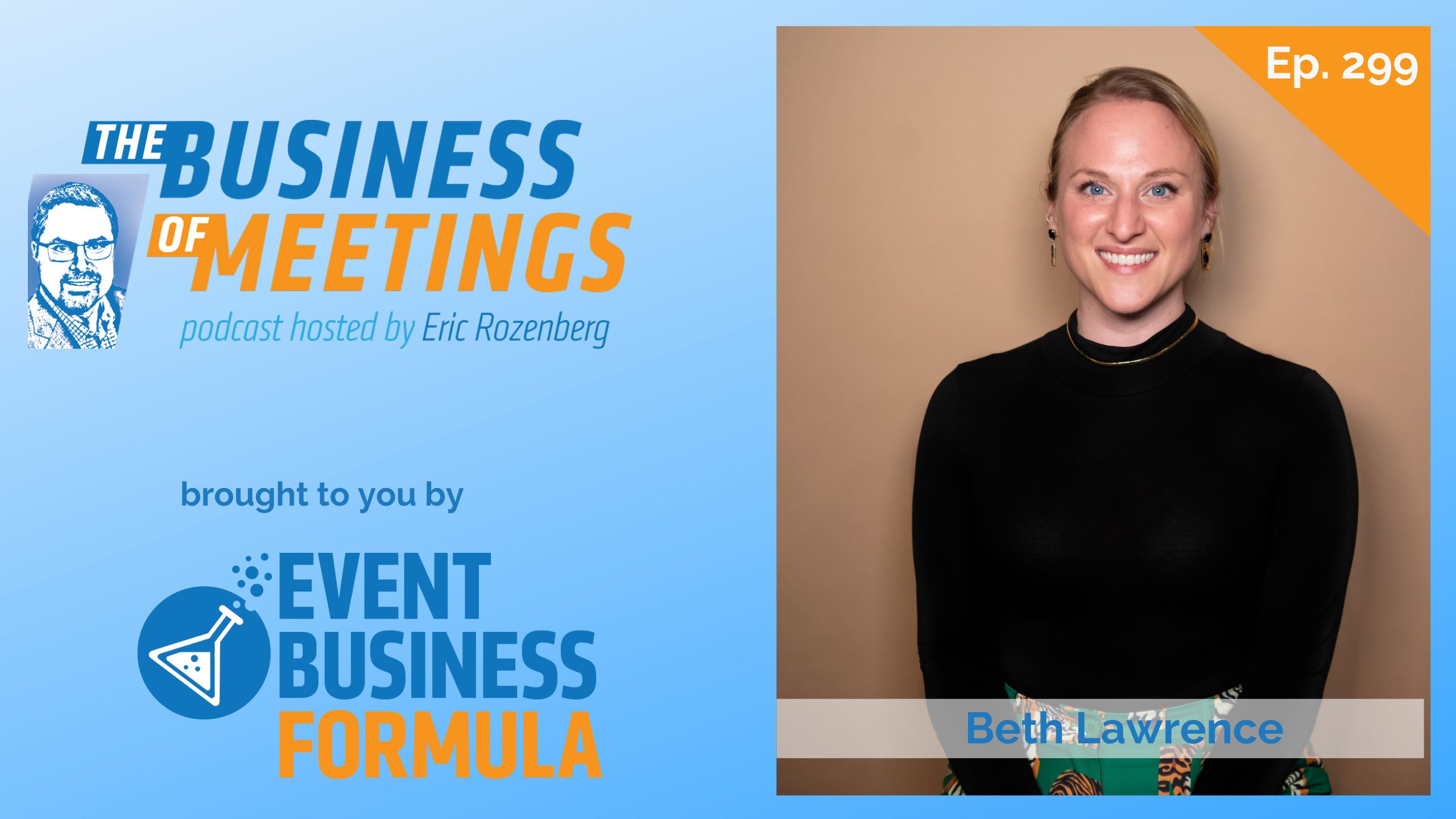
Today, we are excited to welcome Beth Lawrence as our guest. Over the past 20 years, Beth has seen the highs and lows of building and growing a business. Join us as she shares her entrepreneurial journey and the lessons she has learned along the way.
Beth’s Journey
Beth began college aiming to become a writer or professor, but she quickly realized the academic path was not for her, and pivoted. When she discovered event planning, it clicked instantly. She graduated during the 2008–2009 recession and built her career step by step, seizing each available stable opportunity, from property management to luxury catering, restaurants, startups, and volunteer roles. She created her own non-linear education, intentionally collecting skills from every job she did, no matter how small. That combination of creative, logistical, operational, and strategic strengths now defines her.
Grit and Curiosity
Beth treated every role as an opportunity to learn and grow. Administrative jobs, car dealerships, part-time shifts, internships, event operations, and volunteer work all became training grounds. That mindset, coupled with an overachieving work ethic, shaped her as a multidimensional strategist rather than a single-lane planner.
Discovering Her Entrepreneurial Drive
Beth always felt pulled toward entrepreneurship. After years of gaining experience across various organizations, she found a startup role that excited her. When she was unexpectedly laid off, her husband’s encouragement motivated her to launch her own business. Her family and friends supported her decision, recognizing her determination and her ability to succeed.
Uncertainty and Early Mistakes
Beth acknowledges the uncertainty of entrepreneurship and explains how companies often use that as a lever to keep employees in place. She made plenty of mistakes in her early years but reframes them as essential lessons, embracing the mindset that every failure provides data and every misstep informs the next decision. She still relies on her career mementos file, which contains cards, testimonials, and small wins, to recalibrate during moments of self-doubt.
Imposter Syndrome and Growth
Even though imposter syndrome still surfaces at unexpected moments, she has overcome much of it by recognizing that rooms full of accomplished people include her for the unique value she brings.
Her Niche: Event Logistics and Stakeholder Experience
Beth specializes in strategy-driven events for nonprofits, associations, and foundations. Her work spans the entire United States and extends into Canada. She builds long-term partnerships, guiding organizations from pre-event strategy to post-event analysis and year-over-year improvement. Her philosophy is that events must both inspire and deliver measurable results because inspiration without outcomes means the event did not achieve its purpose.
How She Advises Clients and Protects Their Vision
Beth enjoys creative ideation but also brings realism to her work. She helps clients distinguish between dreams and feasibility and is not afraid to say when plans, timelines, resources, or goals do not align well. Her guidance prevents budget issues, poor attendance, sponsor shortages, and rushed events that fail to achieve their intended impact. She sees her role as equal parts strategist, realist, and protector of long-term outcomes.
Bio: Beth Lawrence, CMP
As the Chief Experience Officer of my independent event planning company, I leverage 20+ years of experience in the luxury hospitality industry and my Certified Meeting Professional credential to create impactful, engaging events for a diverse range of clients.
I specialize in event logistics, project management, and stakeholder experience, ensuring that every event is planned and executed with excellence, efficiency, and ease. Since 2018, I have worked with clients such as Independence, Blue Cross, the New Jersey Historical Commission, the American Journalism Project, and Public Interest Law Center to build live and hybrid programming that increases audience engagement, creates community around a product, service, or brand, amplifies online presence, and increases ROI. I also host The Type A+ Podcast, a short-form show offering bite-sized tips to balance your business and life, even during your most hectic times.
I am passionate about human rights, health and wellness, the arts, pop culture, nature, and travel, and I love to share my insights and expertise with my listeners and clients.
Connect with Eric Rozenberg
On LinkedIn
Listen to The Business of Meetings podcast
Subscribe to The Business of Meetings newsletter
Connect with Beth Lawrence
On her website
Listen on: Apple Podcasts · Spotify · YouTube
“An aligned thing will find you. It’s just a matter of time.” (Beth Lawrence)
Beth Lawrence
Full transcript of episode 299 of The Business of Meetings podcast, Eric Rozenberg with Beth Lawrence. Lightly edited for readability.
Eric Rosenberg: Hello and welcome to the Business of Meeting podcast. I’m your host, Eric Rosenberg.
Over the years, I’ve had the privilege of helping businesses in the meetings and events industry grow and succeed. And I’m excited to share that experience with you. If you feel alone and overwhelmed, and if you’re looking to take your business to the next level, improve your strategy and sales, and connect with like-minded professionals, you are in the right place. I invite you to visit eventbusinessformula.com and join our community of event business owners dedicated to exponential growth. Now, let’s dive into today’s episode.
Hello and welcome to a new episode of the Business of Meeting podcast. And today I’m extremely happy to speak with Beth Lawrence. She has her own company. She’s been in the industry for 15, 20 years, and we’re gonna talk about her journey. I’m sure it’s going to resonate a lot with all of you because, guess what, she, like me, like a lot of entrepreneurs, has been going through a lot of things, the roller coaster of being an entrepreneur. So without further ado, Beth, thank you so much for taking the time to speak with me today.
Beth Lawrence: Thank you so much for having me. I love when my story can resonate with others and hopefully it will today.
Eric Rosenberg: I have no doubt, for a little conversation we already have.
Beth Lawrence: Absolutely.
Eric Rosenberg: And before we get to today, and as I was saying, the roller coaster of being an entrepreneur and specifically in our industry, tell us a little bit about your journey and how you came to do what you’re doing today.
Beth Lawrence: I came sort of through a very backend route. So I was sort of born to do this if you had asked my family. I came to college with a mission to be a writer and potentially a journalist and a professor of English. And I took one English class and said, “I can’t really, I don’t think I could picture myself doing this for the rest of my life.” The professor mentioned teaching the same thing every year for 30 years. And I just thought, nope. My brain just shut off. So, I really struggled for a little while of what I wanted to do. And when I came home to tell my parents, I told them I was going to transfer just after midway first semester. They’re like, “You’re not transferring. You got to figure out what you want to do.” So, I was able to find event planning. And when I told my parents that that’s what I wanted to major in, they said, “Well, you’ve been waking up every day early in the morning asking us what we were doing that day since we can remember. So, it’s pretty perfect for you.”
But I graduated in a really hard time. 2008, 2009 market crash, no event opportunities, sort of, I call it the rock climbing wall. So I had to grab the next most stable thing that I could to get to where I wanted to go. So that meant everything from working for a property manager in West Philly and doing their building events and operations to working beautiful luxury facilities and with beautiful catering companies in Philadelphia. I worked for Dave & Buster’s. I worked for a startup out of Austin. I worked for a restaurant and along the way I also did a lot of volunteering. So I sort of built my own career path non-traditionally and always my thought process was what can I do next to learn more. I really wanted to be well-rounded in the industry and so I come from a very unique perspective because of that.
Eric Rosenberg: Wow. I’m listening to you and the words that come to my mind are grit, perseverance, believe in yourself and hustling, hustling, hustling.
Beth Lawrence: Thank you.
Eric Rosenberg: And everything I worked for, the Club Med one year between two years the business school.
Beth Lawrence: Okay.
Eric Rosenberg: They call Gio, taking care of kids between four and eight years old. We had 40 of them. We were two. If you miss one, you’ll be what they call charterized the next day.
Beth Lawrence: Oh my god.
Eric Rosenberg: But I work in a restaurant and I pull cables in a factory. All those elements to me somehow are preparing us for what we doing today.
Beth Lawrence: Yes. Exactly. And you should look at it that way. I think even from your first job, what can I learn here? I worked in a car dealership when I was a senior in high school just doing some administrative tasks and I learned everything I possibly could. I learned a little bit about sales, learned a little bit about business math. Not enough, but I learned a little bit. Enough to learn that I didn’t want to do that full-time, but everything that I did from part-time jobs to internships really have shaped me to who I am today. And I feel like if I didn’t go into every single job with that thought process and with the overachieving nature of who I am, I don’t know that I would be where I am today.
Eric Rosenberg: Absolutely. When did the entrepreneurial bug bite you and you decided, you know what, I’m done working for others? I’m going to do it for myself.
Beth Lawrence: It’s funny you ask because I was one of those people that when I was graduating as a senior, I wrote on my resume that my mission one day was to own my own company and one of my advisers said, “Don’t write that. You want to put what your mission is for the job that you’re applying for. You don’t want to put that you don’t want to work for them one day.” So, I think it always was in the back of my mind, but it was a confidence thing, right? I’ve always been like a shot out of a cannon type of person, for lack of a better metaphor. I graduated ready to be in the industry to kind of make a name for myself. And it was really challenging because there really wasn’t that path. And so, it was just very interesting. It’s always something that I’ve wanted.
So I kind of built my career upon, like I said, learning as much as I possibly could from the part-time jobs, literally 2 hours to 4 hours a week part-time jobs, to the contract roles to everything volunteering that I did. I just kind of wanted to grab everything that I could. And then I was at a role that I loved. It was a startup out of Austin. It was a health food startup. I helped launch it in Philadelphia, which is a market that I absolutely love. It’s my home market. And I sort of told anyone that would listen, “This is my favorite job ever. No matter what happens, whether they lay me off or whether I leave on my own accord, I think I want to do something on my own.” And so when they laid me off two years in just due to restructuring, my husband actually, who I credit just with helping me to get the confidence to do a lot of what I’ve done, came home and he said, “I’m not worried about you. Are you going to start your own business now?” And so that’s what I did. And I’ve had a couple long-term clients that I took in-house roles with, but I always looked at everything from an entrepreneurial lens. Even when I worked for other people, I wanted to know the big picture. I couldn’t just know my concentration. I wanted to know the here and the why and the strategy and the everything. So, I feel like I’ve always approached everything with that mindset, which may have been a little obnoxious to manage when I was younger, but I think it’s a good effect now.
Eric Rosenberg: That’s awesome. Well, obviously you have a spouse who’s very supportive. Was everybody in your family and your friend circle supportive or did you have people said, “Why you doing this? Are you crazy?”
Beth Lawrence: I’m very lucky that you mentioned grit and perseverance. My family and my close friends know that if I have my mind set on something, I’m going to do it. So, I think my close friends and family were very supportive. Some did offer just options, right? I did have full-time opportunities offered to me within the first week that I was laid off from my role. But one person said something that really stuck with me. They said, because I was applying for these full-time jobs and kind of starting a business, they said, “You can’t put one foot in entrepreneurship. Knowing what you want to do, you have to go all in.”
But I did have people. What I did was when I got laid off, I called basically the top 20 people in my contact list that were my contacts and I just told them what happened. I scheduled either virtual or in-person time with them over the two weeks subsequent to me being laid off. And half of those people, I would say, were like, “Why would you start your own business? There’s so many event planning companies. What do you bring to the table that’s unique?” And some of them, I think, were coming from a good place, but I ignored them. And it’s important to know where people are coming from. If someone has worked for a company and grown for 20 years, their advice is going to be very different than someone who has not had that opportunity. Like I have not had that opportunity. So I also kind of took into consideration that they still cared about me, but their lens was a little bit different.
Eric Rosenberg: Absolutely. It’s so true what you’re saying. And also I would add to that those different categories of people, the ones that always dream of doing what you’re doing and somehow, I’m not that jealous, but they’re frustrated that they, I always said for many different settings people will choose misery over uncertainty, and a lot of people will stay where they are in corporate America in associate whatever because they don’t know about what can happen.
Beth Lawrence: Absolutely. Uncertainty is how they keep us in our roles a lot of the time, the fear of what’s next, because there is a real fear. There’s a lot of real risk in what we’re doing. And I didn’t make 100% great decisions the first couple years of my business. I flailed a little bit, but I think it was important that I learned those lessons just like I learned lessons when other people had their name on my business card.
Eric Rosenberg: Absolutely. Unfortunately, we don’t learn without mistakes. And that’s how you look at it. I don’t know who said that. I either win or learn.
Beth Lawrence: Ooh, that’s great. I love that. I need to remember that when I learn,
Eric Rosenberg: right? Is there anything that you were frustrated with when you were not working for yourself that you say that I will never do it, or is it something that you know, this is amazing, when I have my business this is exactly what I will do?
Beth Lawrence: Yeah, I definitely think the transition from being expected to be in a seat 8 to 5 plus every day versus in some of my roles before I went on my own, the two right before it was really, I don’t care where you are physically as long as you get your goals done, and especially when I was a regional, I couldn’t be sitting in the same place. I loved not having to go to the same place every day. So that’s something that I knew. I also never really liked micromanaging. I don’t like being hired and then being kind of made to feel like I don’t know what I’m doing. Obviously, there’s a learning curve and I need to be taught, but there were some managers that you could tell that they were just comfortable with me being in a certain place and a certain place only. And so, one thing that I always also thought was how can I help bring other people up in a way that I necessarily wasn’t nurtured or given those opportunities for a career path at my roles. And so, those are two things that I thought about.
And third, and this is going to sound crazy, but I was in sales and I was making a lot of money for other people. And I just remember thinking, if I can make money for other people potentially, as long as I can learn to hone in on what it is I do and why it is I do it and my value, I can really sell the heck out of myself. And sometimes I prove that right and sometimes I prove that wrong. But like I said, I learned those lessons and now I sit here learning, having learned those lessons, and coming from a place of being able to look back and say, “Okay, I did that. That was a little bit of a silly choice,” or whatever the case may be.
Eric Rosenberg: Yeah. I don’t know any entrepreneur that started that business and went straight line into success. It doesn’t happen like that. But I have a friend, a mentor, who one day told me, because I had doubts as anyone who start their own business, and he said, to your point about sales, he said, “Do you want to build your dream or do you want to keep on building someone else’s dream?” And I was like, okay, end of conversation, I know what I’m doing. And it doesn’t prevent me from having face many times and still some days the imposter syndrome where I’m thinking, I’m going to do this, what am I, why me? When I became chair of MPI, I remember the first meeting I had, on my left somebody who was the head of the largest AV production company and on my right the head of one of the largest hotel company, and I’m thinking, here I am, this guy from Belgium with several millions in revenue and that’s it, what am I doing here? And quickly you realize that you are there for a certain role and just focus on that.
When did you have, if you had in your life, imposter syndrome and how do you overcome it?
Beth Lawrence: I continue to have it. I think sometimes it creeps up when you’re not realizing it and you kind of go, oh, where did that come from? But I definitely think starting out my business there was a bit of imposter syndrome because you’re coming from a place of being laid off. So, you’re coming from a place of someone saying no to you for whatever reason. And then the next day, I remember I had to speak on a panel as the president of a nonprofit membership association. I had to speak and I had no business card to give out and it was the weirdest feeling in the world because it’s like, who am I to be talking about success when I just got laid off? So that was one example and that did actually translate unfortunately to me not really being able to share my value in a real way in the first year or two when I look back.
But I think with time and with experience and learnings you get more accustomed to those little bits and pieces of times where you feel like you’re failing and it doesn’t necessarily feel like the world is collapsing. But similar to what you’re saying, I was awarded in 2024 twice. I was awarded a Top 50 Voices and Events award and I received the email and my first thought was, was this meant for me? This can’t be, this has to be a pay-to-play. It just was because, to your point, the list was like Julius Solaris and the head of CVent, and I’m like, I just started a business seven or eight years ago and I happened to love what I do and talk about it a lot on LinkedIn, and I was so grateful but at the same time I felt so humbled and almost like if I were in a room with all of these people I would think, why in the world am I here? But then you have those friends and family that I mentioned that really are always going to sing your praises and say, exactly what you said, you’re in this room for a reason and that reason is because it has something to do or everything to do with who you are and what you bring to the table, not what those people bring to the table, which is something unique and special and phenomenal, but it’s different.
Eric Rosenberg: Absolutely. I love so much your example. I have a friend, Susan Ford Collins, wrote a book, The Joy of Success, and she, are you familiar with her?
Beth Lawrence: I am.
Eric Rosenberg: Yeah. So one of the things that Susan said is that you have to have your success file and that’s exactly what you’re describing. Then when you have those moments that we all have, think about how far you’ve come already and what,
Beth Lawrence: Oh, I have that. I have a file right behind me. It’s called career mementos and I still have the first card I was ever given by a client when I did a bar mitzvah, which I had never attended, let alone planned in my life, and I was so nervous and I really wanted to make it super special and they were over the moon. They were very picky clients, which I loved because I’m super picky and I have high standards. So I still have that and that was from probably 2010. But I also have cards that clients have written me recently and it does help. And I have a digital version of that too because testimonials aren’t just for external use. They really can sometimes pick you up when you feel like, man, what am I doing this for?
Eric Rosenberg: I love it. And I didn’t know about the bar mitzvah, but I admire being Jewish. I always refuse to plan those. Kudos to you and dealing with the families and the seating plans. Whoa.
Beth Lawrence: It was a phenomenal learning experience and they were a wonderful family. So a very, very, I did a lot of weddings too in my time as a luxury catering and event operations person and I tell you, I learned so much. It was so invaluable and one of the things I learned is that social events are not my thing. So I don’t do social events any longer. But they taught me a lot and the impeccable amount of detail and care that you have to have is something I carry with me.
Eric Rosenberg: What are you focusing on specifically in terms of your niche and your clients?
Beth Lawrence: Event logistics and stakeholder experience, and typically it’s for traditional nonprofits, sometimes foundations, sometimes associations, and I’ve worked with a few kind of larger name clients as well. I’m lucky that my work has spanned the entire United States. I’ve done some work in Canada and that’s just the events that I’ve done on my own and not in collaboration. So it’s funny, most of my clients have multi-year agreements. I work with my clients on everything from strategy through to the event execution, logistics, and the follow-through of the post-event, and really we pick up right after the post-event and try to use those learnings and move to the next year. So typically the clients are making an impact. That’s why when you look at my website it says events that inspire and deliver, because you have to inspire folks to hear your message, to learn what you’re sharing with them, but also you have to deliver on results. You can’t just have an inspirational, as much as I love an inspirational moment, you have to also be able to say, “Okay, well, what did you take away that you brought with you into your daily life? If there’s nothing, then we need to work on the impact.”
Eric Rosenberg: Absolutely. Back then in Belgium when I started my business, people told me exactly the same as you said. Really, there’s already so many companies. And then I quickly realized that on one hand most of my competitors were only focusing on the logistics and asking questions on the logistics, but also on the client side, when I would ask a sales director why do you do a sales meeting and the answer was, “Oh, because we do it every year,” I’m thinking, oh my god.
Beth Lawrence: Oh no. We just melt when we hear that, don’t we?
Eric Rosenberg: Right. So helping them understanding the strategy and helping them align the meetings and the face to face with the strategy, that’s where you winning.
Beth Lawrence: Yeah. My favorite thing is to work with leadership, to your point, and not only leadership but their teams as well. Look at the committee meetings and the department meetings of the entire marketing department or the sales department. If we’re doing a gathering, every stakeholder has slightly different goals. And if we don’t understand that, then we’re not going to speak to them in the right way. We’re not going to prepare them for the event in the right way. And we’re not going to deliver on their expectations. That goes from speakers, attendees, sponsors, media, exhibitors, partners. And I think looking at the event, like I said, I’ve always needed to see the big picture to look at the details. So I have to look at that big picture for the organization and then say, okay, now that I understand your big picture goals, let’s figure out how this event can make those happen or move them forward at least to whatever milestone we agree upon.
Eric Rosenberg: One of the mistakes I made at the beginning was not being assertive enough with the client when they will tell,
Beth Lawrence: Sorry, me too. Sorry, I didn’t mean to interrupt you. I made the same exact mistakes.
Eric Rosenberg: They will tell me, “Oh, and in those three days sales meeting we want to convey this and this,” and they’re like five messages, and I was thinking, but that’s not possible, you’re not going to succeed in that. But I was afraid to tell them. And of course it didn’t work.
Beth Lawrence: No.
Eric Rosenberg: And so it’s only when I put myself in their shoes but also as an adviser that things started to change. Can you share some of the example how you’ve been helping clients and basically being yourself and helping them?
Beth Lawrence: Yes, absolutely. It’s funny. I hate a bubble burster in real life. Like I hate when I say I love, I don’t know, reality TV and someone’s like, ugh, I hate reality TV. It’s like, if you hate it that’s fine, but maybe play along a little bit. But I sometimes have to be the person that is, we have the dream conversation, right? That’s what I love. I love ideating and it’s like, okay, if resources weren’t an object, what would we want to do? Because I think those conversations are important for future, for planning, for just getting you in a place where you’re excited about the event. But I also have to do the feasibility. Then we have to look at, okay, resources are a real thing. Time is a real thing. Amount of people on your team is a real thing, and amount of resources, hard fees and income and resources you can dedicate to the event.
And I think that’s really a lot of the times that’s where I gain their respect because I’m not just going to tell you yes. And I think to your point in the beginning, I have kind of two distinct people inside of me. I guess everybody has multiple, but I have an artist and a creative and a dreamer. And then I have the business person. And the creative and the dreamer would take over and be like, I can see this, it’s going to be great. Not thinking, okay, this is six months from now. They don’t have a sponsorship deck yet. They don’t know where they’re having this. The impossibility wouldn’t even sink in. And to your point, I would get so excited that I would want to inspire their vision, but I wouldn’t take it into that feasibility step as far as I could.
And now I am much more quick to say, okay, well, you want to do a first-time conference and you want to do it in 4 months and you don’t have a location or speakers or sponsors or even a committee to help you plan it yet. You haven’t even hired a planner yet. I don’t think that’s going to happen. Or if it is, it’s not going to happen in the way that you envision it. Here’s how I think it could happen. Or here’s an alternative that I think you could do. I think in four months you could do a great networking happy hour to galvanize people around what you’re planning potentially in the fall, because then it gives you three more months to get your sponsors together, to get your committee together. And they actually wound up listening to me and having an extremely successful event this fall rather than rushing it in June. Also something that I told them on this advisory call was the Philadelphia market is really not around when you want to have this conference. Everyone’s at the beach. So if you’re going to do this first time and you want it to be really impactful, you should do it this time and in this format. And so I think that there are times where it stinks having to be the person to say, “Wait a minute,” or “What about,” or “Have you considered?” But it’s those moments that will save you from running out of food at an event or from not having enough sponsors and then all of a sudden your budget just doubled and now you’re personally taking out of your pocket on a first-time event. These are real repercussions that I want to try to shield my clients from. And then from there, it’s the strategy. It’s like, “Okay, now the tactics. How are we going to actually make it happen?” Because I do at the end of the day want to make the event or the vision happen for them, or I want them to meet their goal and use an event to meet that goal, but it just might not be exactly what they have in their mind. And that’s something that I’ve had to be okay with. That’s been hard.
Eric Rosenberg: Why has it been hard?
Beth Lawrence: It’s hard because you want, as a business owner, to say yes to money. You want, as a business owner, to be the person that says yes to that person and encourages them to meet their vision. I don’t like when people tell me I can’t do something. It’s no fun. But I’ve also hired people before to do a job and then they sort of, like you said, not relying on me to be the expert but kind of putting it back in my court. And I’m thinking, why are you putting it back in my court? I hired you because you’re the expert in this. I’m not the expert in whatever this is. And so it’s hard to have hard conversations, frankly, especially when you’re just getting to know a client. But I think those hard conversations prevent you from having real mistakes or hard conversations later, potentially with sponsors or people that have funded your event and it didn’t come out the way that they thought it was going to.
Eric Rosenberg: I totally agree. And by the way, that’s the moment to have the hard conversations, at the beginning.
Beth Lawrence: Yes.
Eric Rosenberg: Because immediately you will see if they want to work with you and then you set the right expectation, or they don’t and you’re saving time and trouble down the road.
Beth Lawrence: Yep. Exactly. And sometimes saying no to one opportunity, it saves both of you, right? Because sometimes there is another planner that may take that and be able to roll with it the way that the client wants. It may work out, it may not, but at least the client then has their opportunity to go through or to look for other like-minded people to partner with. And then you can do the same thing. I know that when you say no to the wrong things, or the misaligned things, I shouldn’t say wrongs, there’s no good or bad, the misaligned things, an aligned thing will find you. It’s just a matter of time. And it’s a game. It’s a gamble sometimes, but that’s what entrepreneurship is.
Eric Rosenberg: Yeah, it is. And sales is also a game at some stage. At the end of the day, I think that’s also where you’re most aligned with your values and that’s where you are successful in the long run. I don’t see any other way to do that.
Beth Lawrence: Yes, absolutely. And then when you find true alignment, that’s why I have multi-year clients now, because there’s a true alignment there and I understand that I’m an integral part of their planning team and I also get that it’s a partnership. I get that their success is my success. All the vendor success is my success because that’s the client’s success.
Eric Rosenberg: Have you fired a client ever?
Beth Lawrence: Yes.
Eric Rosenberg: How was it?
Beth Lawrence: Really hard and the best lesson I’ve ever learned. I’ve fired multiple clients. Sometimes I look back and think this was the reason it got to the point that it got where you fired them, is because you didn’t set the boundary in the beginning or there was a misalignment in the contract and you chose to ignore it or what have you. There are times where I can look back and I can say, hmm, you played your role in that. And then there were other clients where it just literally wasn’t going to work. The feasibility dwindled every single day and it was an extreme misalignment in our working styles and it was a mutual agreement. I initiated it, but it was a mutual agreement. And it was really hard because I liked people to like me. And so when you tell someone, “I’m so sorry, this isn’t working out,” and you have a contract behind you to have to negotiate whatever that looks like, it’s no fun.
But at the end of the day, again, I think that particular situation, I left with an immense amount of respect for that person. Just because they don’t have the same working style as me doesn’t mean they’re a bad person. And I hope they left with an amount of respect for me because I was able to kind of meet them where I thought was fair in the contract, where I wasn’t taking more than I gave and they weren’t out more money than was fair for them. So, it’s hard, but I think at the end of the day, those are the lessons that got me the good clients, the aligned clients. Again, I shouldn’t say good clients, the aligned clients that I have now and the newer situations that brought me to this stage in my entrepreneurship, which is a stage that was necessary for me to be in and to kind of move through where I was to get where I am now. So, I have respect for all the clients that I fired and I hope that they have respect for me.
Eric Rosenberg: That’s phenomenal. That’s probably one of the greatest explanations I’ve ever had. So, kudos to you. You cannot please everyone.
Beth Lawrence: No. No.
Eric Rosenberg: And the market is so big. You will always find people that want to work with you and those that, to your point, they’re not bad or good. They’re just not the people that you want to spend your life with in the business.
Beth Lawrence: Right. Exactly. And I think people told me to niche down in the beginning when I started my business. This is also a lesson for everyone, especially if you get laid off. I started my business and I was so thinking about the money that was in or lack thereof that was in my bank account and trying to just think, I’ll do everything. I’ll do sales. I’ll do events. I’ll do marketing. I’ll do PR. And then no one knew what to hire me for because they were like, I don’t get how any of these intersect, and you’re only one person, so how are you doing all of these things? And very quickly I realized that events are my first love. I don’t like event marketing as much as I like the logistics and the stakeholder experience and creating what’s happening. I’m not as well versed in PR and I don’t know crisis communications and there are professionals that should be doing those things. And I find a personal conflict with sales and selling, for example sponsorship and working with multiple nonprofits. That’s a conflict for me because I have access to all of my nonprofit stakeholders and I would never mismatch them. But I just think it’s a recipe, even if I did it accidentally, I think it would be a recipe for disaster.
But as soon as I niched down, the right clients started to find me and I started to be able to say, “No, this doesn’t work, but here’s who I can refer you to.” And my business and my network started to thrive even more because I know people that are masters of their craft and communication. That’s who I should recommend my clients to, not me, who would probably ask them for advice while I was doing it. So, I think that’s also a really big lesson to people that are listening, especially if you’ve gotten laid off. Really truly, you don’t have to niche all the way down, right? I didn’t niche all the way down to nonprofits and impact driven organizations or causes till a couple of years ago, and I still expand every once in a while, but I think you should niche down a little bit so that people know what in the world you do in one sentence.
Eric Rosenberg: I couldn’t agree more. I’m coaching the accelerator program for EO, Entrepreneurs’ Organization.
Beth Lawrence: Okay.
Eric Rosenberg: Yeah. And it’s a great program, great people, and I have every year a group of entrepreneurs that are mostly not in our industry. I sometimes have one person from our industry. That’s it. And when I decided last year to go all in in helping small business owners in our industry, people were asking me, “Yeah, but why not any small business owners?” I said, “Listen, 80% is probably the same, but this is the industry I love. This is the industry I understand the most and this is the industry where I started several business before.” So that’s why it’s niching down, but it’s sometimes very hard because you’re looking at other opportunities, and kudos to you to stick with that. Now with everything that is happening today in the world, and I do believe that AI is a wonderful opportunity, but in the meantime there’s going to be a lot of people that will lose their job, will have to do something different. What is your advice for someone who’s being laid off and who’s looking at the next thing they should be doing?
Beth Lawrence: Okay, this is what I do. I can only tell you what I’ve done and what I’ve learned from helping others who’ve been in similar situations. I got laid off on a Wednesday. It was effective that evening. So, that was also really hard for me because I had never been fired, laid off, nothing. And I didn’t do anything wrong, but it just kind of felt like, what do I get up and do tomorrow? So I knew that I had to feel the feelings. So I gave myself two days to cry, and the weekend basically. I gave myself two business days and then the weekend to cry. And then Thursday, so this was Thursday, the day after, I had a networking event. I started to tell people. I had called people immediately when I got laid off at noon. Basically, I called all of my networking contacts, the ones that I made myself that I knew would come wherever I would go. And I just told them what was happening. Like I said, I made appointments both virtual and in person and just told them what happened and what I was thinking. I listened. I took notes. I didn’t take in all of it, but I listened. And it allowed me to help formulate a plan. It allowed me to feel like I had some momentum.
Immediately, like divine intervention, when I got laid off, I logged into Facebook, I remember, and there were two workshops that were being offered. One was making your own website and two was making your business legally legit, and they were $30 total for both of them and I signed up right away. I mean, that was divine intervention. But now there’s so many places that you can look for advice. There’s MasterClass, there’s Coursera, there’s local small business associations and chambers of commerce. But get advice from wherever you absolutely can. And then you have to figure out what you want. What do you want to do next? Do you want to manage people? Do you want to work for yourself, work for someone else, do a little freelancing, do a little of both? Do you want to take a little bit of time? Can you afford to take a little bit of time? And really think about what you want to do, or get a career coach. I couldn’t afford to do any of those things. So, what I did was basically chose a path and went head-on for it. And I think that that’s the best advice that I can give. And if you know that this is your path, no one’s going to be able to deter you.
And what’s funny, this is something I may have told on a podcast before, but after I got laid off, I was setting up my desk and everything in my home and I found a small calendar book from my bag that I used to take to my startup job before I got laid off. And it was a little calendar and notebook that I had taken with me to a BizBash conference. And I was taking notes and I was so inspired by so many of the experiential and event speakers that I wrote, “My name is Beth Lawrence and I own my own events and experiential company.” And I circled it. That’s something that my friends and I do, my high school friends, shout out to them, to manifest. I wrote that in November of 2017, the calendar, and I circled it. I got laid off November 8th of 2017. So, I knew what I wanted to do. But if you don’t, I think it’s critical to take time to find that out. Even if you take part-time jobs to take in income in the meantime.
Eric Rosenberg: That’s awesome. I remember when I decided to start my business. I left an amazing job in finance and marketing to get into partnership with a couple I had met on the holidays. And 10 months later, I had to resign because I realized that one of the persons didn’t want to have a business partner. And so on my way driving home, I was like, why did I do that? Did I make a mistake? What’s going to happen in my life? And by the time I arrived to my apartment, I said, okay, I’m going to start my own business. And I had the chance that my grandfather, who was far from being a billionaire, I would say, “Listen, you don’t have to worry about eating or sleeping for a year.” And then I had two first clients, amazing people I knew. But one thing that helped me as well, besides trusting the guts and said this is what I want to be doing, I was listening to two music but probably 50 times a day. The first one was Mission Impossible.
Beth Lawrence: I love that.
Eric Rosenberg: And the second one was Kajanin, who happened to be a neighbor. She was singing in Swili a cover song of “I’m Free” from Stevie Wonder. And she was saying, “I’m free.” I’m free without any fortune but without any debt, and that will give me so much energy till today.
Beth Lawrence: I love those songs.
Eric Rosenberg: But so what is the dream? How do you see your company in 10 years?
Beth Lawrence: I would love to work with more organizations who are doing great things for the planet. You mentioned AI. I love AI. I think we can’t stop it, right? It’s like the internet. It’s just going to be in our lives. But I think there’s a critical way we can look at it when it comes to the environment. So that’s something that I would really like to find, more organizations, like ethical tech organizations, that look at things like that, especially as it relates to our industry, which has a large carbon footprint as it is. I think I would really love to take my business more global. I’ve done, like I said, I’ve done things all over the country, in Canada as well, but I would love to plan more global experiences, and incentive trips and multi-day conferences are really where it’s at. And eventually I would love to plan something in the music industry, whether that be an award ceremony like the Grammys or a tour or something like Coachella.
Music inspires me endlessly. In fact, I went to a concert when I was 13. It’s the Dave Matthews Band, which is probably the most basic, quote unquote, thing about me, that I love them very much. I’ve been to about 40 of their shows. And I remember looking around and thinking, all of these people are here to watch this one act and we are all here and we have this thing in common and that’s why we’re all here. And it was just such a cool feeling and I think that was my first real feeling of community, like in my chest. I felt like, wow, I’m part of a larger community. And that was one of the things that inspired me and continues to inspire me with events, is bringing people into the fold. Whether that’s again learning, if you’re a scientist or a doctor presenting something at a conference, if really learning truly things that can change the world, if you’re learning tactics to apply to your business, if you’re meeting people that could widen your circle, I think that all reverberates and it creates a larger community and in the end I think will create a better world, the more that people can gather together, share ideas and find commonality. That’s just something that continues to inspire me.
Eric Rosenberg: My goodness, if only you were passionate.
Beth Lawrence: I’ve been told I should run for office and I was like, I don’t want anything to do with that. But yes, I’m definitely a passionate individual.
Eric Rosenberg: I love it. And you have such clarity about where you’re going. So, I’m sure this is going to happen. So, congratulations. I truly enjoy our conversation today. Time flies. And I have two last questions for you. The first one is how do people get in touch with you?
Beth Lawrence: I think the best way is my website, which is bethlawrence,com. So it’s very easy to remember. And then LinkedIn, Beth Lawrence, and it’s L-A-W-N. I’m sure it’s in the show notes, but I like to specify that LinkedIn and my website are the two best ways to follow what I’m doing and get in touch with me. I do have Instagram as well. It’s Beth_Lawrence vents.
Eric Rosenberg: Wonderful. Thank you. And my last question, when we meet next year at this time with a bottle of champagne, what are we going to celebrate?
Beth Lawrence: We are going to be celebrating record-breaking revenue for my company.
Eric Rosenberg: Wonderful. Thank you so much and I look forward seeing you in person at the industry conference.
Beth Lawrence: Thank you. You as well.
Eric Rosenberg: Thank you for tuning in to the Business of Meeting podcast. I hope you found today’s episode valuable. If you enjoy the show, the most important thing you can do is leave a review and share it with your colleagues. It really helps spread the word. I truly appreciate your support. And if you’re ready to take your business to the next level, don’t forget to visit eventbusinessformula.com to learn more about how we are helping event business owners like you. Thanks again for listening and I’ll see you next.