
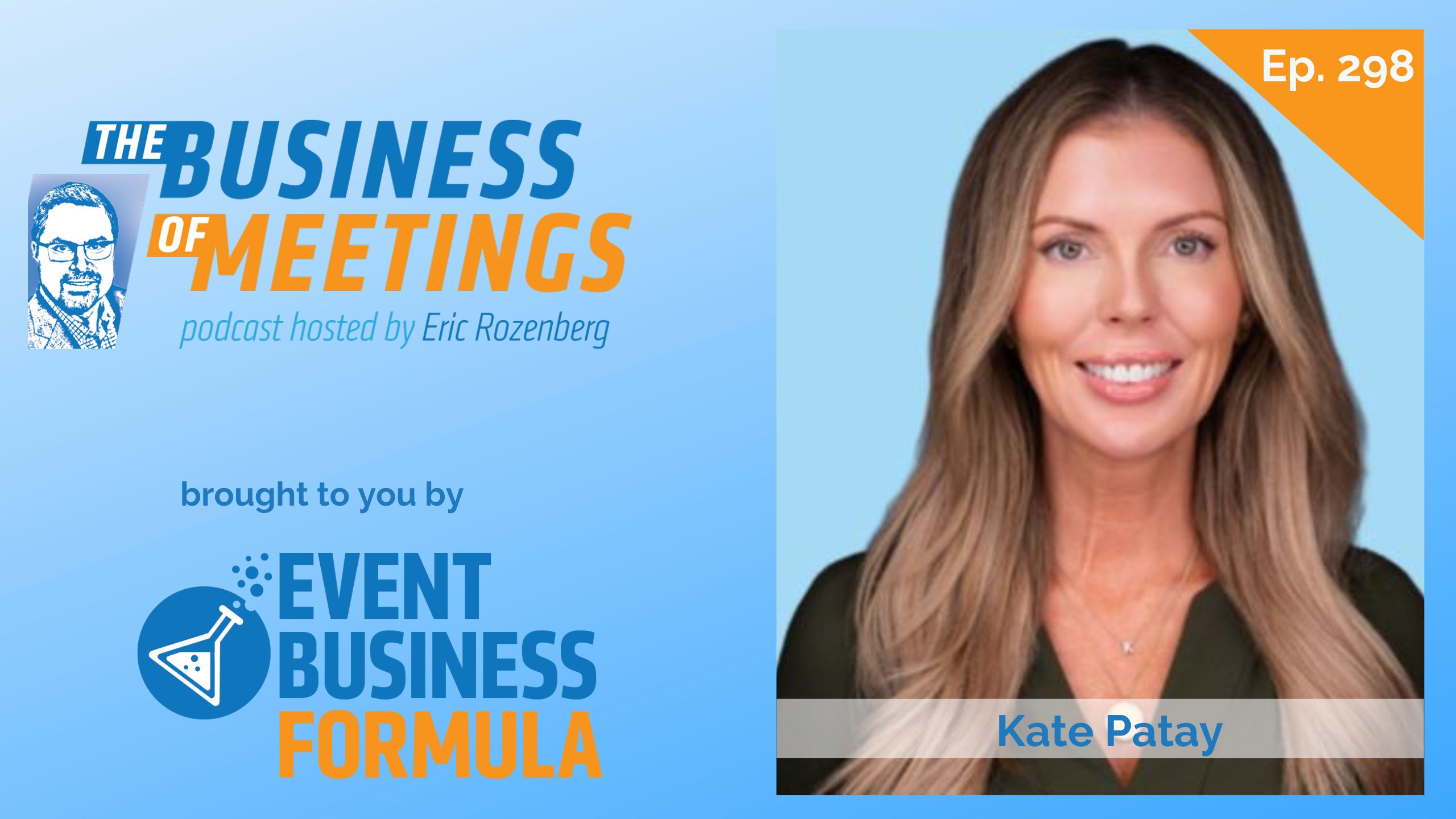
We are truly honored to speak with Kate Patay today.
Kate is a true leader in our industry who excels professionally and consistently gives back in meaningful ways. She is a media engagement strategist, event design and production expert, international speaker, mentor, connector, and travel enthusiast who serves as the Vice President of Global Engagement at Terramar, a DCM company, and chairwoman of the SEARCH Foundation. She is also a proud Swiftie!
Stay tuned to hear about her remarkable journey and the insights she’s gained along the way.
Kate’s Path Into the Events Industry
Kate stumbled into the events world expecting to pursue a different career, but quickly realized that the work was in her blood. She began in food and beverage, moved through catering, hotels, and vendor roles, and ultimately launched her own firm, where she specialized in strategy and growth for small businesses and built a trusted global network. After collaborating with Terramar for years, the company invited her to join the team. The role aligned perfectly with her values, and three-and-a-half years later, she still feels deeply fulfilled, energized, and grateful to be part of a team that makes her smile every day.
Joining Terramar
Kate emphasizes the importance of values alignment, shared commitment to service, and honest conversations about expectations. For her, the biggest hurdle was navigating change management, but she believes that when change is rooted in doing the right thing, people ultimately get on board.
Embracing Change
Growth only happens when we step beyond comfort and into uncertainty. Kate describes fear as a signal that something bigger is coming. She explains that transformation lives just beyond the point of discomfort.
Breast Cancer Diagnosis and Journey
Kate pushed for additional testing after receiving a clear mammogram. Doctors found two cancerous masses, leading to a double mastectomy and multiple follow-up surgeries due to complications, and a third surgery, which required traveling to a specialist with only 96 hours’ notice. Thirteen days later, she stepped onto the IMEX stage to present. Her cancer is now clear, and she awaits final confirmation in January to officially begin her cancer-free countdown.
Mindset, Support, and Self-Care
Kate highlights the importance of putting yourself first. She encourages regular checkups, not dismissing symptoms, and making your health a priority. Support systems mattered a lot to her in her healing process, with colleagues who protected her privacy, stepped in to help, and ensured her work never suffered while she recovered.
The SEARCH Foundation
The SEARCH Foundation supports meeting and event professionals experiencing catastrophic illness, natural disasters, and other crises. The foundation began in 1997 during the AIDS epidemic and has expanded globally. Kate has served as board chair for six years and has recommitted for a third term because she sees so many lives transformed by this safety net. SEARCH is funded entirely by industry professionals, from monthly donors to students contributing just a few dollars.
Bio:
Kate Patay, CPCE – Vice President of Global Engagement, Terramar, a DMC Network Company
Kate Patay, CPCE, is the Vice President of Global Engagement at Terramar, a DMC Network Company, and a globally recognized industry leader known for creating extraordinary events, building strategic partnerships, and delivering experiences that leave a lasting impact.
An in-demand international speaker and thought leader, Kate is celebrated for her authentic, engaging approach to topics that matter most in today’s evolving events landscape. She currently serves as Chair of the SEARCH Foundation, supporting event professionals in times of crisis, and continues to champion innovation, mentorship, and community across the industry.
Her accolades include the prestigious Pacesetter Award from the Events Industry Council, the Richard Carbotti Humanitarian Award, recognition as one of BizBash’s 25 Most Influential #EventProfs, and inclusion in the Top 20 Global #EventProfs to Follow in 2025. She has also been honored as Smart Meetings Speaker of the Year and credited with leading the surprise-and-delight experience design at Dreamforce multiple times.
Kate recently completed multiple certificate programs through Harvard University Online, expanding her expertise in leadership and organizational development. When she’s not on stage or strategizing global programs, she’s a devoted advocate for self-care, believes shopping might be addicted to her, and is an unapologetic Taylor Swift enthusiast.
Connect with Eric Rozenberg
On LinkedIn
Listen to The Business of Meetings podcast
Subscribe to The Business of Meetings newsletter
Connect with Kate Patay
SEARCH Foundation on Instagram
Terramar on LinkedInEmail Kate: kate@katepatay.com or kate@terramardmc.com
Listen on: Apple Podcasts · Spotify · YouTube
“If it helps one person to not feel alone, or it makes one person go get checked and they catch something, then it was worth all of the privacy I lost to put that out there publicly.”
Kate Patay
Full transcript of episode 298 of The Business of Meetings podcast, Eric Rozenberg with Kate Patay. Lightly edited for readability.
Eric: Hello and welcome to the Business of Meeting podcast. I’m your host, Eric Rosenberg.
Over the years, I’ve had the privilege of helping businesses in the meetings and event industry grow and succeed, and I’m excited to share that experience with you. If you feel alone and overwhelmed, and if you’re looking to take your business to the next level, improve your strategy and sales, and connect with like-minded professionals, you are in the right place. I invite you to visit eventbusinessformula.com and join our community of event business owners dedicated to exponential growth. Now let’s dive into today’s episode.
Hello and welcome to a new episode of the Business of Meeting podcast. Today I am absolutely honored and grateful to speak with someone that I’ve never met. She had a post on LinkedIn that really touched me, and reading about her, I realized that she’s a true leader. She’s someone that is not only in our industry but also giving back to our industry. She’s the vice president of global engagement of Terramar, a DMC network company. She’s the chairwoman of Search Foundation. She is, according to her LinkedIn profile, a media engagement strategist, event design and production, international speaker, surprise and delight specialist, obviously Search Foundation chairwoman, ambassador, connector, mentor, travel enthusiast, Swifty. That’s probably the only thing I’m not really aligned with, but I got three daughters. So, ladies and gentlemen, it is my great pleasure and honor to welcome on this podcast Kate Patay. Kate, thank you so much for taking the time to speak with me today.
Kate: Of course, I’m excited to be here and be better connected. When you reached out after my post, it felt like such a good connection. And when I looked into who you’re talking to and your audience and this podcast, it felt very authentic and genuine. So, thank you.
Eric: Well, thanks to you, because yes, I’m focusing on small business owners and helping them grow and manage their business better. And it’s not only that, it’s also giving back. It’s helping people. And that is definitely what you and the Search Foundation are doing. So before we speak about the post that you did a few weeks ago, let’s go back to your journey. How did you join our industry?
Kate: I think I joined like everyone else did. I kind of stumbled into it and thought I might go into a different career path, and as soon as I tried to get away from events, I knew that it was in my blood. This was what I love to do. So, starting on the food and beverage side, catering, hotels, going to the vendor side for a bit, eventually launching my own firm. For quite some time I was helping small businesses, a lot of the strategy and growth behind them, and I loved every minute of it.
And it’s funny, because Terramar is someone I worked alongside when I had my firm. I loved the network. When I needed assistance at any of the destinations globally for the FAM I was helping with, that was my go-to. That was who I leaned on. And at an IMEX in, oh gosh, probably 2021, one of the first ones back after the pandemic, we had some conversations. Terramar had been expanding, and the conversation opened up and they said, “We love what you’re doing and your messaging and everything that kind of falls under the umbrella. Will you do that under ours? Like, be part of this team?”
I don’t think it was a conversation I expected right off the bat, but I think you also kind of carve your path in this industry, because I never thought I’d be a business owner either and have my own firm and get paid to actually do what I love doing and I’m really good at. Being able to carve that out, and that someone recognized it and came to me and said, “Don’t change anything about you, but come do that with us.” It aligned. It aligned so perfectly. And I am so happy sitting here 3 and 1/2 years later as part of this team and watching Terramar. Oh my goodness, I can’t say enough good words about the team that we have. They are pretty spectacular, and every day when I’m getting on the phone, taking calls, replying to emails, or just working with the destinations, I find myself genuinely smiling. It’s like, that’s the dream, right? That you smile when you’re talking to your colleagues.
Eric: Absolutely. I’m listening to you and I’m thinking, wow, how lucky she is, because obviously when you start your business there are different reasons for that, and you need to have a certain character and also be able to manage a dose of stress that actually few people will be able to. And in the meantime, nobody does it alone. So when you’re describing you joining an organization, what were your thoughts when you accepted their offer? Because it’s completely different to have your own business, on your own, working for other people, versus integrating their organization, looking at their values, their culture. You never know what’s going to happen.
Kate: You don’t. And at the end of the day, the values and culture across the destinations, they all were rooted in that same firm belief of delivering unparalleled service, and it fell in line with a lot of my belief system. When I had started my company, one of the quotes I always used was an Oprah quote. It was just one that spoke to me the first time I read it, about your brand and who you are and what you put out into the world is what you receive back.
And I think when I came in, full transparency, the very first thought I had was, one, do they even understand what I’m here to do? And two, is everyone going to be on board with all of this? Because change is scary. You have all these destinations that were successful in their own right and doing great things, and to bring them under that one umbrella together, I think that change management is probably the scariest part of any leader’s job. But when it’s rooted in doing the right thing, eventually everybody gets on board with that. So, it was interesting. Also, being a business owner, I was like, do I have to put things into a calendar? Do I have a schedule? What does that look like now? We had all of those conversations. You have to set expectations. You know that you’re helping people grow businesses.
Eric: Absolutely. And you know what? To your point, change is really the most difficult. In another way, I don’t have any experience with people, including myself, that actually evolve without a challenging situation or without challenges. But also, when we left Belgium with my family, people would say, “Why are you doing this?” And I realized that in general most people will choose misery over uncertainty, and that’s kind of sad to me, because I only have one life. So, I believe that that’s a really sad statement, but it’s true.
Kate: People will choose to be in misery because it’s comfortable and it’s familiar and they know that, versus stepping outside of the box and having change, because that’s so uncomfortable feeling and it’s such a foreign feeling to them. But I think once you can push past that, then that’s where real success comes from. Real change happens when you get past being scared and you step into the unknown. I’ve thought that for years. If I’m making a decision and I have butterflies in my stomach a little bit and I’m not really sure, those butterflies to me are a sign something bigger is coming. I need to lean in on this. It’s like going on stage and doing a keynote. You get those little butterflies before you go on, but you’re out there because you believe in your messaging. And as soon as you step on, that goes away. Like, you’ve pushed past the point of uncomfortable.
Eric: Absolutely. And again, I want to come back to what I mentioned earlier on, which is your post two weeks ago. I know, unfortunately, and we all know, a lot of people that went through what you’re going to explain now, and some people are very, very, very secretive about it and other people are very open and public about it. So tell us what happened and how you discovered that.
Kate: Well, this started as a very private journey, which changed based on the feedback I got from the few people I did share with. But in April, on April Fool’s Day, of course, the least funny day in America for me right now, I was diagnosed with breast cancer and had to go in for a double mastectomy. I had to push quite a bit to get treatment, to get taken care of, because I had just recently had a mammogram. I try to take care of myself, stay on top of my health, because if we’re not taking care of ourselves, we can’t take care of anybody else, our clients, our families. So, I’m very diligent about that. I had just had a routine check, and I came back and I said, “Something’s wrong. Something’s wrong.” And I got told, “You were just checked. You’ll be okay.” And I pushed. I was like, “No, something’s wrong. Please check.” And they listened, and it took a lot. I did get in to see the doctors, and they found that it was indeed a cancerous mass. Then further testing showed that I had a second mass that was not able to be biopsied. So the decision was made to do a full double mastectomy and just take care of the problem completely all at one time.
It was a very quick turnaround. But as event professionals, and being in our industry, I think that’s one of our superpowers: you take all the information you’re presented with and you make the best decision possible in that moment. So that was the surgery that I moved forward with, and unfortunately I had some complications. I was rushed in for a secondary surgery 9 days later, which definitely threw the trajectory off course as far as healing following this.
So not many people knew. I kept it very quiet with my teams, even with Search Foundation. My immediate family knew and a handful of close friends, but it was a very small circle that knew, because it’s been a heavy year. It’s been a heavy few years. And I think that everyone has their own things. They’re carrying loads that you don’t know anything about. And personally, I didn’t want to feel like a burden or add anything else to these loads that people are carrying.
So, I did keep it very quiet, because I wanted to come out of this. I had a very positive mindset. I’m going to come out of it. One surgery, like one and done. I’ve got this, and I’m just going to come back and tell everyone, “Hey, here’s what happened. It went great. I’m good now. I’m clear and off we go.” And that wasn’t how it happened. Unfortunately, I had complications, and then I had to find a surgeon to fix those and go out of network, go out of the state, or not out of the state, but out of where I live, fly down for meetings to try and get on a schedule. He’s known as the best, and that was who I wanted working on me to fix everything. So, I got 96 hours notice that I was going in for a third and hopefully final surgery. That was on September 24th. Packing for a three-week trip, not knowing what you’re going into or how you’re gonna feel, because that led straight into IMEX for me, which, you know, the Super Bowl of meetings and incentives.
Eric: Yeah.
Kate: So, whoever packed that suitcase, that was a crazy person. Following the surgery, trying to sort out what I had with me and what I didn’t was probably one of the biggest challenges. But my husband flew in, my sister flew in, my mother did, and then I just had so many close friends and family surrounding me to make sure that I was recovering. And 13 days, less than 2 weeks after surgery, I walked onto stage at IMEX and presented for the first time. And I actually feel like I’m past the worst of it. The cancer is clear. I do not need to do chemo because it did not spread to my lymph nodes. I got a clean bill of health that they’ll confirm on January 1st, and I get to start that countdown clock of truly being cancer free.
Eric: That’s wonderful. And for those who are, between brackets, just listening to the podcast and not watching it on YouTube, I really encourage you to go to the YouTube and see Kate, the way you speak, the power with which you speak. It’s absolutely phenomenal. I’m very happy for you that now you are in the situation you’re now.
Kate: I’m very happy to be in this situation, too. To finally feel like I’m on this side of healing. Yeah, it’s a good place.
Eric: Absolutely. What would be your advice? And I know everyone is different, but because of your experience, what would be your advice for anyone who would go through the same situation in our industry? I know it’s October, so obviously every woman should be doing their mammogram, but besides that, what is your advice to surround yourself? The psychological aspect, the teams, take us through that if you don’t mind.
Kate: No, I think a lot of it is your perspective on it. People have asked me now and throughout this process, “You’ve traveled, you’ve worked. We didn’t even know you were going through this until I posted on October 1st.” The majority of people that I know had no idea that I was going through any of this. But the few people I did share with, it was so apparent to me how many times we put ourselves last. We take care of everybody else and we’re fixing everything. We’re the doers of the industry and we put ourselves last. And I’ve talked about this when I would present before. Thank goodness I feel like I walk my talk. I hope I do. I have some really good friends that hold a mirror up to me and call me out on my BS if I don’t.
So, I’ve always said you can’t pour from an empty cup, or, what is it, when you get on planes, I’m on planes every week, I should have this memorized by now, when they talk about put your oxygen mask on first, because you can’t help anybody else. And it’s true. You have to take care of yourself first. And I would tell people, don’t put it off. If you’re not feeling well, if something feels off, even just a routine annual check, you need to make the time for yourself so that you’re the best possible version of yourself, or people are only getting fragments of you. And that’s not fair to anyone. That’s not fair to colleagues, to your family, whether that’s spouse, children, whoever it may be in your life, for them to just get pieces of you. That to me isn’t a whole life. And I very much want to live a life that not only feels good on the inside, like, yes, that looks good on the outside, but it has to feel good on the inside. Or why do this?
I will turn off those camera lights. I will cut feed if at any point in time I don’t feel like I’m being authentic or if I’m not where I need to be. If something is suffering in my life, if I need to tune down at work because something’s happening with my family or vice versa. My family fully understands. I have a wonderful husband, and he knew I still wanted to keep that boat steering on course, going the right way, and I wanted to get back to work as quickly as I could. Because at the end of the day, my take on this really has been, this is going to hurt. I had a major surgery. I had three major surgeries. There’s going to be pain, but am I going to be sad laying in bed, or do I want to be up and about and moving and being almost a little distracted at times and just getting through day-to-day? I didn’t want to be in that sad place. That’s a scary place.
That’s part of why I spoke up, because people were sharing with me, the few that did know, that they were going through similar things. And women feel alone. They don’t feel like they have support systems. Between jobs and families and everything else, they feel like they have to walk that path alone. And I don’t think anyone should have to. And if that’s why I got this, because that was my poke to a higher power, whatever that is, telling me that I need to be the one that uses my voice and speaks out and lets everyone know, you don’t have to be alone. That’s okay. I’ll carry that burden.
Eric: That’s awesome. Serendipity of life has it that last week I had lunch with a friend who lost his wife unfortunately last year and who’s starting now a foundation for advocacy for cancer patients. So what you’re saying about the support system, but also helping people in that situation, is extremely, extremely important. I guess you’re more than happy to be in the working environment and family environment you are now, because you had the proof that you were surrounded by the right people.
Kate: The fact that the people knew. There were even people on my team that I work with who I had told one-on-one individually, I’d be down, here’s what’s going on, and we worked together to make sure that there was no blip in service and what was going on with the team. Like, everyone covers for each other. I love that. Like, step in. Where can I help? How do I help? And so the people that knew, I found out after the fact, they weren’t even talking about it amongst themselves, because they were protecting my peace in such a way, and they just wanted me to have the space to heal and come back better than ever. That speaks testaments to who you surround yourself with, and that the people I did tell were the right people. They just wanted me better.
Eric: Yeah. On that note, I always look, being an immigrant from Europe in the US, people here, I think, tend to be very politically correct. They don’t want to offend anyone. They’re afraid of saying anything. And then in a situation like that, actually a lot of people, from what I’ve observed, they don’t know what to say. They don’t know what to do. What is your advice as somebody who would benefit from support from other people?
Kate: I think the biggest piece is the acknowledgement of it. Just the fact that anyone even acknowledged. I got a lot of “I’m sorry you’re going through this.” Just the hearts and people saying, “I don’t know what to say.” That’s okay. We’re not all therapists. We’re not trained to know what to say when you get really, really upsetting news or something you don’t want to hear. And it’s okay to just acknowledge it and move on to something else. Some people shared their stories. That was part of me posting. I had told a very small group of industry professionals, and that first night two women walked up to me who were very good friends and said, “We’ve both had double mastectomies.” I had no idea. I’ve known these women for years. The way people were coming up and responding, and just, “I don’t know what to say.”
That’s probably the biggest thing. Just simply acknowledge it. For me at least, I don’t need people to send things or do anything. If you hit the heart button and just say you’re in my thoughts, that’s wonderful. But just letting someone know that they’re not alone. Again, not everyone, I think, has the security net, the resources that I do. And that’s why I dedicate so much of my time to Search Foundation as well. Search is a 501(c)(3) for meeting and event professionals that are in crisis. That crisis could be in Florida, where you get the hurricanes and flooding that comes through. In Los Angeles, we just had wildfires. If you’ve been in a car accident or if there’s a catastrophic illness like breast cancer, you can apply for funding from the Search Foundation directly.
I’m now in the middle, or actually the end, I’m at the very end of my second term. They’re three-year terms. So, I’m just over six years that I’ve been the chairperson. And I was thinking, is it my time to pass the torch? We’ve built this foundation up. It’s been in existence since 1997. And year over year, taking the helm in late 2019, we’ve experienced 36% growth, which is astronomical when you think of that as individuals in our industry in crisis. That increases 36% year over year as the foundation grows. So, I took a long hard look at that and I didn’t think it was my time. I’ve reapplied for a third term as the board chair and was elected into that role. So, it’s a 9-year commitment now that I’m taking on for Search Foundation, because I see the devastation. I see the stories. I see people that don’t have a safety net that need it so badly. And if this is where I can give back, I want to do that.
Eric: You’re saying it was started in 1997. Who started it and how was it started?
Kate: It was actually started in New York City. It is a global organization. As long as you’re in the industry, you can apply from anywhere in the world, but it started in 1997 at the height of the AIDS epidemic. It was really a grassroots movement in New York City, and event professionals, we didn’t all understand why. Our friends and our colleagues, they were sick, they were dying, there weren’t yet resources or tools. It was still very taboo. And our industry likes to take care of each other. It’s just what we do. It took off so quickly, and everyone just kept stepping forward saying, “How can I help? What can I do?” There’s a group of individuals, and they started in New York, spread up into Boston, down through Florida. It just kept growing. The more people would hear about it, and the more conferences that we were at and just talking about it, the more it just organically reached out to everybody.
I was introduced to it in 2010 at an event. I was told, at this major conference, maybe 8,000 people were at this industry conference in New Orleans, and it was my first time attending that one. I had asked somebody, “What are the events I should go to? Give me the rundown, where should I be, basically,” because I’m not familiar. The first thing they said was, “Make sure you make it to the Search event,” and then they gave me the list of everything else. I was like, okay, bought my ticket, I went in having no idea what Search Foundation was, and found out that 5 years prior they had helped with Hurricane Katrina efforts, because it had started medically, people being sick. When Hurricane Katrina hit in New Orleans, they changed the mission to be anything catastrophic. Someone got up and told a story from Hurricane Katrina, and a second person got up and told a story about having breast cancer. My mother had had breast cancer, and it was still very fresh for me. That struck a chord. And so it’s [unclear] that that’s what has me recommitting to it, is because I went for the people, because I heard it was really great people, and it is. And then I learned what they do and I was like, I’m in. I’m just in. What do you need? Do you need my time? Do you need my checkbook? What can I do? How do I help? Since then I’ve been a part of the Search Foundation. I just believe in what we’re doing.
Eric: That’s amazing. Now, my friend Kelly [unclear] in New Orleans is from New Orleans and actually went back after Hurricane Katrina to help and work in the city. How does the Search Foundation collect the funds, and what is the process if somebody listening would benefit from it, and how do they reach out to you, to the website? What is the whole funding and the whole process in it?
Kate: Well, when we fund individuals, there is a process you go through. You apply for a grant from us. You can apply up to one time per year. So if it were something to be continual, it’s one calendar year you can apply. So it basically vets you to make sure, one, that you’re in crisis, two, that you’re in the industry. You do need to show proof of industry, proof of loss, and that financial burden. On the website, we do tell people that within 10 days we fund cases, but internally our deadline, what we hold ourselves accountable to, is 72 hours.
When something really bad happens, like the fires that were in Maui a couple of years ago, within the first 72 hours we had funded 43 individuals. That’s crisis relief. We have a full crisis relief team. It’s all volunteer. The first piece is, if it’s something that’s a natural disaster, a mudslide, a flood, whatever that looks like, there’s a small team that gets together and they find all of the resources, and we start compiling all of the resources, clicking through the government sites, clicking through FEMA, all the things that they might need. But then our crisis relief team, who’s activated, they grade all of those applications on a rubric based on that need, that loss, and then it gets funded based on what that score is. It’s done anonymously. There is one paid person, an admin on our team who is wonderful, and she goes through, redacts any personal information, and when those cases go out to get graded, we ask them to always turn them within 24 hours and we get at least three back, and then we average those out and disperse the funds based on that. So, it is a very strict process, because having a 501(c)(3) and keeping a good GuideStar rating, the government and everything we need to adhere to is very strict on that side.
But we also want to get money out the door quickly, because when someone’s reaching out to us, they’re in the thick of it. They need to purchase a plane ticket and get out of a disaster zone. They need food and shelter for the evening because their house just burned down. They are in the middle of a huge crisis when they reach out. So, we get them that funding quickly, but then we also provide that resource list on the back side of, okay, here’s what happened, here’s where you can also go to get additional funding, because we are completely self-funded by the industry.
This is individuals like myself who are in the Search 100. They give a minimum of $100 per month in perpetuity. There’s individuals that give what they can. We had a bunch of college students a few years ago. At the time, a Trenta iced green tea was $4.35. They were all donating $4.35 a month. It was just on an auto billing, because they were like, I’m going to give up one Starbucks a month, because they had come and volunteered at one of our events. It’s some companies that give larger grants that are able to. We have a couple that match their employee programs around the holidays, and if an employee donates, they donate alongside. So there’s various ways. We hold fundraisers at different events throughout the year, whether that’s at Connect, at Smart Meetings, at The Special Event or Catersource. All the different organizations are supporting us, the alphabet soup of our industry, whether you’re the [unclear], the [unclear], the [unclear]. I could name a hundred. I’m sure you could add 10 more to that list without trying. They will help anybody in the industry. So everybody contributes, because they know that it goes right back into the industry.
Eric: That’s amazing. Absolutely amazing. What did you see at IMEX that touched you and that you want everybody to know about?
Kate: I think the level of true connection there. I know we’re there to have meetings and get business done, and we do, but the number of times that people step to the side and you can just see that connection, that one-on-one. We’re never going to replicate what we accomplish as humans when we meet together. At the core, we want that human connection with each other, and I got to witness a lot of that. I personally was on the receiving end of so much of it. Just walking that floor, and the people that would stop, people I knew and people I didn’t even know, that stepped out and said, “I’m so happy you’re here.” Just to hear those words, someone is happy that you’re in the room, that you’re joining them. I can’t even put words to what a great feeling that is. So I’m glad I said what I did. That is a very private and interesting, almost embarrassing thing to share, and it shouldn’t feel embarrassing, but it does. You question, should I share this side of my life publicly? And if it helps one person to not feel alone, or it makes one person go get checked and they catch something, then it was worth all of the privacy I lost to put that out there publicly.
Eric: That’s interesting you say that, because I published a book two years ago, why we left Belgium. It was a book for my daughters, and I got kind of tired of explaining to people why. And I asked my wife, “Are you okay if we publish it? It’s extremely private, and pictures and everything.” And she said, “Sure.” So I totally can relate to the aspect of the privacy, and would you do it or not? But it’s helping people to understand. So kudos to you, Kate. I am absolutely in admiration for what you’re doing, for what you’ve been through, and the way you talk about it. I’m so glad you have the support system at home and in the business. I’m part of a mastermind with a guy named Jason [unclear] who came up with one of my favorite questions, and I’d like to end this conversation today with that question. But before we get there, how could people get in touch with you? Whether it’s for Terramar, whether it’s for the Search Foundation, what is the best way to reach out to you?
Kate: I email, LinkedIn. I’m fairly easy to find. If you look up Kate Patay, it’s going to pop up. I use kate@katepatay.com for Search and kate@dmc for the DMC side of things. But searchfoundation.org has all of the resources and information on it. They’re very active on Instagram, and the team for Terramar is very active on LinkedIn. So, jump in, connect with any of us. Message me personally. I thoroughly enjoy hearing from everyone in the industry. And can we also share what your book is? I need to know more now that you’ve put that out there.
Eric: It’s not about me. It’s called Before It’s Too Late, a love letter to my daughters in America. But it’s why we left Belgium. It’s a totally different topic, and I’m here to speak about you, but thank you for asking. I’ll send you a copy. How about that?
Kate: It spoke to me when you just mentioned that. This is why we connected. This is why there was that instant ability to have a conversation and just say yes, this feels right. Let’s do this. I love that you wrote that for your daughters. That’s impactful and meaningful. We all do our part for the industry. And I feel like now I’m going to get a really tough question that’s going to make me think really hard.
Eric: Thank you. So my last question for today: when we meet a year from now, the next IMEX, with a bottle of champagne, what are we going to celebrate?
Kate: We are going to celebrate that I read that copy of the book and that I am on one full year of being cancer free, into what is a 5-year journey.
Eric: Amen to that. Kate Patay, thank you so much for taking the time to speak with me today and for everything you’re doing for our industry.
Kate: Thank you. Thanks for having me.
Eric: Thank you for tuning in to the Business of Meeting podcast. I hope you found today’s episode valuable. If you enjoyed the show, the most important thing you can do is leave a review and share it with your colleagues. It really helps spread the word. I truly appreciate your support. And if you’re ready to take your business to the next level, don’t forget to visit eventbusinessformula.com to learn more about how we are helping event business owners like you. Thanks again for listening, and I’ll see you next time.