
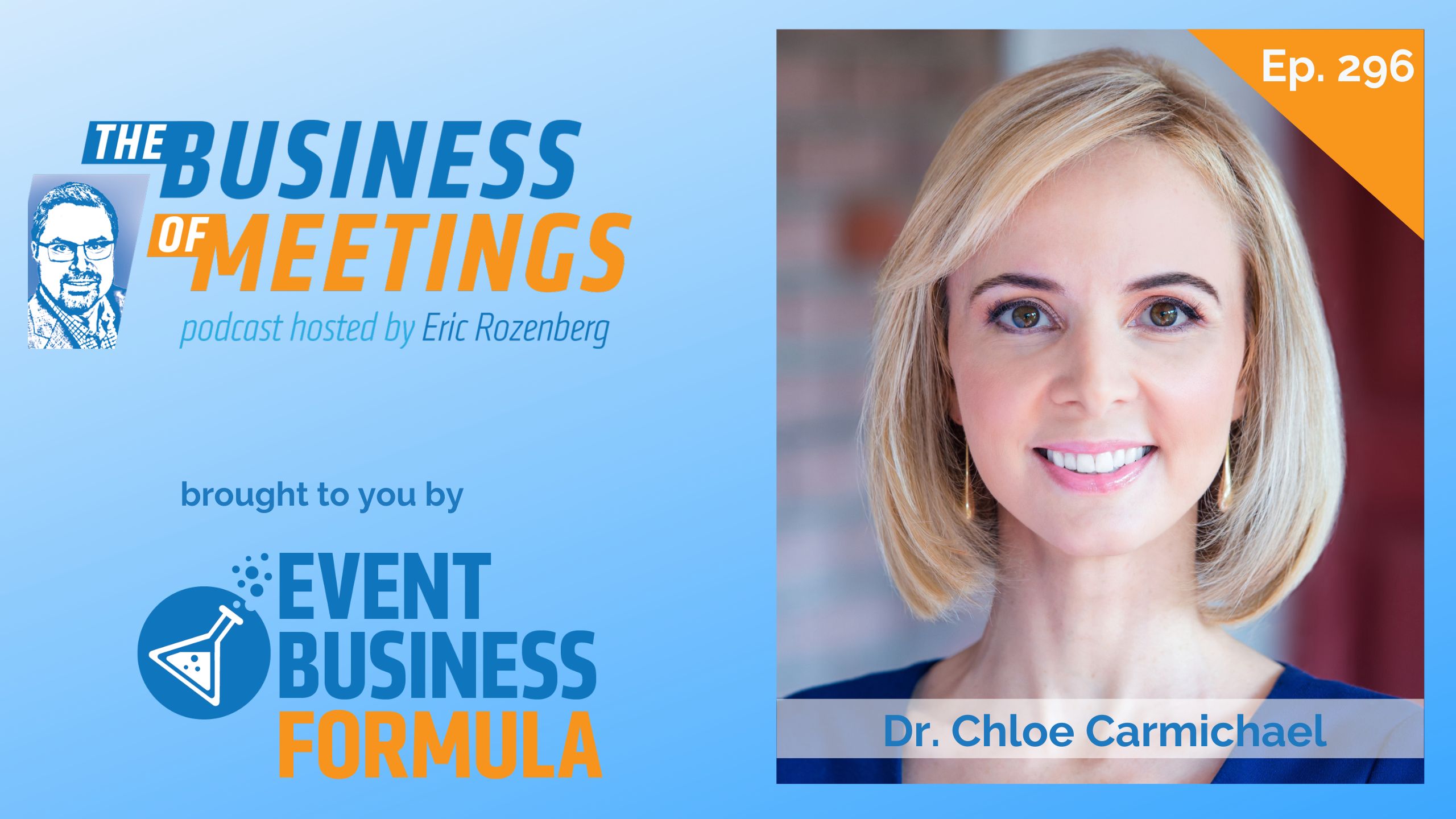
We are excited to welcome clinical psychologist and USA Today bestselling author, Dr. Chloe Carmichael, today.
Chloe wrote Nervous Energy: Harness the Power of Your Anxiety, which Deepak Chopra endorsed. Her latest book, Can I Say That? Why Free Speech Matters and How to Use It Fearlessly prompted Eric to reach out to her. That book received recommendations from Dr. Phil McGraw, Dr. Drew Pinsky, Patrick Bet-David, and various other thought leaders.
She joins us to explore mental health, the importance of free speech, and what goes on within corporate organizations.
Chloe’s Journey
Dr. Chloe Carmichael built her career as a clinical psychologist, author, and speaker, blending academic insight with real-world experience. She holds a Ph.D. in Clinical Psychology and has a private practice in New York City. Her background as a yoga teacher and her fascination with mindfulness shaped her approach to emotional regulation and performance, and she has worked extensively with high-achieving professionals. Over time, her work has evolved from traditional therapy into coaching, corporate consulting, and thought leadership, bridging the gap between psychology and practical success strategies.
Productive Anxiety
Chloe explains that anxiety, when understood and managed, can be a powerful motivational tool because the physiological arousal associated with anxiety is similar to the energy needed for preparation and action. Productive anxiety becomes maladaptive only when paired with avoidance or self-criticism. Instead of suppressing it, people can use that energy to plan, anticipate, and perform better. Recognizing that anxiety is a natural human function helps people shift from fear-based reactions to constructive responses.
High Achievers and Self-Regulation
When anxiety gets reframed as preparation rather than panic, it becomes an ally in achieving excellence. High performers often experience elevated anxiety because they set ambitious goals and carry heavy responsibilities. The challenge is not to eliminate anxiety but to regulate it. Practices such as self-awareness, structured planning, and mindfulness help individuals to harness their natural drive without burning out.
Emotional Awareness
Tuning into emotional cues can offer valuable feedback rather than distractions. Emotions signal what matters most, and ignoring them can lead to misalignment or poor decisions. Identifying the underlying messages (fear of failure, desire for growth, or need for control) allows people to channel those feelings into intentional actions rather than reactive ones.
Boundaries and Self-Validation
Boundaries are essential, especially for those who seek their validation externally. Many high achievers rely on the approval of others, which can increase anxiety when feedback is inconsistent or negative. Chloe encourages the development of self-validation skills and acknowledging one’s own efforts and internal standards. Setting emotional and time boundaries helps maintain focus, energy, and confidence, even in competitive environments.
Practical Tools for Managing Anxiety
Chloe offers practical strategies for turning anxiety into productive energy. She recommends setting clear, achievable goals and using visualization to stay focused on positive outcomes. Scheduling dedicated worry time helps contain overthinking, while separating problem-solving from emotional processing prevents downward spiraling. Reframing self-talk from “what if I fail?” to “how can I prepare?” will turn fear into action and build confidence.
Mindfulness and Grounding Techniques
Mindfulness is essential for calming the nervous system and being grounded. Deep breathing, guided meditation, and journaling slow the mind and create distance from anxious thoughts. Chloe points out that mindfulness does not eliminate anxiety. It helps the mind engage with it objectively, cultivating emotional resilience and better decision-making.
Leadership and Psychological Safety
Chloe highlights the importance of creating environments where people feel psychologically safe to express their ideas and concerns. Leaders who model calm, reflective behavior encourage teams to think critically rather than reacting emotionally. Leaders will also benefit from acknowledging their own anxieties, as that normalizes stress and builds trust within teams.
Balancing Ambition and Well-being
Ambition and mental health are not necessarily mutually exclusive. Sustainable success requires the balancing of drive with recovery. High performers should schedule rest, physical movement, and meaningful personal time to prevent chronic stress.
Integrating Psychology into Everyday Life
Chloe views psychology as a proactive skill set that helps people live with intention rather than reaction. She encourages listeners to use psychological tools in everyday life, not just in therapy or moments of crisis. Emotional tracking, mindfulness, and self-compassion can strengthen relationships, sharpen leadership, and boost creativity.
Meet Dr. Chloe
Dr. Chloe Carmichael is a clinical psychologist and USA Today bestselling author of Nervous Energy: Harness the Power of Your Anxiety (St. Martin’s Essentials, 2021), endorsed by Deepak Chopra. Her new book, Can I Say That? Why Free Speech Matters and How to Use It Fearlessly explains how to unlock the mental health benefits of free speech. The book has been endorsed by Dr. Drew, Dr. Daniel Amen, Patrick Bet-David, Michele Tafoya, and more. Dr. Chloe presents onsite and virtual workshops, equipping individuals and organizations with evidence-based strategies to strengthen personal and professional development.
Connect with Eric Rozenberg
On LinkedIn
Listen to The Business of Meetings podcast
Subscribe to The Business of Meetings newsletter
Connect with Dr. Chloe Carmichael
On LinkedIn
Listen on: Apple Podcasts · Spotify · YouTube
“We can’t just selectively mute parts of our brain.”
Dr. Chloe Carmichael
Full transcript of episode 296 of The Business of Meetings podcast, Eric Rozenberg with Dr. Chloe Carmichael. Lightly edited for readability.
Eric Rosenberg: Hello and welcome to the Business of Meeting podcast. I’m your host, Eric Rosenberg.
Over the years, I’ve had the privilege of helping businesses in the meetings and event industry grow and succeed. And I’m excited to share that experience with you. If you feel alone and overwhelmed, and if you’re looking to take your business to the next level, improve your strategy and sales, and connect with like-minded professionals, you are in the right place. I invite you to visit eventbusinessformula.com and join our community of event business owners dedicated to exponential growth.
Now let’s dive into today’s episode.
Hello and welcome to a new episode of the Business of Meeting podcast. Today I’m very, very happy to speak with Dr. Chloe Carmichael. She’s a clinical psychologist and USA Today bestselling author. She wrote Nervous Energy: Harness the Power of Your Anxiety, which was endorsed by Deepak Chopra. And her new book is really what got me into reaching out to her. It’s called Can I Say That? Why Free Speech Matters and How to Use It Fearlessly. And it’s recommended as well by great people like Dr. Drew, Patrick David, and we’re going to talk about the importance of free speech and mental health and what’s going on obviously in our different corporations, organizations, and I couldn’t think of a better person to speak about that. Chloe, thank you so much for taking the time to speak with me today.
Dr. Chloe Carmichael: Absolutely, Eric, and thank you for inviting me. I was really happy when I saw your invitation because with my previous book about the healthy function of anxiety, naturally I got a lot of corporate speaking requests about that because businesses want to address mental health issues. The topic of free speech, many corporations are a little afraid of it. Some of them are not. I’ve been invited to speak at some big law firms and university stuff. So it’s not 100% off limits, but a lot of business-oriented places can be a little bit afraid of it. So I was really glad to see your invitation.
Eric Rosenberg: Wonderful. And I love free speech. I hate political correctness. I think it’s destroying our societies. But maybe we can talk about it later. But before we dig into the book and what you’ve observed, what is your journey? Because I think you were also a yoga teacher and then became a clinical psychologist.
Dr. Chloe Carmichael: Yeah. So I was a yoga teacher decades ago. I mean, I’m nearly 50 years old, so we’ll start with that. And decades ago, in 2001, I moved to New York City and I was a yoga teacher and I had a yoga teaching business. It was very successful, and it was through that work of doing customized yoga lessons for stressed out New Yorkers that I got really interested in the meditation side and their mental clarity and their stress management, how that was working with the brain and the body. So that’s what drove me to get a clinical psychology PhD. Then I started my business and again, thankfully, it did very, very well. I hired, at one point, over a dozen therapists and broke the million-dollar-a-year revenue mark, which is how I joined Entrepreneurs’ Organization with that. And again, just naturally, the outflow of having been a yoga teacher in my path, I was focused on anxiety. So my first book is about the healthy function of anxiety and it’s been translated into five languages, which is fantastic.
And then came COVID, and that’s where things changed, because people have asked me, “Well, hey, how is your new book about the mental health benefits of free speech? How did this come up?” Right? So what happened is during COVID I had a three-year-old. He’s now eight. But at the time it was the law that you would have to mask even a three-year-old. He was going to start a preschool program, and it was going to be his first time out of our house all day, and I couldn’t do that to him. As a clinical psychologist, I honestly felt like it was really going to be harmful to him to have to be in a mask and be surrounded by people in masks all day long. So my family, we moved to Florida and we’ve been here ever since. We’ve been very happy. And when I got here, I said, “Well, okay, this is great for me and my family that I could do this, but what about all the other kids?” Because I would talk to parents and they would say, “Yeah, it doesn’t feel right, but everybody keeps telling us it’s fine.”
And so I wrote a blog just about all the reasons why, from a psychological perspective, masking children could be harmful. And I shared it with some colleagues to say, “Hey, before I publish this, am I going to embarrass myself because no other psychologists are talking about this? Am I missing something obvious?” And they said, “Chloe, everything in your blog here is correct, but you should not share it because it could discourage people from masking their children,” which is super weird, right? And so I published the blog and it got picked up by some great people, which sparked conversations. And then being in Florida, where there’s less of a political orthodoxy, you can talk about many issues from many perspectives, which you actually surprisingly cannot do in New York City, which I thought would be so cosmopolitan and have diverse perspectives, but that wasn’t entirely true.
So it was through being here and through opening up my own mind and realizing how it sharpened my own cognitive process and made me more emotionally present and made my own social relationships feel more authentic when I wasn’t holding back from people that I started really making the connection about mental health and free speech. And once again, it’s wild, because psychologists are always the first people typically to want to say, “Well, hey, let’s put things into words. Let’s have dialogue.” But psychologists are surprisingly silent on the issue of free speech. So that’s why I felt like I had to write this book almost as a public service announcement to tell people that free speech is actually good for us.
Eric Rosenberg: That’s brilliant. And by the way, I’m also in Florida. I’m in South Florida. I’m also a member of EO, EO South Florida. So I don’t know if you’re going to join the chapter there or are you too far, but it’s
Dr. Chloe Carmichael: No, that’s awesome. No, I’m not in EO anymore because I actually ended up just making a different choice. I wanted to not employ a bunch of therapists. I wanted to just do my own thing and focus on my books, but I would love to come speak at your chapter sometime. So keep me in mind for that.
Eric Rosenberg: I’m definitely going to connect you with the president and the learning chairs. That’s for sure. Now, in your resume and what you’re saying about New York, I’ve seen that you teached at CUNY and, I mean, 13 years ago you’ve been to Columbia. Those are places for me, before coming to the US, especially Columbia and all the Ivy Leagues, but wow, that’s where you raise intelligent people, people that can discuss and have different opinions. And today I would be scared to send my kids to those places. That sounds to me like you are free to think like they do, but you cannot think for yourself. And the last example I want to share with you: when I was a kid, my grandfather would put newspapers in my hands in Belgium and said, “Read. You will read different opinions and then you will make your own.” And to your point, today it’s almost like you need to be in alignment with the general consensus. If not, immediately people are tagging you as a racist, misogynist, a fascist, whatever it is. How do you see that in your practice and especially with people when it relates to corporations and how people feel okay to be themselves and have a different opinion?
Dr. Chloe Carmichael: Yeah. So, I mean, you’re right. It’s so interesting that if you have a different opinion nowadays in a lot of academic institutions, you get labeled, as you said, as a misogynist or racist or all kinds of things with the goal of shutting down the dialogue, when it used to be that the whole point of these universities was to create a salon of ideas, right? Where we would have an open marketplace of ideas, and instead of attacking the person as a racist or a misogynist or whatever, you would attack their ideas, right? And so that is not happening. And I do have thoughts about why. I like to attribute good intentions to people, and I admit that’s not even probably always accurate, but it’s just my natural starting point. And so I think that a lot of these institutions and places that are trying to silence these ideas and labeling them as misogynist or racist, I believe that in their hearts, they’re doing it because they think that they’re helping to make the world a better place.
And it just so happens that university faculty, for example, in the Northeast, where most of the Ivies are located, have a faculty ratio of liberal to conservative of 28 to 1. And so I seriously have compassion. These poor liberal professors don’t have anyone there to check their ideas. And so they get engaged in what psychologists call groupthink, which is where you’re in a situation where you genuinely believe that your ideas are the only ideas that are accepted by reasonable people. And it just inflates and gives you a sense of grandiosity and overconfidence, and you stop doing rational checks on your ideas. And that’s where we see this really irrational behavior, where a person could just simply say, “Hey, I’m against affirmative action because I actually think that it is a racist policy.” And instead of someone saying, “Well, in fact, I support affirmative action because I think it helps to alleviate racism,” and then you have a reasonable debate, instead of that, it just goes to, “Shut up, racist,” right? And so of course that’s not good for ideas and it’s not good for debate.
And my goal is to try to help people who are trying to silence dialogue in the name of clamping down on quote hate speech and bullying, and help them to realize what’s actually hateful and bullying is to silence people from having dialogue. Even the worst people, people we can all agree are racist, out and out KKK members, out and out jihadi members, research even shows that the way those people have their minds and hearts changed is through dialogue. So there’s really almost no situation where dialogue wouldn’t be advisable, unless we’re talking about violence. But again, now we get into the whole words-are-violence thing, which is an irrational thing as well that I think harms people that are maybe well-intentioned. And I just want them to understand that they’re taking a mental left turn, so to speak, with that, and it’s not helpful.
Eric Rosenberg: Absolutely. Now, you’re talking about affirmative action. I remember reading an amazing biography of Thomas Sowell called Maverick. I think the book is phenomenal. And here is somebody who’s African-American and who’s against affirmative action. And the rationale and the data he’s using is quite interesting, but he’s been attacked as a traitor by other leaders that are also African-American. And it’s like the cancel culture. Now we’re talking about EO in South Florida. There’s a friend called Evan Nearman who wrote a book called cancel culture. And I know you see that in your practice. How can you overcome this cancel culture and how can you be yourself and express ideas when you fear losing your job or not even being accepted with your colleagues in the company?
Dr. Chloe Carmichael: Yeah. Well, the first step, I think, is to understand that just staying silent about who you are and what you really believe has a cost to it. Because I’ll say, I was in New York City for 20 years and I did a lot of staying silent to get through my PhD, to be popular in the media, to do all the things I wanted to do. And it didn’t occur to me that there was any cost. The first thing a person would have to do is to become conscious of the fact that just simply staying silent and smiling and nodding while everybody says a bunch of stuff like trans women are women, that maybe you don’t actually believe that, it’s not just meaningless to smile and nod. There’s a cost to that. And then we can get into that, which would motivate you as to why you would want to go through the discomfort of speaking up, because I acknowledge it can be uncomfortable. And so first, before we would go out and do something that would be uncomfortable, we first have to understand why we would do that. So can we talk about the costs first of denying who you really are?
Eric Rosenberg: Absolutely. I always say that silence is complicity and we all need to speak up. And to your point, when the first DEI program came in, I thought, who’s against diversity? Who’s against equality? Who’s against inclusion? Any rational human being should be like that. And then, being Jewish, I realized that those programs in the university were actually excluding my people. And so I didn’t say anything when I was in a conversation. And to your point, I felt extremely uneasy and something inside didn’t work until one day I said, “Listen, why are Jews excluded from those DEI programs?” And it was like, “Wow, what did you say here?” But then I didn’t get any answer.
And so to extrapolate that on the mental health benefit of speaking up, how could a leader, in the meetings and event industry, bring people together? And they always talk about safe space, which makes me smile. I believe in safe people. I don’t believe in safe space. But how could a leader, how could a business owner, create an environment where it’s okay to have different opinions and still be working together?
Dr. Chloe Carmichael: Yeah. So I do want to talk about that, but first I want to really quickly explain to people why it causes a mental health problem if you don’t speak up and why, as a boss, it costs you intellectual capital within your team if you force people to paralyze their brain, right? Because they’re afraid to say something that is going to make waves. So when we deliberately stop ourselves from saying something, it’s called suppression. And if we do that often enough, it becomes somewhat automatic and it sort of graduates to what’s called repression, which is where you just stop even really forcing yourself to stay silent. You just automatically know, “Not that I can’t talk about that here.” And if you do that often enough, it graduates to denial, which is where you are not even fully in touch with that part of your brain and how you really feel, but it’s still operating in the background. And so when we have things operating in the background of our brain that we’re not fully conscious of, that we cannot sort of take out and examine rationally, that’s when we start acting out with passive aggressive behaviors.
So I share a story in the book, for example, about a man that was really upset because there were a lot of initiatives around promoting women in his workplace, and he was told explicitly by a friend in HR that he just wasn’t going to get promoted because they needed to promote more women. She just said, “Hey, you know what, we have enough of the straight white men here, we really need to get some diversity, so I’m sorry, it’s not your time.” And he was afraid to deal with that directly because it would create a big conflict and he just wasn’t sure how to handle that. So he did that repression, suppression, denial and basically just started acting like he thought it was fine. And then he started having some difficulty trusting women. He started having a hard time feeling comfortable and fully himself around women, including at the workplace and in his personal life. And he hadn’t been able to really put together why until we unpacked the whole sequence of events.
So it can definitely be harmful to bosses if they create dynamics in the workplace where there’s no viewpoint diversity allowed on values-based topics. Now, as a boss, I get it. We have to put some kind of boundaries around what sort of viewpoints are permissible. Again, you’re not going to hire David Duke, a grand wizard of the KKK, and say, “Hey, viewpoint diversity,” right? And so I would say a good rule of thumb is simply to turn to the law, right? What is the law, which is we can have free speech, we can express our viewpoints so long as we’re not degrading and discriminating against people based on immutable characteristics and we’re not advocating for actual violence against any group. And I say actual because it’s easy for somebody in the workplace to say, “You know what, words are violence, and when this person says that he doesn’t like the idea of men in the women’s bathroom, that’s violence to me.” No, it’s actually not.
And another simple rule of thumb is that I, as a clinical psychologist, if a client comes to me and tells me he’s going to physically harm someone, I am legally obligated to break confidentiality and go to the authorities. If a client comes to me and says, “I’m going to say something mean and stupid to someone,” it’s totally against the law for me to break confidentiality, right? Again, you don’t want people saying mean stuff at the workplace, but as long as people are just simply expressing a relevant opinion, again, if it’s even relevant to the workplace, which a lot of political topics are now relevant in the workplace. If you’re at a law firm or a banking firm, there are issues about immigration. These things can come up and people have opinions. And to ask them to either pretend to have an opinion they don’t have or to somehow feel like they have to walk on eggshells around certain topics, what you’re going to do as an employer is you’re going to lose a lot of the brain power, because we can’t just selectively mute parts of our brain. What happens is we end up just dampening our intellectual capacity and our creativity.
So that is why, first of all, I want to get bosses and employers and people out there incentivized to say, “Okay, staying silent isn’t just a polite thing with no cost. It’s actually stifling myself and maybe even causing other people around me to be stifled.” And so that’s why it’s worth it to go ahead and take the risk and deal with a little bit of friction or confrontation.
Eric Rosenberg: Absolutely. I was listening to you, I couldn’t help but think about a recent conversation I had with an organization, and I know a lot of people there. And basically I was mentioning the fact that somebody showed up to me on a Zoom with the Keffiyeh Palestinian scarf, which, unless you’ve been living in a cave the last two years, those are the supporters of Hamas, those are the people in the school calling to kill Jews, those are the people in the tweets that are calling to erase Israel from the map. And I was so offended and so disgusted that I didn’t want to talk to that person anymore. And one of the leaders in the organization, when I asked how can you let that happen, said, “Oh, we don’t do politics.” And I said, “What do you mean you don’t do politics?” And then I look at him. So imagine that I’m coming with a hood from the KKK to a meeting and somebody who’s African-American comes to you and rightly says, “Who’s this? You should kick him out.” Are you going to look at that person and say, “We don’t do politics here”? Of course not. So why would it be different for Jews? But just by saying that, in an environment where I’m clearly a minority, I don’t want to shut up obviously, but it might impact as well the will of some people to work with me, which somehow it’s fine if you’re independent. But how do you advise people when it comes to the working environment and obviously the risk of losing their job?
Dr. Chloe Carmichael: Yeah. Well, that’s an interesting one because you’re right. The CEIA is a political statement in and of itself. So the answer of “we don’t do politics” feels like weak sauce, right? And I can understand. I think a lot of employers have become really terrified because up until recently, the left had a bit of a monopoly on the social narrative. So we have to understand some background here, which is that in the past five to seven years the government was controlling what could be published on Meta, which is Facebook and Instagram, as well as Twitter and now even recently YouTube. All of these companies have openly acknowledged, by their own executives’ reports, that the government was silencing perspectives from the right.
And so again, with compassion I can understand why business owners simply looked around at the social landscape, which social media is a huge indicator, or at least we thought it was, of what the social landscape is. And so they said, “Oh, okay, I guess the new social norm is that causes aligned with the left are totally fine to trump it because it’s the new norm. Trans women are women, and free Palestine, and BLM,” right? And they don’t think that they’re taking a political position. They think that they’re just aligning with the social norm that everybody holds because the government, unbeknownst to corporate America, was creating a false social narrative.
And the good news is I think that false social narrative has now crumbled. In fact, Donald Trump won the popular vote. So we know that it’s a close popular vote, though, so let’s just call it 50/50. Half the country feels one way, half the country feels the other way. And so I think corporate America and academia are now starting to realize that if they want to say we don’t do politics at work, that has to include both the left and the right. So they might say, “Hey, look, no BLM flags at work. We’re not going to do Pride Month the way that we used to.” But also, “We’re not going to do the Right to Life March on Washington either. We’re going to stay out of both sides of political issues,” which I think is perfectly fine. Or a corporation should say anybody can express their political viewpoints at work. To be honest, for me as a business owner, I would rather just keep the focus of my business on business. And so I would rather just tell everybody at the workplace, we don’t do politics at work. That’s fine, but it has to be applied evenly, meaning not just the left or not just the right.
Eric Rosenberg: Got it. But then you see free speech and real dialogue as part of the foundation of healthy corporate culture, and if this is the case, then how can you put that into practice in day-to-day business?
Dr. Chloe Carmichael: Yeah. So what that means is that in the workplace, if politically adjacent topics come up, which they absolutely can, as I said, I speak at law firms where it’s definitely going to be relevant, again with immigration issues and policy changes and things like that. What I would do is explain to employees, if anything political is coming out of your mouth, what we need to know, as a rubric, is: is this directly related to advancing a work product? And if yes, can you explain how? Right? So I’ve worked with lawyers that are talking about immigration law and how they can deal with companies that are dealing with the H-1B visa thing, for example. So in that way to say, “Yeah, you know what, I think the administration is tightening this law and this law, and here’s how we can potentially get around it or whatever,” that’s fine, because it’s a politically adjacent topic, but you’re not attaching your personal values to it.
Now, say in education, it certainly gets a little bit trickier there when you have a professor that’s going to teach a course about economics or about philosophy or certainly even about psychology. And if they want to teach critical race theory or something like that, and they say, “Well, it actually is part of my subject matter,” that’s fine. But then again, I think that you have to be able to say, “Well, you must allow students in the classroom that see the issue differently to be able to speak up,” as well as maybe assign some opposite text reading as well. As long as it’s relevant to the work product that you’re doing, whether that be in an academic classroom or a law boardroom or whatever, it’s fine.
Now, the issue though that does come up is, what about the lunch break, right? So what about if you’re on the lunch break and Susie wants to say, “Well, I was driving in and I saw a bunch of those maggots,” right? Which is a slur for people who support MAGA, Make America Great Again. They can get smeared as what’s called maggots, right? Or on the opposite, what about if a Trump person was like, “Oh, well, what about those libtards,” right? Which is another slur for people on the left, right? I would say that you might want to just simply say in those cases, “Hey, we don’t allow for any type of derogatory language about anybody at the workplace,” and that includes political groups. You could certainly say, “Hey, I saw some clips of ICE doing some raids and I really disagree with that.” And another person could say, “Well, in fact, I think it’s a good thing, and here’s why.” And as long as two people can discuss it in a civil, rational manner, that’s fine for the corporate lunchroom. But the moment it devolves into name calling, then that’s where you’ve crossed the line.
And that would apply to anything, right? To just be able to say to yourself, “Well, what if we were talking about Broadway plays?” And Susie says, “I think the new Broadway show is amazing.” And Timothy responds, “Well, you’re a complete and utter moron.” Right? Timothy can say, “I disagree with you. I think that show was not any good.” But the moment he devolves into name calling, that’s where we have a problem.
Eric Rosenberg: Absolutely. I love your example. You often speak about Make America Healthy Again and how this concept will connect to the organization and also to leadership and how people are leading their organization.
Dr. Chloe Carmichael: Yeah. Again, because free speech is good for mental health. So when people can speak freely, they can use the full benefits of language, and language helps to sharpen our cognitive process. This is an indisputable psychological fact, right? I mean, there are countless chapters and entire courses on language and cognition when you’re going to become a psychologist that you take. So language assists us in problem solving. Even by yourself, talking through a problem facilitates problem solving. Talking through a problem with somebody else can also even more facilitate problem solving. Naming our emotions, so being able to say, “Gee, I’m nervous about this big meeting,” has been shown to decrease amygdala activity. The amygdala is the part of our brain that gets active with fear. Having a supportive conversation with somebody has been shown to reduce cortisol levels and increase social bonds.
So again, if we want to have good strong teams, we have to allow people to be themselves and to speak freely, because again, it’s not just a selective muting thing where I just say, “Well, I will totally mute myself about one topic, but expect that my entire brain will remain loose and creative and relaxed in the others.” Again, I get it. It doesn’t mean that anybody can come to work and just say anything with no filter. My book has an entire chapter on the difference between self-censorship and healthy self-restraint. It is good to have a certain amount of self-restraint. But we have to understand that we can’t make people feel unwelcome in the workplace simply because they hold common mainstream views. And that goes for the approximately 50% that voted for Harris as well as for the approximately 50% that voted for Trump. We have to make them all feel welcome in the workplace. That’s the bottom line.
Eric Rosenberg: Absolutely. And I fully agree with you. And I’m thinking, people before obviously working, they’re going to college. And if you don’t learn in college how to have different opinions and how to respect different opinions and really have a true dialogue, why would you expect people then, as soon as they leave college, to switch and suddenly become open to different opinions? So do you see any results? Do you have any studies where actually you see the working environment where free speech is encouraged and the impact that it has on the mental health and on the results of a company?
Dr. Chloe Carmichael: Well, that’s an interesting point that you’re making there, Eric. I just want to back up a little bit because, as you said, when you have these college situations where it’s completely the norm to stamp out and belittle speech or opinions that are associated with the conservative viewpoint that half the country voted for, the students, again, all compassion to them, they just simply are learning that it’s fine to do that and that the leftist viewpoint is the only one that’s valid. And then they go into the workplace and they start behaving with that attitude in mind. I think that actually explains why, for example, Bill Aman and others have said that they no longer like to hire students from the Ivies, right? Because they have this very rigid and very narrow worldview and they don’t know how to get along with others that have different viewpoints.
So I do think that that might be something that employers might want to start screening for even, is just to say, “Hey, we’re a place that really celebrates viewpoint diversity. Can you talk about a time when you’ve spent time around people that have a different viewpoint from yours, and it’s not even that your viewpoint changed, but that you were just able to coexist and get along and be productive with people that had a different viewpoint from yours?”
Now, to your point about workplaces, you said, “Do I know any studies where a free speech environment has been emphasized and how did that impact workplace dynamics?” That’s a great question. I don’t think a study like that has been done. But I can tell you again that there are countless studies for decades showing that when people work together and speak freely, their problem-solving abilities skyrocket. It is through dialogue that people learn how to solve problems together and it’s how they reduce conflict. Again, I say it with great compassion. I think a lot of people who want to stamp out speech due to quote hate speech and bullying, they are just genuinely misinformed. If they understood this, which is that if I’m working with a violent offender or a person with an anger management problem, my first order of business is to increase their ability to engage in dialogue when they are frustrated. Those kinds of people typically come and they’re confused. They say, “Dr. Chloe, I’m going to learn how to just keep my mouth shut and then my problems will go away.” And then they say, “I was doing great. I was being quiet and then all of a sudden I just lost it.” And I’m like, “Yeah, that’s totally normal. That’s what happens when we stifle ourselves and we let things fester. We create a powder keg situation.” So the goal, again, it’s well-intentioned but misguided. When people tell people to just not express things because it’s quote hate speech and bullying, they’re actually, I think, intensifying conflict.
And one more thing I think is important for employers to understand, and when I say this, they usually nod and they’re like, “Oh yeah, I always knew that intuitively, but I never knew how to express it,” is the concept of secondary gains of victimhood.
Eric Rosenberg: The concept of secondary gains of victimhood. What is that?
Dr. Chloe Carmichael: Secondary gains of victimhood. So when Susie labels Timothy as a bully in the workplace and then Susie becomes the quote victim, she gets secondary gains of that victimhood, right? So maybe suddenly she’s allowed to have priority over the schedule so that she doesn’t have to be around Timothy. Or now that Timothy’s been labeled the bully, Susie can even say things that are a little bit needling around him and he just has to shut up and take it because he’s now been labeled as the bully and she’s labeled as the victim.
This is such a well-known concept in psychology. It’s not even at all controversial. So the classic example in a psychology 101 textbook is that there’s a little girl who breaks her leg. She gets a cast. She gets to miss gym class. Everybody signs her cast. She feels very special. When her leg is healed, the doctor says, “Time to take off the cast.” Susie protests. She’s not even trying to lie, but she’s grown so attached to the cast and the benefits of missing gym class and everybody treating her specially that she doesn’t want to accept that the problem is gone. She becomes attached to the problem.
And so the same thing can happen when workplaces bend over too far backwards to say we’re not going to tolerate any hate speech and bullying. So, anybody that thinks in any way that they’ve had anything hateful or bullying, speak up and we’ll defend you. They’re almost creating an incentive structure for people to define themselves as having been a victim, which then makes the other person in your workplace the quote villain, and then you’re alienating those people. Now, obviously, if there are hateful things going on or true bullying going on, it obviously needs to be addressed. But I think that we’ve gotten so carried away with all of this that we’ve ceased to realize that silencing people or preventing them from just being themselves is also a form of hatefulness and is also a form of bullying. So I think we all just need to take a deep breath around the hate speech and bullying thing, because it’s going into a place I don’t think even the best of intention people intended.
Eric Rosenberg: Oh, wow. Yeah, it’s a very vicious situation that you’re just describing. And I can relate to that. I can see that for sure, Chloe. Dr. Chloe, it’s a passionate topic and I love listening to you, and it’s a podcast format. So before I ask you the last question, I just want to restate the name of your new book. Can I Say That? Why Free Speech Matters and How to Use It Fearlessly. How would people get in touch with you if they want to invite you as a speaker or have a meeting with you?
Dr. Chloe Carmichael: Yeah, they can go to freespeechtoday.com. It’s a super easy URL. So freespeechtoday.com, and that’s where they can see more about the book and click through to contact me about speaking. I often speak virtually, so it’s super easy for people, and I’m, believe it or not, speaking at Columbia University about this topic next week.
Eric Rosenberg: So they are
Dr. Chloe Carmichael: Yeah. And I spoke for a big law firm, at a top five in the world law firm, just a few weeks ago. So big law as well as big university, industry, they are waking up to this, and so all the credit in the world to them that they just want to finally say, almost even to cover themselves, to say, “Hey, nobody can accuse us of not being a free speech place. We even had a workshop about it. So let me help check that box for you.”
Eric Rosenberg: Wonderful. Dr. Chloe, in one year we see each other with a bottle of champagne. What are we going to celebrate?
Dr. Chloe Carmichael: I think we’ll celebrate that free speech has been on the rise. I would love to celebrate that my book is no longer relevant, right? That everybody will be looking back and laughing at the times when we all got a little bit in our heads too much about all this speech stuff and that we finally learned how to just relax and be real people with each other. Again, as you said, a true safe space is one that can withstand different opinions and can even withstand some conflict. That’s what a truly safe space is, and that’s what I hope we celebrate.
Eric Rosenberg: Wonderful. And as Ellen DeGeneres said, I hope we’ll go back to judging the people only by the type of car they’re driving. That’s South Florida, right? Thank you so much.
Dr. Chloe Carmichael: Thank you so much, Eric. To you as well.
Eric Rosenberg: Thank you for tuning in to the Business of Meeting podcast. I hope you found today’s episode valuable. If you enjoyed the show, the most important thing you can do is leave a review and share it with your colleagues. It really helps spread the word. I truly appreciate your support. And if you’re ready to take your business to the next level, don’t forget to visit eventbusinessformula.com to learn more about how we are helping event business owners like you. Thanks again for listening and I’ll see you next time.