
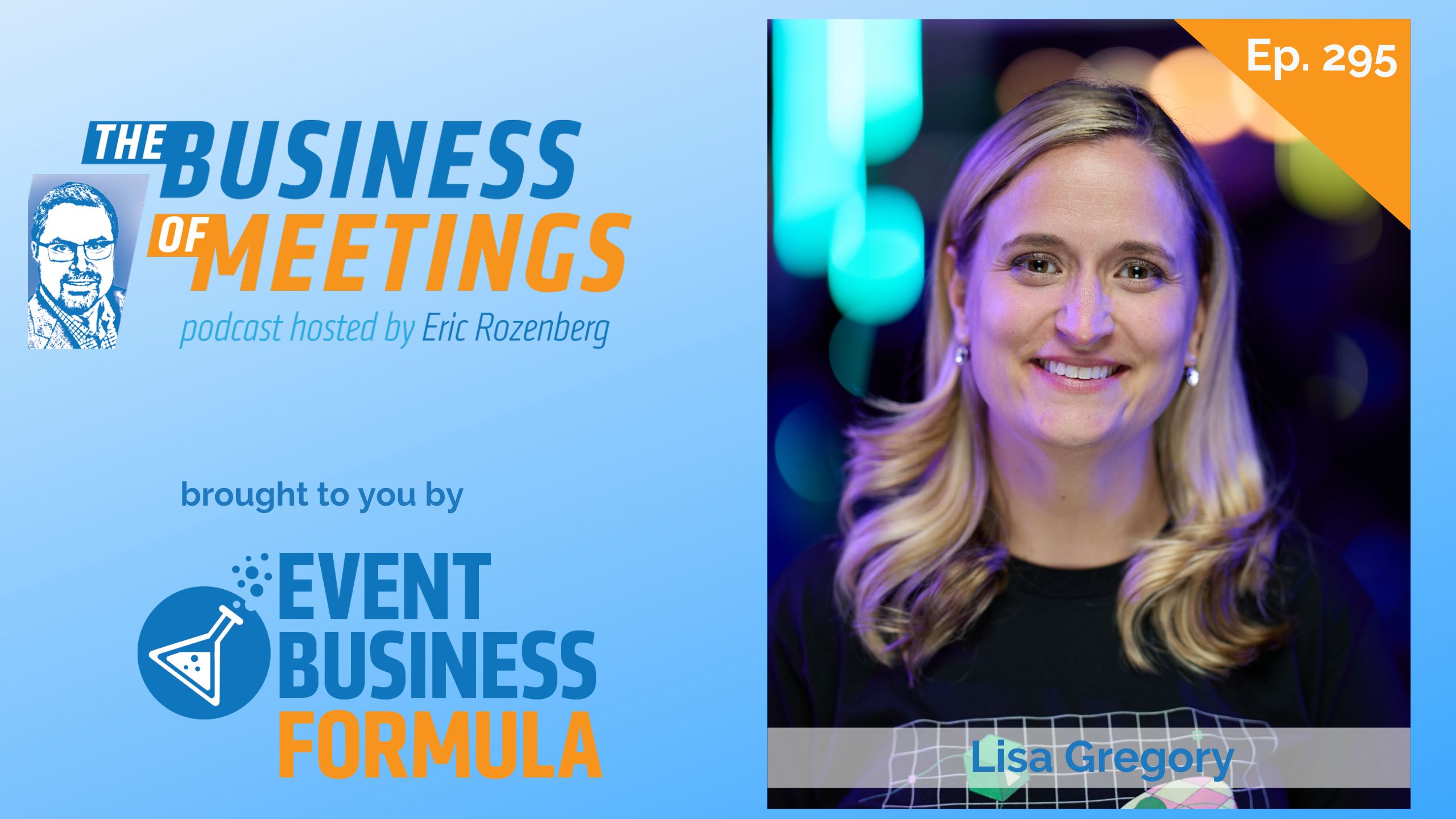
Today, we are delighted to welcome Lisa Gregory, the founder and CEO of Gregory Event Services.
As a dynamic entrepreneur with an impressive career, Lisa understands the highs and challenges of running a business, from sleepless nights to navigating the unexpected with determination and grace. She joins us today to share her journey, insights, and lessons learned along the way.
Lisa’s Journey
Fueled by a passion for purposeful leadership and continuous growth, Lisa built her career in the events and marketing industry. Her company initially focused on events and marketing, but is rapidly evolving into an AI-driven business. Guided by a commitment to innovation, culture, and purposeful service, Lisa has grown her global team across the U.S., Europe, and Asia. She balances strategic vision with a hands-on approach, emphasizing culture fit, skill alignment, and sustainable growth. She also founded the Event Professionals Network, a free global community connecting over 900 event professionals to share knowledge and support one another.
The Power of Complementary Teams
Lisa believes that a successful business requires a team with complementary skill sets rather than one entrepreneur trying to do everything alone. While many entrepreneurs struggle to delegate due to financial or ego-related fears, she stresses that sustainable growth comes from shared responsibility and clear role definitions. Her success grew from learning to focus on her strengths while trusting others to manage daily operations.
Transitioning to an AI-Driven Future
Lisa’s company is transforming from a traditional events firm into one that actively integrates artificial intelligence. She urges professionals to embrace AI responsibly and purposefully to stay relevant. The goal is to use AI to enhance strategy, not replace human creativity or connection.
Why Human Connection Still Matters
While AI is revolutionizing workflows, Lisa points out that human connection remains irreplaceable. The most meaningful industry trends are toward smaller, regional events that prioritize face-to-face interaction, shared learning, and relationship building. She views this era as one where people crave authenticity, trusting personal experiences over digital marketing claims.
Building a Strong Global Culture
Lisa’s leadership philosophy centers on culture fit as the foundation of a thriving company. The first step in her hiring process is to continuously assess alignment with company values before evaluating skills. Her employees undergo skill-based training and are carefully matched to clients based on personality and expertise. Continuous feedback and alignment calls keep everyone on track, fostering transparency and mutual respect across diverse teams and time zones.
Growth Through Purposeful Leadership
Lisa is committed to scaling at a pace that supports both excellence and employee well-being. Her company now includes an operations manager, a chief of staff, and an executive assistant to ensure accountability and maintain quality. She is willing to decline projects if her team cannot deliver 110% and prioritize sustainability over expansion.
Elevating Customer Service
Customer satisfaction is central to Lisa’s business model. Her company uses NPS scores, client surveys, and monthly check-ins to assess performance. Every feedback cycle is built into the client’s project schedule to ensure accountability. She views exceptional service and strong client relationships as the most powerful engines for long-term growth.
Looking Ahead
In the next decade, Lisa envisions stepping back from the center of her company while strengthening middle management and refining internal systems. Her ultimate goal is to remain in the experiential and production side of the business, possibly integrating AI into large-scale creative projects. She hopes to sustain a culture that balances ambition with team health, reducing burnout and promoting longevity in the events industry.
Bio: Lisa Gregory
Event Strategist | Marketer | Sponsorship Sales
With over 25 years of experience with tech and lifestyle brands, I bring enthusiasm, drive, and resourcefulness to my work, and I am not afraid to give clients a straight answer. (When you’re trying to stretch your event budget and resources, that matters.)
Specializing in high-tech, healthcare, education, and nonprofit events, I plan and host events along the West Coast and throughout the United States, Europe, and parts of Asia. I’m based in Portland, Oregon, with a partner network that spans continents.
I’ve partnered with a wide range of tech clients, including HashiCorp, Kong Inc., Venafi, Sysdig, PagerDuty, Cayuse, Tecton, NS1, Trifacta, Fivetran, Puppet, Segment, Inedo, Sensu, Gremlin, Drupal Association, Chocolatey Software (and many more). I have collaborated on sponsorships with Cisco, Docker, Gartner, Google, IBM, Intel, AWS, Microsoft, etc.
Healthcare clients include the Institute of Human and Planetary Health, the American College of Lifestyle Medicine, the Lifestyle Medicine Foundation, Patients United, NW Lifestyle Medicine, and LifestyleFacts.org.
Winery clients include the Oregon Winegrowers Association, Women in Wine, LIVE Certified, Argyle Winery, Gloria Ferrer, and more!
In short, I build lasting relationships and draw on a network of local and global organizations to ensure your event marketing has an impact.
Connect with Eric Rozenberg
On LinkedIn
Listen to The Business of Meetings podcast
Subscribe to The Business of Meetings newsletter
Connect with Lisa Gregory
Gregory Event ServicesOn LinkedIn
Listen on: Apple Podcasts · Spotify · YouTube
“The in-person connection right now, it’s invaluable.”
Lisa Gregory
Full transcript of episode 295 of The Business of Meetings podcast, Eric Rozenberg with Lisa Gregory. Lightly edited for readability.
Eric: Hello and welcome to the Business of Meeting podcast. I’m your host, Eric Rosenberg. Over the years, I’ve had the privilege of helping businesses in the meetings and events industry grow and succeed. And I’m excited to share that experience with you. If you feel alone and overwhelmed, and if you’re looking to take your business to the next level, improve your strategy and sales, and connect with like-minded professionals, you are in the right place. I invite you to visit eventbusinessformula.com and join our community of event business owners dedicated to exponential growth. Now let’s dive into today’s episode.
Hello and welcome to a new episode of the Business of Meeting podcast. And today I have the great pleasure of speaking with another entrepreneur. She had an amazing career. She owns her own business. She knows what it is to have a sleepless night and then always be ready to tackle the unexpected, obviously, business owner, manager. She is traveling all the time. So I’m very lucky to speak today with Lisa Gregory, who’s the founder and CEO of Gregory Event Services. Lisa, thank you so much, in between travel, to take the time to speak with me.
Lisa: Of course, Eric. Thank you so much for having me. I can’t wait to dive in.
Eric: Wonderful. So, let’s go and let’s start with my favorite first question for every guest I have. I try to have different questions, but the first one and the last one are always the same. What is your journey? How did you come to this industry?
Lisa: Yeah. So, for event planning and just really being an entrepreneur, it all starts from childhood. So, I have my mother and I have my father. My mom is a school teacher. My dad is an entrepreneur. I am the perfect combination of both of those humans. So, my mom loves to nurture. She’s very patient and kind. She also loves to educate. She’s very hardworking and just puts her heart and soul into everything. Just like most teachers.
My dad is an entrepreneur. He moves fast. He has lots of ideas. He fails forward. And he had many businesses when I was growing up and so I got to watch and feel what that felt like. I’ve watched him go top-top-top and down-down-down. So through that process I have been able to learn a ton.
Eric: Amazing. So you were very familiar with the roller coaster of being an entrepreneur at the early age.
Lisa: Very much so. And I’m from a very strong family. So my background and family is very strong. Lots of very strong women. My grandmother was a force to be reckoned with. So, back when she was younger, she was a stay-at-home mom. That’s kind of the role. But if she would have grown up when I grew up, watch out world. So, I watched her. I learned from her on everything on how to produce events and that’s where I work. I’m an event producer. We do events and marketing global campaigns all over the world. And so from a very young age, I was watching and being led by my very strong female role models within my family.
Eric: That’s awesome. And you’re preaching to the choir to a guy who has three daughters and whose mom was a dentist at the time where very few women were actually going through college. So that resonates a lot with me. And were you the one having a lemonade stand when you were a kid?
Lisa: Okay. Someone asked me this the other day. So, I started my first company. I was probably seven or eight.
Eric: Really?
Lisa: Yep. It was called Friends Forever. I even had a heart logo with all the dots around the heart represented all my best friends. And it was a card company. So, I started basically my version of Hallmark. I created my own cards. I sold cards to the neighbors. And that was my first business. I had a business partner. She lived across the street and we had campaigns where we’re like, we want to make x amount of money. We’re going to go to these neighbors. This neighbor already bought some cards from us so we think they’re going to buy again. And so very young, very, very young. And I think that’s because of the role model of my father.
Eric: That’s amazing. And how or when did you learn about our industry? As far as I’m concerned, I had no clue there was such an industry. I discovered, a couple on the early days told me about it. But when did you discover it and when did you have this bug, said that’s for me?
Lisa: In college. So I attended the University of Oregon. They had a continuing education program in addition to my fine arts major. So I’m very creative and then I was a project management minor. And then someone said, “Hey, you are really good at being organized. Would you go into this continuing education program?” and it was specific for event management. So I did get trained. I did practicums and research. I volunteered through the program and through the university at a very young age. I went through what they called introduction and I was fascinated. I was like, wow, this is amazing. It was a massive event for all the freshmen coming in and I thought that was the first time where I was like, this looks like something I’d want to be a part of.
And then through college I got nominated to be the recruitment chair for our sorority, which is just a group of women coming together to further our education and have fun.
Eric: Yeah. Lots of fun. Which sorority?
Lisa: Well, I was a Kappa Kappa Gamma.
Eric: Okay. Kappa.
Lisa: So I did that for a year. We had the most successful recruiting class that we’d ever had. And then Panhellenic said, “Well, why don’t you come try to be our vice president of Panhellenic?” And I was working and going to school at the same time, but I was like, “I’m probably not going to win it. I’m sure somebody else will get it, but it’ll be a really good experience for me to go and interview and go through that.” And so I thought, why not? Well, I got it.
So, I did that for a whole year and I planned one of my very first big events, 1,400 women over a week. And so, I had a team of 12 staff in college that I managed anywhere from operations to marketing to recruiting, all sorts of stuff. And then I had over 50 managers managing all of the 1,400 women. So, I managed them. And after that, I was like, “This is for me.” And by the way, probably I’ll never plan an event this complicated ever again. And from there, I just got a really good job out of school and so on. So, yeah.
Eric: That’s cool. So, you were supervising the rush as it go.
Lisa: I was in charge of all the things. Yes. I was the one human that if something went wrong, it was my fault.
Eric: Wow. And I’m glad you explained what a sorority is for anyone listening that is not from North America, because as an American born in Belgium like me, I had no clue what a sorority was and I had no clue about the process and I actually learned through my daughters what it is. So it’s huge in terms of organization. I was a member of ISC, a student association, and the same thing, similar to you. That’s the type of, you’re traveling, you’re working with different culture, you’re organizing events and stuff like that. So fast forward, you are going out of college, you know that industry you want to be working in. How did you find the first job to really work in this industry, or did you start directly in this industry?
Lisa: Well, right out of school, I was pretty scrappy. So, I had a lot of jobs. I worked for my dad’s relocation department. I worked within his mortgage and loans and titles department. I worked for his marketing department. I also was a nanny for two different families. And I was a hostess at a restaurant. So, you can only imagine the color coding in my calendar because I was waiting for my boyfriend at the time to graduate. And so I was like, I don’t want a big job yet. And then I did a little bit of sales. So I dabbled in sales just locally and loved it. Loved it. I was like, “Ooh, this is fun. I’m helping people get what they want.” So that was a really good experience.
And then how I got my first big job, it was in Portland, Oregon. And really it was just word of mouth, knowing the right people. I got in front of the right person from just someone who knew my family recommended me. I’m super young, right? Pretty much right out of school. Not even a year out of school. And it just was perfect alignment because they didn’t have a lot of money, but they wanted someone really thirsty to come in and really move them from almost 100% paper. The gal who had been in that job before me had been there 50 years. And he had a stroke. And so they wanted someone young and nimble to come in and move everything onto the internet, get everything online. And so that was my job right out of school, was to run their annual meeting, which is a huge meeting. I worked on the Portland International Auto Show. I ran all of their press and media events. I did their golf tournament, all sorts of stuff. Very, very, very young.
Eric: And basically, with everything you’ve done before, had more experience to do that than somebody who would just move to that department even if they’ve been in the business for several years. So that’s very interesting. So at that moment you mentioned the education or the character, the DNA that you get from your mom and from your dad. When did you know that you wanted to have your own business, because you say you started your first business seven, eight years old? So, I’m guessing you’re getting into that job and wondering, should I stay here or should I start my own business?
Lisa: Yeah. Well, it was at the next company I went to. So, I was recruited to the next company that I went to and it was a global marketing and PR agency. They did a massive amount of tech consoria events and I watched the business owner grow the company. And because I watched him and I watched how he kind of built things globally, not just small but globally, it really kind of brought in my mind, I can do this. Before it was kind of like, I don’t know exactly, right? But if he can do it and I watched him do it, not just on a small level but on a global level, and I was working with super talented people. I think at that point I was probably 26. At that point I was like, I can do this. I don’t know when, but I can do it.
Eric: Amazing. So, and I want to assume that’s exactly that when you started, but from the moment that you said, “Okay, I can do that. I’m going to have my own business.” What was the reaction of your parents? Again, I would assume that your dad would say, “Great.” Or say, “I know what it is and I don’t want that for you.”
Lisa: No. So, my family is Mondo supportive. To give you an example, when I went to college, I thought for sure my mom was going to say, “You have to be a teacher or a doctor or something.” She did not. I was shocked. She said, “Lisa, follow your passion. That will make you happy.” So, I got to choose my major and I got to choose my path. And it was the same for that. She was like, “Start your own company. I think that would be great. You’re so good at organizing things.” And same with my dad. They knew it was probably just a matter of time.
But I’ll tell you what changed in my daily lens. My daily lens of how I processed work, how I met with people, how I showed up, it shifted to how am I going to duplicate this when it’s mine? How am I going to streamline this when it’s mine? And so my lens of learning over that time from 26 to about 32, my mind was constantly thinking, how can I do this better when I’m servicing my own clients? That’s the first time I’d ever worked for an agency. And so that was a really good experience for me.
Eric: That’s brilliant. You didn’t make the same mistake I did when I started my first business. I was 28, corporate event agency in Belgium, and the first two years I had two major clients to start with and it was like, those are my clients, this is my brand, nobody’s doing it better, until I almost burn out. And now everything I’m doing, I’m thinking, okay, how can this be done better and who else than me can actually do it so that I can focus on what I do best, what I like. And for me that is not a question of age or experience. It’s a question of mindset.
Lisa: Yeah. So I just hired my first chief of staff. Big hire. She’s learning how I do things, how I function through life. And we were talking a couple weeks ago and she goes, “Lisa, you have a growth mindset. A lot of people have a fixed mindset. This is how it has to be. There’s a lot. It’s fear-based.” I don’t have that. I was very lucky to grow up with a very strong family that let me fly from a young age. I played sports. I was put in high pressure, high grit situations from a very young age. I was the youngest of four, so I was always an observer. I also have an identical twin sister.
Eric: Oh, really?
Lisa: Yep. She looks just like me. Actually, I could probably go off camera and put her on and you wouldn’t even know.
Eric: Maybe it’s your AI. I don’t know.
Lisa: Yeah. I mean, anything’s possible these days. But I have always been growth mindset, super positive, half glass full, and then just continually I just love to learn. I always tell myself that I almost put myself through grad school on my own every day.
Eric: I love it. The thirst for learning. That’s the right mindset to have. Just one question apart, but is it true that when you have a twin sister, whatever she thinks or feels, you can think and feel as well?
Lisa: Oh, yeah. Absolutely. She could be clearly across the room and I kind of look at her, I know exactly what she’s thinking. Even if she’s having a bad day, sometimes she’ll just call me and be like, “Are you okay?” I’m like, “Yeah, no, I’m having a bad day.” It’s true. It’s definitely a trip for sure to be a twin, right?
Eric: You work together or not at all.
Lisa: We do not work together. So, out of, there’s four of us siblings. We all own our own businesses.
Eric: Oh, wow. Amazing. What a family. So, you decide to start your own business. How is that happening? What’s going on in your mind? How are you announcing that to the people you’re working with? And how do you find your first clients?
Lisa: That is a very good question. So I got laid off from a job. So I was on unemployment and I turned to my partner and I said, “Okay, we have options here. I can either stay on unemployment or I can start my own company. Whatever happens first, I’m going for. Are you on board?” And he said, “Absolutely. Go for it. Whatever you want to do.” So within two weeks, what I did is I started networking. I went to nonprofit events. I went to for-profit events. I was volunteering. I was doing everything I could to get in front of people. And within two weeks, I got my first client.
Eric: Wow. How did that happen?
Lisa: I had that client for 5 years. I was sitting at OSU, which is the hospital, very prestigious hospital in Oregon. I was sitting at a nonprofit dinner. It was a gala and the gal next to me, we were just chatting. I was telling her about my journey and she said, “I have the person you have to meet.” She introduced me. I drove down to meet him. He hired me on the spot and we worked together for 5 years.
Eric: Amazing. And so I always say that ideally you should not have one client representing more than 20% of your revenue, but definitely profit. And when you start, I mean, you have to start. So yes, how conscious of that were you at that moment and what did you do then to grow the business?
Lisa: Yeah, I think my goal initially was just to learn, right? Again, I’m a constant learner. So I was like, okay, let’s set the infrastructure of the company first. How do I do my billing? How do I do my marketing? How do I provide the best service? So instead of growth, I was more focused on infrastructure. How can I make this sustainable for my income, for my family, and then really for the client? Because the success is always going to be in the client referrals, right? If I impress them, I do a good job, then number one, I don’t have to worry about more money coming in. They’ll just keep me ideally. And then they’ll spread the word and go from there.
Additionally, what I did is I continued the volunteering and the networking. And I felt that if I was going to work for someone, because I didn’t have proven experience in having my own company, right? So if I was going to work for someone basically for free or for very affordably, really, really hard, and they were going to see that value, they would recommend me. And they did. Absolutely. That’s what I did.
Eric: Yeah. No, that’s absolutely right. And at the same time, in order to be able to do that, it’s breaking that hamster wheel. And again, you didn’t make the same mistake I did, which is great. But at the beginning, it was like, okay, I have a project. Wonderful. Nobody does it better. Blah, blah, blah. Wonderful. Oh, shoot. The project almost over. I have to find a new project. Oh, I got a new project. And it was like all the time until decided to hire people, structure, start putting process and system in place. How did you manage to serve your client and in the meantime continue to do the networking and the prospection?
Lisa: Well, there’s two points here. I have a very high tolerance for pain and I can smile and work through it. So, me going from 30 to 60 hours a week is pretty breezy for me and I have a huge pain tolerance. And I actually didn’t know that until a CEO told me. He said, “Lisa, wow, you have a huge tolerance for pain.” And I said, “What do you mean a huge tolerance for pain?” He goes, “You can go from here to here in 2 seconds.” I was like, “Oh, you’re right.” So that was a superpower.
And then what I did is I gave myself a goal. So, if I wasn’t super busy, and even if I was, I would put time in my calendar that said, “Okay, each week I have to meet with five people.” Now, they don’t have to be coffee all the time or lunch or whatever, but five people. Sometimes it was more, but five people. It could be people I know that already love me and know that I’ll do a good job, and I’m just telling them what I’m doing so they can be advocates. And it could be somebody that they know that they think I should connect with. And that’s what I did.
Eric: I love it. And those are the three things for me. The time blocking, the two pitches that you have and the KPIs. It’s very impressive, especially for young entrepreneurs starting their own business, to be aware of it and to do it. And that there’s, I don’t know any other way to grow your business, by the way. So you start doing that, did it go straight into the company today or was there a roller coaster in the process?
Lisa: Well, there’s always a roller coaster. There’s a couple roller coasters. So I did grow the business very quickly and I did hire support, just contracting support, so that with the events, the seasons ebb and flow, and so that was really lovely. I did go through a divorce when my kid was quite young. And that happens, right? Divorce happens. And so my biggest client at that time, a different client, graciously came and said, “Hey, we really want you to come in house. We know you’re going through a lot. Would you be willing to come in? You can run all of our events.” Which was like 75 global trade shows and 25 regional events and a huge user conference and all this stuff. And I said, I think at this time that would be a good idea. So that other big client I had had for five years, we just absolutely loved each other. So I kept them for another year.
My manager said I could. I asked for permission. He said, “Yeah.” He goes, “I trust you. Obviously hire someone else to do a majority of the work,” which I did, and then I would have my meetings with that client during lunch. So do you see how that worked? I had an income. I had my salary. I had another income. And so what that did is that gave me the ability that when I was ready to go back out and start my new company, I already had a business plan. I saved all that money from that year from that client so that when I was ready to go, I could leave my job and fly back when I was ready.
Eric: That’s amazing. Bad thing, good thing, you never know. It’s what you make of it. And go with that. When you go back to owning your own business, are there any way of operating the business or things that you’re doing that are completely different from when you had the first time your business? Or
Lisa: Yeah. Okay. Yeah.
Eric: Tell me about it.
Lisa: Which I think is awesome, right? It’s a huge opportunity. You have a business, you sit back for a year and a halfish, and then you get to come back in and fix all the things. I mean, who gets the opportunity to do that? Not very many people. The first thing I did is I hired an accountant. I didn’t want to be an accountant anymore. I hated it. So, I hired an accounting team to help me. And then I hired more team members because I was like, I don’t need to be doing all this. And I need some team infrastructure. I need to start training. So I hired more people so that I could also focus on sales and infrastructure and building the company at the same time and really trying to scale things a little bit more. And then guess what happened?
Eric: It grows.
Lisa: It grew big time. So I was at the max amount of events I had ever done ever. And then COVID hit.
Eric: Yeah. So what did you do during COVID? What happened to you during COVID? Me personally, I was the CEO of a SaaS company, which is the ticketing platform using blockchain that FIFA is using, and I was tasked by opening the US Latin America for them. So, believe it or not, we grew during COVID because there was a time where people are more available and they have less pressure if they change their system, which is
Lisa: Oh, love that.
Eric: Which is what we took advantage of. But, and I wrote a book for my daughter. So why we left Belgium and I launched a podcast, so get myself busy. But, and I went through the situation during the subprime, I had my full team. I imagine that you look at that, there is a very tough decision that you have to take.
Lisa: Yeah. Well, so what I did is I just pivoted just like I had done. I was like, look, clients are going away. I was lucky, I had some clients stay. So financially, I’m not a huge spender anyway, and I’m a huge saver. So financially, I knew I would be okay. I knew it would come back. I just didn’t think it’d take as long. So I just pivoted. I did social media marketing, general marketing, project management. I just kind of pivoted a little bit and it was fine. But here’s where the opportunity came for me. I had done virtual events before. They just weren’t called virtual events. It was called live streaming. So at the time I was a single mom, right? I had to pivot and I’m also an entrepreneur obviously. So I was like, this is actually a huge opportunity because everybody was scared. They had never done it before. Well, I had done it and I’d already been scared. So I just dove right in and we took over the virtual market overnight. And that’s how my company, just like yours, just skyrocketed. And so that was a huge success and a huge opportunity and it worked out really well for us.
Eric: So you didn’t have to lay off anyone.
Lisa: We did, because it’s contractors, we did shrink the contractor base, but then as soon as we started to grow, which really wasn’t that much of a lag. I think it was March, April, maybe May a little bit. As soon as we got clients, we just blossomed. I mean, it was super fun. I was able to hire way more people and provide a new service and have fun learning all these new things, but able to drive it because I had had some of that experience and wasn’t afraid to just jump right in.
Eric: Were you remote and came back in person afterwards, or how was that structure?
Lisa: Yeah, my whole team is distributed. So, we’re all over East Coast, West Coast, Central Europe. We even have representation and help over in Taiwan and Tokyo.
Eric: Nice.
Lisa: Yeah. So, just all over. So, we just worked from home and it was a lovely experience to grow the company and a whole another layer of learning.
Eric: Brilliant. How do you maintain culture? How do you transmit the values in your company when you have people all over the world?
Lisa: We have what’s called an all brand standard booklet essentially. So we document our missions, our values, how we communicate together. So it’s all documented in all brand standards. It’s very detailed, but even the voice and tone, how we onboard people, even down to our email signature, every single thing that we do, how we open up our meetings with clients, with the team, how we close our meetings, how we send reports, how we communicate with them, everything emulates our brand constantly.
Eric: The full playbook.
Lisa: Yep. A full playbook. And that was just developed. It’s been developing and we’ve been doing templates and trainings and all sorts of stuff for years, but really since hiring my chief of staff, that’s when she put all the things that we had been doing for years into one all brand standards document.
Eric: I guess now you know it afterwards, that is the best thing. I learned it afterwards that basically when I was successful is when I had somebody who is completely different than me with different skills that are complimentary, so that I can be out with the client, I can be out on project and can be out selling, and there’s another person who’s managing the daily, daily activities. So I know too many solopreneurs or entrepreneurs in our industry that they want to do everything. They don’t want to take the risk to hire somebody else, financially, time, ego, mindset, whatever. And they’re burning out. I mean, they’re burning themselves. So when you do that, how did you define what you were going to focus on and what your chief of staff was going to focus on?
Lisa: That’s a very good question. And I’ll be honest, because I put myself through grad school all the time, it’s constantly evolving and we have what’s called operation meetings and then I have very streamlined communications with my team. So we have our goals of what we’re driving to and our quarterly review. So we know for sure these are the things that everything should tie back to, but we evolve quickly. So something might shift. So for example, we’re doing a new AI project right now. Our company really is an events company. It’s an events and marketing company, but is transforming very quickly to be an AI company. And if you aren’t transforming and leaning into AI, hold the phone, because you need to be right now. You have to use AI very responsibly and very purposefully. But if you don’t start exploring it and fully understanding the opportunity behind AI, you will be left behind.
Eric: I can only agree with you because the random of the calendar is that this week I’ve launched my own AI where solopreneurs, small business owners can ask me questions about growing their business and managing their business better. And somebody was telling me, “Yeah, but then they won’t need you.” I said, “Oh yeah, I’m not afraid of that. On the contrary.” And please tell me what you think about it and if you see with your client, the more you have the tech, the more you have the AI, the more people want to come in person and see that they’re really talking to you, that the exchange, the serendipity, the conversation. Do you agree with this? And then do you see that with your client?
Lisa: 100%. So, we are using AI and every day we’re learning how to better use it. There’s a good way to use it and then there’s a terrible way to use it. So the prompts and the AI agents are really, really important. If you don’t have that on point, it’s going to fail. But the in-person connection right now, it’s invaluable. So a trend in the industry is just there’s a lot more smaller regional events where people can see each other, they can learn from each other, they can connect afterwards, continue the conversation. And it’s not about who you know, it’s about that knowledge sharing. It’s the knowledge, because we’re all trying our very best when we go to work every day, but we only know what we know, right? And everything is so fast-paced right now. We’re seeing ads and AI this and AI that and these updates and all this stuff, but what actually works? It’s when you talk to a human and say, “I tried that app and it was garbage. It didn’t work.” But this one actually does work, or you know what I mean? So that is so important right now. And I do think that’s why my company is growing in the event industry in a lot of ways. It’s growing and I think it’s the brand, right, and my growth mindset and the way that I, the culture we’ve created, and hopefully that keeps emulating through our clients and our services.
Eric: So I want to finish the conversation today and talking about the future, but before we go there, one question. You mentioned that you have teams in Europe, in Asia. What do you notice in terms of cultural differences in terms of doing business, and how do you try to make everyone aware of them when it comes to working in the same company?
Lisa: Okay, I love this question, especially as we grow, right? Because there’s different personalities, different backgrounds, different cultures. So yes, there’s cultural differences globally and we look at this as an opportunity also with our customers. They’re global, right? So we want to kind of mirror their experience, what they’re going through. So that’s a huge opportunity. What I’m going to relate this question to is just the background in which people come to us with. So a lot of this has to do with experience. So we find that to build a successful team, they have to fit our culture. So our very first interview as we’re building our team is a culture fit. That’s the first, we don’t even care if you actually know how to do the job. If you are going to fit the culture, you’re going to get in. And how you’re not going to get in is if you’re the person who rolls their eyes or kind of throws people under the bus. You’re not going to work here. It’s just not going to fit. It’s going to be a waste of time for both people.
So that’s what we do first to build the team. And then we focus specifically on the skill set of making them successful. So we do very stringent onboarding but really it’s a skill set analysis and then matching the skill sets to that particular client, which can be a little bit tricky because you get new business coming in and you say Sally Joe, for example, has hours available. Well, just because she has hours available does not mean I partner her with that client. And that’s a tough call, because if it can’t be successful, I don’t want to be involved. Absolutely. I just won’t. So that’s the tricky part, is making sure that the skill set, the personality, the values, right, all align. And so that’s a huge balancing act. And we spend a ton of time on forecasting and really like matchmaking essentially, watching and learning and growing.
We also have a culture of continual feedback, good feedback and constructive feedback and real-time feedback. So, if you and I are on a call together and I think you did a really good job, I’m going to tell you immediately. I’m going to say you did this and this and this and this, thank you so much. If I think something should have been changed, I will tell you immediately.
Eric: Love that.
Lisa: Great job. Here’s how we can improve. This is how we want to lead the client. This is what the expectations are. Are we in alignment? Okay. Sometimes we are not. So when you feel the swirl or your eyes start to roll or you’re not quite sure, that’s when we require an alignment call. And so we have a lot of alignment calls. And not that anyone’s in trouble or anything like that, just making sure everybody is in the same boat headed in the same direction and purposely aligned. And so we do a lot of that.
Eric: Wonderful. Where are the people that you work with in Europe based?
Lisa: We’ve had Spain, the UK and the Netherlands is mostly where we work with folks, but we’ll work with anyone anywhere really.
Eric: Of course. And I won’t go into that rabbit hole because when I finished my business study, I did a thesis on cultural differences in business. So, but I could already picture. I’ll just give you one quick example. I had a Spanish person in my team in Brussels and one day I’m hearing the shouting on the phone, really shouting, and I finish, I wait for her to finish conversation and I, what’s happening? And she goes, “What?”
Lisa: Yeah.
Eric: You were shouting. “Oh, no, no, no. I’m just talking with a hotel in Madrid.” I was like, “Okay, never mind.”
Lisa: Yeah. So, we would align very quickly, like that’s okay. If it’s a Madrid client and they’re used culturally, go for it. But if it’s a US client, we would say nope.
Eric: Nope.
Lisa: Yep.
Eric: That in Belgium you would say, I don’t know. And here people would say, I’m not sure. What do you mean you’re not sure? You know you don’t know. I’m not sure. Anyway, let’s finish the conversation today, Lisa, with the future. How do you see your business in the next 10 years?
Lisa: I want to grow purposefully and healthily. That’s where I want to grow. And right now, we’re growing fast. So, which is great. I love that. I love to be able to provide excellent service to amazing clients all over the world. But if that starts to become not healthy, we will pause. Right? So that’s why I’ve built a lovely team. So we have an event operations manager. We now have a chief of staff. And now I have a part-time EA. So these are my go-to people to help pulse, right? We had to let go of a piece of business this week, a new opportunity. My gut was saying our team can’t deliver 110% on this project. So we actually declined it. So that’s how I want to grow and then really provide even more layers of better customer service. Right? So right now we know we’re good at what we do. We’re good at logistics, at marketing, production, experiential. What I’d like to improve on is customer service. So, I’m focusing on that because when you have champions and you have happy customers, that’s really how you grow. We grow because our customers love us.
Eric: How do you measure the customer service? You do NPS score or what is it?
Lisa: Yeah, we do have an NPS score. We have a client survey too. So, at the end, we do send a survey just asking how we did and then I check in about once a month depending on the client and just say, “Hey, how’s it going? How’s our team performing for you? Do we need to change anything?” And all of that is built into the client workback schedule. So they know it’s coming. So our whole CS strategy is built into their event workback schedule. Built it all in. So we’re held accountable. They know it’s coming, right? And so we did have it outside, but this year we moved it inside the customer workback schedule.
Eric: Is there anything that you’re doing today that you think you will not be doing in 10 years in the frame of your business, things that you say, you know what, I should not be involved in this anymore?
Lisa: Well, in 10 years I don’t know, I may be retired.
Eric: I don’t believe that people like you are entrepreneurs.
Lisa: Exactly. Exactly.
Eric: Retired is like re-tired. Yeah.
Lisa: Oh, I already have ideas of what I want to do. Okay, 10 years from now, to my 10-year self, what I’d like to do is be in experiential production. That’s where I’d love to be. Whether that’s in AI or working with a big production company or who knows what. Maybe in 10 years just high-level, amazing production where I’m experiential. But I think right now I’m still working on getting out of being in the center of the company. So what we’re working on is building middle management and accountability. And so that’s what we’re focused on right now. So in 5 years, even a year from now, 2 years from now, what I’d like is a little bit more management help and systems and processes for accountability. And so that’s really what we’re focusing on right now. A lot can change in our industry in a year. So let’s just scoot into the two years. That’s where we’ll go.
Eric: I’m all for systems and processes, although I’m more the ADHD type, and there is no way you can grow and operate a business without systems and processes. So kudos for you. I have one last question before that. How do people get in touch with you if they want to speak with you?
Lisa: Yeah, you can just find us on our website. So, it’s just gregoryevents.com and then on the page you click on contact us and they can contact us there if they just have questions, they want to work with us. And then it’s important to know I did start that nonprofit. I started the Event Professionals Network, which is a free Slack room with over 900 event professionals globally. They can also go to our website, just click gregoryevents.com, and they can click to apply to get in there. The membership is free. We do monthly webinars and we just empower our community. And the reason why I do that is because, well, I think I was put on the earth for a purpose. I wasn’t put on the earth to run a company. I was put on the earth to be purposeful. And so my purpose is to really gather people and uplevel people and that is my purpose. So that’s my purpose-driven work, is that nonprofit.
Eric: That’s wonderful. And my purpose is to protect and create connection. So, a great opportunity. So, Lisa, my last question. When you and I sit down in a year time with a glass of champagne, what are we going to celebrate?
Lisa: What are we going to celebrate? Oh, that’s a good question. Hopefully that I have an even stronger team, right? That I have some really soft like that. We’re just maybe doing bigger and better events, working with tons of different types of companies. Right now, we’re spreading our wings into different verticals. And so, who knows what we’ll be doing in a year. We could be doing tons of different verticals. Right now, we’re focused on tech, healthcare, education, a little bit of wine because wine is delicious. But, we’re kind of pretty focused. So, maybe we’ll be working on some other verticals and have some other, some big client wins. That’s what I think. And then just making sure our team is continually focusing on health. If I can get my team to not max out right before an event and be working 60 hours a week right before, and we have every single event we try to bring in support and more support. What I’d like to do is I’d like to see my team not kind of get into that burnout realm. Keep our hours down. Make sure we’re being very strategic. So those are kind of the two big things. New accounts and just a healthy team.
Eric: Wonderful. Lisa, thank you so much. Safe travels and thank you for taking the time to speak with me today.
Lisa: Of course. Thank you. It was lovely. I really appreciate you inviting me on. And to anybody that’s listening, thank you so much. We appreciate you.
Eric: Thank you for tuning in to the Business of Meeting podcast. I hope you found today’s episode valuable. If you enjoy the show, the most important thing you can do is leave a review and share it with your colleagues. It really helps spread the word. I truly appreciate your support. And if you’re ready to take your business to the next level, don’t forget to visit eventbusinessformula.com to learn more about how we are helping event business owners like you. Thanks again for listening and I’ll see you next time.