
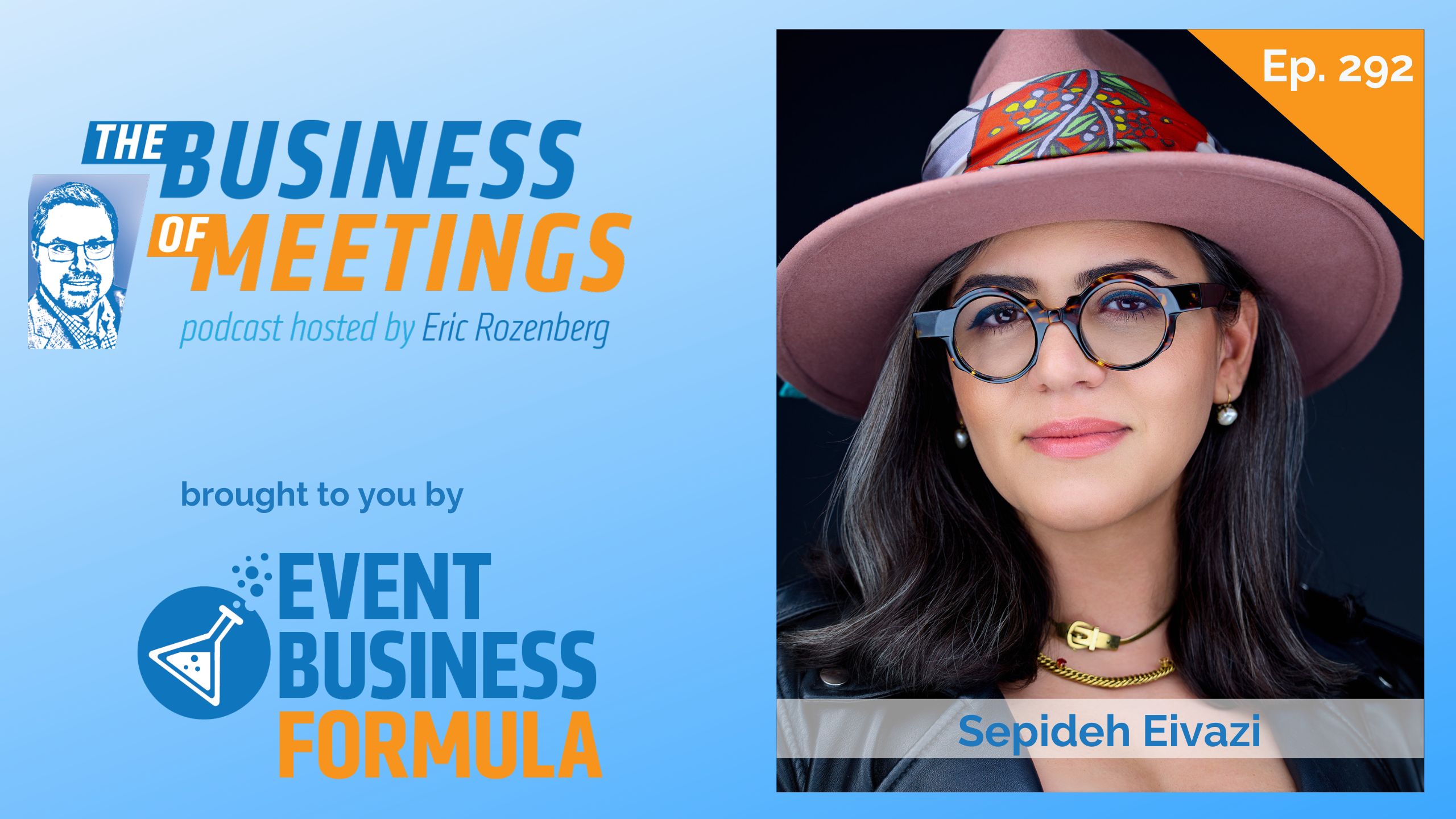
We are delighted to welcome the inspiring Sepideh Eivazi as our guest today.
Sepideh is on a mission to move everyone she encounters, leaving them changed and feeling seen. She is a 2025 inductee of the Smart Meetings Hall of Fame, a Smart Speaker, a 40 Under 40 honoree, and a 2025 Meetings Today Trendsetter. Her powerful TED Talk, Breath as an Act of Rebellion, has inspired audiences around the world.
She joins us today to share her journey and insights.
This information is for educational purposes only and is not medical advice. Consult a qualified healthcare provider before using any plant medicine
Sepideh’s Journey
Sepideh Eivazi grew up in Iran, navigating a life constrained by societal and political limitations. At the age of 20, she moved to the United States with her younger sister in search of freedom and opportunity. Starting from scratch, she worked in hospitality in Las Vegas, learning about the event industry from the ground up, embracing mentorship, and observing inspiring and cautionary examples of leadership. Eventually, she relocated to Los Angeles, where she joined Elevated Meeting Solutions and later launched her own wellness platform, Dawn of the Earth, which integrates tea culture, somatic breathwork, nervous system regulation, and psychedelic integration practices. Her work focuses on conscious leadership, healing trauma, and empowering others, bridging both Eastern and Western wellness traditions.
Freedom and Feminism
Sepideh shares the challenges Iranian women face under restrictive societal norms, particularly the compulsory wearing of a veil. She emphasizes the importance of personal choice, freedom, and human qualities over appearance or imposed rules.
Singing as Healing and Expression
Reclaiming her voice through singing became an emotional and symbolic act of empowerment, connecting Sepideh to her heritage and generations of suppressed women in Iran. She views singing as both a personal healing practice and a form of standing for those who cannot freely express themselves.
Mentorship and Community
Sepideh credits several mentors and supportive figures for her growth. She emphasizes the importance of showing up for others, paying support forward, and nurturing a sense of community.
Leading Beyond Burnout
Burnout is a result of prolonged stress, fight, flight, freeze responses, and neglecting emotional and physical health. Sepideh utilizes somatic breathwork to help leaders and employees regulate their nervous systems, process suppressed emotions, and create safe spaces for vulnerability and healing. She explains that burnout is preventable when organizations and individuals prioritize conscious, holistic self-care.
Plant Medicine and Integration
Sepideh views plant medicine as a tool for mental health and emotional integration, highlighting it as a catalyst for self-awareness rather than a recreational high. She works with clients to integrate insights from plant medicine into daily life, cultivating emotional intelligence, forgiveness, and presence. Her approach combines body awareness, somatic practices, and intentional reflections.
Performance, Presence, and Ritual
In high-performance industries, constant productivity and measurement can undermine confidence and well-being. Sepideh advocates rituals and presence-based practices, such as mindful breathing, sensory activation, and slowing down during daily activities, to reconnect with oneself and cultivate sustainable performance without anxiety or self-judgment.
Future Vision and Celebration
Sepideh measures success through progress and the ability to give back to humanity. She values learning, growth, and curiosity over rigid goals or timelines, viewing each step forward as a meaningful achievement for herself and others.
BIO:
Sepideh Eivazi is a revolution in motion, a visionary TEDx speaker, event designer, trauma-informed mental health activist, and founder of Dawn of the Earth, a purpose-driven wellness platform weaving together somatic breathwork, plant medicine, and ritual tea alchemy. Born in Iran and rooted in global consciousness, her work seeks to repair our disconnection from mind, body, and soul.
As a psychedelic integration practitioner and member of the Global Wellness Institute’s Breathe Initiative, Sepideh is redefining how we gather, designing immersive events that awaken, restore, and transform. Her mission is to leave every soul she encounters moved, seen, and forever changed.
A 2025 Smart Meetings Hall of Fame inductee, Smart Speaker, 40 Under 40 honoree, and 2025 Meetings Today Trendsetter, Sepideh’s work has been featured in Poosh, The Purist, Skift, Women to Watch, IMEX, and MPI. Her groundbreaking activations include wellness roadshows with Caesars Entertainment and the somatic pre–Met Gala experience with Morphe and Dripology.
Leading Beyond Burnout in Hospitality & Events – why nervous system regulation is the missing key in one of the world’s most high-stress industries.
Breath as a Leadership Tool – harnessing somatic breathwork to help event planners and leaders cultivate presence, clarity, and resilience under pressure.
From Survival to Sovereignty – shifting from fight/flight into grounded, visionary action in the fast-paced world of meetings and events.
Embodied Leadership in Hospitality – integrating wellness and nervous system practices into event design to transform both leaders and attendees.
The Future of Events & Leadership – moving beyond performance-driven models toward human-centered, regulated leadership that inspires connection and creativity.
Connect with Eric Rozenberg
On LinkedIn
Listen to The Business of Meetings podcast
Subscribe to The Business of Meetings newsletter
Connect with Sepideh Eivazi
On her website
Sepideh’s TED Talk, Breath as an Act of Rebellion
Listen on: Apple Podcasts · Spotify · YouTube
“Burnout doesn’t happen overnight. Burnout is a buildup of fight, flight or freeze for too long.”
Sepideh Eivazi
Full transcript of episode 292 of The Business of Meetings podcast, Eric Rozenberg with Sepideh Eivazi. Lightly edited for readability.
Eric Rozenberg: Hello and welcome to new episode of the Business of Meetings Podcast. Today it’s an amazing guest. I never met her. We have a lot of friends in common. But I was really impressed by her TED talk, which is Breath as an Act of Rebellion, and we’ll talk about this. I reached out to her and then I found out that she is a 2025 Smart Meetings Hall of Fame inductee, a Smart Speaker, a 40 Under 40 honoree, 2025 Meetings Today Trendsetter, and so on and so forth. She’s been speaking all over our industry and I’m really looking forward to our conversation. Ladies and gentlemen, this is Sepideh Eivazi. Hello and thank you so much for taking the time to speak with me today.
Sepideh Eivazi: Hi Eric. Thank you so much for this amazing warm welcome. It’s an honor for me to be here, and thank you so much for listening to my TEDx and welcoming me on your podcast.
Eric Rozenberg: Oh, great pleasure. And let me again mention it. It’s called Breath as an Act of Rebellion. It’s on the TEDx Pacific Avenue. But without further ado, why don’t you tell the listener about your journey?
Sepideh Eivazi: My journey is not a normal journey. And I really believe that I’m not a normal person. I never lived by the norm. And growing up in Iran, I feel like that I lived multiple lifetimes. So I left Iran at the age of 20 with my younger sister, who was 17 at the time, and we moved to the United States because we both wanted to have a brighter future. And as you know, Iran is a very interesting place to be because of the political and also the location of the country. Women are very restricted by certain rights, and I really struggled as a young adult living there.
Fast forward, moved to the United States with my younger sister, and then I moved to Las Vegas, and Las Vegas became my home, the first home that I have in the States. And I met amazing people in the event industry. I worked at Bellagio and MGM Grand doing convention services and operation and convention sales, and I literally grew in that space learning how to do events. I was zero. I had no idea what meetings and conventions was all about. I just said yes to all these opportunities that’s been showing up for me. And very grateful that along the way, people that I met, they held my hand, they offered kindness, they offered mentorship, they offered holding space. And from some of them I learned who I don’t want to be, or what kind of a leader I don’t want to be, and I send my gratitude thing and thank you to them also, because I really believe in conscious leading and leading from the heart. So all those lessons and time that I lived in Las Vegas, it was very valuable for me.
And end of 2018, I left the hotel side, moved to Los Angeles and joined Elevated Meeting Solutions, opened the Los Angeles office, and since then I’ve been with Elevated Meeting Solutions. However, my passion and my heart, besides the wellness and events, lands on the world of wellness and conscious leadership and conscious living. And in that area, I launched my own company, Dawn of the Earth, that started as a tea company during COVID. And the reason was because my heart really landed and went back to where I was born. I went back to my grandmother’s kitchen. I went back to the herbs and teas that I learned and I grew up with. And I wanted to really bring that eastern medicine, the eastern connection, that warmth that when we sit at the table and share our food and share our tea. And this is one of the traditions in Iran, that when people come to your home, we always serve tea. It’s a way of welcoming them to our space. And I really wanted to create that connection for them to really understand that east and west can merge in one space, and we all can feel one. Because truly, in my heart, I believe that we all experience the same thing. We experience pain, we experience sadness, we experience happiness, we experience joy. All of that always tells me that we’re all one at the end of the day. We may experience that in different shape or form, but we’re really connected in those spaces.
So my mission and vision has been always to connect and unite everyone in one space, because living in the east, knowing how much separation, and all these media and propaganda, and how they just feed the eastern through the west and the west through the east, there’s always separation. And I stand for humanity and community and bringing everyone together.
So from the tea, I fast forwarded to become a somatic breathwork [practitioner], because as you listened to my TEDx, breath played a very major role in my life in regards of healing my trauma and all these trapped emotions, and the way of living that I had in Iran, and just not knowing how to live my true authentic self. And breath really became an alchemy in my path. And the more I started feeling that revolution in my life and that transformation in my life, I decided to incorporate that in my wellness platform. So I completely redesigned my tea company to a wellness platform. I incorporated somatic breathwork and nervous system regulation, because I do understand very well that in order for you to be whole and complete, it’s all about operating from a place of calmness and regulated state of emotions. And working in hospitality, being a former hotelier, being an event planner, with all the travels, stress is one of the number one issues that everyone deals with, and I wanted to serve the community and give back. So again, bringing the somatic breathwork to my platform. And then I joined the Global Wellness Institute. I became one of their Breathe Initiative members. So just learning about how we can incorporate these practices in our industry to serve, to support, to lead.
And another piece that I just added recently is the psychedelic integration practices. So my wellness platform has three pillars. Psychedelic integration practices, because I truly believe that the future of mental health is plant medicine. And plant medicine is not for everybody. So practicing plant medicine with integrity and understanding how to serve others is really major. And I see myself as a thought leader and as a forward thinker, and I’m one of those people that I would like to take the risk. I would like to try, and I would love to walk on the edge, if you want to call me. I test and try things that a lot of people, they’re scared of. I mean, my migration from Iran to the United States at the very young age is a testimony of the fearless part of me, that I’m very fierce and I’m ready to make a difference, and I want to be a forward thinker. So this platform is serving others who are ready to just really take their existence to the next level.
Eric Rozenberg: Awesome. I was listening to you and I was thinking a little bit of my own journey, why we left Belgium, and I realized that many people in general, they will choose misery over uncertainty. So kudos to you for doing that. If you don’t mind, and I know you gave me the authorization to ask you that when we prepared, because there is one thing that every time I hear about Iran and the women. If I’m not mistaken, nowhere in the Quran is it written that women should be wearing a veil. But what I see, the difference is, when I see someone like Linda Sarsour, who was leading the feminist and became an icon of feminism in the US, wearing the veil, and in the meantime, you’re going to infamous on that, women in Iran who want to remove their veil are being beaten or getting put in jail. It’s just insanity to me.
Sepideh Eivazi: Yeah. And thank you for being so aware of what Iranian women are going through. Living in the States, I always see so many question marks when it comes to Iranians and Iranian women. I experienced that myself. I’ve been living in the United States for the past 20 years, and I still experience such questions, that people are not fully aware what’s happening in that region. So to me, that veil is a form of suppression, it’s control, it’s repression. And when you are not allowed to choose what you need to wear when you want to go outside, because it’s attached to consequences, that to me is not freedom. That to me is not feminism. That to me is actually dictatorship. It’s something that women are not allowed to choose. If I choose to wear the veil in the United States by choice, it’s one thing. But if you are going to wear the veil and going to jail or getting killed, or all these consequences that’s attached to that, it’s really heartbreaking. We only have one life. What you wear should not be a dictator in your life to tell you what kind of a human being you are. The qualities and values that we need to focus on is the kindness, is the compassion, is the quality of you as a human being, what you can offer.
So for example, for me as an Iranian woman who lived there, I mean, I grew up in an Islamic country, but I didn’t grow up in a family that they were Muslim, right? So you’re very confused at the very young age, because there’s one way of living at school and in the society, and there is another way of living at home with your family. And I’m a teenager. I want to be cute. I want to look good. I want to see boys. You’re just going through the whole, your confidence is shaping. You’re trying to find yourself, and then you experience all these obstacles along the way, that the society is pushing you back and telling you you need to wear a scarf, for example.
Iran has advanced so much since then. Women have pushed back since I left. I left in 2006. Women have been taking the lead, and they’ve been fighting the system and fighting the government and asking for freedom. So I’m not saying they have placed… I call that invisible borders and boundaries. There’s so many young women that they’re going out without wearing the veil and just asking for their freedom. I admire them from miles away. But still, for me, who lives in the United States and I have all these privileges, I’m afraid to go back there. I haven’t been back there for 10, 12 years. I don’t feel fully comfortable to go there because of the things that I know from living there, and then also seeing how women are being treated. So I don’t take my freedom for granted. I don’t take the simple things, that you can get up and wear whatever you want and not even think about it. It’s a privilege, and a lot of people don’t even understand that.
Eric Rozenberg: Absolutely. And you told me as well that one of the things you’re doing now that you enjoy is taking a singing lesson.
Sepideh Eivazi: Yeah. For me, I’m very intentional and I really lead from a place of empowerment versus victimhood. We can all sit here and we can go back to so much evidence of how women are being treated poorly, and all the things that we all know, that it’s heartbreaking, it’s harsh, it’s unfair, it’s not okay. Right? But what can I do as Sepi, in the place that I live, to empower the women in my country, to empower my neighbor, to show them who Iranian women are? So I really wanted to go back to singing, because our voice is medicine, and Iran is a place of poetry and music and dance, and this is what we’re known for, and the Persian culture.
Eric Rozenberg: Absolutely.
Sepideh Eivazi: Exactly. And I look back to those times and moments where my grandparents and my parents lived, and how beautifully they were embracing all these incredible… it’s medicine for the soul. And then I grew up under situations that women were not even allowed to sing. And a few months ago, because I’m curating my own guided meditation and breathwork, and I’m writing all the content in a poetic way, I was just talking to my musician, and I told him, I said, “I want to start singing in my own tracks.” And there was a moment that when I said that, I started crying. I started crying because, living here for 20 years, I didn’t even see that as a possibility. And we go back to trauma, we go back to the limitation of the belief systems and the things that I’ve been told at the very young age, what you’re not allowed to do, which singing was one of them. Because if women sing in Iran, solo singing, you would go to jail, or there would be consequences attached to that.
So I started taking a singing class with this instructor in Iran, actually, that he’s teaching me how to sing via Zoom. And the first time I heard myself singing, it was very emotional. Every time I do my practices, it’s very emotional. And my stand is, I’m standing for women in Iran, because I want to just sing through all the years that they weren’t able to sing. I want to stand for them and show them what’s possible. It’s not only about me. It’s about generations of suppression and repression. And I’m so excited for this journey. And I have no idea where it’s going to take me, but I’m just so excited to just hear my voice, hear myself. And it’s so healing also. It’s so healing. Singing is healing. But just with all the background that I have, it’s just really making a difference in my life.
Eric Rozenberg: Wow. I’m speechless. And it doesn’t happen very often.
Sepideh Eivazi: Thank you. You’re so kind.
Eric Rozenberg: Thank you for sharing that. I have tears in my eyes listening to you, and it’s very inspiring. This is also why I love doing this podcast, is meeting people like you and hearing stories like yours. Now, you have obviously all this trauma, you’re coming to the US, you’re starting with the industry. You mentioned amazing mentors that helped you. Maybe you want to name some of the mentors that helped you in the industry.
Sepideh Eivazi: Yeah. I want to name somebody who’s not actually in the industry, but she was the first person, when I met her. Because the first job that I got in the United States, I worked at Panda Express. And fast forward, like 6 months after, I was living in this apartment complex, and the manager at the property, she just sent me a note and said, “Can you come to the office?” And I went to the office and she hired me as a leasing agent. Granted, I’m 6 months new to the country, and I have to do all these contracts. I have no idea what renting the apartments is all about. Zero. And I remember I used to have a little dictionary. I used to take the contracts home at night and search for the words and try to understand what all these things were about.
So this woman, her name is Denise Jugenheimer. She became my angel. I worked with her, I think, for five or six years, and she taught me everything, whatever I needed to learn. I didn’t even know what a credit card was about. I didn’t know how to rent an apartment. I didn’t know how to buy a car. There were so many things that were just so basic to so many people who were born and raised here. She was my angel. And I always tell people, when they come to me and they talk about, “My dad is not showing up, my mom is not showing up, my sister is not showing up,” I always ask them, “Who else in your community is showing up?” Because we have expectations for certain people or certain roles in our life to do certain things for us. But at the same time, we have an abundance of other people in our lives that, when they show up, they really make a difference in our lives. And I wanted to thank her, because she was the first person, when I moved to the United States, who stood for me, who believed in me. I was going to school at the time. She was helping me to go to school and then also working full-time.
And me, as an immigrant, as a woman, that is my role and responsibility, to give the same thing back to people that I see and they come along the way. So I recently hired an assistant. She moved from Colombia with her husband a few years ago, and I met them at the beach very randomly. They’re in their 20s, both of them, and they started sharing their life stories with me, and it literally took me back to that moment when I moved here and I didn’t know a single person. And I looked into her eyes and I said, “I’m going to help you.” And I just knew in my bones that this is my time. This is my time to give back. This is my time to stand for another person. This is my time to listen to the inner voice and really stand for people. It’s courageous. It’s courageous for you to leave your country and come to America. And I have so much respect for immigrants, because leaving all the things that you know, especially your community and your family, and moving to a new city, to a new country, a new system, it takes a lot of bravery and adjustments and timing. And so that’s one part. I wanted to just mention her name and just remind all of us that it matters that we give back. It matters that we offer a hand to other people and offer kindness and generosity, because this world only gets better when we as people start helping people around us in our circle.
Eric Rozenberg: Absolutely. Absolutely.
Sepideh Eivazi: And then in the industry, as I mentioned, when I started working for the conventions, Tim Glanzer actually, he was the executive director of convention services at Bellagio, and he hired me as his own assistant. And basically, that’s how I learned the industry. He took me under his wings. He taught me the industry. I became the employee of the month at Bellagio. I was the finalist for employee of the year. I became a convention services manager at Bellagio, producing events. And then with Elevated Meeting Solutions, I work with him as a third-party event planner. So there are people that walk into your life, they show you the way, but then you make a choice how to embrace those opportunities. I was a hardworking individual who wanted to make a difference in the world. And I’m always grateful when people see talents and they believe in you. You know what I mean? You really elevate in that space. So I’m always grateful for him and the opportunities he’s given me.
Eric Rozenberg: That’s awesome. A small world, now joining both, that it’s your background, your history, the trauma you went through, and also what you know in the industry, and you’re now starting with all this wellness initiative. There’s one thing I’m going to ask you, because when I started my first business, I said, “Okay, I have two clients. Those are my clients. Nobody’s going to do it better than me. It’s my brand,” blah blah blah. And I just worked like crazy and almost burned out. And by the way, that’s how I also love coaching people in our industry and helping them get over that hurdle. But you have this experience, and then you help people, with the work you’re doing now, to lead beyond burnout in the industry. Can you speak about that?
Sepideh Eivazi: Yes. Because burnout is what I hear in every single conversation, from the hotel side, from the planner side, from the client side, any industry that we work with, from tech, finances, pharma, health. People are living in this state of burnout. And burnout doesn’t happen overnight. Burnout is a buildup of fight, flight or freeze for too long. Burnout is us not taking responsibility for our mental health, for our physical health, for our emotional health. Burnout is a process. So I work with a lot of leaders, I work with a lot of people, clients, and my work with them is just to help them get out of fight, flight or freeze. Because a body conditioned to live under fight, flight or freeze for too long, the cells in the body start changing and shifting. And the only way that they can go back to normal is by putting the body in a regulated state of emotions. And breath is this inner medicine that we have that can help us get to that space. And that’s why I’m so passionate about the power of breathing.
And I remember 6 years ago, when I was proposing to do breathwork in every single space of hospitality, people were like, “No, Sepi, we’re not getting people in the conference room and asking them to breathe. That doesn’t make sense. Leaders are not going to do that. People are not going to be interested.” And they were kind of right, because at the very beginning, my sessions were not packed. The people that were coming to my sessions were the people that were living conscious living. So it was really a handful of people that were saying yes to that. But I did not give up. I did not give up, because I could see a lot of potential in that space. I knew that people needed alternatives. A lot of people were tapping into western medicine, which I don’t have anything against. But when something is chronic, you really need to get to the roots of the problem and see how you can help yourself, because being on pills, staying on pills and medications for too long, it doesn’t help your body. And also, I’m always fond of holistic practices where it’s applicable, which this is a great way for anxiety, panic attacks, chronic depression.
And I always say we’re living in a global chronic depressive era in our world, right? So based on the reports that we see, between 70 to 80% of the people are dealing either with anxiety or panic attacks. New generations that are born to technology, a lot of them are dealing with managing their stress. They have social anxiety. The Gen Zs are just dealing with a lot of that. So it wasn’t only from the top. It was a collective that I started really feeling, and said, “Okay, there is a space for this.”
And fast forward, one of the major momentums that I’ve had was when Caesars Entertainment… I had a conversation with Raina, and she said to me…
Eric Rozenberg: Oh, she’s wonderful.
Sepideh Eivazi: She’s amazing. Raina came to one of my sessions with Gabby when I did it in Vegas. It was just total off the Strip, not an industry event, that I was doing a somatic breathwork. She came with Gabby and they did the session, and then right after the session, Raina said, “We need to bring this to our events.” And I was so fortunate to work with both of them. Raina got behind this work for the past, beginning of the year, Q1 and Q2. We did about seven cities, wellness roadshows, where we got in front of top event planners, and we did immersive experiences about breathwork, nervous system regulation. And the responses, people couldn’t even believe this. Because I feel like, being part of this industry long enough, we are really good at wearing the mask, and we’re really good at saying, “I’m fine, I’m okay,” and we’re just living internally under a lot of stress and pressure. So that vulnerability and that safety that I create for them, the safe space that they can be themselves and they can let it out.
And the first concern was, “Well, I don’t want people to cry.” And in my head, I’m like, I want people to cry. Because as much as breath is our inner medicine, also there’s a reason that we have our tears. And I really value our tears, because the tears are there to release the tension, the pressure, the unprocessed emotions. So when I talk about these things, when people go through divorces, COVID was major because a lot of people lost their jobs, all these traumatic experiences that happen in our lives, and we don’t know how to process that. The more we suppress and repress our emotions, it leads to depression. Tears, on the other hand, help us to release those emotions from our bodies. And how powerful that is. So I always bring them back to this inner wisdom and inner medicine that has anciently always existed within us. We just chose to ignore that. So from these experiences, group practices, tears, vulnerability, openness, what we create is community and connection and safety. And that’s unmatched and priceless to me. And I’m so grateful for Caesars for taking the lead and believing in me and this work, and also wanting to make a difference in the world.
Eric Rozenberg: Amazing. Now, you’re talking about divorce and COVID. I was at a dinner recently when somebody, introducing themselves, said, “Yeah, I’ve been married for 20 years, and during COVID I realized that I love my wife.” I love that. Everybody was laughing around the table. You also have a lot of experience with plant medicine, and I know that, I mean, years ago it was taboo. Now it became buzz and it became trendy, and probably now we’re coming back to the middle of what we can do with that. So what is your experience with plant medicine? What do you recommend for people to do, and to treat what?
Sepideh Eivazi: Yeah. So I really see plant medicine as the future of mental health. And how many people live on Prozac and different antidepressants, that they go back to the doctor and say, “I’m not getting better,” and then they just add another dosage to that. So plant medicine, I want to be very clear with that, is not for everybody. Plant medicine, on the other hand, has so much wisdom. Plant medicine gives you insights. Plant medicine gives you the information that the subconscious has been holding on to, because it didn’t have the safe space to share or to release that information. Plant medicine is a catalyst.
So my work is mainly the integration part. When people sit with the medicine, they get a lot of downloads. For example, one of the personal experiences that I’ve had, from my relationship with my father in my life, it’s been very intense, and through plant medicine I was able to heal a lot of trauma that I had with my dad. And that was one of the reasons. It was just all my curiosity from my personal healing and personal discovery and exploration that led me to places where I wanted to bring this to humanity. So through that experience, I was able to really go deeper within and understand what happened. And really, at the very end, I saw my father as a child, and in that space I was able to offer a lot of forgiveness and compassion.
And plant medicine is a heart opener. And a lot of times, I work with a lot of people that don’t understand, the more we live life, sometimes they close their heart because of the events and incidents that happen in their lives, and they just want to protect their heart and they want to protect themselves. But they don’t understand that they’re setting all these invisible boundaries and walls around them, that they’re just very numb to life. So plant medicine is beautiful in regards of activating those senses, bringing you back to life, reminding you of joy, happiness, healing, possibilities.
And my work is integration. So I sit with them. We sit with the body, because our body holds a lot of information. And working in the somatic world, soma means body. Walking is body work. Eating is body work. Sleeping is… So we ignore our body so deeply and majorly, especially in the west, because we’re so focused on western practices, which I don’t say they’re not practical. However, our body has its own intelligence. And when we really sit with the body and receive that information and go deeper through somatic practices and work with integration practices, people start seeing the world so differently. Leaders, instead of operating from a place of limiting belief systems, are able to lead from the heart.
And this is really something that I’m really focused on and I’m very passionate about. We’ve been told in the past, a leader is a leader who makes the best decisions. The brainy leaders were getting rewarded in the past. But now, the connection, the heart has its own intelligence. A leader who’s able to offer compassion and empathy is an outstanding leader to me. A leader who can connect the heart and the mind is a leader who can lead from both those areas and tap into those intelligences. Which plant medicine can really help you in that space, to be an elevated human being who can be connected versus being disconnected and transactional. To be a present person in that space, versus totally exchanging business cards and moving on with life. Versus, you know how you get curious about my life? I would always remember you. I would always remember this conversation because of the way that you’re showing up in that space. And plant medicine is opening that space for us to tap deeper within.
So in my work, there’s the whole process they have to definitely go through. I check the medicine that they take. There are certain people that, emotionally, they’re just not in a place to receive that at that moment. Mainly I do work on microdosing. So it’s a smaller dosage where people can function during the day. They can work, they can work out, they can live their lives, but at the same time they learn how to manage their anxiety, ADHD, all of that that we deal with. Because to me, it’s important to be able to apply that to our day-to-day.
And recently I just submitted a talk to South by Southwest, which we all know is a forward-thinking platform, and my talk is called Beyond the Trip. And the whole concept is about, when you sit with the plant medicine, now what? Because if you’re not integrating back into your body and really downloading that information and understanding how to apply that to your life, it’s another high. It’s like we’re chasing another high, and I’m not for that. I’m about going deeper. I’m about listening to our bodies, because your body holds a different sort of information versus my body, right? So only when we’re present to those moments are we able to really hear that. And that’s what the plant medicine does, which I’m really excited about. I love to see so many lawmakers really being open-minded to that. There are investors. I go to the MAPS conference, which I was there in Denver in June. I was so moved and inspired just to see how it’s expanding, and humanity, people coming from all over the world asking for these practices, because they know the power of plant medicine.
Eric Rozenberg: Yeah. Actually, talking about lawmakers and change, I had the chance to meet several times Dan Engle, who wrote the book A Dose of Hope.
Sepideh Eivazi: Yes.
Eric Rozenberg: And basically he was explaining that, was it the 60s or 70s, that it had been banned, but for the wrong reason, and now it was changing. I’d love to listen to you for hours, but it’s the podcast, so let me ask you two last questions for today, if you don’t mind. The first one is, we’re always talking about performance. Especially in the US, you have to be performing, performing. There’s competition for everything, from sports or activities, since a young age, and sometimes, unfortunately, that creates anxiety, that creates a situation, a context where people are starting to take pills and things like that. How do you go beyond that in the future and put back the human side at the center of everything we’re doing?
Sepideh Eivazi: I love this question, because as we both know, our industry is very performance-driven, and all the industries that we have in the US are very performance-driven. I just came back from France, and people were on vacation. It’s summertime. Nobody’s working, and I’m literally thinking about my life here.
Eric Rozenberg: Nobody’s working in France. Not only during the holidays, the whole year.
Sepideh Eivazi: Totally. And it was an epiphany. It was an aha moment. Although I have a very well-balanced lifestyle, when I came back, I was literally thinking through the same thing, how we are living in this FOMO and constantly, constantly wanting to produce. But here’s the thing. When you put your worth and value on those performance activation numbers, it really messes up your psyche and your confidence. So one of the things that’s very common with hotel sales: there are so many amazing high-level performers, but every year their goal gets reset. They become zero, right? So they could be the best performer the previous year, but now they’re zero. And if they’re not performing to that number again, their worth and value is nothing. And I always look at that as human psychology, their confidence and worth level, the internal conversations that they have with themselves.
And what I’ve been able to do for me is I create rituals. Again, I go back to the ancient wisdom. Morning ritual, midday ritual, night ritual. How do I help myself to just slow down and pause? And simply, breathwork is actually a beautiful way to just come back to yourself, to just sit and close your eyes. And you don’t have to know meditation. You don’t need to know how to breathe. You can just slow down your breathing, simply that, and just tap into your heart. Again, I bring that concept back to the heart, because when you’re performing, you’re living in your brain a lot. You’re analyzing, you’re living in logic, you’re just putting data together, blah blah blah blah blah, the whole thing. And I always invite people to just slow down, and breath actually can be a very strong catalyst in that space to bring you back. So even if you can put your hand on your heart, close your eyes and do a deep inhale from your mouth, and big sigh, release and let go, and drop your shoulders. And I invite you to hear that sigh. Deep inhale from your mouth, big sigh, release and let go. Just practicing that, it helps you to break the automatic from a fast-paced lifestyle and bring you back to your body, bring you back to your space.
And sometimes when I’m driving, when you’re driving, you think about a lot of things. Or when you’re taking a shower, or when they’re brushing their teeth, people are not thinking. These are things where they’re living in a hypnosis state. They’re not being present. So when I brush my teeth, sometimes I change hands. I’m right-handed. I brush my teeth with the left hand. So I need to be present when I’m brushing my teeth, right? Or when I’m driving, I really try to be present when I’m holding the wheel. I feel it. I start paying attention to that feeling. It’s all activating the senses. When I work out, instead of getting lost in my thoughts, when I’m holding the weight in my hand, I feel the metal. These are small practices, but bringing your attention back to tangible things really disrupts the automatic, from getting lost in your thoughts.
Eric Rozenberg: Amazing. And we all need that. Amazing. Absolutely amazing. Before I ask you the last question, again, your name is Sepideh Eivazi. How do people get in touch with you, learn about your work, invite you for a session, for a keynote? How can they get a hold of you?
Sepideh Eivazi: So LinkedIn is always a great way to reach out to me. Sepideh Eivazi. S-E-P-I-D-E-H is my first name, and last name, E-I-V-A-Z-I. And by the way, you’re one of the first few people who pronounce my name correctly, my first name and last name. So kudos to you. I was very impressed. And also my website, dawnoftheearth.com. There is a section, Contact Us. You can always shoot me a message. I read all the messages myself. I respond to all the messages. And on my Instagram, spideheivazi is also available. So you can reach out to me on any of those platforms.
Eric Rozenberg: Awesome. Thank you. My last question: in one year, when we sit down with a bottle of champagne, or sorry, when we sit down with a cup of tea, what are we going to celebrate?
Sepideh Eivazi: Progress. Just progress. I really think that this journey, for me, it didn’t have a clear 2025, 2060, whatever. None of those. It was just my curiosity that led me to different places. And every time I progress, every time I can give back to humanity, I’m winning, and you’re winning, and people around me are winning. And progress, to me, is the real success. The timing doesn’t matter. It’s just the progress that we make along the way, the lessons that we learn. Because every single lesson is a gift, and there’s no mistakes and there’s no errors, and we’re not failing. We’re all expanding. We’re all growing. And this is what I truly believe in.
Eric Rozenberg: Thank you so much. Glad we could meet. Looking forward to meeting you in person, and thank you for everything you’re doing.
Thank you for tuning in to the Business of Meetings Podcast. I hope you found today’s episode valuable. If you enjoyed the show, the most important thing you can do is leave a review and share it with your colleagues. It really helps spread the word. I truly appreciate your support. And if you’re ready to take your business to the next level, don’t forget to visit eventbusinessformula.com to learn more about how we are helping event business owners like you. Thanks again for listening, and I’ll see you next time.