
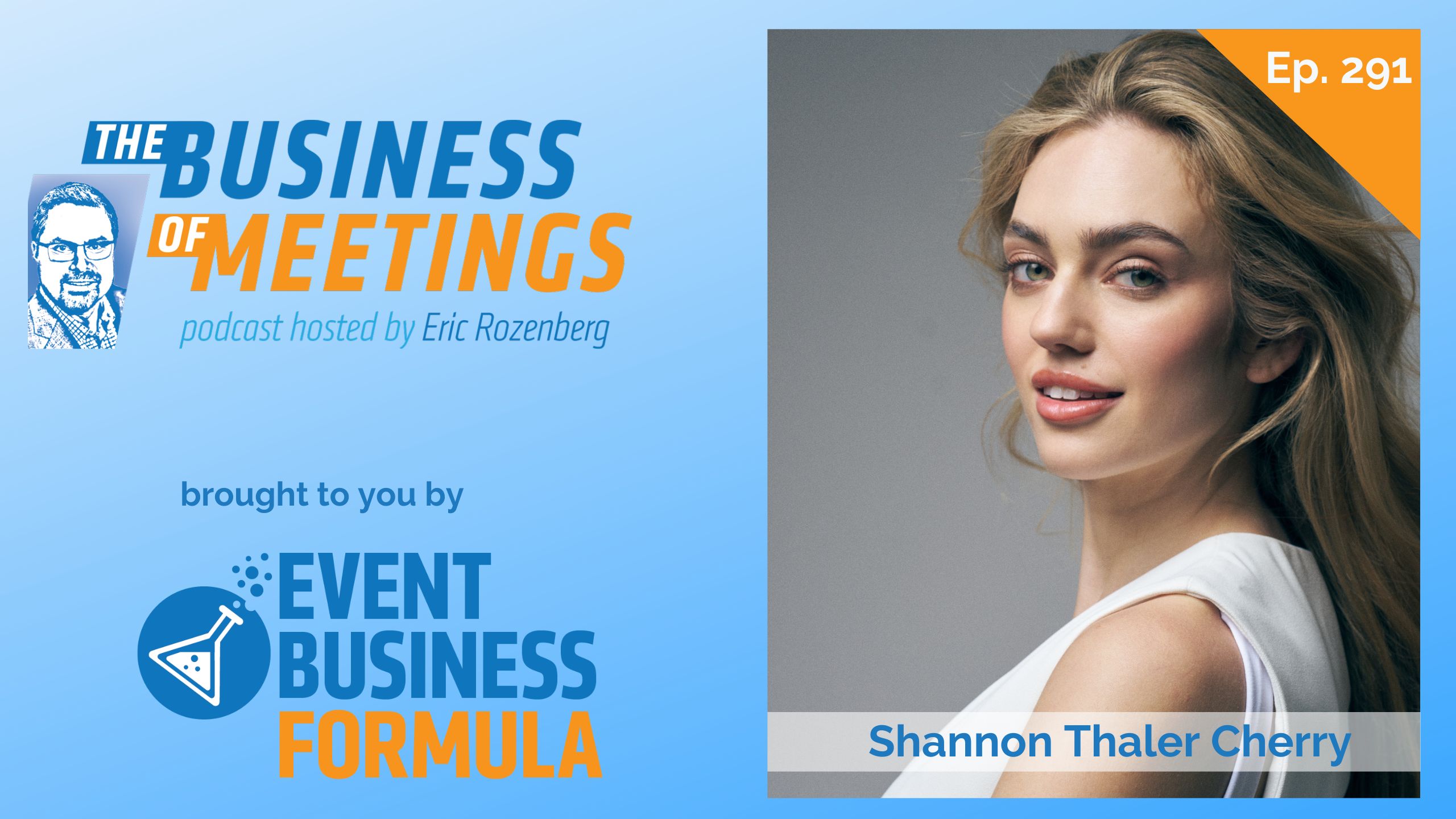
Today, Eric is thrilled to welcome Shannon Thaler Cherry as his guest.
Shannon began her career as a model before pivoting to become a successful journalist, emcee, and host. She now leads content sessions at trade shows, corporate events, webinars, awards shows, and other events.
Tune in as she shares her journey and the nuances and facets of the dynamic career she has built.
Shannon’s Journey
Shannon began as a dance major in high school. She then signed a modeling contract rather than going straight to college. While traveling internationally as a model, she pursued digital journalism studies through Penn State’s World Campus. A chance conversation at a photoshoot led to her first writing opportunity, which opened the door to an internship at BizBash after months of persistence. From there, she transitioned into newsroom roles at Daily Mail and New York Post before returning to freelance writing, where she found her niche in event journalism. Today, she combines writing with emceeing, carving out a unique space at the intersection of storytelling and live events.
Planning Career Transitions
Changing careers requires preparation. Shannon maintained her freelance work as a safety net to ensure she had income streams in place before leaving her former roles.
The Modeling Industry
Modeling is highly competitive, but Shannon pushes back against the stereotyping that portrays models as shallow or unkind. For many, modelling is a stepping stone to other opportunities. She also notes how the modeling landscape has shifted to become more competitive, with influencers taking a share of the opportunities once reserved for traditional models.
Pursuing Multiple Careers
Shannon learned that to manage her multiple careers successfully, she had to ignore outside opinions. She also realized that at least one of her chosen careers needed to be driven by passion to give her the resilience required to ride out all the ups and downs.
Journalism Realities
Young writers seldom choose their own assignments. Content is often driven more by clicks than quality, which can undermine investigative work. Shannon’s strategy has been to find niches she genuinely enjoys within those constraints.
The Event Industry
What sets the events world apart is its people-first culture. Shannon finds professionals in this space more collaborative and responsive than those in newsrooms. LinkedIn networking has also been a cornerstone of her growth as both a writer and emcee.
Preparing to Emcee
Shannon avoids over-reliance on technology and instead memorizes scripts through repeated writing and rehearsal. She advises joining planning conversations early, connecting with speakers in advance, and over-preparing for the likelihood of any technical glitches occurring.
Handling Uncertainty on Stage
For Shannon, the key to handling uncertainty on stage is to stay calm and keep her energy flowing when something goes wrong. She uses housekeeping announcements or light engagement to bridge awkward moments without embarrassing speakers.
Burnout and Balance
Organization is essential. Shannon schedules everything in her Google Calendar, including her downtime and walks. She also views dinner times with her husband as a daily grounding ritual, a habit she credits to her upbringing.
Technology and the Future of MCs
Shannon is not worried about AI replacing live emcees. Unlike a faceless “voice of God,” an emcee offers human connection, eye contact, and the kind of responsiveness that technology cannot replicate.
Personalization in Events
Shannon highlights a growing industry focus on “personalization at scale.” Attendees now expect experiences that feel crafted just for them, whether at small gatherings or massive festivals.
Bio: Shannon Thaler Cherry
At just 26, Shannon Thaler Cherry has already built over a decade of professional experience. Today, she works as a full-time content specialist, out of NYC, contributing to leading outlets including A Media Operator, BizBash, Corporate Event News, Trade Show News Network, and Vendelux, among others. Beyond writing, Shannon is also an experienced moderator, host, and emcee, leading content sessions at trade shows, corporate events, webinars, awards shows, and more.
Shannon’s career began on a very different stage: as a model, traveling the world for brands like Reebok, Louis Vuitton, Sally Hansen, and Colgate, and appearing in the pages of Glamour, Teen Vogue, and Seventeen Magazine. She later shifted her creative focus to journalism, sharpening her craft as a breaking news reporter at the Daily Mail and business reporter at The New York Post, before stepping into the specialized world of events media, where she continues to blend storytelling, performance, and industry insight.
Connect with Eric Rozenberg
Listen to The Business of Meetings podcast
Subscribe to The Business of Meetings newsletter
Connect with Shannon Thaler Cherry
LinkedInEmail Shannon: shannonthaler@gmail.com
Listen on: Apple Podcasts · Spotify · YouTube
“I think the event industry is a people-first industry in a way that no other industry is.”
Shannon Thaler Cherry
Full transcript of episode 291 of The Business of Meetings podcast, Eric Rozenberg with Shannon Thaler Cherry. Lightly edited for readability.
Eric: Hello and welcome to the Business of Meetings podcast. I’m your host, Eric Rozenberg. Over the years, I’ve had the privilege of helping businesses in the meetings and event industry grow and succeed. And I’m excited to share that experience with you. If you feel alone and overwhelmed, and if you’re looking to take your business to the next level, improve your strategy and sales, and connect with like-minded professionals, you are in the right place. I invite you to visit eventbusinessformula.com and join our community of event business owners dedicated to exponential growth. Now let’s dive into today’s episode.
Hello and welcome to a new episode of the Business of Meetings podcast. And today I’m absolutely delighted to have a conversation with basically the person that is the MC that you see everywhere now. She has an amazing career as a journalist, an MC, as a host. She also in the model industry. We’re going to talk about all those elements with none other than Shannon Thaler Cherry. Shannon, I know you have a very busy agenda, so thank you so much for taking the time to speak with me today.
Shannon: Yeah, Eric, thank you. It’s weird to be on the other side of the conversation. I’m usually in your seat, so I appreciate it. Thank you so much.
Eric: Great. Bear with me. I’ll hope I’ll do a good job. So, we’ll see. Tell me.
Shannon: You’re fine. You’re fine.
Eric: Thank you so much. My very first question, which I always asking my guests, is what is your journey and what do you decide to do in your life until today?
Shannon: Wow. Okay. Big question, big start. To answer that question, I have to go back quite a bit. I think my experience in journalism really started, well, in high school. I had a teacher in a writing class who was like, “I think you would be a great journalist. Have you thought about writing in college?” And I honestly hadn’t. I went to a magnet program in high school. I was a dance major. I loved performing. I loved being on stage. I loved all the production behind that, but I didn’t really know how to transition it into a career.
So, long story short, I thought I was going to go to college. I ended up signing a modeling contract. I deferred, and when I went back fully online, I went to Penn State World Campus and was modeling and traveling the world. I was in Japan for a bit, LA for a while. And yeah, so now I’m equipped with this digital journalism studies and then my modeling.
And I was shooting a magazine one day and the photographer was asking, making small talk, asking if I have any hobbies. And I was like, “I am trying to be a writer.” And he asked me if I had ever covered an event. And I don’t know what in the world made me just say, “Yeah, I have.” I hadn’t. I was still in school. And I think in the back of my mind, in the modeling industry, they say jump, you’re supposed to say how high. So when he asked me that question, I just said yes.
Long story short, I covered this event for his magazine, and I had to touch base with the producer, and she had a long-standing relationship with BizBash, and she was the one who told me if you want to work in events or break into the industry, BizBash is a really wonderful place to do that. And yeah, I guess you could say the rest is history from there. I bugged the editor-in-chief on LinkedIn for probably about eight months until she agreed to let me be her intern. And that was my first job in writing.
And from there, it kind of just went up from there. I worked full-time for BizBash for a while. Then I left and did a stint in newsrooms at the Daily Mail and the New York Post because I was based in New York. BizBash was down in Atlanta, so I wanted the opportunity to be in the mix in Manhattan, to do the corporate thing. And yeah, ultimately ended up leaving a little over a year ago now, last May, and I’ve been full-time writing, and I found myself back in this event industry niche, and I’m sure we’ll get more into that, but that’s the long story short of it.
Eric: Nice. Very nice. When do you know when it’s time to change, or is it just serendipity and your gut telling you, you know what, yeah, why not?
Shannon: A little bit of both. I wouldn’t consider myself the most serendipitous person. I’m very type A. I very much wanted, like, a safety net if things didn’t go well. So the great thing was is that I never stopped freelancing. So even when I left the events industry and went to a more traditional newsroom, I never stopped writing for trade publications, never stopped working with BizBash and working on those relationships and attending events on the side. And so I had this steady line of freelance work. And so in the back of my mind, I’m like, “Okay, how much can I realistically ramp this up before I even jump?”
And that is also kind of what led me along the way there. I left modeling fully to be in a corporate role, and I signed a modeling contract again as kind of as job security, really. I didn’t know how else to make money. And so I definitely lined some things up and was like, “Okay, if I fall flat on my face, I have some sort of job security in a sense.”
Eric: Is it true what they say? Because I don’t know much about the modeling industry, but is it true that it’s extremely competitive, that you have no friends, that you have to hunt only on yourself?
Shannon: The extremely competitive is correct. If I could debunk anything, it’s that models are competitive and mean and not intelligent and all those things. I have met some amazing women, and everybody has their own grind. I would say most of the women you meet, modeling is not their end-all be-all. And sure, of course, I mean, you’re in a very competitive industry. There’s going to be some sense of competition, but those rumors aren’t necessarily true. But it’s definitely harder now more than ever. You bring in influencers. Social media has made anybody a model. And you can see brands are partnering with the people you know and love on social media, not the no-name model from a small town. So things have changed for sure.
Eric: Yeah, that must be different to travel the world and modeling and then going into writing and being a journalist. What would you suggest and advise somebody who wants to do a different career? Because I love the fact that you have different, how do you say in English, the different profession, if you want, at once. You’re not in the box, which, as an immigrant from Belgium, I sometimes see the US very boxy. If you’re getting out of the box, oh my god. And Europe more generalist. What is your advice for people that maybe want to try something else in the meantime instead of, or, what they doing now?
Shannon: Yeah, exactly. And it is hard. I think stepping out of the box, that’s probably been one of the biggest things I’ve had to overcome, is that, like, you can’t care what people think. If you cared, then you wouldn’t be able to do what you want to do. And I think at the end of the day, at least one of those things you have to have, like, a real passion for, because things are going to ebb and flow. You’re going to have really high highs, you’re going to have really low lows. And especially when you’re working for yourself, even on the high highs, my thought is like, “Oh my god, I just don’t want this wave to be over. Like, what’s on the other side of this high? Am I just going to come crashing back down, or do I have things lined up on the other side?”
And so I would just say, to anyone who wants to diversify their professions or their income, make one of them something that you love so much that, like, it sounds cheesy, but that the work doesn’t feel like work. And yeah, and then you can kind of, like, embrace that, for lack of a better word, about the other things, because I get to go home and work on that project that I’m really excited about, or, like, I’m looking forward to later this week when I get to do whatever it is.
And so that’s definitely something that’s really kept me going, is that, I mean, I’m fortunate, there’s parts of both of my jobs that I love so much that sometimes I’m on set, like, really eager to get home and work on a story, and sometimes a modeling job pops up and I’m like, “Oh darn, I’ve, like, been really in the thick of this project and I don’t want to let this go.” So it’s that constant passion that keeps you steady when, like, that wave is getting high and low around you, if that makes sense.
Eric: Yeah, absolutely. I love a writer named Ryan Holiday. I don’t know if you’re familiar with him. He studied the Stoic, the Greek time, and he has different book that are about courage, about all the values of Stoicism. But before that, he wrote a book called, if I’m not mistaken, Trust Me, I’m Lying, and it was all about not the journalist but the blogger. The same way that anybody can become a model with the social media today, anybody can become a blogger. And so you had companies that were absolutely focused on the number of blogs you were writing per day, not on the quality of the stories. When you go into journalism and in editorial, obviously there’s some guideline to do it, but can you write about stories that you’re passionate about? Can you pick the stories? How is that working when you are in a writing position and an editorial position?
Shannon: Yeah. So, I would say no. Honestly, like, no. I think especially first as a young writer, you’re getting assignments, and maybe if you’re lucky and you have a great editor, they know that you really like a certain thing and they’ll be like, “Oh, well, you can take this.” Like when I was in the New York Post newsroom, I was a business reporter, but everybody knew that I liked Taylor Swift. And so when everything kept coming out about the Eras Tour and all this stuff about how she was becoming a billionaire, and it fell into our kind of, like, jurisdiction on the business desk, my editor would be like, “Oh, well, Shannon, you can take that story,” because I enjoyed that topic.
But for the most part, no. And then now a lot of the things guiding what you’re reporting on is clicks, and, like, how long people stay on a story, time. And so you may have a story that sounds really good and has a lot of journalistic integrity and takes a lot of investigation, but if it goes up and it gets half the amount of clicks and people aren’t reading all the time that you spent investigating, then there’s really no point. And so that’s what’s driven a lot of the decisions over the course of my journalism career, is what are the readers going to click on?
Eric: Now you’re in different industries. Obviously now, as I said in introduction, the MC that everybody want to have in the meetings and event industry. What do you see in this industry that you really like and that might be different than in the other industries that you know?
Shannon: I mean, it’s hands down the people. I think the event industry is a people-first industry in a way that no other industry is. I’ve brought, at this point, some newsroom friends over to the trade publication side and the event space, and when they’re first starting out, I always tell them, like, go to LinkedIn and don’t be shy on who you reach out to, who you connect with, who you send a note to. This industry is extremely responsive, and I don’t know how that, like, works out, or why. Maybe event professionals are more active on LinkedIn than anything else. But if I sent out 10 emails on the business desk at the Post, 10 LinkedIn DMs, I would be so lucky if I got one answer. In the event space, I could send out those same messages and I expect an 80% response rate.
That’s how I’ve grown most of my business. That’s how people have reached out and inquired about wanting me to MC for their event. It’s really all been through LinkedIn. And so it’s just kind of worked out. I didn’t even seek it out intentionally that I’ve gotten myself involved in an industry that does really care about the people. And it makes sense given what they do and what the goal of these events are at the end of the day, about creating memories. And I’m not working with salespeople who are just thinking about numbers and ROI. And of course that matters, but a lot of the reoccurring themes in the sessions that I’ve been seeing lately is it’s about the engagement. It’s about creating a memory. It’s about making someone feel like a moment was made just for them. And then in turn, those things that sales representatives care about will happen. But yeah, so it’s a very special industry in that way.
Eric: I can only agree, of course, having spent almost 30 years.
Shannon: Yeah, absolutely.
Eric: How do you prepare when you have to MC? Let’s say, for instance, you recently MC Connect here in Miami. I’m sure there are different session, different speakers. How do you prepare for that?
Shannon: Yeah. So I have a long-standing relationship with Informa at this point, so it’s nice that they know how I like to work. I like to be involved as early on in the process as possible, and I tell them the more that I can embody the lines, the better. If I can touch base with a speaker weeks out when they’re asking their initial questions about what’s going on at the event, I’m going to have a much easier time than if at the end I’m just getting pages and pages worth of documents.
But really what it is at the end of the day is, maybe controversial, but I don’t want to rely on the tech. We have what we call DSM, the downstage monitors, that have my script up on them, and I get a little clicker and I can click through my script. But oh my god, every single show I’ve been a part of, you click next, it lags or it doesn’t come up right away or it cuts out for some reason. And even though that may be the tech fault, I’m the one standing up there going, I don’t know what to say.
So, it’s a lot of writing and rewriting. So once I have my script, I have a notebook that I literally just rewrite it paragraph by paragraph, and then I say it out loud, write it again if I mess up. And something about that, like, physically writing-to-brain connection really works for me. And yeah, and just getting involved as much as I can. If I’m lucky, I’m working with a client that lets me be on the Zoom calls with the speakers, and putting those faces to names and getting a feel for the people as early as possible is always really helpful. But I’m pretty psycho about writing and rewriting things. I have pages and pages, notebooks filled with just rewriting.
Eric: Just another illustration of, people don’t see how much work goes into the preparation before.
Shannon: Yeah.
Eric: And to your point about the AV or something else, I had a corporate event agency for 20 years. I worked in over 50 countries for major Fortune 500 companies.
Shannon: Yeah.
Eric: I never had one project that was executed exactly the way it was planned.
Shannon: Yeah.
Eric: There’s always something.
Shannon: Yeah. Exactly. And you have to almost prepare to pick up the slack, because in those situations, like, you are a team. Like, I can’t get off stage and start, like, being rude to the stage manager and being like, “Where was my script? Why didn’t that happen?” Like, it’s a team effort. And so I think, especially being as perfectionist as I am, I don’t want to feel like I can put the blame on anybody other than myself. If something goes wrong, I’m not going to put myself in a situation where I feel like the stagehand did me dirty or the tech guy did something wrong. It’s like, no, well, you could have spent an extra hour memorizing something and then this wouldn’t have been a problem. And so that’s kind of how my thinking is, too. It’s just prepare so much that anything goes wrong and you’re just stable. I guess I’m back to that, like, being that solid line while everything’s just, like, going crazy around you. But yeah, it’s true.
Eric: You know what? It’s exactly what I’ve said many times to my family. Somehow, to work in this industry, there’s a lot of adrenaline, and, oh yeah, you need to like the unexpected. Some people froze and other people go, “Aha, okay, what are we gonna do now?” Because there’s always something.
Shannon: Yeah. I guess it’s like why some people like roller coasters and some people don’t. But I definitely feel like you’re flexing a certain muscle, too, as far as memorization, but also with, like, the adrenaline. The more that you can, like, feel that, like, butterfly-in-your-stomach feeling, at least for me, the more I feel like it’s like revving an engine. It’s a great feeling. I like it.
Eric: Is there any part of the industry you say, ah, no, I could not do that, or any topic that you would be concerned, or you can prepare for any type of industry, any type of organization?
Shannon: Yeah, I would say that I can prepare for anything and everything. I mean, to some extent, I mean, my business is really in the events sector, or I’ve found this little niche, and so when I’m up on stage with event professionals, I feel a little bit more comfortable kind of bouncing off of things that they say and maybe lending a little bit of things I’ve seen in my own reporting. But as far as MCing goes, I could prepare for any industry. I may just not be as comfortable, something like an infrastructure conference talking about, like, building infrastructure or certain types of technologies. But yeah, give me something and then tell me I can’t do it, and I’m definitely going to do it.
Eric: I love it. Now you’re in touch with a lot of event professionals. What do you see today that is changing compared to a few years ago?
Shannon: Yeah, I think the biggest thing, it’s almost like a new buzz phrase that’s coming up, is personalization at scale. Event professionals are talking about how can we personalize things, whether you have those 40-person invite-only pop-ups or 400-person sporting events or 4,000-person festivals. Finding a moment where every attendee almost has an opportunity to say, like, “Wow, that was made just for me.” I think in order to accomplish that, I’m hearing a lot of, like, choose-your-own-adventure-style events. But I think more than ever, there’s almost, like, an expectation from an attendee to kind of sit back and be like, “Okay, I’m waiting for you to give me my surprise-and-delight moment,” rather than, like, a general surprise-and-delight moment. It’s a big ask.
Eric: Yeah, absolutely. I’ve seen more. So, I have three daughters. The three of them are Gen Z.
Shannon: Okay. Yeah.
Eric: And I’m Gen X. I see that there’s more commonalities between Gen Z and Gen X than with millennials. Is it me, or do you see also the difference in expectation in the way that they’re enjoying or complaining about the conference?
Shannon: Yeah, I think so. Yes and no. Because I think that Gen Z is tapped into tech and social media in a way that is very uniquely Gen Z. And there’s certain things that, like, I went to a Savannah Bananas game this past weekend. I don’t know if you’ve ever seen them on TikTok.
Eric: Well, actually, Jesse Cole was a previous guest on the podcast. I had
Shannon: Oh, that’s so funny.
Eric: I had the opportunity to meet him thanks to Jayson Gaignard and MMT community, and we went to a game of
Shannon: Yeah, that’s wonderful. It was such a unique, like, I’ve never really seen, like, an experience like that. But I’m on TikTok, or at least I don’t use it, but I scroll through it. My husband is not, and so there were so many little, almost like, inside jokes between people who follow them on TikTok and the people who don’t. And it was interesting to see. I don’t think that the experience was any less enjoyable for him, but there were definitely a couple things where he was scratching his head and I was like, “Well, you have to be on TikTok to, like, get it.”
And so I think that’s just an example of, like, how people are leaning into, like, the Gen Z fandom. I don’t think a millennial or a Gen X would get, like, those inside jokes aren’t being established between those generations. And there’s definitely, yeah, like a different communication model, I guess, between a brand and its Gen Z audience.
Eric: And in the case of the Savannah Bananas, it’s just, they were, was it like last week? Oh, what is the name of the show with, oh, I have a blank now. Very well-known talk show.
Shannon: They were on the talk show? Was it Good Morning America?
Eric: No, I think it’s the one that they film in Chicago.
Shannon: Oh my goodness. Wait, was it the talk show? I think I saw a clip of this where they were, like, disguised as audience members and then they
Eric: Yeah.
Shannon: And then they ripped off the clothes and they had their uniforms.
Eric: Yes.
Shannon: I did see that. I don’t know what talk show it was either, but I did see that clip.
Eric: I have a blank on the talk show host, who’s extremely well known.
Shannon: Extremely well known.
Eric: But the point was that they always tried to come up with new ideas, and this conviction of what Jesse Cole has decided, and his wife, have decided to do and to build. It’s phenomenal. They have how many million of people waiting to buy a ticket, how many thousands of people waiting to work for them.
Shannon: Amazing. And I was at the game in Yankee Stadium. So I think it was, like, especially meaningful for them, given that they sold out Yankee Stadium, and Jesse got on the mic and was saying like, “I can’t even tell you how many years ago I was struggling to sell 20 tickets among family members, and here they are,” I think 45,000 fans that sell out Yankee Stadium. And it was incredible.
Eric: And at the beginning, they were even sleeping on the mattress in the old stadium in Savannah. It’s a beautiful American success story.
Shannon: Yeah, absolutely.
Eric: So, you do many different things, and I know that you have to be extremely organized. You have to manage deadlines. And I know you also have a specific point of view and advice for people in our industry for not burning out. So, how do you do that? How do you have the time to managing the deadlines, to do the research, to prepare for the interview, to be creative, to travel, and in the meantime to avoid being burned out?
Shannon: Yeah, I mean, I can’t say that I know the tip to avoiding burnout, because it happens to me. But I think, I don’t know, I wish it were more groundbreaking than this, but, like, I love my Google Calendar at the end of the day. It’s like, I schedule every itty-bitty little thing. If I email someone, “I’ll follow up with you early next week,” I’m putting something in my calendar on Tuesday at 11:00 a.m. and saying, “Follow up with so-and-so.” If I feel like I’ve been working really hard and I’m approaching this burnout, I’m going to put a schedule of 20 minutes in my calendar and say, like, “Go for a walk.” And so it may seem silly, but my calendar is my Bible during the week, and it’s really helpful.
And I think also it’s something that my mom really instilled in my brother and I growing up, is dinnertime is a very sacred time. And so as much as possible, put your phone away. The entire family should be around the dinner table, and it’s like an event every night. Like, I don’t go as far as my mom did, as far as, like, she used serving platters, like, every single night. My husband and I can make our plate at the stove and then, like, come and sit down. I’m not putting everything on serving platters. That’s so many dishes at the end of the night. But I really try, between work schedules and everything, if I have to wait an extra hour or my husband has to wait longer, whatever it takes for us to be able to sit down at the end of the night together. And I think that’s really centering, and that’s really helpful. And there’s plenty of nights where both of us after dinner go log back on and work more. But to be able to have that moment together is, I think, something that definitely keeps me sane.
Eric: And it’s very unique what you just said, at least for me, because my wife and I, we always have the kids at the end of the dinner. First of all, we have dinner together, which apparently is not the case for most of my kids’ friends.
Shannon: Yeah, I remember that growing up, too. Yeah, my mom was very much, I mean, my brother and I were both very involved in activities, and of course there were some nights you couldn’t avoid it, but the nights that we could all sit down together, we were sitting down together.
Eric: Yeah, we do that, and then we asked the three good things of the day at the end of the dinner, which is something I like very much. When you look at the whole technology, when you look at, for instance, one of my youngest, she’s texting and, “What do you do?” “I’m speaking with my friend.” “No, darling, you’re texting. You’re not speaking with your” And she goes, “No, that’s my way of communicating.” And we’re like, “Huh, she’s got a point.”
Shannon: Yeah. Right.
Eric: The question I have for you now, in terms of technology and AI, are you concerned that what you do as an MC one day could be replaced? Or, like, Mark Cuban tweeted two months ago and said one of the profession of the future will be event planner, because people want to come in person and see people.
Shannon: Yeah. I mean, I kind of think about it like this. We call it voice of God. So if there’s no MC and you just kind of hear, like, a voice coming in from overhead, that’s what they call the voice of God. If they were going to replace MCs, they would have used the voice of God for everything a long time ago. And so, no, at least in the current iteration that we’re in, I’m definitely not worried about MCing going anywhere.
I think there’s also something to be said about having something up on stage to look at at all times and to feel like, as much as I’m not interacting with the audience, I am. And given the type of MCing I do, it’s also on a trade show floor. So oftentimes it’s not one of these stages where the lights are so blinding that you can’t see the people in the audience or anything like that. So when I say something and I can see people head nodding, I can be like, “Oh, okay. We have a lot of people in the audience agreeing with” like, I’m right in it with them. There’s no, like, fourth wall to be broken. It’s more of, like, a presentation to a room of colleagues, really, than a stage-audience-member type setting. So no, I’m not worried, to answer your question.
Eric: Very good. I agree with you. Just wanted to have your opinion on that. I’m sure you have moment when it’s your turn to come back on stage and you’re waiting for the speaker and you’re thinking, “Oh my god, I have to go back,” that the speaker didn’t connect or there were something special. What do you do at that moment? Do you use humor? What’s happening when you have to go back on stage?
Shannon: Yeah, that’s a tough one, because I think you want to jazz everybody back up, but you also don’t want the speaker to feel like, “Oh no, I just, like, bombed.” So I think, more than anything, I mean, I do more often than not, like, have a prepared script. I think it’s just coming out there and maybe, like, saying a couple more housekeeping notes and just getting the energy back up and flowing, just getting to the next engaging thing. Because I’m also not the presenter. I’m just introing the next person. So I think I really can set a pace and just get the show moving on, and people can feel like, okay, I’m not, like, waiting for the next thing anymore, then that’s ideal.
And yeah, oddly enough, even though housekeeping notes sound like they would be boring, more often than not, they’re engaging. I’m telling people to plug in their headsets and listen to their headsets and adjust the volume, or try out this booth, or check out that alcohol-infused ice cream. And, like, again, we’re on a trade show floor. There’s so much to be interacting with. So there’s some fun things that I can talk about that make people go like, “Oh, okay. I want to check that out,” or, “That sounds fun.”
Eric: Right. And I had a sales meeting in Portugal, in Lisbon, where we had one of, I won’t mention the name, a very well-known professor from a very well-known business school speaking about motivation and about sales, and didn’t want to prepare anything and lost the crowd because he was using example of baseball. Nobody plays baseball in Europe. And people start talking, and up to the point they say, “If you continue like that, I’m gonna leave.” And so the MC afterwards had an interesting job to do going back on stage. Now, I don’t want to embarrass you in asking you a nightmare situation, but the opposite. What was one of the greatest moment or the greatest person that you were an MC and you got the chance to meet and to introduce?
Shannon: Oh my god. Will Guidara, I would say, hands down.
Eric: Yeah. Unreasonable Hospitality.
Shannon: He was our keynote for Connect Spring Marketplace. I believe it was at the Wynn in Las Vegas. And yeah, he was definitely the most engaging, like, first of all, coolest person to meet backstage. With a keynote, sometimes the personalities can be interesting, and they come in and they think they’re the hotshot of the sessions and everyone’s coming because they’re there, and they kind of hang out in the corner with, like, a domineering presence. And Will Guidara walked in, like, so excited to almost, like, be a part of the team for this next hour, and introduced himself and talked a little bit about his session and wanted to know about me. And I think the whole concept of being interested rather than interesting goes really far when you’re talking to people. And Will Guidara is interested in people.
And even just getting up on stage, he did this little bit that I’ll probably, like, never forget. He had champagne and champagne flutes ready backstage, and he was going to ask people in the audience, “Who’s ever been engaged at a restaurant, and were you offered free champagne?” And if the people said no, then he was going to offer them the glass of champagne that they should have gotten, because, like, that’s the whole epitome of unreasonable hospitality. And if everybody said yes, then we just got to drink the champagne backstage among the, like, stage crew. And so that happened. We got to drink the champagne backstage with the crew. But I think he was somebody that I sat backstage and watched his session and was like, “I am learning from this.” And so I always really appreciate when I can, like, walk away feeling inspired, too. And yeah, so, Will Guidara.
Eric: Wonderful. That’s awesome question. Shannon, I could talk to you for hours. Obviously, there’s a podcast timing, and I know you are extremely busy.
Shannon: Are we coming to the end already?
Eric: It goes fast.
Shannon: I know. It really does.
Eric: It’s great. It means you didn’t see the time passing, then I did an okay job. So that’s great. I have two more questions. The first one is, how do people get in touch with you if they want to talk to you, if they want to talk about the project of you being an MC at their conference? How do they get in touch with you?
Shannon: Yeah, absolutely. I mean, LinkedIn. You can always reach out to me on LinkedIn. I’m always going to answer my DMs. And all my personal contact information is on there. My email is just my name, Shannon Thaler, my maiden name, shannonthaler@gmail.com. And yeah, send me an email. I’m very responsive. I get through all of my emails. So it would be great to get in touch with whoever is listening and wants to chat more.
Eric: Wonderful. And now that’s what everything comes full circle with my last question. You’re going to see why I mentioned already Jayson Gaignard, the MMT community, which is a fabulous community of entrepreneur. He always bring amazing speaker, and he always prepare for days. The introduction is just insane. And one of the best introduction that I’ve seen him doing, and we had the speaker in front of us, was for Will Guidara.
Shannon: Really? Oh, wow. I love it.
Eric: It’s kind of interesting you just mentioned that. And the other thing is, you mentioned about the champagne story. And one of my favorite questions, if not my favorite question, which I’m going to ask you now, comes from Jayson as well. When we meet in a year from now with a bottle of champagne, what are we going to celebrate?
Shannon: Ooh. I think, oh gosh. Wow, that’s tough. I want to be hosting an award show, like a big-time, bigger-time award show. And yeah, so I hope that we’re toasting to new clients and new successes. I would love to grow my book of business even further. And yeah, I think, personally, I just got married, and so I hope there’s some personal wins in the future, too, as we look to buy a house and start our life together. And so, gosh, I can’t whittle it down. I feel like, for better or for worse, I, like, dream too big. So I just hope that just success, and whatever that means for us at that time.
Eric: Keep dreaming big. If everybody’s listening, keep dreaming big. And Shannon, thank you so much for speaking with me today.
Shannon: Thank you, Eric.
Eric: Thank you for tuning in to the Business of Meetings podcast. I hope you found today’s episode valuable. If you enjoy the show, the most important thing you can do is leave a review and share it with your colleagues. It really helps spread the word. I truly appreciate your support. And if you’re ready to take your business to the next level, don’t forget to visit eventbusinessformula.com to learn more about how we are helping event business owners like you. Thanks again for listening, and I’ll see you next time.