

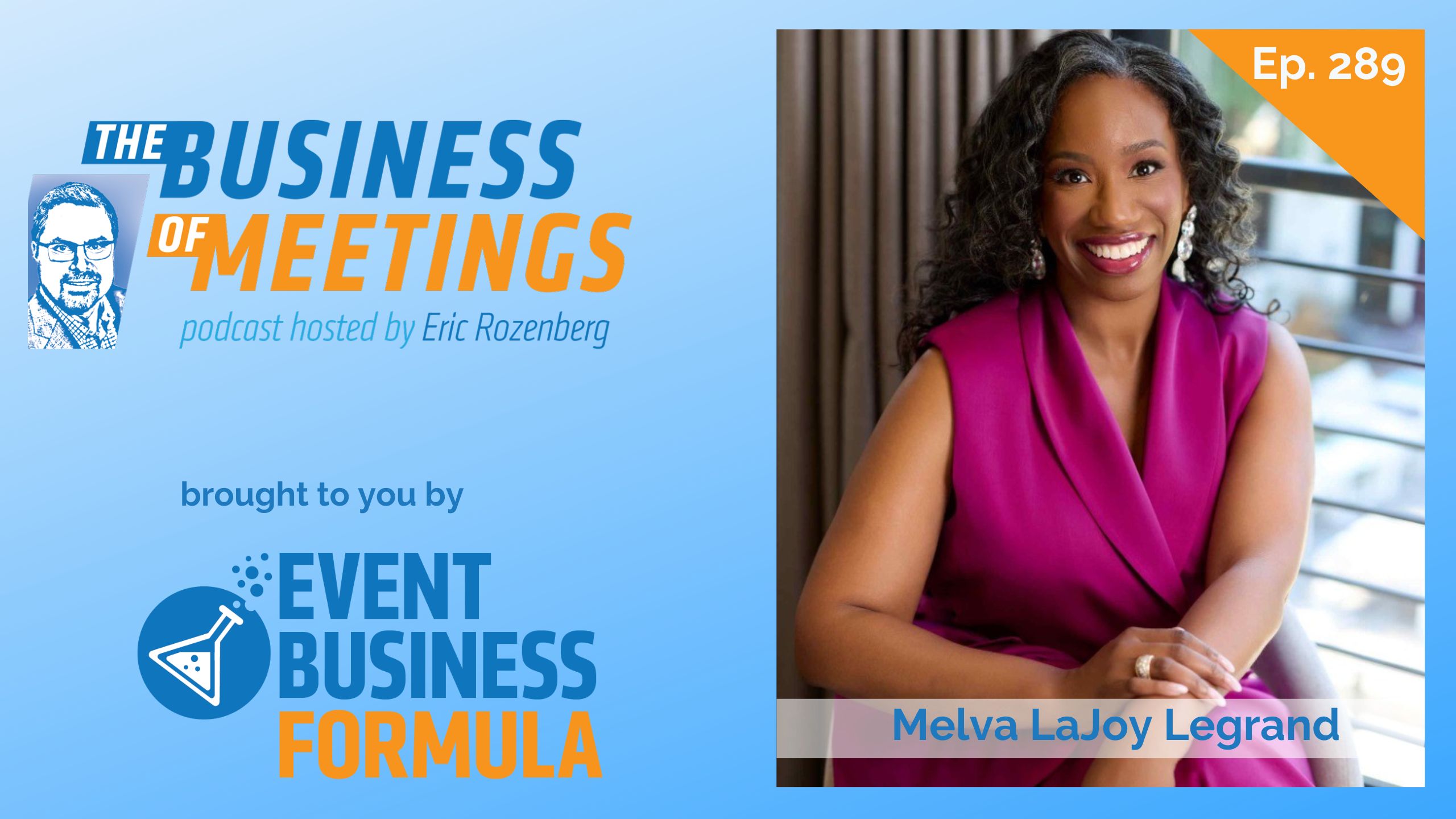
Today, Eric is delighted to welcome Melva LaJoy Legrand as his guest.
Melva is an icon in our industry, having built an impressive career that spans the US, France, and Europe, earning numerous recognitions along the way.
In this episode, she shares her journey and discusses the honors she received within the industry, offering inspiration and insights for solopreneurs and small business owners.
Her Journey
Melva began her career as a teacher, but her creative spark kept pulling her in a different direction. A volunteering stint at a radio station one summer introduced her to concerts, festivals, and events, and she discovered her true calling. With the unwavering support of her parents, she stepped into event planning, starting at the bottom, and soaking up every lesson she learned along the way. With the help of her mentors, she managed to overcome her fear, learn about leadership, and shape her emotional intelligence. With perseverance, faith, and resilience, Melva built her own business, LaJoy Creative, weaving together her professional achievements and her personal trials.
Her Early Career
Melva describes her early years as a “preparation season”, where she embraced every small task with humility, absorbing lessons from behind the scenes. That shaped her professional values, helping her decide the kind of leader she wanted to become.
Mentorship and Growth
Melva had several mentors who were all central to her development. One of her mentors encouraged her toward a leadership position at a major festival, creating a breakthrough moment where she discovered her own capacity to lead. This experience highlighted the importance of humility, teachability, and persistence in building effective mentor relationships.
Building Confidence and Starting Over
Melva restarted her business in 2019 during a deeply challenging period while caring for her ailing father. His encouragement gave her the courage to relaunch her business, and she also received additional confirmation from her mentors and unexpected encounters, fueling her belief that her business was her purpose.
Overcoming Trauma and Anchoring in Faith
As a survivor of abuse and trauma, Melva knows that therapy, faith, support groups, and resilience are an essential part of the healing process. Her faith and clarity about her values have shaped her leadership and business decisions, ensuring she only accepts work that aligns with her principles.
Awards and Recognition
Melva has received numerous honors, including recognition for organizing survivor-focused events, being named a Top Female Founder 500, and winning Silver for International Event Agency of the Year. Those awards affirm her parents’ belief that the world would always make room for her. She also takes pride in recent collaborations, including honoring cultural icons at a major beauty and artistry event.
Cultural Perspective: US vs France
Living between the US and France has given Melva unique insight into the work-life balance. She contrasts the American culture of overwork with the French emphasis on rest and leisure. While she acknowledges higher US salaries, she credits her best creative breakthroughs to the mental clarity she gained during her time abroad.
Bio: Melva LaJoy Legrand
As a C-Suite business leader, entrepreneur, and public speaker, Melva LaJoy Legrand has dedicated over 20 years of experience in education and event production to helping individuals and companies elevate their missions, rooted in social justice, educational access, climate change, diversity, equity, inclusion, and belonging. She has worked closely with executive leaders to create organizational cultures that support overall wellness, encourage feedback, value empathy, and authenticity within their leadership teams. As the Founder/CEO of LaJoy Creative (fka LaJoy Plans), an event planning firm launched in 2007, Melva has been recognized as a trailblazer in her industry, recently joining the list of Inc.’s 2025 Female Founders 500, receiving a spot on SUCCESS Magazine’s 2024 Women of Influence, and a 2024 Women Entrepreneur of the Year Award. For her Events Industry work, Melva has received the 2024 International Event Agency of the Year and the 2024 Women to Watch in Meetings. Recognized nationally for her thought leadership, Melva is a 10x award-winning CEO who has used her social impact to grace the stages of international conferences throughout Germany and France, as well as being a 2x speaker at IMEX America (2024, 2023), IBTM Americas (2022), and four cities for BizBash’s Connect Conference (2022). In 2023, she launched her YouTube video subscription series, Mondays with Melva, writing, producing, and starring in two seasons and eight episodes, dedicated to business leadership and career advice. Melva has been featured in Forbes, The Washingtonian, Black Enterprise’s Sisters Inc., Authority Magazine, and The Black Wall Street Times, speaking to the issues surrounding the gender pay gap, empathetic leadership, redefining what success looks like for mature women, navigating career changes, being an ally for Black women in the workplace, and building a legacy business through impact. Having relaunched her business in 2019 only to lose 98% of it during the COVID pandemic, Melva embraced the pivot and re-established her business offerings to build her company to where it currently stands: achieving footprints in 42 states, working with budgets in excess of $1.5 Million, and hosting notable attendees such as Grammy Award- winning artist, Ciara; Inaugural National Youth Poet Laureate, Amanda C. Gorman; Netflix co-founder and Executive Chairman, Reed Hastings; civil rights icon, author, and founder of The National Memorial of Peace and Justice, Bryan Stevenson; along with former and current US Secretaries of Education, Dr. John B. King Jr. and Dr. Miguel Cardona. Because of her ability to adapt, sustain, and grow LaJoy Plans, Melva made another shift in 2025, rebranding her agency to LaJoy Creative, which represents a range of new creative services beyond the event production world.
Connect with Eric Rozenberg
On LinkedIn
Listen to The Business of Meetings podcast
Subscribe to The Business of Meetings newsletter
Connect with Melva LaJoy Legrand
On LinkedIn
Listen on: Apple Podcasts · Spotify · YouTube
“If you build a business based on principles, you will live abundantly.”
Melva LaJoy Legrand
Full transcript of episode 289 of The Business of Meetings podcast, Eric Rozenberg with Melva LaJoy Legrand. Lightly edited for readability.
Eric Rozenberg: Hello and welcome to the Business of Meetings Podcast. I’m your host, Eric Rozenberg. Over the years, I’ve had the privilege of helping businesses in the meetings and event industry grow and succeed, and I’m excited to share that experience with you. If you feel alone and overwhelmed, and if you’re looking to take your business to the next level, improve your strategy and sales, and connect with like-minded professionals, you are in the right place. I invite you to visit EventBusinessFormula.com and join our community of event business owners dedicated to exponential growth. Now, let’s dive into today’s episode.
Hello and welcome to a new episode of the Business of Meetings Podcast. And today I’m delighted to speak with Melva LaJoy Legrand, and I’m pronouncing it the right French way, and you’ll understand in a second why. She’s an icon in our industry. She’s traveling and working between the US and France and Europe. And she has been recognized many times. Now, we’re going to talk about that as well, in our industry. But Melva, more than anything, I’m delighted to speak with you because I know that this conversation is going to inspire a lot of people and a lot of solopreneur and small business owner in our industry. Thank you for taking the time to speak with me today.
Melva LaJoy Legrand: Thank you so much for that introduction and pronouncing the name correctly, and hello to everyone. I’m just very grateful to be here. Thank you.
Eric Rozenberg: Wonderful. So, what I didn’t mention is the new name of your company, which is LaJoy Creative. So, that’s very important as well. But my first question I always love to ask: how did you get into our industry? What is your journey?
Melva LaJoy Legrand: Well, I love to tell people that I think the industry found me. So, my first career, I was a teacher. I taught first grade, second grade, and then had the honor of teaching on the college level. And we have summers off. And I always had this burning itch that I was a creative at heart, but I was scared to pursue it because the way that I was raised, you either taught, you went to law, or you got a government job. And being a creative was a hobby. So I took a summer and, through a family friend, worked at a radio station. And I say “work” in parentheses. I was a very motivated volunteer, that I was an assistant in the promotions department, and I just absorbed everything. And that opportunity exposed me to concerts, festivals, exhibit hall management, and I got the bug. And once I got the bug, or once I met my calling, I could not shake it, and I became relentless in changing careers and finding my fit, if that makes sense, in the industry.
Eric Rozenberg: Wow. Tell us a little bit about the reaction of your family when you say, “I’m leaving what I’m doing now and I’m going into this industry.”
Melva LaJoy Legrand: So I am lucky that my parents, Melvin, my late father Melvin, who I’m named after, and Joyce, their love is without condition, even if they didn’t fully understand. So when I told them, “I think I’m going to give this event planning thing a go,” my mom was like, “The what? You mean like the birthday party? Huh?” I was like, “Well, no, Mom. It’s an industry. Think of this, think of that.” And to their credit, they were like, “Go for it. Pursue your dream. We’ll be here if you need support, emotional support, but don’t live this life without regret.” And I give my parents a lot of credit because even when I didn’t have confidence, my parents loved me so complete that they always instilled in me that the world was going to have to make room for me. I just had to catch up with that belief. So they were very supportive, even though they didn’t understand it at first.
Eric Rozenberg: What a wonderful gift. That’s absolutely amazing. So, the first two, three years joining the industry, what did you do? Were you thinking immediately to start your own business, or was it working with other people? Tell us a little bit about that.
Melva LaJoy Legrand: So the first couple of years, I would say, and I would tell this to anyone, were my preparation season. I said yes to everything. I remember being put in a green room to dethorn roses for a group by the name of Boyz II Men, by myself, because they had a hit song and they would give girls these roses, and imagine if they pricked themselves. I remember being the person in the room to stuff, I don’t know, 500 bags by myself. I remember going to meetings and the only contribution I had was to take notes, right? So the first couple of years were my preparation season. They were my learning season. I was humble and I was very shy. I was very, very shy. But looking back, and I credit my mentors, I was a sponge. I was watching everything. I was deciding then who I wanted to be as a professional, what I wanted to contribute. And so those years were critical. Those years were critical.
But the most important moment that I can recall was somewhere in between that journey. It was at the old convention center in Washington, DC, which is now CityCenter, with Chanel and Tiffany’s. It didn’t look like it back then. Then we were getting ready to set up for a festival that no longer exists in DC. It was through the radio station. I want to say 20 to 40,000 people. And my mentor at the time looked at me and said, “Melva, you’re in charge.”
Now, I want to be honest. Anyone who knows me knows I quickly went to the bathroom. There was a lot of sweat. There was a lot of disbelief. But then something clicked. Something clicks, and I knew what I knew, and I just did it. And I think that was really the beginning, that someone created access in me. Someone saw me before I could see myself, and all I had to do was show up and perform. And that only happened because of the benefit of being a beginner. You’ve got to be a beginner. Does that make sense?
Eric Rozenberg: It makes total sense. And you’re actually talking to a recovering introvert, believe it or not. So what you’re saying reminds me that the very first time, I’ll never forget, the very first time I spoke in public was 1988 at a student conference in Panum, in the north of Denmark. I knew very well my topic, but I was so scared that my lips was stuck up there because I didn’t have any more saliva in my mouth, and I keep the whole speech moving the lips back. So yeah, absolutely.
You mentioned mentors, and that is so important. First of all, to have this mindset of “alone I can do nothing, and so I should surround myself with people that know better or inspire me.” When and how did you find those mentors? Did they come to you? Did you look after them? How did that happen?
Melva LaJoy Legrand: So it’s a combination of both. But there is one mentor, I won’t say her name because she’s very private, but there was a woman who I desperately wanted to work with. And I think part of what I want to share to the solopreneurs of the world is humility is a critical ingredient to your success. So I desperately wanted to work with her. I did all of the things right. I was a finalist and I didn’t get the opportunity, and I waited 2 years to apply again, and the second time I got the opportunity. Now, why did I want to work with her? I wanted to work with her because she was an incredible writer, but she also had a skill that I knew I needed to enhance, and that was emotional intelligence and empathy. Because someone along the way, I don’t remember who it may have been, my mom, said, “People will leave people, not organizations,” right? And I wanted to be the type of leader that, even if the work was stressful, which this work can be, even if there are mistakes made, that because of my humanity and leadership, people would stay the course. And for me, this particular mentor was that woman, and she helped me. So that was a case where I sought someone out and I wasn’t going to take no for an answer, and I was willing to be humble and try again and again.
Now, in other circumstances, I think sometimes what happens is you may find yourself in a work environment or in a situation where you’re being taught by people, or people are rooting for you, or people are saying your names in rooms that you’re not in. And that’s a form of mentorship. I think what’s important for any professional is to be open to both. And how are you open to both? One, you have to know that you don’t know it all. You have to have a teachable spirit. And if there is someone you admire, not to be afraid to put yourself out there more than once, which I actually did, to be in a space to learn from them. Because we aren’t that great. Let me talk about Melva. Melva is not that great by herself. I need my mentors. I need them.
Eric Rozenberg: Amazing. I was thinking about this mentor you said that gave you the responsibility for a 20, 30,000 people event. How do you think that happened in their mind?
Melva LaJoy Legrand: Well, I asked her. We talked about it years later. She said I was joined at her hip. I mean, for me, this woman, second to my mother, like every woman, but second to my mother, was the epitome of elegance, intelligence. She commanded a room. And at this stage in my life and in my career, I didn’t know that power, that power that all of us have. Whoever is listening to this, we all have unique gifts. We all have the ability to command a room. But sometimes our negative narrative, or what other people have projected on us, holds us back. Holds us back.
And so years later, when I processed this with her, she said to me that she knew I could swim, but I was never going to dive into the deep end if she didn’t push me.
Eric Rozenberg: Wow.
Melva LaJoy Legrand: And I said, “But how did you know? Like, I could have messed it up, and all of the sponsors could have been mad.” And she was like, “I know what I know.” This was a woman who was transitioning out of working. “I know talent when I see it. I just needed you to see what was already there.” She was like, “So I had to push you, and it was on purpose.” And I would learn years later she was actually not around the corner, but in a position where she could see me. So if I did fail, she was going to come down and manage the situation. But instead, she saw me rise.
Eric Rozenberg: That’s phenomenal. And again, what a gift to have people like that. I’m not sure that everyone have that luck to have somebody like that in their life. In the meantime, I always believe that it’s a mindset to be ready for, like, to be open to it, and then look around you and the people that will see it as well. It’s a little bit a mix of both. When did you really had the confidence and said, “Okay, now I’m going to start my own business”?
Melva LaJoy Legrand: I think there’s levels to this. So I actually want to go to 2019, when I restarted my business, because it’s gone through phases. And in 2019 I was in a situation where I was starting completely over, and my life anchor, my father Melvin, at that point had six strokes, five brain bleeds, a brain surgery, and dementia. And my father, for me, was everything to me. And there were moments where I was trying to figure out what I wanted to do. At the time it was called LaJoy Plans. And my dad, who was fleeting, if anybody knows what happens with dementia, I would ask him for advice. I still needed his advice.
And my dad said to me, in his clear moments, he had very rare clear moments, he was the one that said to me, “Anything that has ever happened to you…” And it is not a secret that I’m an abuse survivor. It is not a secret that I’m a rape survivor. It is not a secret that I have lived through some trauma. And he said, “You know what I admire about you, Melva LaJoy?” And I said, “What, Daddy?” He said, “Everything that was meant to break you, you have built from.” And he said, “So,” and this is a man going through the later stages of dementia, and he said, “So your business is just another building block.” Does that make sense?
Eric Rozenberg: Wow.
Melva LaJoy Legrand: And then Daddy went on to talking about a war in Philadelphia. So his words were like the foundation, right? But then also in 2019, I’m trying to start over, I ran into a mentor. Now, her name I’ll say, because she wouldn’t mind. Her name is Miss Banks. And I was feeling, I get emotional thinking about it, I was feeling very down and out. I ran into her on the streets of DC and she saw me. She said, “Melva, come to lunch with me.” And I said to her, “Miss Banks, I don’t know if I can do this. I’m overwhelmed. The contracts. I’m starting over.” I wasn’t living on my own. Like, I was really starting over. And she looked at me and she said, “Melva, now don’t you know you can do anything?” I never saw Miss Banks again. If she hears this, Miss Banks, I love you. I have not seen her in 6 years.
And so, here’s what I believe. This is a long answer, but it’s important. I don’t know that you always have the confidence, but what I do believe is when confidence is bleeding, when doubt is creeping in, if you are meant to own a business, if you are meant to do anything, what you will get is confirmation. My dad, in his dementia state, gave me confirmation. A mentor who I have not seen in six years gave me confirmation. And so that was the fuel for my fire, and I went for it.
Eric Rozenberg: Amazing. Just through the Zoom, your strength is evident. It’s just very, very impressive. And I cannot help but think about what you’re saying about your dad, and dementia is something that unfortunately I’m very familiar with in the family. And it’s fascinating to me how the brain works, that despite the fact that he had dementia, he was so, so on point and so inspiring and so clever to say that to you. It’s just, it’s amazing. I’m speechless.
Melva LaJoy Legrand: Well, I have to say this as an honor to my dad. So, my father died May 7th, 2021. And a few days before his death, I was in denial, as I think a lot of kids would be. And I’m listening to the softness of his breath, and I’m holding his hand, which he was smaller. And my dad closed his eyes for a week and never woke up. But I said to my dad, I’m an only child, I said, “Daddy, what am I going to do without you? How am I going to do this?” And the last word my father ever said to me in this life, it was very faint, but I heard it clearly. I said, “Dad, what am I going to do?” He said, “Everything.” And my dad died the next day. Confirmation.
So I’ve changed your question, but I don’t think, if people are honest, nobody feels confident all of the time. I certainly do not feel confident all of the time. But I do know there is enough evidence, that I have seen enough signs, that right now in 2025 I am meant to be the owner of LaJoy Creative. This business, my business baby, is meant to be successful. And there is nothing, no one, no circumstance that can stop that. And when it is time for it to stop, it will stop. But right now, I’m no longer in my preparation season. I’m no longer planting seeds. This is my harvest. This is my time that I work for, 20 years in the making. And what I want to encourage a solopreneur, because I don’t know where you are, that maybe you’re in your preparation season, maybe you’re planting seeds, maybe you’re in your harvest season, maybe you’re in this season where you’re full circle, you’re pouring into the next generation. But what I want you to know is don’t be discouraged if you don’t feel 100% all of the time, because no one does. But if you get that confirmation, if you get that fire, go for it. Go for it.
Eric Rozenberg: Love it. I’m sorry for your loss of your dad. And in the meantime, I’m happy for you that he was able to give you those gift and saying “Everything.” And it’s just, wow. Yeah, I’m sorry, I’m speechless with that, which doesn’t happen very often, for those who know me. But thank you very much for sharing that.
You mentioned some of the terrible things that you had to overcome. Who helped you overcoming that? And we have so many stories of people that have overcome terrible things in their life. It’s the saying that what doesn’t kill us make us stronger, unfortunately, has proved many, many times. Who helped you? And if we can link that afterwards to the business, which obviously is not incomparable, but still scary at some stage because you don’t know what’s going to happen. How do you find and surround yourself with people that are helping you? And I know the first thing is you, before anything else.
Melva LaJoy Legrand: Well, here’s my honest answer, and I want to say that whether or not we agree on what I say, this is what’s real for me. I have a huge faith orientation. I identify as a Christian. It is a cornerstone in my life. And so there were moments in my journey where I was broke and I was too embarrassed to tell my parents, and a minister in a church gave me cash. I used to work the clothing ministry. Too embarrassed to tell my parents, and so I would get clothes from there. I would get food from there. So that absolutely helped me. But I want to be clear that trauma, and the level of trauma that I went through, I don’t think I would have survived without dedicated therapy, support group, journaling, like all of the tools possible. And then, yes, me, because now at this stage I would say me, and the me who is willing to use my trauma as evidence that that is not the end of the story. So I am talking to the person who is listening to this, who has gone through abuse, who has gone through whatever the trauma is. Trauma that I can’t even imagine. It actually isn’t the end of the story. It’s just another layer to the complex masterpiece that you are.
And so for me, how I’ve positioned that, if you can say it that way, into my business is this. I am at the point in my life walk that I am very clear on who I am and whose I am. I own my mess, and I have messed up a lot. But I do not hold on to the old version of myself, because I have grown, because I have evolved, because I am strong, because I know what I know. And because I know what I know, it positions me to feel confident in expressing the value proposition of LaJoy Creative. Because I’m clear on the value proposition of LaJoy Creative, it positions me to attract clients where we are aligned from a value standpoint. Because here’s where people mess up, myself included. Sometimes you just think you need the quick money, and I get it. Like I just told you, I needed cash from people. But all money is not good money. All money is not good money. And at some point you have to decide to build a business that you believe in. Because if you build a business that is just based on money, you will have transactions. You will have money in your account. But if you build a business based on principles, you will live abundantly. And I don’t mean to be cliché. People know those are the facts. There is some business that I’m just not interested in, because I know who LaJoy Creative is. I know what we do. I know what I’ll accept, and I know what we deliver.
Eric Rozenberg: Love it. I love it. Love it. Love it. I don’t know how to express that better than one of the session when I have this framework and coaching program. It’s the importance of knowing your values and using your values to build the culture of your company, and having the strength and the clarity of the type of team you want to build and the type of clients you want to have. You’re really preaching to the choir. And I think, interesting that you said that it’s your truth, but some people might not accept it, or might, I don’t think you used the word, but some people would be offended because you speak about faith. I think it’s beautiful, and I think it’s very important that ones express themselves. I’m Jewish. I have a lot of Christian friends that are going into Bible discussion groups, and they tell me how positive it is for them in terms of how they see life, the strength it’s giving them, and the framework it’s giving them. I think it’s absolutely beautiful and needed. Whether you call it faith, whether you call it religion or value system, I think the human beings need a framework to evolve. So, thank you for sharing that.
Melva LaJoy Legrand: Oh, absolutely. And I agree with you. And I think here’s the thing. We could try to do it alone. We could try to make it about us. We could try and think that we’re so great. And I feel like, if that is true, eventually you’ll end up empty and with no one and with nothing. And so you don’t have to believe what I believe, but I would venture to say that most of us believe in kindness, empathy, respect, attempting to do what’s right, apologizing, a baseline of civitas. When I was talking to someone about this the other day, I actually just wrote about this, and it’s this. In my industry, because I realize there’s a myriad of solopreneurs listening, sometimes, because I’m in a service industry, people can believe I’m their servant, right? They can think that’s a thing. It’s actually not a thing. Now, I am a servant because I want to see good happen in the world. In that regard, I’m a servant. But regardless of what you believe or who you believe, like, as a baseline, a great business principle to have is character. When you have character, and when you fall short, owning that you fell short, I think your business is destined to be successful.
And I think sometimes, because we are in a world where material things, I like nice things. I don’t know if anyone listening to this, you like nice things too. But if that is your obsession, if you start worshiping the thing, then you miss that your business can be a vehicle for transforming something, for solving something, for healing something. And so for me right now, my business baby, the joy of it all is we are working on our assignment to work with organizations that I decide, because I’m the owner, doing good work in the world. And it’s just that simple.
Eric Rozenberg: Absolutely awesome. You’ve been awarded left and right. Yeah, and rightly so. What are the two, three recognitions that are the most meaningful for you from this career?
Melva LaJoy Legrand: Well, here’s what I’ll say. When I was working at university, so this is outside of the industry, but it needs to be said, I was awarded a recognition for hosting, for lack of a better term, an event for survivors of sexual assault and domestic violence for almost 10 years. And we’re talking about thousands of survivors. And my former student, who now has a business helping survivors of sexual assault and domestic violence, that award is significant for my life.
The second one, since you said three, would be last year, although announced this year, was to be a Top Female Founder 500. Now, when I found out, I kind of had the “What?” Like, because I do have a small business, and there were huge businesses on that list. And one of the reasons they said I got the award is from 2024, or 23 to 24, hopefully I’m having the years right, business grew by 30%. And actually, that was at the point of the submission, and it actually grew more than that. And for me, that was so significant because it tells me that it’s not about the size of your business, it’s about the impact. And almost every award, I say, is due to my parents. So that was a special one.
I think the third one, and there have been so many, but again, that’s just the season I’m in, and seasons come to an end eventually, is that we won an award, silver recognition as the International Event Agency of the Year. And again, the businesses that were on this list, I mean, I’m proud of us, but I was like, “What?” And for me, I’m just being honest, I am so thankful that this, the little joy in me was just jumping up and down and sobbing and crying. I found out when I was at my home in Paris, because it lets me know that my parents never lied to me. That the world did find a room and a space and place for me, and now it’s on a global stage. Those are the three that stick out right now. And that spans from, I think, 22 years. So the two were more recent, and the first one, rather, would have been, I think, in 2002, but I’ll never forget those survivors and their stories.
Eric Rozenberg: That’s amazing. And congrats again. It’s clearly deserved. So it’s beautiful. And you also told me about Fashion Week, and you just had a recognition recently, and I think it’s very meaningful. So if you can share that, that’ll be great as well.
Melva LaJoy Legrand: Sure. And I want to give my client of 2 years the recognition they deserve. And that’s they created a business that is focused on honoring the beauty, the artistry of hair stylists, makeup artists that work with all people, but particularly people of color. And this event that we had last week, the icon winner, and there were a lot of winners, was a model by the name of Iman. And Iman, please Google her. I can’t do her justice, but I will tell you who Iman meant for me. Iman is a brilliant, brilliant businesswoman, but she also has my color of skin. And as a little girl, there were not a lot of examples of beauty, outside of my mother, who looked like me. And for me to see her get her flowers, her recognition in this life, because sometimes we talk about how great people are once they pass, it gave me chills. And I was honored for the little role that we played to honor someone who has made a mark in culture, made a mark for businesswomen, and made a mark for Black people. There are no words. There are no words.
Eric Rozenberg: And when you mentioned her name, I went like, “I know her. I know the name.” And then you would say, yeah, she was David Bowie’s, love of his life, and vice versa.
Melva LaJoy Legrand: But more significantly, I think, now she didn’t say this, but my opinion is that women who have impact, behind me is another, Tina Turner. I think women who make a difference, women who history remembers neighbors. They can be the love of someone else’s life, but chances are, first and foremost, they are the love of their lives.
Eric Rozenberg: Absolutely. That’s exactly what I’ve been telling my daughters. I read a book years ago called Lean In by Sheryl Sandberg. And one of the thing is a quote that I put on the fridge, that I’ve been brainwashing them since they were a little child. And the quote said, “If anybody tells you that you’re bossy, tell them that you have executive leadership skills.” And that’s really believing in yourself.
Now, you are in both continent, both side of the Atlantic Ocean, and your name obviously is French. You told me I’m the only one who can pronounce it well, because here people would say LaJoy Legrand, like it’s “grand.” So before you explain that, it reminds me of a joke. There’s a bus of American tourists in Paris, and I became American, so I can say that. And then the guide goes, “Ladies and gentlemen, on your right, lean.” Nobody moved. “Ladies and gentlemen, on your right, we are in the middle of lean.” Nobody moves. And then, “Ladies and gentlemen, on your right, we are about to leave the Champs-Élysées.” “Oh, the Champs-Élysées!”
And I was very surprised that we spoke in French just before we hit recording here. So how is it for you to have this two culture, and what difference do you see, probably also in business, between the US and France?
Melva LaJoy Legrand: It is the gift that I never imagined I would have, and so I have to thank my husband Emanuel for exposing me to this culture, to this life. What I will say, and I know this is factual, the American culture is designed to reward overwork. It is how we’re socialized. You climb a ladder if you’re not working 24/7. I still do this. I still do this. I’m getting better. Vacation, what’s that? Vacation with a laptop, you’re definitely doing that if you’re in the US. Conversely, I have friends in France, in Paris, who have businesses, and where I plan my year based on projects, they plan their year based on vacation.
Eric Rozenberg: That’s true.
Melva LaJoy Legrand: They plan their year. So when I’m like, I’m trying to squeeze in 3 days, they are squeezing in the month of August usually, or, because it’s a Catholic country, the month of May. Holiday, holiday, holiday, holiday. And so I don’t say that to say that the US is right or France is wrong. But what I will say is, for me, I do think the French, whose part-time sport is complaining and protest…
Eric Rozenberg: That’s so true.
Melva LaJoy Legrand: I do think they understand enjoying life differently. I do think that, I think it is a value that is socialized probably when you’re very young. And all of the data suggests that when you give people vacation, when you give people quality healthcare, they come back with mental clarity. And what I will say factually is I produce beautiful work in the US. I do. But some of my best writing, my decision to change the name of the business, some of my most creatively challenging projects are born when I’m in Paris, when I’m abroad, because I do have mental clarity that is different from the speed that is here. That is a requirement. I recall, and I’ll give a factual example, not that long ago I had a death in my family. I indicated that I was on bereavement for only 2 days. And inevitably, I got a text message from a client that said, “I know you’re on bereavement. I don’t want to bother you too much, but just wanted to put this in your text thread,” right? I am convinced in France that would never happen. That would never happen. And so that’s the difference. I think that’s the difference.
Now I have to be fair on what does the US do that France doesn’t do. So I do think, I believe this is true, I think our salaries are higher here in the US. I think the median salaries in the EU, even for educated people, are lower. But there’s a balance to that.
Eric Rozenberg: Yeah. Yeah. Absolutely. No, being born in Belgium, everything you just said now resonate. And I had this humor way of looking at things, saying you have an out of office in June in France or in Belgium, and they would say, “I’m on the holidays. I went backpacking. I’ll be back in September. Please reach out at that moment.” And here it would be, “I’m going to a heart transplant. Sorry for the delay. I’ll come back to you tomorrow.”
Melva LaJoy Legrand: Yes, yes. Mhm.
Eric Rozenberg: Melva, I mean, I could speak to you and listen to you for hours, and again, I’m very grateful you took the time to speak with me today. I have one last question, but before I ask this question, how could people get in touch with you? What’s the best way?
Melva LaJoy Legrand: The best way to be in community with me, I think, right now, is LinkedIn. So please find me on LinkedIn. I would say the best way to stay engaged with LaJoy Creative, or the LaJoy of it all, is also on LinkedIn, but more so on Instagram, @LaJoyCreative. And for those of you that want to know more about the human me, the Instagram would be @B-E-L-A-J-O-Y-F-U-L, which spells @belajoyful.
Eric Rozenberg: Wonderful. Thank you very much. Now, my last question. When you and I meet in a year from now with a bottle of champagne, what are we going to celebrate?
Melva LaJoy Legrand: I believe we’re going to celebrate expanding my business, continued growth. I believe we may celebrate the completion of a manuscript that I am working on, and I am putting out there another documentary, because last year I wrote my first, and thankfully we won some awards. Just like I got the event planning bug, I now have the telling stories, the storytelling bug. So I think we’ll be celebrating with a glass of champagne, those three things.
Eric Rozenberg: Ah, the best one is Dom Pérignon, for sure. Well, I said it was my last question, but it’s not. My last question is, what is the name of the documentary?
Melva LaJoy Legrand: Ah, the documentary. It’s a beautiful piece. It’s called An Avenue Named Justice: 50 Years of Second Chances. And it’s about a powerful organization in New York that exists in every borough, who is changing young people’s lives and really breaking the prison pipeline. I don’t want to give too much away, but it is an incredible organization. I highly encourage people to look them up. It’s Avenues for Justice, and they do the hard work of giving people who otherwise may not have second chances. And it was an honor to write and produce their story.
Eric Rozenberg: Melva, thank you so much to have taken the time with me today. I look forward to meeting you in person, and definitely one of the most impressive person I’ve been able to speak with in close to 300 episodes. So, thank you very much.
Melva LaJoy Legrand: You’re so welcome. Thanks, everybody. I hope you enjoyed it.
Eric Rozenberg: Thank you for tuning in to the Business of Meetings Podcast. I hope you found today’s episode valuable. If you enjoyed the show, the most important thing you can do is leave a review and share it with your colleagues. It really helps spread the word. I truly appreciate your support. And if you’re ready to take your business to the next level, don’t forget to visit EventBusinessFormula.com to learn more about how we are helping event business owners like you. Thanks again for listening, and I’ll see you next time.