
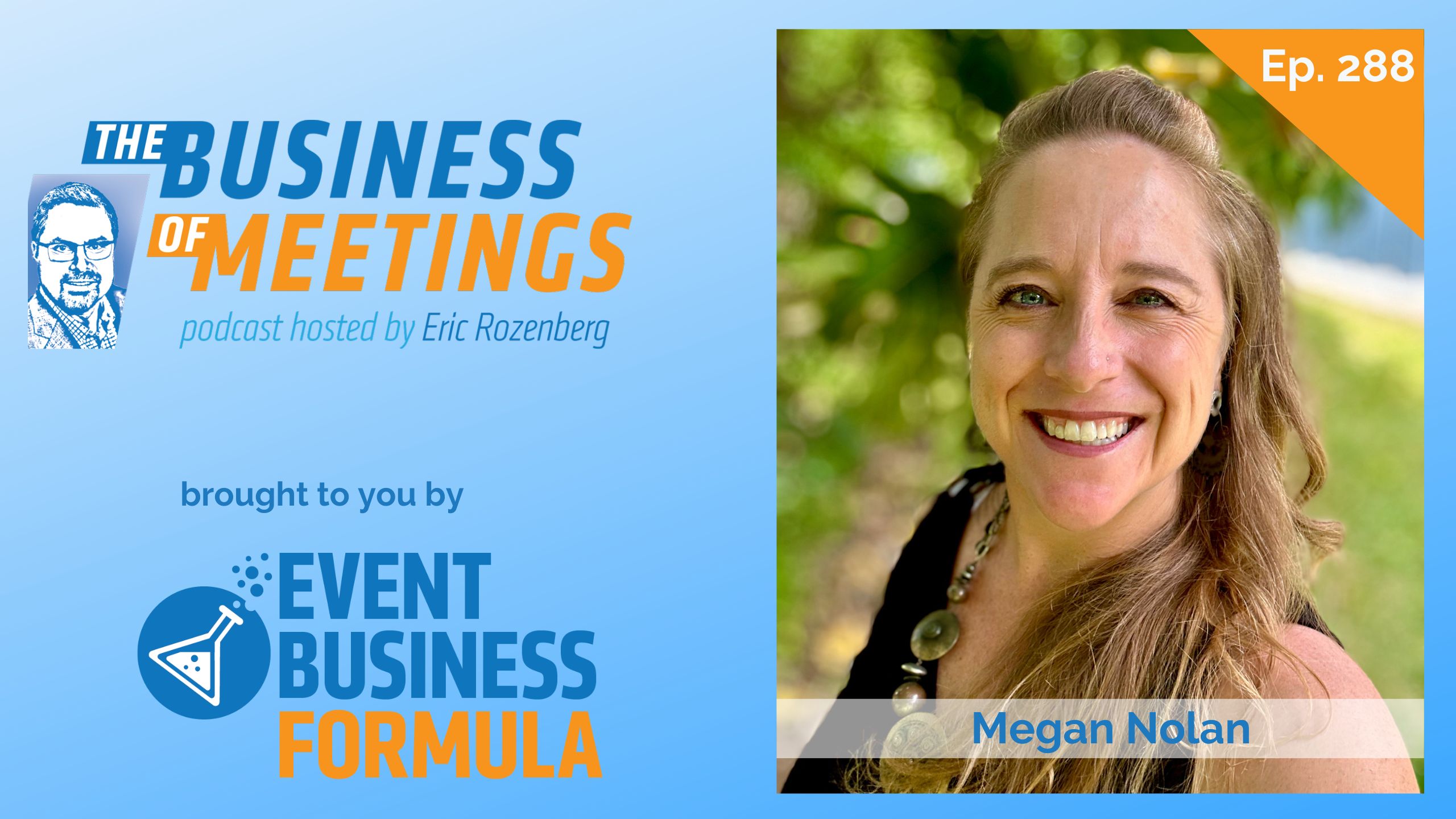
Today, Eric is excited to welcome Megan Nolan, the founder of Vitality Wellness in Maui.
With extensive experience in yoga, mental health, and well-being, Megan brings powerful tools to support small business owners and professionals within the meetings and events industry.
About Megan Nolan
Megan Nolan is a yoga teacher and personal trainer based in Maui. She combines movement, mindfulness, and strength training to help people improve their posture, energy, and mental focus. Beyond individual sessions, she specializes in bringing wellness into the conference and events industry by leading yoga, breathwork, and “power pauses” that energize participants and boost engagement. Her mission is to make healthy habits accessible, fun, and sustainable, whether for individuals, teams, or large audiences.
Generational Awareness of Health
Younger generations are highly aware of their mental and physical health. They openly communicate about emotions, seek out wellness tools, and tune into their bodies. Older generations, by contrast, often adapt more slowly.
Technology and Posture
Today’s youth are growing up with devices in their hands, and it shows in their posture. Postures previously associated with aging are now common, even in children, driven by extended hours of sitting and screen use.
Preventing and Correcting Rounded Posture
Megan highlights that a rounded posture is preventable and, to some extent, correctable at any age. Even into the 90s, the body is capable of gaining bone density and muscle strength. Through neuroplasticity, the body can adapt when weak muscles are strengthened and tight tissues are stretched. While skeletal issues may limit the degree of improvement, regular movement and targeted exercises can restore alignment and function.
The Toll of Sitting
Sitting for eight to ten hours a day quickly reshapes the body. Extended events or workdays often leave people feeling one with the chair, collapsing into poor posture. That reduces energy, focus, and creativity. Megan recommends taking short breaks to stand up, stretch, or strike a power pose to instantly improve attention, boost creative thinking, and sustain productivity.
Hot Yoga: Trend or Health Tool?
Practiced in rooms heated to about 105°F, hot yoga can help soften tissues and deepen flexibility. However, Megan cautions that most people are dehydrated, and the extreme heat places extra strain on the heart. Without strong body awareness, participants may overstretch tendons and ligaments. For those who are healthy, hydrated, and experienced, hot yoga can be beneficial. For most others, Megan recommends warm yoga as a safer alternative.
Power Pauses and Adult Recess
Megan has developed the concept of power pauses, short, intentional breaks for breathwork, stretching, or light movement. These re-energize participants during long events, especially after meals. She frames them as “adult recess,” making wellness fun, inclusive, and highly effective for engagement and focus.
Wellness at Events
Megan integrates yoga, breathwork, and energizing breaks into conferences and events, both in Maui and virtually. She often starts mornings with grounding practices, weaves in power pauses throughout the agenda, and closes with mindful exercises. Her keynote, Habits of a Happy Human: Small Shifts for a Chaotic World, adds another layer of impact, helping participants stay engaged, energized, and connected.
How to Connect with Megan
Megan offers one-on-one yoga and personal training sessions in Maui, as well as tailored wellness programs for conferences and events worldwide. She invites people to experience her approach directly through a complimentary demo session.
Bio: Megan Nolan
Tired of losing half your audience after lunch? Megan Nolan keeps attendees
energized, engaged, and focused all day long. As the creator of the Power Pause Method™, Megan delivers science-backed wellness breaks that turn post-lunch slumps into peak engagement.
With over 20 years of experience as a personal trainer, yoga instructor, bestselling author, and award-winning speaker, she has built her career around one simple truth: tiny moments can create massive energy shifts. Known for her authentic, energetic, and supportive style, she creates experiences that are both fun and professional, leaving attendees refreshed and organizers thrilled.
Connect with Eric Rozenberg
On LinkedIn
Listen to The Business of Meetings podcast
Subscribe to The Business of Meetings newsletter
Connect with Megan Nolan
On LinkedIn
Book a complementary session with Megan
Listen on: Apple Podcasts · Spotify · YouTube
“Remember that the attendees in the room, they’re not rocks, they’re humans.”
Megan Nolan
Full transcript of episode 288 of The Business of Meetings podcast, Eric Rozenberg with Megan Nolan. Lightly edited for readability.
Eric Rozenberg: Hello and welcome to the Business of Meetings podcast. I’m your host, Eric Rozenberg. Over the years, I’ve had the privilege of helping businesses in the meetings and event industry grow and succeed. And I’m excited to share that experience with you. If you feel alone and overwhelmed, and if you’re looking to take your business to the next level, improve your strategy and sales, and connect with like-minded professionals, you are in the right place. I invite you to visit eventbusinessformula.com and join our community of event business owners dedicated to exponential growth. Now let’s dive into today’s episode.
Hello and welcome to a new episode of the Business of Meetings podcast, and today I am absolutely delighted to speak with Megan Nolan. She has a company called Vitality Wellness, which is already telling you a little bit about what we’re going to be talking about today. She lives in Maui and she has a lot of experience in yoga, in mental health, in wellness, and because we’re speaking to small business owners in the meetings and event industry, it’s absolutely appropriate to have a conversation with her. Megan, thank you so much for taking the time to speak with me today.
Megan Nolan: Oh, well, thank you so much for having me on. Aloha, everybody. It’s so great to be here with you and I’m so excited to go on this journey together today.
Eric Rozenberg: Wonderful. But first of all, tell me a little bit about your journey. You’re not born in Hawaii, right? You’re in Canada.
Megan Nolan: Yes. Yes. Well, I was actually born in America and my parents are Canadian. So I had spent most of my life in Canada, in Ontario, Canada, where it is beautiful but brutally cold and very snowy, and I have decided that I am allergic to snow and being cold. I really don’t like it. And so I kept moving more and more west. And eventually I moved about as far west as you could go, out into the middle of the Pacific Ocean onto the beautiful island of Maui. And I’ve lived here for 14 years. And yes, we do get snow periodically, but only at 10,000 ft on top of the volcanic crater. So it’s more of a novelty at that point, but it’s lovely and magical and I’m very grateful to live here.
Eric Rozenberg: Wonderful. So I thought you were Canadian, but you’re born in the US, so you can become president, which I cannot. So that’s a good thing to know.
Megan Nolan: Yes, I have dual citizenship thanks to my very creative parent.
Eric Rozenberg: Wonderful. Wonderful. You didn’t start in the yoga since the moment you were born. So take us a little bit through the journey where you start being interested by everything related to wellness.
Megan Nolan: Thank you. So I have always loved movement and exercise. I’m one of those people that sometimes is an anomaly to others, because it’s something really fun and enjoyable to me because I love how I feel after. I love feeling strong. I love feeling energized. I love feeling happy. I love feeling clearheaded. So, it’s been part of my journey since really as far as I can remember. Even when I was little, I would dance ballet and all that fun stuff.
And so my parents were very adamant that I go to secondary education, and I didn’t really know what I wanted to study. And so I did a little bit of research and I came back with, okay, well, the population is aging, so gerontology might be an interesting route to take. Let’s go. So off I went to university and my parents were happy and I was sort of happy and I loved going to school and I loved learning, and so I studied gerontology, which is the study of aging from a sociological and a psychological perspective. And after four years of school and a lot of money, I walked away with one core lesson: that movement is the fountain of youth and, from a variety of perspectives, is so vital.
And so when I decided to, instead of going to work at a retirement home or a nursing home facility, which as somebody who’s really empathetic, I realized I couldn’t do. I get too attached to people. It would have been too hard for me. And so after I decided that, I came back to my parents and said, “I’m going to take a preventative approach to aging and I’m going to move to Hawaii and become a personal trainer.”
Eric Rozenberg: Nice. They were like, “Okay. So we paid for all the studies for that?” That’s what they say, essentially.
Megan Nolan: Yes. They weren’t thrilled. But my parents were in medicine, and so they understood the research and the importance behind that. And I’ve lived in so many different countries, and as you learned initially, I was born in one place, lived in another. So the fact that I wanted to move out to the middle of the ocean wasn’t a big shock to them, but it was more of that abrupt turn in my career path.
So I moved to the Big Island of Hawaii, which is so incredible and so powerful and just a really incredible place to live, but it’s very different than Maui energetically. I mean, it’s an active volcano, so you’ve got to realize it’s kind of different. So after doing a few years of the more traditional personal training approach to wellness, I decided to move back to Canada, and I moved to British Columbia, and that’s where I did my yoga teacher training.
And I merged the two worlds because they both have such incredible value. Of course, we need strength training and cardiovascular health and core strength that personal training and exercise can bring us, right? But yoga has so much rich personal development and awareness and connection and understanding of self and breath and posture and flexibility and balance. And so really merging those two worlds gives you the core elements of lifelong vitality, which is a huge part of my work.
And so after a while I realized, well, British Columbia is really lovely, but it rains all the time and I don’t like rain either. And so I moved back to Hawaii. And now, yes, 14 years. So it’s been an interesting, as it is with many entrepreneurs where we’re so passionate, right? This interests you and you kind of follow that for a while. I call it following the thing from Dr. Seuss. We kind of follow it for a while and, oh, I don’t know, maybe I’ll try this now. So for me, as somebody who’s always loved wellness, it’s a beautiful gift to be able to share my passions with my community, with my clients, as my profession. I feel very blessed.
And so when I started to do more of a workplace wellness approach to my work and started to help people in the office setting, as well as in a variety of financial institutions here, as well as with the County of Maui and different businesses here, including Maui Electric, which is obviously our electric company here, and teaching yoga inside all the power plants, and that was really fun, totally unique experience, I realized that these tools are so potent and they’re very practical and they’re very impactful.
And so it’s great for us to have a morning routine, which I’m a huge proponent of. But if we just do something in the morning and then we go and sit and sit and sit and sit and sit and sit, and you get the idea, all day long, it has an effect on us. It has an effect on us very quickly physically, but also mentally and emotionally and spiritually as well, right? Because all layers of our being are interconnected. And so what I came to realize is that when we can take these little mindful moments throughout the day of movement, of grounding, of breathing, whatever it is, little power pauses I call them, then you can weave these tools into your life.
Because especially as entrepreneurs, as creatives, we’re going out there. You’re going out there and you’re giving so much to your community, to your audience, to the event, to your client, and all of that is a reflection of you and your energy. And if you’re tapped out and you’re unresourced and your nervous system is just fried and burnt out, then you might think you’re hiding it. But people pick up on that. They pick up on it. People are more sensitive than they realize. Some people know that, but not everybody. But all humans are constantly scanning the environment for information. And if we are tapped out and we’re not taken care of, and we present in a sales call, for example, or on a podcast, and we show up and we are defeated and deflated and imposture, then people pick up on that so quickly, right?
And so it’s been an evolution and a deeper understanding of how these ancient tools of yoga, and of course of exercise physiology, not as ancient but still well researched and validated, can be really impactful in the workplace setting, and especially when we have periods of long duration of sitting. And we can talk about the impact of sitting and all that we’ve come to know about that and how it impacts focus and creativity and all of that. But where I get really interested in it, of course from all of those perspectives, but as somebody who’s very interested in supporting other entrepreneurs and making sure that you are vibrant and you’re showing up fully and grounded and taken care of, because you’re here to do big things and it’s important that you continue to do all those big things, is from a mental health perspective, because life is stressful.
Being an entrepreneur is a lot more stressful than I thought. I didn’t read the brochure, apparently, but it’s a lot. And so giving people these tools in a really impactful and usable way, whether that’s at an event or in somebody’s home work office, whatever it is, it can be such a game changer for people. And so I’m grateful to be able to share some of those with your community today.
Eric Rozenberg: That’s awesome. Do you have like an app or a meditation that you’ve recorded yourself?
Megan Nolan: Yes.
Eric Rozenberg: ‘Cause I have to tell you, you’re talking about the volcano. I don’t know, we never met. So, it’s just from some conversation with on Zoom today. You have this volcano aspect in your personality. And in the meantime, when I’m listening to you, you have, I don’t know what’s the right word in English, a soothing voice that, it’s calm listening to you. So you’ve recorded some meditation. Where can people find it?
Megan Nolan: Well, definitely on my YouTube channel, and I can share more information at the end. On my YouTube channel, a lot of it is inside communities that I host. And so thank you. I appreciate that. The volcanic energy. Wow, that’s a compliment.
Eric Rozenberg: And both. So you’re talking about the impact of sitting, and I know that’s one of the topics that you like to talk about, and I read it when you say the impact of sitting on mental clarity, on focus, and on information retention. And I was like, you know what? When I’m coaching small business owners and solopreneurs in the industry, one of the things is they are alone, they’re overwhelmed, they don’t have clarity on how they’re going to go and develop their business. And so you mentioning the impact of sitting on that. So what is the impact of sitting on mental clarity and focus and information retention?
Megan Nolan: Sure. Well, I think it’s best experienced. Shall we do something fun and give it a go and get a sense for it? So, it looks to me like you’re standing right now.
Eric Rozenberg: Yes.
Megan Nolan: Yes. Okay. So, we both are standing and we can do it standing, and that’s fine. So, for anybody that’s listening, obviously, please be mindful. If you’re driving, just keep your eyes open and all that. Be safe. Be safe. Be safe.
So, what I’d love for you to do right now is, regardless of whether you’re sitting or standing, if it’s safe for you to do so, and only if it’s safe, you can go ahead and close your eyes. Okay? So, just go ahead and close your eyes for a moment. And let’s take a breath in and notice how it feels to breathe. Just be present with your breath.
Good. So, we’ll use that as a comparison point. And now, open your eyes. If you’re not sure what I mean, what we’re going to do is pretend that we’re sitting, or if you are sitting, you’re just going to kind of sit your hips back a little bit like you’re sitting into the chair. Okay? So, move your weight into your heels. Sit your hips back. Take care of your knees. Just make sure you’re good. And then round your back a little bit and place your hands in front of you like your hands are on the keyboard. Okay. Yeah. Hands are on the keyboard.
And now allow your head to drop a little bit and take a big deep breath in. And think about a time when you’ve been really overwhelmed in your business. Just think about that for a moment. You don’t know what to do. There’s so many things. Oh my goodness, what do I do? Okay, stay there. And now breathe again. Okay, just notice it. Notice it.
Okay, that’s enough. I don’t want to leave you there. Please go ahead and stand back up or sit back up. Relax your shoulders back and take another breath.
Okay, perfect. Definitely DM Eric and I. We’d love to know what landed, what did you experience? But Eric, you can tell me, what did you notice there from that little mini experience?
Eric Rozenberg: It was calming.
Megan Nolan: Okay.
Eric Rozenberg: And then when I stand up at the end and took another breath, I was not thinking about the overwhelming situation.
Megan Nolan: Okay, perfect. And when we went into that rounded, slouched, stressed-out posture when we were pretending we were sitting, how did it feel to breathe when you were in that position?
Eric Rozenberg: Actually, more difficult for me.
Megan Nolan: Okay. Did you feel like you got more or less breath?
Eric Rozenberg: Less.
Megan Nolan: Okay. Did you feel any tension in your back?
Eric Rozenberg: No.
Megan Nolan: No. Okay. We weren’t there very long, so it’s all good. Okay.
Eric Rozenberg: So, I feel tension in my legs, like doing burpees.
Megan Nolan: Okay. Yes. Well, that’s why we didn’t stay very long, ’cause we weren’t warmed up to do squats. So, I didn’t want to leave you there. So, thank you for proving my point, Eric. You just proved my point perfectly well.
So what happens when we sit is we tend to collapse our posture right away. If we go from standing, if you can see me, I have my hands straight up. If you can’t see me, use your imagination. It’s all good. You know what sitting versus standing is. So if we’re standing, our body is upright. Shoulders are over top of ribs, over top of hips, over top of knees. You remember. So we’re standing up nice and tall. Whereas when we sit down, right away we hinge at the hips because we’re sitting, right? Our knees are bent, our ankles are bent, and then our spine very quickly, right? We all know this. We all know this. Very quickly when we sit, we tend to go from sitting upright, being present, focusing on what we’re doing, to rounding over the keyboard, looking like a croissant.
Eric Rozenberg: Yeah. Yeah. Thank you, merci beaucoup.
Megan Nolan: Yeah. And so what happens when we go into this seated position, usually slouching position, no shade, we all do it, right? Heads are heavy. Anywhere between 8 and 12 lbs, the average human head. It’s heavy. We get focused on what we’re doing. You love what you’re doing or you’re worried about something, right? And so we get very absorbed.
And so what happens is that when we sit, there’s limited blood flow, which means less oxygen, less nourishment. But when it comes to what we’re talking about here, our breath, when we move into that more rounded, weaker, not as efficient posture. I never say it’s bad. It’s not bad or good. It’s just not as efficient as being upright. Our vital lung capacity, which is your ability to breathe deeply and fully, goes down by 30%. So that means 30% less oxygen and nourishment throughout your entire body, which, I know you’re smart and you know, includes your brain, right? And so that’s one of the very direct impacts on creativity and focus.
So most people spend anywhere between 6 to 8 hours working sitting down, and usually with eating and leisure times, it’s upwards of 10 hours a day. Obviously, there’s differentials in this based on occupation and country. We all have different movement patterns. Some people have standing desks, etc., etc. So the duration of sitting matters, because after about the 30-minute mark, some people start to experience changes, and usually at about the 60-minute mark is when we start to notice very marked physiological changes, in that we have that decreased energy flow.
And our body, even though you may not think that you’re stressed, you might be like, “This is the best email I’ve ever written. I’m so excited to send it.” But you’re breathing in a way that your body is receiving the signal that you are stressed out, right? Because you’re taking those short and shallow breaths, ’cause you’re not breathing as properly, ’cause the backup team, which is in your neck and shoulders, isn’t as good at breathing as your diaphragm is.
So when your brain receives the signal from your body, and your body sends 80% more information to the brain than the brain sends to the body, right? The body sends way more information. And so your body’s saying, “We’re stressed. We’re stressed. I don’t know what’s going on, but we’re stressed.” And so your brain says, “Okay, survival mode activated.” And what happens then is that your prefrontal cortex, which is the big logical, cognitive function, higher aspect of the mind part of the brain, goes, “We are not needed right now. We are in survival mode.” And your brain goes into threat detection mode. That is not where we have creative ideas. It’s survival mode. And this is your biological wiring. This is non-negotiable. This is human reality. So it’s so important for us to be aware of that.
Eric Rozenberg: That’s fascinating. So what are the recommendation to avoid that? First of all, I guess first of all is to be aware of it and your posture. But what is it then? It’s work like both of us are now, standing up. It’s going out for a walk, and it’s having a timer every hour to get up, like I have with my watch. What is it exactly?
Megan Nolan: All of those. All of those are excellent suggestions. And I have found that within myself and in the entrepreneur community, we do best when we have those reminders, because we can have really good intentions going into it, but you get into the flow of what you’re doing and like, “Oh, just one more thing. Just one more thing.” And then it’s 3 days later and you’re still doing one more thing.
And so the general rule is 20-8-2. So if you are comfortable sitting, my back doesn’t really like me sitting much, so I mostly do my work standing and I sit periodically. So you can go 20 minutes of sitting and working, very focused work. Turn off the distractions. What can you do in 20 minutes, right? The work that we have to do expands to the container that we give it. It’s called Pareto’s principle. So if you say, “20 minutes, I’m going to get it done. I’m going to send out three emails,” or whatever, give yourself that really dedicated time. 20 minutes.
Okay, so 20 minutes, and then eight minutes. If you have the standing desk, right, you can do standing, or maybe there’s some work that you could do standing, right? Maybe that’s when you could go into your DMs and you’re standing. You could reply to a couple people, whatever. And then 2 minutes pause. Two minutes of coming back into your body, coming back into strong, efficient, confident posture, because your energy will benefit from that. When you get grounded back into your body, when you come back into that open, confident posture and you go into your next sales call like that, you write your next email like that, it’s different. It’s completely different, because you have affected change at the deepest level of your being, your nervous system. So 20-8-2 is really key.
You can set reminders, you can time block, whatever it is for you, but it’s about having these little intervals, power pauses throughout the day, especially before you notice that dip, right? We all have natural cycles of energy. It’s called our ultradian rhythm. Similar to the circadian rhythm, where we go to sleep at night, we have natural waves of energy in the brain activity. And so we want to harness that. And that’s why it’s important that in the work setting, we do this. We do this intentionally to give yourself a little moment away, but also in the events, that we really harness those natural rhythms of being. And remember that the attendees in the room, they’re not rocks, they’re humans, right? And this is a core need. And so those are some key ideas to start with. Would those be helpful for you?
Eric Rozenberg: Absolutely. Absolutely. Now, when you go into those mini pauses, and to your point when you were mentioning timing everything, how many times when I’m working from home in the evening, my wife said, “Okay, enough for today.” “Yeah, 10 more minutes.” And then an hour later, I’m still in the thing. So, for people in the meetings and event industry, it’s already stressing, and a lot of people are overwhelmed. The unexpected is the rule. But now add to that the fact that we own our business. So I got the 20-8-2, and even with the alarm, I said, “Oh, but I’m in the middle of something. I’ll do the pause later.” And it continued, continued. What are other advice you have, especially where you are at a trade show or where you are at a conference?
Megan Nolan: Brilliant. The beautiful thing about this tool set is that it is very versatile once you know how to use it, right? A lot of times people think, “Okay, if I’m going to take a power pause and I need to go and meditate, I can’t meditate at a trade show. You’re crazy, Megan.” No. So, we infuse things with presence. That’s the key, because what’s happening when we’re stressed is our brain is in that looping mode, seeking action, seeking answers, seeking clarity, seeking safety. That’s what it’s doing. So, knowing that, if you’re in a very busy, high-stress situation, it’s these little intentional moments.
And one that I love is when you are washing your hands in the washroom. Wash your hands. Be present, right? Sure, there’s going to be other people there. You might be talking to somebody, but of course, if you are, continue to engage with them. But see if you can do this, too. But you’ll probably need to practice it on your own first before you can do it and talk to somebody at the same time. Just be very present with the sound of the water, the warmth of the water. Maybe you can smell the soap. Just really hone into the details of the present moment, because what that’s doing is signaling to your brain, “Oh, we’re not paying attention to threats right now. We’re listening to the sound of the water, and that’s something we do when we’re totally safe.” So that’s what’s happening neurologically. But what you can do is just take that moment of washing your hands and ground your body.
Or another great one is when you’re standing and waiting for the elevator, right? Or you’re waiting in line somewhere, and if you’re just kind of looking around and you’re thinking, “Oh, this is chaotic. There’s so many people.” Just ground your feet down, right? Just ground your feet down. Feel your feet. Relax your shoulders. Become aware of your posture, right? Because if you’re standing there and you’re like, “Oh my god, I have so many things,” and you’re totally stressing out, you’re gripping and you’re signaling that stress to other people. They’re picking up on it by way of mirror neurons.
So, it’s these little moments where you become aware of how powerful you are, because you get to decide what you’re focusing on and how you’re going to go back into the next moment. And that’s really what the Power Pause Method in my work is all about, is reminding you of how powerful you are, because you have the ability to do that and to shift your state anytime, anywhere. It just takes that intentional decision.
Eric Rozenberg: Amazing. I’ve also heard that one of the way to realize how strong you are and give more energy is to actually stand up, exactly like you said, but also put your two hands on your hips.
Megan Nolan: Yes. Okay. Yes. So there’s an incredible body of research by Amy Cuddy, and she’s at a university here in the US. I believe she’s at Stanford, and she studied deeply the impact of body language. And so what you’re talking about, I call, and she calls this too, is the power pose. Some people call it the Wonder Woman pose or the superhuman pose or whatever, right? Whatever you want to call it, whatever you identify with.
And so it’s really simple. And you could do this in the washroom too, like in the stall, or when you’re standing. And a lot of people just do this and they don’t even realize they do it. One or two hands on their hips. And actually, when we place our hands on our hips and we bring our feet down and we open up our body, we can do it together. Again, if you’re sitting, you can do it sitting, but it’s more about opening your body and having a big, open posture rather than a collapsed and contracted one.
And so after about 2 minutes, what happens internally is that, because you’re focusing on your breath, so let’s breathe in through our nose and out through our mouth. Use your “ha.” Ready? Breathe in. You’re just breathing normally. You’re standing tall. You’re feeling your muscles, so you push into your feet. Draw your shoulder blades back like you’re about to go walk on stage or do something great. Okay? So, you’re holding that nice big posture.
And what happens after 2 minutes, not very long, is there’s actually a significant decrease, so decrease, going down, in cortisol. So, cortisol is one of our main stress hormones, associated with inflammation, pain, and really associated with stress. And stress is, we could talk a lot about how it’s associated with every major chronic disease. So when we bring the cortisol levels down, so what’s happening in the power pose? Cortisol is coming down and testosterone levels are going up. And we all have testosterone regardless of gender. We all have testosterone to varying degrees. So that means that you are less stressed, and testosterone is involved with going after it, taking action. Yes. Energy, big energy, leadership energy.
So that’s where you’re getting into that leadership energy, in that regulated state of the nervous system, really in that powerful, confident pose, tapping into the energy of, yes, I can do this. And it’s so simple, but we forget that you have a body that is such an incredible tool, because most people live as an out-of-body experience. They live in their head all the time, and it’s normal. But you have this incredibly fine-tuned, incredible organism and vehicle that you get to inhabit, your body. And so it’s a really incredible tool to be able to use.
Eric Rozenberg: Amazing. Now it reminds me of my teachers when I was a kid. They were always looking at me with the two hands on the hips.
Megan Nolan: Oh.
Eric Rozenberg: For other reasons.
Megan Nolan: Yeah. I wonder.
Eric Rozenberg: Now, my wife and I took our kids to Hawaii a few years ago, and to announce them that we were going to go there, we played Hawaii Five-0, the music from the TV show, and they look at us, “What are you doing?” So, obviously, they never saw the show before.
And so my question was, with your work, we see now different generations working together in the same company. We see the impact of AI and technology and the stress that some people can get, and the excitement can get, but we also see a lot of people on their phone all the time. Do you see any difference of using the techniques that you know, and also having an awareness of the need for pause, based on generation? Or is it absolutely irrelevant and it’s only from one person to another, so I’m aware and some completely ignorant?
Megan Nolan: Well, there’s always going to be individual differences, for sure, but from a demographic perspective, yes. Younger generations are very concerned with their health and their wellness, and specifically their mental health. And they are already looking for ways to support that, and already are very aware of what they do and how they feel, very tuned into their own body and their own emotions, and expressively communicating that to other people. And so I see really significant levels of awareness in younger generations, and maybe a slower adaptation and integration from older generations that are, “Oh, this is just the way we do things. This is what we do.”
And I find that there’s that from that awareness level, but the other interesting component is from a need level, is that younger generations have been using phones and devices for most of their lives, depending on how old they are, right? Some kids look like they’re born with an iPad in their hand. And that’s okay. I’m not a parent, and I understand it’s a lot. But what we also are seeing are physiological changes from children that are in that rounded, slouched croissant posture from very early on, right? And so there’s lack of muscular development. There is a slower opening of the body. And so it’s just really interesting to think about it. And so that’s a great question. Thank you.
Eric Rozenberg: Whoa, that’s frightening. A little bit.
Megan Nolan: Yeah. Unfortunately, because we used to think that that rounded posture was the posture of aging, right? We think of, “Oh, what does an old person look like?” And not to be stereotypical, but most people would say something to the effect of, well, rounded over, walking with a cane. And the interesting thing is that, for the most part, that posture is preventable.
Eric Rozenberg: Okay. It’s preventable. Is it correctable? I don’t know if it’s the right word in English. Can you correct it?
Megan Nolan: Correctable. Yes.
Eric Rozenberg: Can you correct it if you have that?
Megan Nolan: Gradually, depending on how far. Yes, to a degree. Yes, for sure. Of course, if there’s skeletal, like if there’s skeletal spine issues, then it’s a little more difficult and a slower transition, but there’s always ways that we can strengthen muscles and stretch other tissues to allow the joints to be more supported and mobile. So there’s always opportunity. Even as late as the 90s, 90 years old, there’s ability for bone mass growth, muscle mass growth. So there’s ability to change at any time. It’s called neuroplasticity. So there’s always an ability to change it, just to varying degrees.
But I bring that up because we used to just think, “Oh, that’s what old people look like.” But since so many people are spending 8 to 10 hours sitting down, and often in that posture, the human body adapts very quickly. So it’s adapting to that, right? And just think about it. You’ve been at three-day events, maybe longer. By day three, you’re like, “I am one with the chair,” and that’s just it, right? You just feel like you just collapsed into the chair.
And so what we’re seeing is a need for that recognition of the impact of sitting on our creativity, our focus, retention, and how easy it is for us to just get up and do the power pose, and just stand up or whatever, and introduce a little activation that makes a really big difference in that moment and ability to pay attention, but then of course increases creative output if we’re talking about the solopreneur at home. So, very versatile.
Eric Rozenberg: Wonderful. Thank you. I’m very curious. I’m hearing a lot about this, I don’t know the name, yoga, but in a very hot, hot yoga, and then something like the temperature is insane. Is it some of this buzz thing, fashion thing that a marketing genius has found, or does it have real benefit on your health?
Megan Nolan: That’s a great question. So what you’re speaking to is hot yoga, or it was branded as Bikram yoga by…
Eric Rozenberg: Yeah.
Megan Nolan: Yes. And there’s a whole other story we could talk about with that guy. But as far as the actual practice itself, I am always about people doing yoga and I think it’s very important. But I’m on the fence about this one because of a few things.
Most people are chronically dehydrated. Most people don’t drink enough water. And so going into a room that’s going to cause you to sweat profusely, because it’s 105 degrees Fahrenheit, I forget what that would be in Celsius for our Canadian friends. It’s hot. It’s hot. You start sweating as soon as you walk in the door, which then softens the tissues, our muscles, which is great. But so we’re sweating a lot. Then your heart has to start pounding because it needs to cool your body. But the intensity of the practice doesn’t match the intensity of the heart rate increase. So there’s a little bit of discrepancy there. So it’s a little confusing for your body. So your body is pumping really hard to get blood and oxygen and cool you down through sweat. So it’s a little bit hard on some people’s heart. So that can be a challenge too.
And then the other thing is that it’s like when you bring a piece of chocolate out, and say you put it on the counter because, I don’t know, you’re going to bake with it or something, and it comes out of the freezer and it’s really hard, right? It’s really hard. You could snap it. That’s how we are when we walk in the room. So, we get out there and we start to kind of soften a little bit, and we’re moving and we’re doing the things, and so like that piece of chocolate, we get softer and softer and softer, and the chocolate will eventually kind of melt, right? And it just clump.
And so what happens is, if people don’t have a physical awareness, physical strength, and feel compelled to push, push, ’cause there’s a lot of intensity in the practice, and the way that that practice is taught is that sometimes people go too hard too fast, right? And they just don’t have that level of body awareness, and the muscles don’t have the capacity to stretch, and then the tendons and the ligaments take the brunt of it. And so that’s just what I have done and learned in my research and working with people.
And so if you feel that you are hydrated, you have really great body awareness, your heart is healthy, you’re strong, but maybe you want to work on your flexibility, then go for it. I love it. I’m here for you doing yoga. But I would say maybe warm yoga. It’s like warm yoga, not hot yoga.
Eric Rozenberg: Very good. Thank you.
Megan Nolan: We’ll be in the middle. And I don’t want to sound like I’m talking poorly of the practice. We always need to be aware and we always need to be educated and empowered with that information before we do something, especially when it’s super hot. Well, super hot, but hot as in trendy.
Eric Rozenberg: You’re not talking poorly. I’m asking your opinion. So, I’m glad you shared that. So, thank you so much.
Megan Nolan: Thank you.
Eric Rozenberg: With everything you do in our industry, with association, with corporation, with hotel, can you tell us, anyone listening now, what are the services you’re providing and how they can get in touch with you?
Megan Nolan: Sure. So thank you for that opportunity. I appreciate that. So yes, I mean, I am a yoga teacher and personal trainer, so I do work with people one-on-one, both here on Maui, so if you come to Maui on vacation, let me know. We can do yoga outside. It’s always a good hit. And then of course, I work inside the conference and event industry.
So, what I love to do is get the party started, whether that’s with an energizing yoga practice or breath work practice in the morning, and really bring people together, especially here on Maui. It’s a lovely way to tap into the energy, but of course, we can do that around the world. So having that intentional start to the day, which really gets people grounded and present, and a really lovely way to come together in practice.
And then integrating power pauses, as you’ve experienced today, at very intentional intervals throughout the agenda, right, for activation purposes, that are quick. They’re fast, but they’re very effective for retention and engagement and energy. So those can be woven in throughout the day whenever it works, whether that’s before the keynote, or at the mid-morning once people come back from the break, and specifically after lunch, because right after lunch, blood sugar spikes. If we just eat our lunch and we go sit there and then we drift off into space, right? We’ve all experienced that post-lunch crash and we’re like, “I’m so tired.”
So really being able to bring these tools and make them work for your theme, for your group, for your community, right? And because they are so versatile, how they can all be done sitting down, right? If we want to make sure that everyone’s included. Excuse me. So inclusive and fun and engaging, and also, to the degree that we spoke to today, helping people to understand what’s happening in their body. Some people really need that, to prove it, and I get it. I get it. I like proof. I like proof, but it can also be really fun. And so we call these recess for adults. It’s the same thing. It’s getting up and getting moving, energizing.
So those are what I offer throughout the agenda, as well as doing my keynote, Habits of a Happy Human: Small Shifts for a Chaotic World. So there’s lots of ways that I can support throughout your event, both virtually and of course here on Maui. I mean, it’s a lovely destination. So if you ever come here, let me know.
Eric Rozenberg: Awesome. And how do people get in touch with you?
Megan Nolan: Yes. Well, if you would like to experience a power pause for yourself, you got to experience little ones here, right? Hopefully, you were playing along with us, and I’d love to know how those landed for you. But if you want to experience one that’s designed for you, your body, your needs, or maybe you have something coming up, you can go to takeapowerpause.com. So, takeapowerpause.com, and then you can book a complimentary demo with me, and then we’ll get connected and I can answer any questions, and then we’ll go from there.
Eric Rozenberg: Wonderful. Megan, my last question for today. When we meet at a conference in one year with a bottle of champagne, what are we going to celebrate?
Megan Nolan: Oh, we will be celebrating at IMEX, and me being on stage at IMEX.
Eric Rozenberg: Wonderful.
Megan Nolan: Love that. I love this game. Thank you.
Eric Rozenberg: Thank you so much for taking the time, and I look forward to meeting you in person.
Megan Nolan: Okay. Me, too.
Eric Rozenberg: Thank you for tuning in to the Business of Meetings podcast. I hope you found today’s episode valuable. If you enjoyed the show, the most important thing you can do is leave a review and share it with your colleagues. It really helps spread the word. I truly appreciate your support. And if you’re ready to take your business to the next level, don’t forget to visit eventbusinessformula.com to learn more about how we are helping event business owners like you. Thanks again for listening, and I’ll see you next time.