
Today, Eric shares a recent coaching experience he had with an entrepreneur who was hesitant to grow her business because she was happy with her current setup and did not feel the need to expand.
Stay tuned as Eric takes a closer look at whether or not that way of working is, in fact, sustainable.
Growth Can Create Freedom
Staying small might feel comfortable, but constantly jumping from one project to the next leaves little room for personal time or long-term progress. Growth allows business owners to step back from their daily tasks and invest their time where it truly matters- on clients, strategy, and the parts of the business they enjoy most.
Delegation Is Essential
Delegating is about sustainability rather than relinquishing control. Many entrepreneurs wait too long before trusting someone else with parts of their business, which often leads to burnout.
Delegation makes space for high-level focus and prevents the business from becoming overwhelming.
Representation
The most valuable contribution a business owner can make is representing the company and nurturing relationships, which includes sales, brand presence, and staying in touch with clients and prospects. Those are all time-consuming tasks, and the only way to prioritize them is by letting go of lower-level responsibilities.
80 Percent Is Good Enough
Client satisfaction should guide your decisions around delegation, not perfectionism. No one will do things exactly the way you do. So, even if someone can only deliver 80 percent of your standard on your behalf, and the client is still satisfied, that is okay.
Personal Lessons from Early Burnout
In the early years of his corporate events business, Eric believed no one could serve his clients as well as he could. So, he avoided delegating, fearing it would compromise his brand. This mindset led to exhaustion, and he nearly burned out. Only after hiring a project manager did he realize clients were happy even without his constant presence. That allowed him to build systems and focus on growth.
Start with a Long-Term Vision
You cannot make aligned decisions without a long-term vision. Defining what you want your life and business to look like in 10 years will give you the clarity to act with purpose. That clarity is also the foundation of strategic growth.
Develop the Right Mindset
Entrepreneurship is not linear. It is a rollercoaster of unpredictable challenges. To be successful, you must be mentally prepared, able to manage stress and stay focused on the reason you started. Surrounding yourself with the right kind of support and using tools like journaling and meditation can help you remain grounded.
Manage the Chaos
Running a business means juggling high-level strategy with everyday tasks. Unpredictable factors add to the stress, especially in fast-moving industries. Learning to navigate the chaos is essential for staying grounded and moving forward.
Stay Consistent
Progress comes from steady effort, not big leaps. Small, repeated actions will create meaningful change over time. Even when momentum feels slow, doing a little bit every day will impact your long-term results and the growth of your business.
Sustainable Growth Requires All Three
By combining your long-term vision with a strong mindset and daily consistency, you can create a foundation for healthy, sustainable business growth. Without those, it becomes much harder to build something lasting and fulfilling.
Connect with Eric Rozenberg
On LinkedIn
Listen to The Business of Meetings podcast
Subscribe to The Business of Meetings newsletter
Listen on: Apple Podcasts · Spotify · YouTube
“One drop and one drop and one drop finally breaks the rock.”
Eric Rozenberg
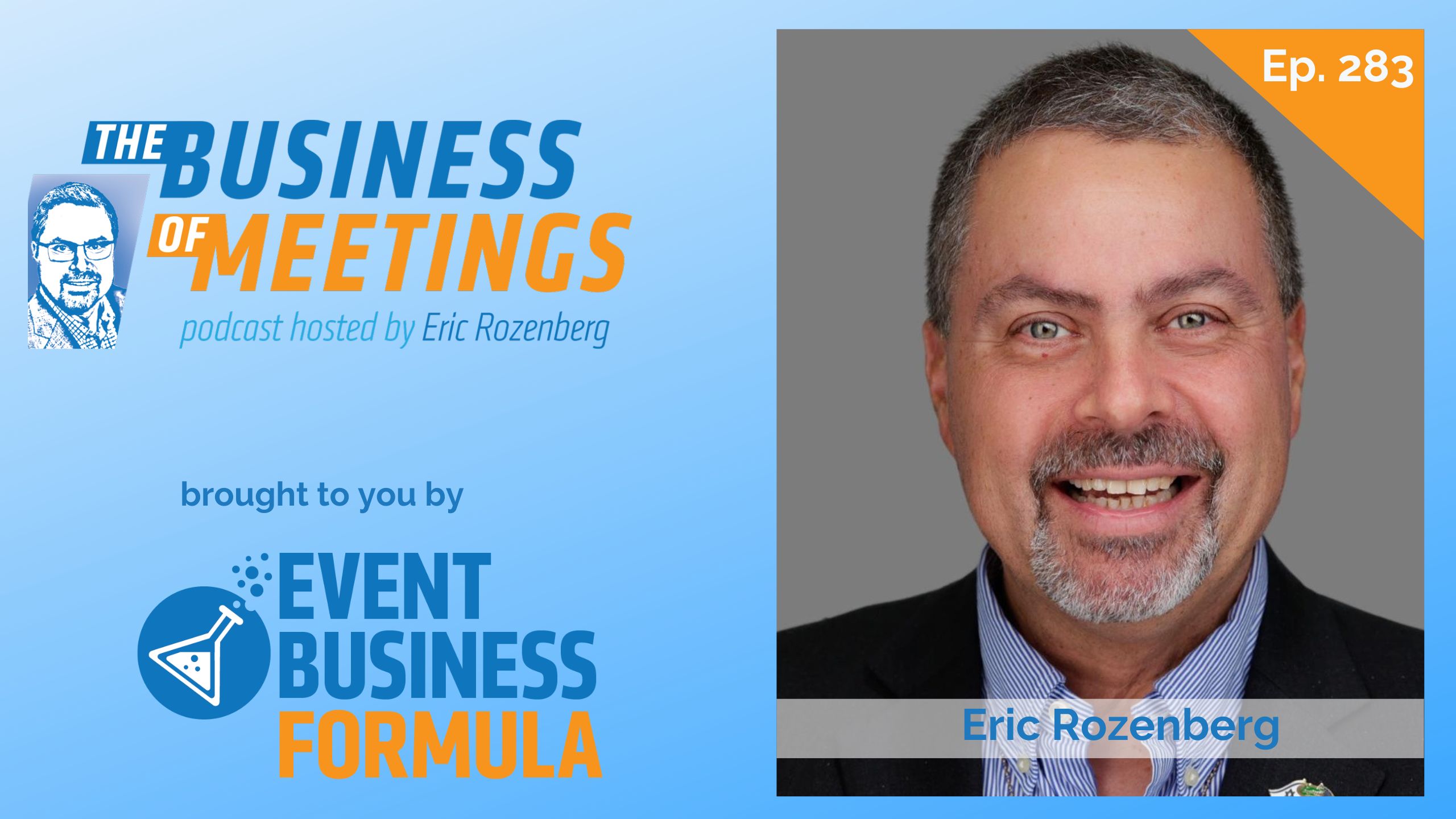
Full transcript of episode 283 of The Business of Meetings podcast, a solo episode with Eric Rozenberg. Lightly edited for readability.
Eric Rozenberg: Hello and welcome to the Business of Meetings podcast. I’m your host, Eric Rozenberg.
Over the years, I’ve had the privilege of helping businesses in the meetings and event industry grow and succeed. And I’m excited to share that experience with you. If you feel alone and overwhelmed, and if you’re looking to take your business to the next level, improve your strategy and sales, and connect with like-minded professionals, you are in the right place. I invite you to visit eventbusinessformula.com and join our community of event business owners dedicated to exponential growth.
Now let’s dive into today’s episode.
Hello and welcome to a new episode of the Business of Meetings podcast. Today I want to speak about something that happened recently to me when I was speaking with one of the person we’re coaching, and she was telling me, “I don’t want to grow because I like the life I’ve built for myself and I enjoy working with a handful of clients I have.” And I thought about it, and then my answer to her was, “Well, actually, you going from one project to another, you don’t have much time for yourself, you kind of stress, and I believe that the more you’re going to grow, the more you’ll be able to delegate and really focus your energy and your time on what matters for you and what you like.”
So, I’ve heard that many times from people, that I don’t want necessarily to grow, and it’s fine. I mean, not everybody wants to build the next unicorn and a company worth a billion dollars, but quite frankly, there’s the other extreme, which is extinguishing fires all the time. And that to me is not a life that in the long term, it is not sustainable. That is not something that you can pursue for life. And there comes a moment where you’re getting burned out.
So I just want to offer to you not even the idea, but the suggestions that you should delegate most of the things that you are doing that could be delegated and focus really on what matters the most to you and what matters the most for your company. And I would offer that what matters to you for the company is you representing your company, you representing your brand, you being in touch with your prospect, with your clients, and making sure you’re maintaining that relationship. And that takes time, obviously.
Now when it comes to delegation, I would say that if you can delegate to someone and that someone would do the task like 80% as you would do, it’s great. It’s good enough. Clients will be happy. You might be the one who’s not fully happy, and I know the feeling because no one will ever act, work, and deliver exactly the same way you do. But the most important is really what the clients are thinking. If the customers are happy, then everybody should be happy.
And that reminds me the first two years when I started my first business, my corporate events business. I had two major client, and my thought was, “It’s my business, it’s my brand, nobody does it better. I am not going to let anyone touch my client. If they do, the client’s going to go away,” which of course is total BS. And only after two years and almost running into burnout, I decided to hire project manager. And guess what? The first weekend when we had two project and I was at home, I was biting my nails, but nothing wrong happened. The clients were very happy. I was in touch with my team one or twice during the weekend, and everything was fine. And that’s when I really started systematically put system in place and making sure that I was not the one who was on every project, but I was focusing on what matters for the client, and that I would be there probably at the last evening if there was an incentive trip or a program, because you’re talking about the next year. But really focusing on sales and representation.
And so there’s three things for me that you could be doing for yourself in that framework. The first one is to define your long-term vision. Without the long-term vision, there is no direction. There is no decision being made whether this is something that you should be pursuing or not. So having this image of what is your life in the long term, in 10 years, it’s very important, and there’s a process to it, which we can talk about another time if you’re interested. The point is, from the moment you’ve defined that long-term vision and then you know where you’re going, everything you’re going to be doing should be somehow moving the needle in that direction. So that’s the first thing, is the long-term vision.
The second thing really, it’s your mindset. It is difficult to be an entrepreneur. It is not a straight line from beginning until you might even someday sell your company. It’s a roller coaster. And quite frankly, it’s the kind of stress that it’s not for everyone. And I would even add that being an entrepreneur in the meetings and event industry is even more stressing because of the number of factors that come into play that we cannot control. We cannot control a weather disaster. We cannot control a strike. We cannot control all those different elements that will impact what we doing. So there’s the stress, there’s a roller coaster, and this is something that you should be ready to face and also be prepared to manage.
And the stress that you’re going to have and the doubts that you’re going to have, and trust me, you’re going to have stress and you’re going to have doubts. But there’s different elements that you could do to fight that. It’s really the having the mindset of being an entrepreneur, but also calming yourself, surrounding yourself with the right people, surrounding yourself with your personal board, with a coach, with friends that you can talk to, and all those tools about wellness, about meditation, about journaling. Those are different tools that exist. And that is something that you should be ready to do, especially if you’re coming from a large organization where you had hundreds of people working for you, and now you are starting your business. You have in the morning an appointment with the CEO of a client company, and in the afternoon you’re at Costco because there’s no more soap in the bathroom. So that’s also part of life of being an entrepreneur and starting a business. But even if you have developed a business, and even if you have 20, 30 employees, trust me, the stress you’re going to have is something that you have to learn to manage. Somehow it’s exciting, but it can be also challenging.
So the first thing is having your long-term vision. The second thing is having the mindset of understanding why you’re doing that and continuing and making sure that you staying focused on the long-term goal.
And last, but certainly not least, from the moment that you have your long-term vision, from the moment that you’re ready to take on the roller coaster and have the right mindset and keep the right mindset, the third thing really is consistency. Life is happening. Rome wasn’t built in one day. And so, it’s extremely important that not only you remain focused, but you do a little bit every day. My dad always told me when I was a kid, “A little bit every day.” And I hated that sentence. And guess what? He was right. It’s a little bit every day, is the consistency of doing the effort every day and making sure that by doing those effort every day, you’re going to impact the long-term results and the grow of your company. The perfect example I have is when you look at the water and the rock. At the end of the day, one drop and one drop and one drop finally breaks the rock. And that’s what you should be doing. That’s what I’m wishing for you: having the long-term vision, getting the right mindset, and having the consistency of doing the work every day.
And if we at Event Business Formula can help you in any way, please reach out. Enjoy the journey, and I look forward seeing you at the next industry conference. Thank you.
Thank you for tuning in to the Business of Meetings podcast. I hope you found today’s episode valuable. If you enjoy the show, the most important thing you can do is leave a review and share it with your colleagues. It really helps spread the word. I truly appreciate your support. And if you’re ready to take your business to the next level, don’t forget to visit eventbusinessformula.com to learn more about how we are helping event business owners like you. Thanks again for listening, and I’ll see you next time.