
Today, Eric dives into the importance of self-care and focusing on mental health, particularly during times of uncertainty.
Stay tuned as Eric shares practical ways to remain grounded and support your well-being, even when things feel unpredictable.
A Late-Night Emergency in Sardinia
While organizing a sales meeting for a medical device company in Sardinia, Eric experienced a powerful reminder of why health must come first. In the early morning, as his team was wrapping up video edits for a final presentation, he found a man lying unconscious with blood coming from his head. The man had fallen and hit the corner of a table.
Acting Quickly—Even Against Protocol
Eric contacted the head of the company, who happened to be a trained nurse practitioner. She warned that moving the man could be risky, but leaving him could be worse. When the hotel insisted on following procedure before calling a doctor, Eric bypassed protocol. He contacted his local partner, who helped him find an ambulance meant for another injured guest and had the man transferred to the hospital. The next evening, the man was back at the bar with a bandage on his head. He had just had too much to drink the night before.
The Lesson: Take Ownership of Your Health
That incident reinforced something Eric believes firmly: if you fail to take care of yourself, no one else will. In uncertain times, the only thing we can truly control is how we show up for ourselves. We may not be able to influence global events, but we can impact our health, mindset, and those around us.
Making Health Your Priority
Even though most people know what to do to stay healthy, when under stress, those habits tend to slip away. So, Eric encourages us to follow a morning routine that involves meditation, exercise, or writing. He reminds us that the challenge is not about knowledge. It is about making your health a consistent priority.
Start with One Hour a Day
In an unpredictable world, a daily routine can provide stability. Eric encourages everyone to block one hour each morning, even if it means waking up an hour earlier, and do whatever you can to support your well-being. That could be meditating, moving, reading, or writing. Eric reminds us that the best way to help others is by taking care of yourself first.
Connect with Eric Rozenberg
On LinkedIn
Listen to The Business of Meetings podcast
Subscribe to The Business of Meetings newsletter
Listen on: Apple Podcasts · Spotify · YouTube
“If you don’t take care of your health, nobody else will for you.”
Eric Rozenberg
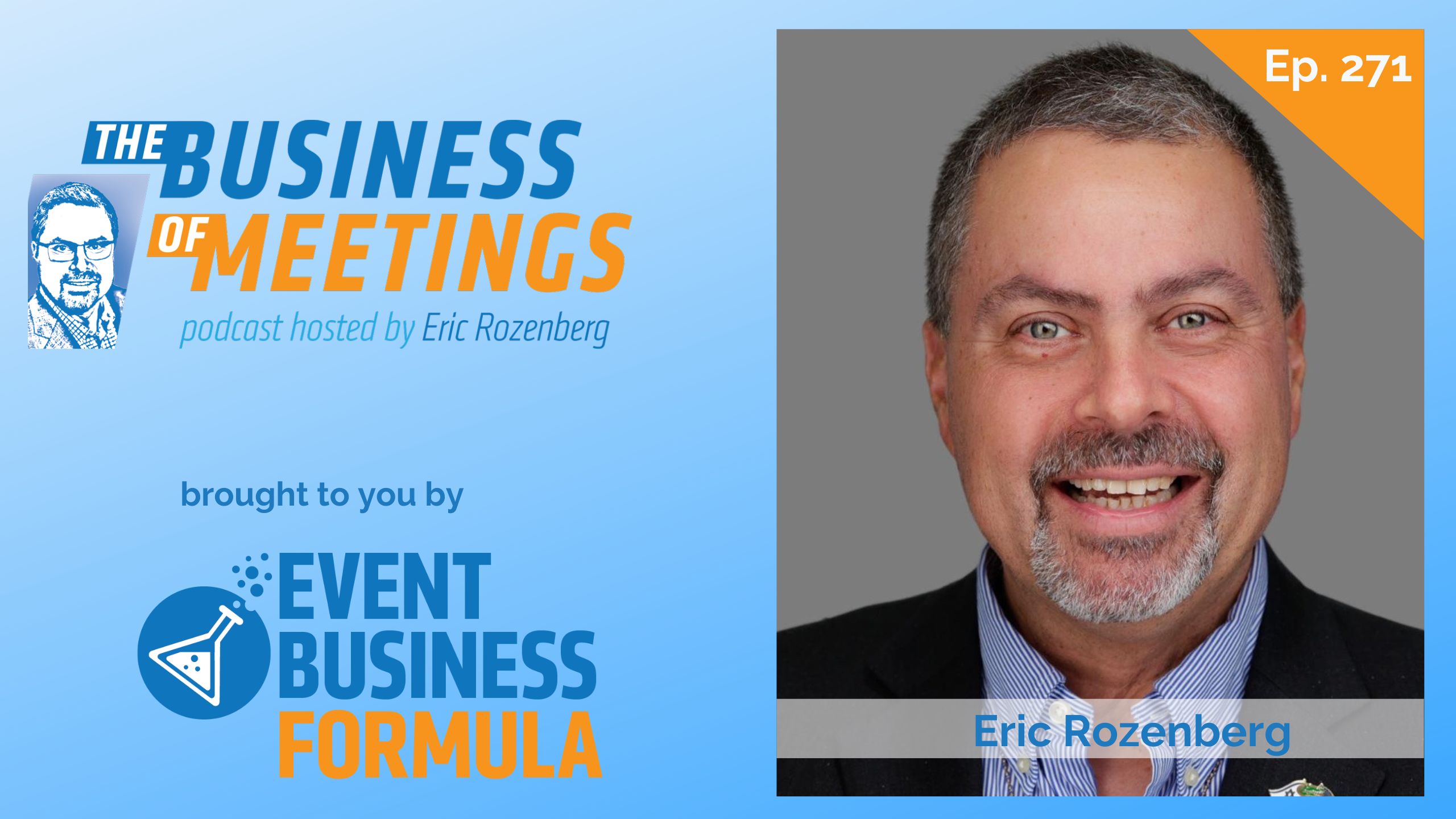
Full transcript of episode 271 of The Business of Meetings podcast, a solo episode with Eric Rozenberg. Lightly edited for readability.
Eric Rozenberg: Hello and welcome to the Business of Meetings podcast. I’m your host, Eric Rozenberg. Over the years, I’ve had the privilege of helping businesses in the meetings and events industry grow and succeed. And I’m excited to share that experience with you. If you feel alone and overwhelmed, and if you’re looking to take your business to the next level, improve your strategy and sales, and connect with like-minded professionals, you are in the right place. I invite you to visit eventbusinessformula.com and join our community of event business owners dedicated to exponential growth. Now let’s dive into today’s episode.
Hello and welcome to a new episode of the Business of Meetings podcast. Today I want to talk about taking care of oneself, focusing on our mental health, and especially now that there’s a lot of uncertainty. And before we get into that, I want to share with you a true story that happened to me in Sardinia. We were organizing a sales meeting, a big sales meeting for a medical device company at the Forte Village.
And the last night, I was with the editing team looking at all the videos from the entire week, and we were preparing to do a surprise the following evening. We were actually going to have the dinner and then finalized the editing just for that day and then show the summary of the entire week after dinner. So, it was quite late, almost 2:30 at night, and I went down to take something at the bar for the team. And as soon as the elevator doors open, so it’s 2:30 at night, and I see people around a guy who was lying on the floor with blood coming out of his head. So, I immediately went and asked what was going on. Apparently, he fell backwards on the corner of a table. His head was bleeding.
So I immediately call the head of the company I was planning the meeting from the UK. I know she was a nurse practitioner by trade, and thank God she was available and came and look at it, and she said, “Listen, if we move him, there’s a risk, but if we don’t move him and if the bone in the head went into the brain, if we press too hard, we might kill him.” All the detail, the medical detail, but basically the summary was or we take some risk and we move him to the hospital, or we keep pushing there and he’s going to maybe die from having this bone getting into the brain and losing the blood and everything.
So, I went immediately to the reception. I said, “I need transportation to the hospital.” And the guy at the reception told me, “Sir, we have a procedure. We have first to call a doctor.” And I look at him, said, “F the procedure. I need transportation now.” And he said, “No, I can’t.” So I call immediately Kai, which was our partner on site. It’s now 2:35 to 40. And I say, “Kai, please send me an ambulance immediately to the Forte Village.” And as I was hanging up with him, I saw there was a van. And actually the van was there for another group, for a lady that had fallen and twist her foot. So I went there, said, “I’m sorry. It’s a question of death or life.” And so we start moving the guy who was bleeding into the van. And I had people telling me, “Well, you cannot do that. It’s dangerous.” I said, “Listen, I spoke to somebody who’s knowledgeable. We’ve taken a decision. Let’s go.”
And so we start driving and I call Kai again. I said, “Listen, I found a van. Please call back the hospital. Tell them to tell the ambulance that when they see a van flashing the lights, it’s us and they have to stop.” And so, as we were driving, we saw the ambulance with all the lights, we start flashing, they stopped. We transferred the guy in the ambulance and saved his life.
The next evening, who was at the bar with a big bandage on the head and drinking beer again? This guy, who by the way was not part of the team of my client. But I was like, come on, this guy yesterday fell on his head because he had drank too much. We saved his life, and there he is again. So, you know what, as they say in English, you can bring the horse to the water, but you cannot force him to drink. So if you don’t take care of your health, nobody else will for you.
And my whole point about the story is that we are in an uncertain time. And it’s stressing, but on the same token, we can only focus on what we have an impact on. As I always said, I don’t have an impact on the rest of the world. I don’t have an impact on potential war in other countries. I don’t have an impact on tariffs. I do have an impact on me. I do have an impact on my business. I do have an impact on my client. That’s what I should be focusing on. And the first thing that we should be focusing on is on ourselves. It’s on our health, is on our mental health. My favorite quote from Rabbi Hillel is, “If I’m not for me, who will be? If I’m not for the others, what am I worth? And if not now, when?”
So, I’m speaking regularly with friends that are telling me, “I know what I should be doing. I used to exercise a lot. I used to do CrossFit or tennis or whatever it is, and now I’m stressed, and I’m not exercising anymore, and I’m not taking time for myself.” And you know what? At the end of the day, we all know what we should be doing. We all know that we should take care of ourselves, and we know exactly what we should be eating, what we should be doing in terms of exercise or meditation. We just don’t block the time to do it, and it’s kind of a slippery slope, which can lead to very interesting moment, as I experienced two months ago, but that’s for another story. But my point is, especially now more than ever, it’s absolutely crucial to focus on our own health, on our own mental health.
So my call to action to you: block one hour per day and start the day with that, and do your morning routine, whether it’s meditation, exercising, writing. There’s an acronym in the book The Miracle Morning from Hal Elrod that I try to apply every day. It’s called SAVERS. It’s silence, meditation, affirmation. V is for visualization. E is for exercise. R is for reading, and S for scribing. So, writing. I’m not good at writing every day. I try to do it once in a while. But the rest, in terms of meditation, in terms of even walking, exercising, reading, visualization, that is something that I try to do every morning. And I know that if I don’t do it in the morning, there’s a lot of chance I’m not going to do it at all during the day. But that’s started with me. That started with my own health. That started with my own mental health.
I also now work in an office where I see other people. So it’s sort of a co-working place, but I am not alone. I see human beings, and there’s a dynamic in seeing other people working as well. And I do exercise regularly, which is absolutely essential. It’s basic. Everybody knows what they should be doing. Most of us are not necessarily doing it.
So I would strongly recommend that in this day and age, in those following weeks and months where there’s a lot of uncertainty, focus on what you can have an impact on. The certainty of exercising every day, the certainty of taking care of yourself, and the certainty of taking care of your mental health will have an impact on you, will have an impact on your business, will have an impact on your family and the people around you. And that’s something that we can definitely impact. It’s our own will. It’s our own organization. It’s our own planning. It’s our own calendar. And it’s our own priorities.
So, my wish for you is, as soon as you finish listening to this, if you haven’t done it yet, block the 1 hour in the morning. If it’s needed, wake up a little earlier, but take care of yourself on a daily basis. Thank you, and I will see you on the next podcast or the next industry conference.
Thank you for tuning in to the Business of Meetings podcast. I hope you found today’s episode valuable. If you enjoy the show, the most important thing you can do is leave a review and share it with your colleagues. It really helps spread the word. I truly appreciate your support. And if you’re ready to take your business to the next level, don’t forget to visit eventbusinessformula.com to learn more about how we are helping event business owners like you. Thanks again for listening, and I’ll see you next time.