
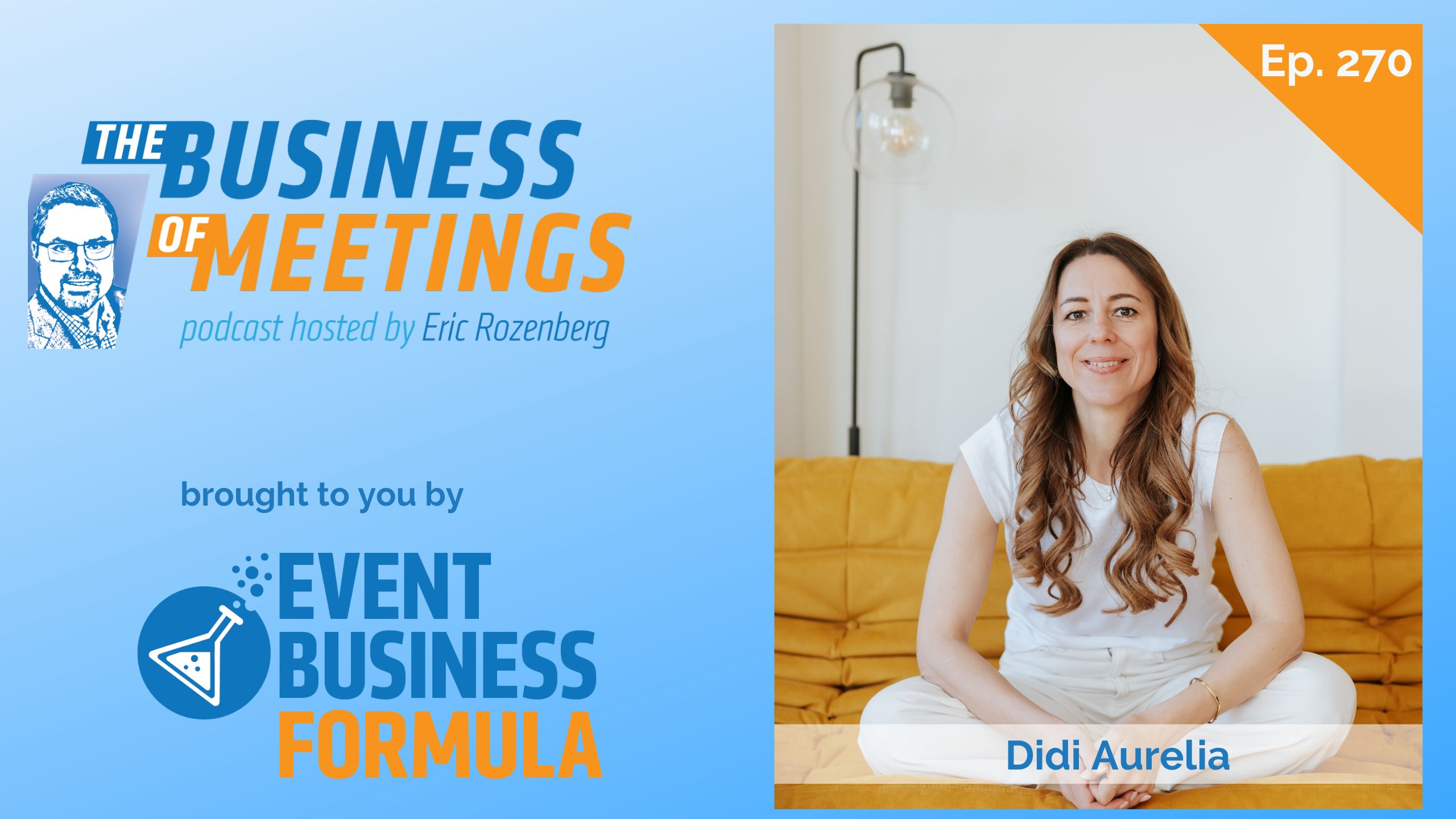
We are delighted to have Didi Aurelia as our guest today. Didi is an educator, psychologist, speaker, and the author of 100 Days to a More Aware You.
Having spoken recently at the World Economic Forum about the role of AI in supporting conscious decision-making, Didi is the ideal person for business owners and those seeking to integrate more mindful decision-making processes into their practices to consult with.
Stay tuned for Didi’s thought-provoking insights on using AI to enhance awareness and support intentional choices.
Personal Transformation
Didi highlights her journey of self-awareness and growth in her book, 100 Days to a More Aware You. She believes lasting transformation comes when people engage deeply with their lives, make conscious decisions, and take small, intentional steps toward change. She encourages individuals to become aware of their habits and mindsets and make the necessary shifts to align with their goals.
Redefining Identity
After leaving the corporate world, Didi found it hard to lose her executive identity. Initially, she struggled with the idea that success was defined solely by her title and role. However, over time, she learned to focus on her fulfillment, which mattered to her, and redefine her identity and success instead of focusing on external labels.
The Why Not Me Movement
Didi launched the Why Not Me movement to help people overcome impostor syndrome and self-doubt. By encouraging the simple question, Why not me?, the movement challenges limiting beliefs and empowers people to pursue their goals with greater confidence and self-assurance.
Living in Alignment with Personal Values
Didi highlights the importance of living according to core values like honesty, integrity, and authenticity. By staying true to your values, you can develop the ability to navigate challenges and make decisions that align with who you are. That approach leads you to a more meaningful and fulfilled life, where you can feel empowered to make choices that reflect your beliefs.
AI for Self-Awareness
Didi sees artificial intelligence as a powerful tool for increasing self-awareness. She believes that AI platforms, such as ChatGPT, can serve as mirrors to help people reflect on their actions and decisions by providing insights into behavior patterns and offering alternative perspectives to improve decision-making skills and promote conscious behavior.
Changing Roles of Women in the Workplace
Even though there has been significant progress in terms of the evolving roles of women in the workplace, women still face challenges, particularly in asserting their worth. Didi encourages women to self-promote, embrace their value, and take ownership of their achievements, to break free from traditional gender roles that often lead to underrepresentation and underestimation of women’s contributions.
Teaching Leadership to the Next Generation
Didi believes leadership is about nurturing confidence, courage, and authenticity from a young age. By instilling leadership qualities and empowering young girls to believe in their potential, parents can help break down societal gender norms and build more confident future leaders.
Embracing AI for Change
When used mindfully, AI offers powerful opportunities for personal growth and societal advancement. Rather than fearing it, individuals can use AI to increase self-awareness, improve decision-making, and foster deeper connection and understanding in an increasingly digital world.
Bio:
Didi Aurelia: Author of ‘100 Days to a More Aware You’
Didi is a psychologist, educator, speaker, and former finance executive. She has charted a dynamic path from leading finance teams across Europe to founding a Montessori school that champions conscious parenting and personal transformation.
Armed with dual credentials in psychology and management accounting (ACMA), Didi brings a rare blend of corporate strategy, emotional intelligence, and deep personal insight to her work.
Through her platform More Aware You, she now speaks, consults, and creates experiences supporting individuals and organizations navigating change gracefully and stepping into purposeful leadership.
Didi believes that awareness is the most powerful tool we have in a fast-evolving world. Whether she’s guiding someone through a personal turning point or exploring how AI can support collective well-being, she is rooted in one mission: to help others ask Why not me?, and move forward with courage.
Connect with Eric Rozenberg
On LinkedIn
Listen to The Business of Meetings podcast
Subscribe to The Business of Meetings newsletter
Connect with Didi Aurelia
On LinkedIn
Listen on: Apple Podcasts · Spotify · YouTube
“Honesty doesn’t mean you’re unkind, but honesty comes with courage.”
Didi Aurelia
Full transcript of episode 270 of The Business of Meetings podcast, Eric Rozenberg with Didi Aurelia. Lightly edited for readability.
Eric Rozenberg: Hello and welcome to the Business of Meetings podcast. I’m your host, Eric Rozenberg. Over the years, I’ve had the privilege of helping businesses in the meetings and event industry grow and succeed. And I’m excited to share that experience with you. If you feel alone and overwhelmed, and if you’re looking to take your business to the next level, improve your strategy and sales, and connect with like-minded professionals, you are in the right place. I invite you to visit eventbusinessformula.com and join our community of event business owners dedicated to exponential growth. Now let’s dive into today’s episode.
Hello and welcome to new episode of the Business of Meetings podcast, and today I’m delighted to speak with an old friend. Her story is absolutely amazing. She’s an educator. She’s a psychologist. She’s a speaker. She’s an author of a book called 100 Days to a More Aware You. She’s been speaking recently at the World Economic Forum about the topic of how to use AI to make conscious decision making. This is the perfect person to talk to for business owners, but also for people who want to have the convergence between AI and conscious decision making. Ladies and gentlemen, please welcome Didi Aurelia. Didi, thank you so much for being here today.
Didi Aurelia: Such a pleasure, Eric. Thank you for having me. I’m excited.
Eric Rozenberg: You have the same thing as I do, as you have an accent. So, you have to tell us a little bit about your journey, and not only where you come from, but what you’ve been doing in your life and what got you to what you’re doing today.
Didi Aurelia: Okay. Okay. Well, that’s a great beginning. I live in London, UK for almost 20 years now. However, I was born and raised in a small tiny country in Eastern Europe called Bulgaria, one of the oldest countries, by the way. And I grew up there. I was born during the communist regime, which meant quite a lot of things growing up. And definitely it meant not being entrepreneurial or being a small business owner, because that concept did not exist at the time.
And yeah, the reason why I came to London 20 years ago was because of my job. I was supposed to be a psychologist. I did a master degree in psychology. I always wanted to be a psychologist. However, my career took me into finance. I became a qualified accountant in the meanwhile. And I was very early on a CFO of the American company branch, insurance company, which was building their offices in Eastern Europe at the time. And after a few years working for them, they moved me, relocated me to the City, which was a great opportunity for me to build my career even further. And I stayed in the City for about 10 years, working for different companies, generally on finance executive roles, leadership roles quite often.
I mean, I loved my CFO role a lot in Bulgaria because I had much more helicopter view. As a CFO, you directly report to the CEO. You are in charge of most of the projects. You have the helicopter view of what’s going on in any company. And when I started, was seven people. When I left, we were 45 people. So it grew significantly. And I was part of that. When we moved to London, of course, you work in a much smaller environment. So I was quite often either doing good FP&A roles or building IT budgets and allocations. That’s my love for it as well at the time.
And everything changed for me when I read a book by a guy who I’m sure your audience would know of, called Tim Ferriss. He wrote the book The 4-Hour Workweek. And I stumbled upon this book by pure chance in Borders. It doesn’t exist anymore, one of the bookstores in London. And I was chasing my corporate career. I never had any questions. I felt some sort of emptiness inside sometimes, but I never questioned it, just because my life was so full of work and traveling, and I had to travel a lot for my work as well. So I never had the time to pause. And when I read this book, it opened completely new perspective and shifted almost everything for me, because it took me out of my reality. I did not know that people can live the life that he described, that they can work less, that they can retire early. It showed me that I’m very stuck in my own framework and what good life is.
I decided that I need to change that for me, and my quest of figuring out what’s next for me. And no, I don’t want to be stuck in a corporate career, which I loved, by the way. It’s not that I didn’t, but it just didn’t feel the right thing for me long term. I was 42 or 43 at the time, thinking, what the heck, is this how my life is going to look like, working from 7 till 9 for other people? And I went to an event that he organized. That was back in 2011. I loved meeting these people. It’s something like Mastermind Talks. I think Mastermind Talks was very much, it’s an event that Eric and I go, that is very much inspired by what Tim did back at the time with 100 people. And I decided that I’m out of corporate and I’ll go back to psychology, coaching, and then building my own business.
And once I had my child, when I got pregnant, I built my first, it wasn’t full-on business, it was more like a project, but it was the thing that took me out of corporate. So I created, at the time was very popular to do online programs, I created a baby feeding program. I created a YouTube channel where I talked a lot about parenting. Smart Parent Stories was, at the time, called. And I delivered a lot of values to parents at the time. And I blended my psychology, conscious parenting, psychology education into what I thought it’s a way to live a much more conscious and aware way. And that’s kind of the beginning of how I transition to where I am now.
So fast forward, I built a school, Montessori school, when my son was three years old. I run it for about seven years, up until a few months ago. And whilst I was running it, I still had the same love and desire to learn more. How can I be a more conscious human? How can you be a more aware? And you know that because you have kids. When you have children, they highlight that need quite significantly for you. You’re either becoming more aware, you’ll dive deeper into unconsciousness. And I studied more. I truly loved, even when I studied Montessori, just so that I know, by running a business that is completely new to me, from finance to education, I needed to know that I would be able to answer the questions that my staff would have for me, that I can run a business knowing what I stand for and set up a vision based on what I believe, because our vision is also always based on what we believe is the right thing, right?
And yes, and then I wrote a book two years ago, my book 100 Days to a More Aware You. It was a passion project as well, which turned into something bigger. It started as a project over Instagram, but then people loved it so much, they said, “You should publish it as a book.” And it was just pouring what I was living at the time, how I felt at the time. It was very much about my love for spirituality and my love helping people to pause sometimes, to take even five minutes a day to pause and think about what’s important to them. What kind of labels do I carry that I do not need anymore? What identities I’m building up that I don’t care?
And now my work expands more on More Aware You. So I’m building a platform, educational platform with different educational trainings for more aware parent, more aware children, more aware leadership. And I am very passionate about doing workshops for organizations and for people as well, to help them grow and claim their power and become more aware. So here I am.
Eric Rozenberg: Amazing.
Didi Aurelia: From a small place in an old country called Bulgaria all the way to London, changing my identity few times on the way.
Eric Rozenberg: That’s fascinating. As a psychologist, I can understand the change from finance to education, although it’s different, and it’s very helpful to have the background you have. How did you become a CFO? And I don’t know many CFOs whose background is actually psychology, although they should be using it more, but it’s quite unique.
Didi Aurelia: It’s very interesting, because when I studied for ACMA, which is the equivalent of, I would say, probably CFA in the States, I don’t know your… ACMA is very much management accountancy. It was pure chance. When I joined the company that I joined, Marsh McLennan was an insurance broker company, and they have a sister company called Mercer, which was in consultancy and HR. So they were supposed to basically have a sister company opening the offices back at the time in Bulgaria, and I was hired to welcome the opening of the office. I was still at university and kind of find my way. And I think that was only possible back in early 2000s in our part of the world, where very young and brilliant people were given the opportunity to actually rise fairly quickly, because there weren’t many people speaking language, being more entrepreneurial, or being willing to say yes to a lot of things.
So for me, it was just, I studied psychology. I went for a few courses on insurance and finance, just because I joined this company. I like knowing what I’m doing, and I like to know the businesses that I’m working in. It just gives me the confidence that I’m on the right path. And at the time, we had external accountancy, both external company that was doing the American cover plus the local accountancy. And then I start doing few things for them, and my boss saw that I’m really good at it. So I immediately wrote for ACMA, which is like the accountancy course, and then I did really well, like super well. And he said, “Do you want it?” And I said yes.
I think a lot of my success early on was because I kept saying yes to everything. I hardly ever said no. And that’s kind of my advice to a lot of people. When they say, “Oh, you should be very careful what you say yes to, what you say no to,” I’m like, when you’re in your 20s, you say yes to everything, because you have no idea which path will take you where. And that’s been really, really good for me. And I remember I would say yes, like immediately, for any project, without even knowing how would I deliver. And that turned to be a very good asset for a lot of companies, because they’re looking for someone who is willing to take a risk and step in and doesn’t complain and gets the job done. And that was me. So that’s my career. It was a pure chance.
And to be honest, I think that there are so many compatible elements between being a psychologist. I feel being a psychologist is amazing, because it helps you understand human nature, and I’ve always been fascinated by behavior. However, I’ve always been good at math as well. So, that was kind of my favorite subject in school. I love psychology because I love people and I love studying behavior. But so much in my ACMA, in my study, was also organizational psychology. How do you build teams? There is so much psychology in any leadership role. So all your business owners who are listening now, they would know that we need to be a leader. We need to be good listener. We need to be good visioner. We need to be good empower person. We need to be able to work with all sorts of types of people, and it’s greatest asset. So I just truly love how my path turned into something different, and it’s going now back to something different as well.
Eric Rozenberg: Great. Now, you’re talking about chance.
Didi Aurelia: Yeah.
Eric Rozenberg: You had chance, but that’s a little part. You were prepared for chance, and you were able to seize the opportunity, because I see a lot of people that are afraid of making decision, afraid to making risk. They’re always thinking about, if I say this or if I do that, if I’m in a corporate environment, would it be good or bad for my career, instead of thinking, would it be good or bad for the organization? And then they don’t want to take any risk. So saying yes. But you say something that I thought was very interesting as well, among all the great things you just mentioned in your career. You said that you were ready to take risk, or no, you were not ready, and not knowing how you were going to deliver. And we both from Europe. Belgium was not as bad, but still a very socialist country, which is not encouraging entrepreneurship. How do you attribute the fact that despite the environment in which you were raised, you were able to think like that and to act really as an entrepreneur?
Didi Aurelia: Honestly, if you ask me whether I’m entrepreneur, I wish I can say that for me. I am. I’m a business owner. I build businesses based on projects. I still feel uncomfortable saying this word about myself, because in a way, it took me a long time to believe I’m creative person, or you come with this background and you think numbers and things like that, your creativity, it’s not your biggest asset.
I thought a lot about your question before, in the past, because I remember I was 11 when the changes happened, when the Berlin Wall fell and the communist regime fell apart. So my teenage was very turbulent. I was living with parents who did not know any different. Nobody in the country at that age would know anything different. I remember I hated a lot of what the communism brought up. Hate it probably is a strong word. I mean, I don’t like hate as a word. But in general, I did not like how they put us all in a box. You are not supposed to think differently. You are always supposed to be like everybody else. You are not rewarded. You’re punished if you stand out. And I hated it as a child. I always remember that I felt that I have to hide it.
And when I go back saying, how can I have such a successful career very early on? I’ve been appointed very early on for very senior roles in a men’s world in the City. I was the only woman out of 20 men often at the meeting. And I was thinking, I know it’s because I said yes. I said yes. I never complained. I always took the load from the CEO. I never said a word about overwork or being tired. I think it’s not because I came with something special or I had good examples. I definitely did not have that many good examples, but it was my pure love and desire to learn. I’m just extremely curious person, and I always say to every young person who comes to me and ask me questions about that, just be curious, because you don’t know.
And I never watch the news. I’ve never been into watching TV. I don’t know how people even have the time to do that, when as a curious person you can learn something new. You can grow in certain way. So my curiosity always brought me to a part where I say, I want to learn more. It was never about the money. It was never about the status. It was more about, oh, that’s an opportunity to learn something new. Oh, this is a new project. I have no idea, but I’m not going to be bored, because I’m going to be in learning mode all the time. I honestly think that that’s the main reason why I said yes to these things. It wasn’t because I wanted to build something or I wanted the big title. I just did it because I wanted to learn, and I feel I’m still like that right now.
Eric Rozenberg: Curiosity. I agree with you. We never stop learning. That’s for sure. And then fast forward again, despite you didn’t know before, despite your career, you decide, where you are not at the top, but really, yeah, at the top, are very, very successful, you decide that you don’t want to continue in that environment. What was the reaction of people around? It’s like when somebody decided to start their own business, you always have some people that genuinely want to be nice to you. “Are you nuts? Are you crazy? And the position you have, and the salary you’re making,” and blah, blah, blah. So what in your mind at that moment?
Didi Aurelia: I have a lot of that. I had a lot of that. I remember I was afraid to tell my mother, because leaving a high-level job in the City to become what, and to be who? And especially like building a school. A school, it’s not as rated highly in the mind of a lot of people, when you have the successful finance career. It wasn’t easy, I must say. It wasn’t easy not only because of people pressure, but because of my own questions inside, from the point of view of, like, I’m saying no to something that, honestly…
So, a little bit step back. I tried to leave two years before I actually left. I tried to leave. I said, “I’m just going to do consultancy. I’m going to figure it out. I’m going to build my own business.” And I couldn’t. I was sitting at home like three days a week, two days consulting, and I’m like, what am I doing? I did like coaching courses, Tony Robbins courses, all sorts of courses. And I just couldn’t figure it out. And I kept doing what it was easy for me, which was just consulting here and there. And once you have a good reputation, people call you. So it’s hard to cut the string, and I kept coming back, kept coming back, until I got pregnant.
So my child gave me the reason to leave, because when I got pregnant, I was working for another big American organization, and I said to myself, I’m not going back, because if I go back, the comfort would keep me there, and I cannot do that to my child. I want to step into this person who I knew I could be, and I’m just going to use that and burn the bridges, and I’m not going back from maternity. So I vividly remember, I’m pushing the pram and I’m repeating myself, “I need to figure it out. I need to figure it out. I’m not going back here.” The maternity in the UK is one year. So I felt like I have this year where I’m not that much paid, but at least I can decide to go back to work if I want to. And I had to figure it out. And I burned the bridges. I wouldn’t have done it otherwise.
I mean, when my son was three or four years old, I did still a little bit consultancy, just for people asked me, and it felt interesting. It was something about the NHS, which is our current medical system. I thought that I can contribute quite well. It was for people who I knew. But I said, if I don’t cut the strings now, I will keep going for more and more, just because it’s an easy income, and I don’t feel I’ll grow the way I want to grow. Although the school is not as rewarding, at the time at least, in the beginning, it’s a lot of risk. It felt much more aligned to who I want to be as a person, and living for my own values. Not having a boss, not having someone to respond to. Freedom is one of my biggest values. So, like, how I’m expressing my values if I don’t go for that?
Eric Rozenberg: Amazing. So amazing. Especially at the moment where people will say, “Oh no, I will wait now. I have a child, and no, it’s not the moment.” But you did that. When you say you burned the bridges, which, by the way, is probably the best way to move forward. And I remember when we came to America, I told my kids, I said, “Listen, we don’t know the system. You have to understand the system. And by the way, I don’t want to hear it’s better or worse than what you learned before, you experienced before. It’s forward. That’s the only way.” But how do you burn bridges? You call your boss and you say go to hell? What did you do?
Didi Aurelia: It was more psychologically inside of me, deciding that this is not an option, because if you go back now… ‘Cause I did it. I told you I tried to leave and I couldn’t. Of course I could, I have to change my language. But it felt easier and it felt comfortable, and it felt, oh, that’s what, and why don’t you just do it? You’re so well paid. I had to decide in my head that no matter what, I’m not going back, because if I go back, then I’ll stay. I knew I would stay for a long time. So I had to make this choice for myself and for my future self. And it hasn’t been easy.
You know that, you’ve been building businesses too. Like when I built the school, it’s completely new business, nothing to do with what I’ve been doing before, and you have to figure it out. You have to learn how to do it. You have to manage a team in completely different environment. But I still feel when you’re resourceful, and most people who own businesses, we are resourceful, we make it work. And we can wear 100 hats at the same time, which is very different than corporate.
I actually stepped into my business with a corporate hat, which was not the right thing to do, because I come from very big organizations that are extremely rich, with a lot of resources cashwise, and like, it’s okay, hey, I can pay for everyone, like overpay them, and they can have this medical system doing that. It took me time to actually realize that I cannot run my business the way I’ve been running my team or been operating in a corporate environment. But I didn’t know anything different. Yeah. So you have to take the risk. You have to be willing to fail and look stupid and bear some financial consequences in order to learn. But that’s the best MBA, right?
Eric Rozenberg: Absolutely. And that’s something I always say to people are starting their own business, especially if they’re coming from large organization. You need to be aware of one thing amongst all the others. It’s, you have this habit of being surrounded by a lot of people, by having teams, by having people that you can delegate to. And then the next day, you’re building your own business. In the morning, you’re having a meeting with one of the C-level executives that you want to sell to, and in the afternoon, you’re going to Costco because there’s no more soap and you need to buy. And that’s one of the main challenge for somebody starting their own business.
Didi Aurelia: Yeah, definitely it was for me. I felt that, oh, I would rather hire people to do things that you should not be hiring people to do. And then I learned my lesson, and now I’m much more smarter that way. But again, I don’t get caught too much in the reasons why I’ve done something wrongly. It’s not the right way, because you don’t know. You always do your best, right? You just don’t know at the time. I see it as a learning curve, and I just say that’s MBA expense. It’s university degree in real life.
Eric Rozenberg: Yeah. And you get better and better.
Didi Aurelia: Yeah. Get better and better. That’s why awareness is so important to me, right? Because you cannot get anywhere without being aware of where you’re going, what stops you, what your limitations are, how you make decisions. All these things really matter.
Eric Rozenberg: And so talking about being aware, that’s where triggered writing the book, the 100 Days to a More Aware You.
Didi Aurelia: Yeah. I did that, as we said, it started as a project that turned into a book. I did that over 100 days, posting on social media about things that would help people become more aware. And I did it because I was at a really great place at the time, and I was running these free calls, coaching calls with people from my following list. And I felt really good about the way they perceived the value that they were receiving. And sometimes I say this book just came to me. Every day something came to me, and it was never pushed or forced. It was truly the way I was seeing and living life at the time.
And that can change. Sometimes I open my book nowadays just randomly and I’m like, did I write that? How is this possible? I wrote that, really? And then I remind myself how we have different phases and we change as people as well. And sometimes we have periods of time where we leave from this place, and we have periods of time where we need to reach out to different type of skills and resources in us, and it doesn’t matter. It only matters that we’re moving, growing, and that we are aware of where we’re heading to, because otherwise most people live unconsciously, right?
I certainly was living unconsciously in my life to a certain point, just going with the flow with what people say was the best thing for you. That’s why when you ask me how was it to leave the identity of the corporate executive, it wasn’t easy. Even sometimes up to date is not easy, because if I go to certain events where you don’t have the label of, especially if they’re more corporate events, and you feel, oh, okay, they speak only this language, like they will see me differently if they know I was a CFO, if they know, oh, you’re not Didi, the CFO of a big company anymore, you know.
Eric Rozenberg: Exactly.
Didi Aurelia: And it takes time, right? And I always say to people, it’s good to sit with that. How many labels we carry, how many identities, how much attachment we have to these identities, because sometimes it may feel that they’re good for us, but this is what stops us to grow or to build the life that we actually want to live. And based on that, we redefine things like happiness, success. And most people don’t even take the time to sit down and think what success means for me, what living a happy life means for me. And I’m very aware of it, because I fall into the trap as well. I’m a human, most of the times, especially when I’m around other…
I am very excited now to launch a new movement called Why Not Me?
Eric Rozenberg: Why Not Me?
Didi Aurelia: Yes. Because it makes me feel, I think, the more I deliver workshops or talk to people, how many of us suffer from this imposter syndrome. I’m not good enough. Why would I do that? Who am I to do that? Who am I to think bigger? Who am I to dream bigger? And why not me? Like, why not me?
Eric Rozenberg: Exactly.
Didi Aurelia: Who else? Like, you have to choose yourself. If you don’t do it, everybody goes through the same, no matter how well they mask it, no matter how much they cover it up. Why not me? Why you? And I feel that it’s a very strong message for people who needs to overcome self-doubt and needs to go to the next level of deciding that it’s worthy to take some risks nowadays, because I think with everything going on in the world, again, I’m not into the news that much, but of course I feel it, we need more people who are willing to take the risk and step into a different place.
Eric Rozenberg: And I agree, and as I’m watching the news, I’m reading a lot but not bad. And what you say about imposter syndrome. I take the small business owners, specifically in the meetings and events industry, through a three months program, and the second session is exactly about the mission, the values, the mindset, and talking about imposter syndrome. Because you were talking about freedom being an important value to you. First, I believe that knowing your values, but being ready to live by your values, gives you strength and success in the long term. But second, I think that related to imposter syndrome, the day you start not giving any importance to what other people think about you, now you give… that’s the path to freedom. And I’m not saying that you shouldn’t care about people. Of course you should. And I’m not saying that you shouldn’t ask question or learn from others. But when you start not wondering what, they say in the States, is it keeping up with the Joneses or something like that, when you have to look what the others do or what they think of you, and when you start not giving a damn about it, that’s when you become… that’s what true freedom is, I believe.
Didi Aurelia: I truly agree with you. And it’s the definition of spirituality. That’s the enlightenment. You don’t actually care anymore, because you act from your internal desire and internal truth and internal knowing of what is it that you want to do. But it’s a hard path, I must say. I mean, I don’t want to generalize, but from what I see, for women it tends to be more difficult, and in a way they’re hiding their voice. I keep encouraging most women, especially business owners as well: raise your voice. Raise your voice. And I’m definitely guilty of that myself. And wisdom also comes with age. When you’re 20, 30, it’s a little bit different, but then you become more aware, if you’re lucky, and you can become more aware. Just awareness comes, and then you cannot continue to act in the same old way that you acted before, if you become aware of something.
And I love what you said about the values, because not many people take the time to define their values, and not many people, even if they define their values, they just put them in a piece of paper, they do not really live by their values. And I’m a big, big proponent of defining your values and live by them, because, going circling back to the decision making and making conscious decision making, with AI or without AI, when you have your inner compass, and your inner compass is the values, when you know where you’re heading and when you know what you stand for, and this can change, it’s fluid. You can adopt certain values for the coming year or coming two years, and then change to another value if you want to act as a certain person.
For example, for me, I adopted honesty and integrity as a big value. Honesty, integrity has been, but honesty, I incorporated it the last two years as one of my biggest values. And it shifted a lot of things for me, because it wasn’t my value before. Now it became my value, which means, oh, am I honest in every interaction that I have with people? Which means, can you be honest and kind? Because I wasn’t honest before, because I was thinking maybe I won’t be kind, but kindness is one of my values. So you have to really redefine. Yeah, honesty doesn’t mean you’re unkind, but honesty comes with courage. So you need to adopt courage immediately, because if I have to be honest with you now about something, but I don’t know how, and it’s a difficult conversation, I would have to be courageous as well. So some values come together and stuck, and this really helps you with making the right decisions for you. Because I think Tony Robbins used to say the quality of your decision determines the quality of your life. And you make decisions based on, consciously or unconsciously. If they’re unconscious, based on the way life hits you left and right and what other people want from you. If you’re conscious, based on your values. You have your compass.
Eric Rozenberg: Absolutely.
Didi Aurelia: And that makes everything much easier.
Eric Rozenberg: Absolutely. You have to be courageous to be honest, and even if you say it in a genuine way, it depends as well on the person with whom you’re being honest. Because the number of people, the number of times I’ve heard, “Oh, we need to be comfortable having difficult conversation,” until you start having difficult conversation.
Didi Aurelia: I like that. Yes.
Eric Rozenberg: It doesn’t work that way. And what you were saying about women, and it comes with age, I remember, I think we’re like 15 years ago, reading a book that I bought and offered to all my female friends who are in corporation. It’s Lean In from Sheryl Sandberg. And in that book, I learned something that I never thought of, which is very true, and from the moment you’re aware of it, then you can start acting upon it. And this is the following idea: a man will apply for a job even if they can deliver 50% of what is required for the job, and a woman will wait to be at 90% of knowing what to do in the job to apply for it, which is insane if you think about it. But when you become aware of it, then you can also be a little bit more, you can lean in and be more competitive in that sense, that you don’t necessarily need… And you’re the perfect example, when you say that you didn’t know how you were going to deliver, but you say yes and go with it.
Didi Aurelia: Yeah, I did not. I think somebody asked me recently at an event, is there something that I appreciate growing up in a communist country? Again, I was 11 when the changes happened. And my first reaction was, not much. I did not like the fact that there was no free market and ability for you to be who you are. But who I was to know at this time? And then I thought of it, and I said, actually, what I loved about that, and I always try to think to find things that we love versus things you don’t like, right, is the fact that I saw a lot of powerful women role models, because I come from a place where women were always working. I’ve never ever met a woman who didn’t work. That’s the first time, in the UK when I came, and I realized that there are women who stay-at-home moms. It just never occurred to me that it’s a possibility. In my reality, it never existed.
And I knew that women are so powerful, not only because, still, our culture is masculine and feminine culture. So men don’t do much in terms of household work, at least back at the time. Women not only take care of kids, not only do it all, but they also work, and they also work in equally higher positions. So I never thought that that can be an issue for me. And that said, I still have a lot of the difficulties of promoting myself in a certain way or acting a certain way. And now I see a lot of women who are building amazing businesses, and I congratulate them. Like, I’m clapping on the side saying yes, and they’re marketing. Sometimes in my old world I would say, shamelessly, oh, how can she market herself that way? And I’m like, good job, good job, going for it. Because when men do it, I would be like, oh, men, they just go out with the 50% and they’re like out there cheering for themselves. And woman shows up, and, okay, I have this book here, I just wrote it. But yeah, and you don’t do anything with it. So I’m definitely also one of the people who played that role for a long time. And that’s why I’m saying it’s time for us to rise up our voices, and if there aren’t enough role models, to be the role model.
Eric Rozenberg: Yeah. No excuses. Absolutely. I love it. And as a father of three daughters, I even love it more.
Didi Aurelia: Exactly. That’s why I saw that you have three women, three girls at home. So it’s good to be aware.
Eric Rozenberg: And that’s how they’ve been raised. I always had this poster of Sheryl Sandberg quotes on the fridge, and I was like brainwashing the three of them. If anybody tells you that you’re bossy, what do you answer? I answer, I have executive leadership skills.
Didi Aurelia: I love that, Eric. How was it the book that made you so much aware that you can incorporate that in your parenting?
Eric Rozenberg: Correct. That was the book, and then this quote resonate with me, and so I print it and I stick it on the fridge. And since they were able to read and talk until they leave the house, I keep repeating that to them.
Didi Aurelia: Wow. Amazing. That’s how parenting can make you also aware of things that you may not even have thought of before. And for the sake of your kids, you want to actually do it and live by it, for the sake of your kids. If you are not in love of yourself so much to do it for your own sake, sometimes it’s easier for us to do things for others, right? As servers.
Eric Rozenberg: That’s right. That’s right. Time flies, and maybe one day I’ll be able to do like Joe Rogan a three hours podcast, but I don’t want to end this without asking about the impact of AI on conscious decision making. So I got the part of conscious decision making that you talked about and what you’ve done in your life. How now are you incorporating AI in that process? And people that are listening, what can they do, and how can they use AI for that?
Didi Aurelia: Okay. So the presentation that we did in Davos was very specific, with a very specific type of AI, which was predictive AI, for a company that somebody with whom I did, like my partner, we did it together. He has an AI company, and it was in the context of that. In general AI, and we talked a lot about the fear of AI, in the sense of that we do not adopt, even now most people do not adopt easily what’s to come, because they’re fearful. And that’s very normal. We are all fearful of change, and this change is too big and too quick for all of us to embrace with ease, and especially because for the first time in the history of humanity, humans question who we are. Like, what do we do here? We used to be on the top of the chain, and we were who we thought that by being able to rationalize and to think, we are really the gods of the universe. And suddenly there is AI coming, and it asks the question, philosophical question: Who are we? Where am I heading to? Am I disposable? Am I actually needed as a human?
And we talked a lot about these fears and how to approach them, because ultimately AI, the consciousness of AI, the way I see it, because I’m big into consciousness, right? We are all conscious expressing itself through us in a certain way. The consciousness of AI would be fed by who we are and where we are right now. So it can go either way. And the more conscious people like us, the more growth mindset people, the more people who want to learn and give and do more, the more people use it, the better it will be.
That’s why I encourage everyone to go and use all sorts of tool that are out there. If people are afraid to start and they haven’t started with anything, I would be very surprised, because I think everybody who I know, and most people, would use at least ChatGPT by now, or the version of ChatGPT in Europe, which is Mistral, or even DeepSeek. I would encourage everybody to use it in a more conscious way, in the sense of to try to understand themselves more. AI is not going to take out, in terms of awareness, it’s not going to take out the job of psychologist or therapist. However, it can give you a great ability to start getting yourself more.
Like, literally, what I suggest people do is to talk to ChatGPT. They don’t even have to write anymore. Just talk to ChatGPT and go through: this is what I’m going through right now, this is what’s happening in the office, this is what I’m struggling with, and can you just keep a reference of that and then give me five ideas of how I can work on that, or five journal prompts, or can you give me explanation as to why my pattern shows up in this way or that way. You have to customize it. It’s really important to personalize it and customize it. But it really can be a great tool of self-awareness for beginners who have never done any work.
And even just from a point of view of, some people don’t like reading much, and of course they’re not going to probably sit down and read big books on spirituality or psychology or awareness or even business. But even if you use it as, can you give me as promises, can you give me, let’s say, definition of happiness throughout the history and modern psychology, and learn from the synthesis and the summary of what ChatGPT gives you, it can be very powerful, because then you can dive in something that speaks to you more. Because some people don’t know what speaks to them more. It’s kind of, in a way, some people don’t even know how to define their values. So you can use that even for: I don’t know what my values are. How can you help me to define my values? Can you give me a list of values? Can I give you situations throughout the day for which I go, and you can help me define my values?
Eric Rozenberg: So any possible way to get to know yourself better, and to be more conscious when you’re making decision.
Didi Aurelia: Yeah, I mean, to be more conscious in making decision. There are tools out there that probably are different. Like, my partner has a big AI company, which is a scale-up right now, and they help companies make more conscious decision making, whether it’s in regards to bringing more investments or moving, or whether it’s in regards to predicting behavior of the company. So that was a very specific topic. In general, I’m sure that there are a lot of solutions out there that can help companies. In our case, it was very specific topic for companies that are looking for, let’s say, investing in more conscious businesses, or how you can, as a family office, let’s say, or investor, invest in certain type of environment that otherwise you wouldn’t have access to.
But in general, I personally, on a day-to-day basis, of course there are options for now for the web pages that I’m using, presentations and things like that. But in general, for self-awareness or awareness or decision making, we make thousands of decisions a day, if that can help people. We make thousands of decisions a day. There is something called decision fatigue. We all heard of that. The more decisions you make, the more fatigue you get. Therefore, it is good to minimize the number of decisions you make throughout the day. And how do you do that? You can simplify it. It depends on different ways. But just to make it quick, because we have 2 minutes: when you know where you’re heading to and when you know what your values are, and you can use AI to help you with that if you are not willing to look outside with the help of coaches or awareness teachers, then get much easier for you to make decisions, because the answer shows up very quickly.
And I would suggest everybody who is a business owner, and they have values in their businesses, to revise their values, because they may not be adequate now. They might have been just values that they put years ago. And see how often they discuss their values with their teams and actually live by their values, and then do the same thing in their personal life. And again, I would encourage everyone to do revision of their values at least on a yearly basis and say, okay, how did I show up here? If I choose courage, am I being courageous? And just put it on the fridge and say, okay, how would I act in this situation? Am I courageous? No, I’m not living by my value right now. So that’s how you bring awareness to your day-to-day moments, because that’s what the awareness, right? It’s in the day-to-day little moments that we go through.
Eric Rozenberg: Wonderful. Thank you so much. And as the great Belgian philosopher Jean-Claude Van Damme would say, you have to be aware. I truly enjoy the conversation, and I look forward to seeing you in person very soon. So thank you very much.
Didi Aurelia: Yes. Thank you so much for having me, Eric. I truly enjoy all my conversations with you, and I always have so much laughter and smiles after talking to you. So thank you for that.
Eric Rozenberg: Thank you for tuning in to the Business of Meetings podcast. I hope you found today’s episode valuable. If you enjoyed the show, the most important thing you can do is leave a review and share it with your colleagues. It really helps spread the word. I truly appreciate your support. And if you’re ready to take your business to the next level, don’t forget to visit eventbusinessformula.com to learn more about how we are helping event business owners like you. Thanks again for listening, and I’ll see you next time.