
Today, we’re taking a closer look at what it truly means to build a business that works. We’re moving beyond the notion of being busy, booked, and indispensable, and instead focusing on how to create a business that delivers real value.
Stay tuned as we explore why so many business owners still operate like highly paid freelancers, and what needs to shift to build something scalable, transferable, and sustainable.
Busy and Booked
If your business stops when you stop, you own a job, not a business. Being busy and booked does not mean you’re successful. Revenue is not the same as business value, and strong client reliance on you could indicate that the business is fragile, as it depends on your direct involvement.
The Biggest Industry Lie
The industry glorifies and rewards hustle, hero mode, last-minute problem-solving, and being indispensable, even though it often leads to stress and burnout. The more indispensable you are, the less valuable your business becomes to a potential buyer. A business built on dependency is not a company, because you, as the owner, are the system.
Transferability
The goal is transferability, not performance. A real business can operate without you. If someone else cannot sell, deliver, manage clients, and make decisions, you don’t have a business asset. Your focus needs to shift from creating amazing events to making them repeatable without you.
The Hero Trap
The Hero Trap stems from the belief that nobody can do it better than you. You become the fixer, the closer, the savior. It feels rewarding, but it makes the business entirely dependent on you.
The Customization Trap
Each client is different. Your offers should be tailored, and your client’s needs must be understood, yet there must still be a repeatable process. Without standardization, customization kills scalability and limits growth.
The Control Trap
Believing that things will not be done right unless you do them yourself keeps you involved in everything. That notion is usually driven by perfectionism and fear of delegating. It leaves you stuck and repeating the same patterns, which prevents business growth.
A Real Business
A real business has defined offers, not random services. It has a sales process and a clear sales playbook that enable others to sell consistently. It has delivery systems and documented workflows. It also has a team, where people can make decisions within a clear framework without constantly requiring approval.
Documentation
If something lives in your head, it does not exist. Documentation allows you to train others, delegate effectively, and create consistency. It also creates the highest value for your business.
From Operator to Architect
Operators solve problems, architects eliminate them. The operator mindset focuses on getting things done, fixing problems, and personally delivering outcomes, whereas the architect mindset focuses on designing systems. So, instead of doing everything themselves, those with the architect mindset assign ownership to others.
Practical Steps
Start by identifying where the business depends on you. It could be sales, client relationships, delivery, or perhaps even decision-making. Then systemize one area at a time, ideally starting with sales or delivery. Create a sales playbook that includes questions, objections, and answers. Document everything before delegating to avoid chaos. Finally, build ownership by making your team responsible for outcomes.
Building A Scalable Business
The ultimate goal is a business that can run independently of you. Ask whether the business could operate for 30 days without your involvement. Consider whether someone else can close deals, deliver projects at your standard, and manage clients. If you cannot step away, you cannot scale, and you cannot sell the business.
Connect with Eric Rozenberg
On LinkedIn
Listen to The Business of Meetings podcast
Subscribe to The Business of Meetings newsletter
Listen on: Apple Podcasts · Spotify · YouTube
“If you cannot step away, you cannot scale, and you can definitely not sell.”
Eric Rozenberg
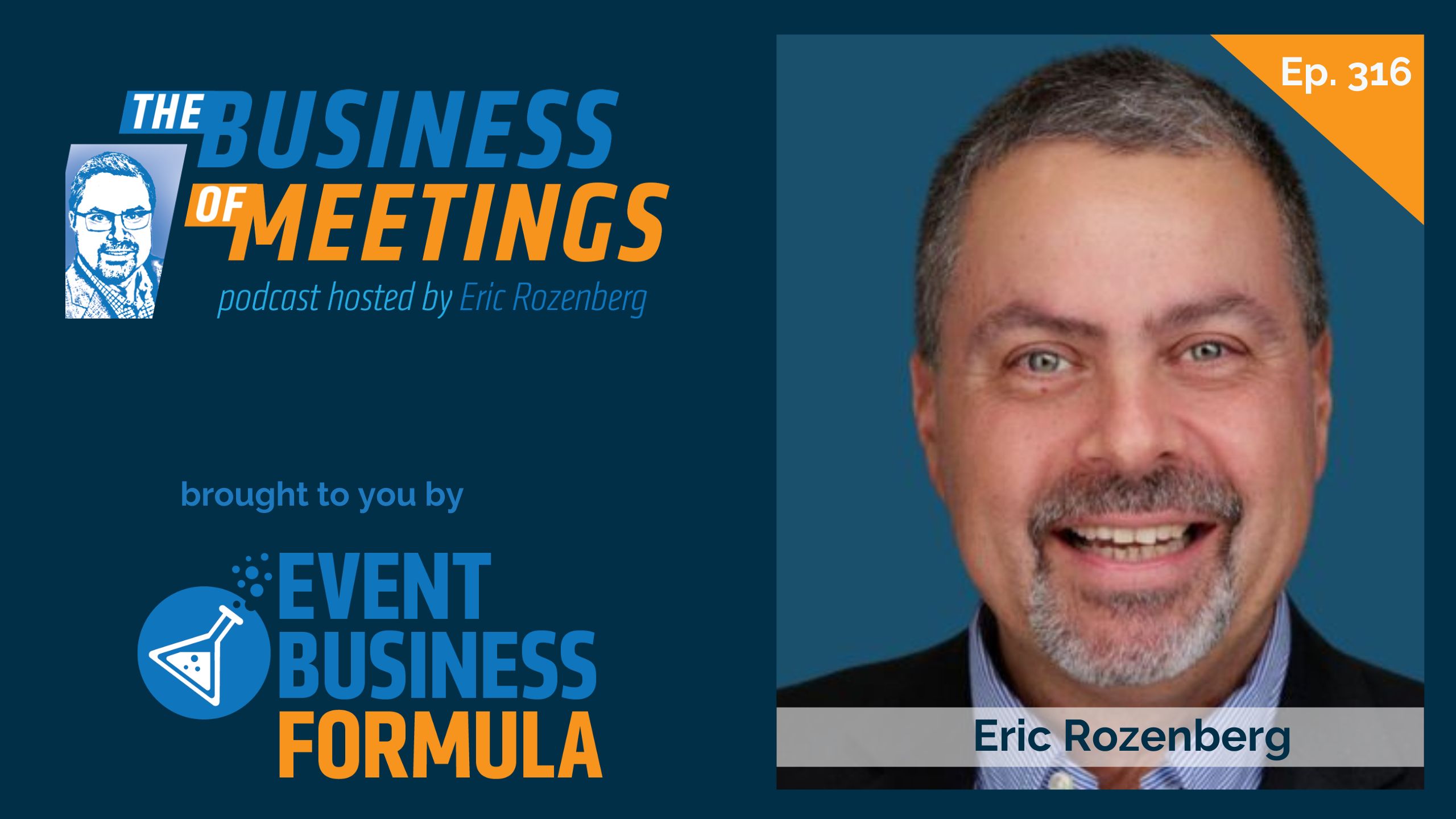
Full transcript of episode 316 of The Business of Meetings podcast, a solo episode with Eric Rozenberg. Lightly edited for readability.
Eric Rozenberg: Hello and welcome to the Business of Meetings podcast. I’m your host, Eric Rozenberg.
Over the years, I’ve had the privilege of helping businesses in the meetings and events industry grow and succeed. And I’m excited to share that experience with you. If you feel alone and overwhelmed, and if you’re looking to take your business to the next level, improve your strategy and sales, and connect with like-minded professionals, you are in the right place. I invite you to visit eventbusinessformula.com and join our community of event business owners dedicated to exponential growth. Now let’s dive into today’s episode.
Welcome to a new episode of the Business of Meetings podcast. You see, most event business owners, I don’t believe, are really CEOs. They are highly paid freelancers with a lot of stress. And the bottom line is that if your business stops when you stop, you don’t own a business, you own a job. The goal is not to have better events. The goal is to have a business that works without you. Because if you think about it, we are always saying that we’re busy, that we’re booked. That doesn’t mean we’re successful. We always talk about revenue, but that’s different than business value. And we always talk about our clients who loved us, but that also means our business is fragile. And so I want to talk about this today. And what if everything you’ve been optimizing was actually the wrong goal?
Let me first start by mentioning the biggest lie of our industry. We reward hustle, hero mode, last-minute problem solving, and being indispensable. And year after year after year, you have this survey coming out and telling us the top five most stressing job. Of course, our industry is in it. Being a business owner in the industry is in it. Being an event planner, and we kind of glorified this, which actually is totally insane as far as I’m concerned.
The problem is that the more you are indispensable to your business, the less your business is valuable to a potential buyer. And to me, you’ve built dependency, not really a company. Why? Because you’re the system, and that’s really the problem. The real goal is to be able to transfer the business. Doesn’t mean that you have to, but to build a business that is sellable and then decide what you want to do with it. And so the goal is not really the performance. The goal is the transferability. In other words, can someone else sell for you? Can someone else deliver for you? Can someone else manage your clients? And can someone else make decisions? And if the answer is no, well, you don’t have a business asset.
So, how do you go from “how do I make this event amazing” to “how do I make this repeatable without me?” And for that, I want to tackle three main traps that are keeping business owners stuck in their growth: the hero trap, the customization trap, and the control trap.
The hero trap is exactly how I thought the first two years of having my first business. Nobody can do it better. It’s my business. I cannot have someone else taking care of my client. In other words, I was the fixer. I was the closer. I was the savior. And it’s very rewarding, personally speaking, if you think about it. And so I kept doing it until I almost crashed. And so the trap here, the hero trap, is being addicted to being needed. The shift in your mindset is to always ask yourself, when you do something, can somebody else do it instead of me? So that’s the hero trap.
The second trap is the customization trap. Every client is different, so we’re reinventing the wheel all the time. There’s no standardization, and basically the customization kills the scalability. And I’m the first one to tell you that you have to tailor-make the offer and understand the needs of the client and understand the goals of what they’re trying to achieve and the profile of the people that are coming. But there’s also a certain process that can be repeated, and that’s the challenge when you have the customization trap.
The third trap is the control trap. It won’t be done right if it’s not done by me. So you stay involved in everything. And at the end of the day, perfectionism is somehow meaning that you fear. You fear letting go. You fear delegating. And at the end of the day, this control trap will also impeach you to grow your business and make sure that you’re going to keep doing the same thing all the time expecting a different result. That’s the definition of insanity, as Einstein would say.
So what does a real business look like? A real business would have defined offers, not random services. A real business will have a sales process, not only charisma. So you have a sales playbook. So you’ll have the objections, you’ll have the answers to those objections, so that someone else can sell for you and will say the same thing and represent your company the same way as you would. But that’s also the sales process helping you to do that.
A real business will have delivery systems, not only by memory. I know I have to do this, I know I have to do that. You need to document everything you’re doing so that you can train other people and they can start managing the project the way you would manage it. Would anyone manage the project 100% like you do? Never. But guess what, if they deliver 80% and the client is happy, then everybody’s happy.
A real business has also documented workflows, not habits. Exactly as I just mentioned, you need to document everything so that it’s very clear the way you’re operating. And a real business has a team with ownership, not dependency on you. They can take decisions. They know in which frame they can take decisions, but they don’t always have to come to you and have your approval. And that goes both ways. You need to give ownership to your team, but you also need to have team members that are independent and that can take decisions and take initiative instead of always looking for your approval because they’re scared of making a mistake.
The bottom line is a real business has the defined offers, the sales process, the delivery systems, the documented workflow, a team with ownership, and if it lives in your head, it doesn’t exist. You need to document everything. And if you’re like me, more a visionary, it’s boring. It’s frustrating. It’s not what you enjoy doing the most. And it is what is going to create the biggest value for your business.
So what you need to be doing is shifting from being an operator to being an architect. And so the operator mindset that you and I would have when we start our business the first time, the operator mindset is “how do I get this done,” “how do I fix this,” “how do I deliver this.” And we are excellent in shifting into this mode of, okay, something’s happening. It’s almost like we’re having a kick out of it. And quite frankly, if you don’t have that, you probably won’t stay long in this industry, because yes, you need to love somehow the unexpected and that something is happening and say, okay, you’re in charge. But you need also to understand that if you are always the person that is needed, not only you’re the bottleneck, but you’re never going to grow.
So from an operator mindset, you need to change to an architect mindset. Instead of “how do I get this done,” it’s “how should this be done every time.” Instead of “how do I fix this,” it’s “what system prevents this issue.” And instead of “how do I deliver this,” it’s more “who owns this outcome,” so that it’s not you who should always be the person dealing with everything. And if you want to summarize it, I would say that operators, they solve problems, while the architect eliminate the problem.
So in order to be more concrete and actionable, first of all, you need to identify the zone where it’s dependent on you. Are the sales depending on you? Are the client relationships depending on you? Is delivery depending on you? Is decision-making depending on you? What would happen and what would break if you would disappear for 30 days? And then again, I’m not saying that you should not be involved in sales or client relationship and delivery and decision-making. Just a little bit, so that you don’t lose track of the reality. And especially the client relationship, when it comes to your main client, you want to make sure that somehow in the process you are involved and they continue to see you. But quite frankly, most of the time you can delegate all those different aspects of your business. So first, identify the zone where you’re dependent, if you want.
Step number two, systemize one area first, not everything at once. Pick one and ideally start with, usually, sales or delivery, which is the most important, biggest impact on the business. Systemize one and tell yourself that by the end of this month you will have a sales playbook. You will have all the definition of how is it that you’re selling, what needs to be said, what type of questions should be asked, what are the main objections, what are the answers to the main objections. So step number two, systemize one area first.
Step number three, document everything before delegating. If you’re not doing that, you’re going to create chaos, because you’re going to think, “Yeah, I know. It’s obvious. People should know.” No, they don’t. So you need to document everything you’re doing before delegating. Everything should be on paper. You create those playbooks, and based on the playbook, you train the team and you delegate to your team.
And so, step one, make sure that you identify the dependent zones. Step two, systemize one area at first. Step three, document before delegating. And step four, build ownership, not tasks. Stop assigning tasks. Start assigning outcomes to people. Create a culture where people own the responsibility, own the outcome. It’s okay to make mistakes as long as you don’t repeat the same mistakes. But seriously, when you are in a situation where people can come and say, “Listen, I made a mistake here, and this is how I’m going to solve it,” it’s great. I prefer to have that than people that are trying to put the dust under the carpet. That’s not how you build a team.
And so at the end of the day, what you want is to make sure that you have a business that is running without you. And ask yourself those questions. Can your business run for a month without you? Can someone else close a deal with a client? Can someone else deliver a project at your standard? And would a buyer for your business be interested to pay for your business, or would that potential buyer only buy your client list? If you cannot step away, you cannot scale, and you can definitely not sell. So, stop trying to be the best event professional in the room and start becoming the business owner who doesn’t need to be in the room.
Thank you for tuning in to the Business of Meetings podcast. I hope you found today’s episode valuable. If you enjoyed the show, the most important thing you can do is leave a review and share it with your colleagues. It really helps spread the word. I truly appreciate your support. And if you’re ready to take your business to the next level, don’t forget to visit eventbusinessformula.com to learn more about how we are helping event business owners like you. Thanks again for listening and I’ll see you next time.