
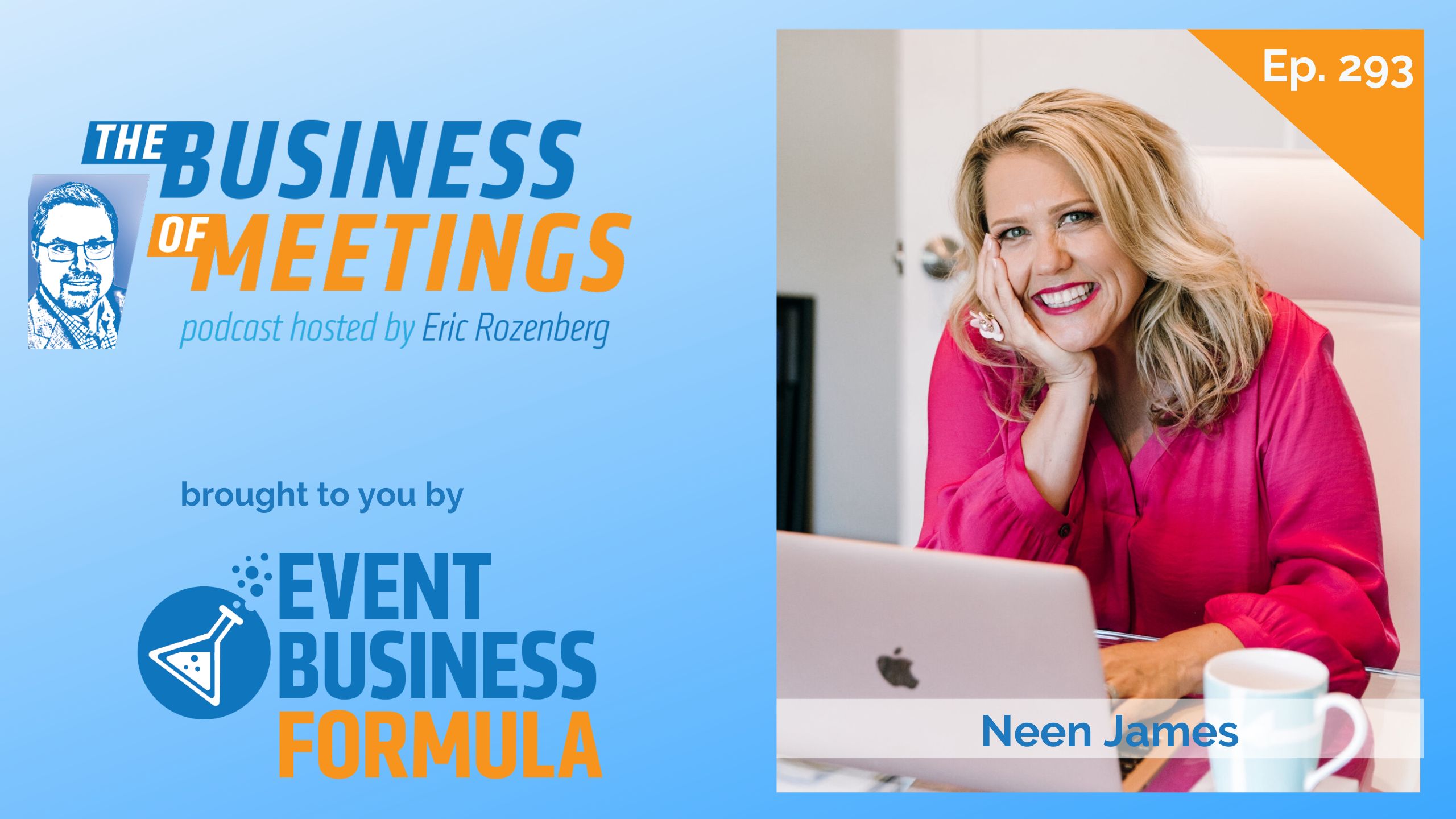
We are thrilled to welcome Neen James, the expert on luxury experiences, back on the show today!
Neen is currently releasing her fourth book, Exceptional Experiences. She is one of the brightest and most data-driven thinkers in the events business, and everything she does and writes about is grounded in research.
She joins us today to share her insights on luxury experiences and discuss Mark Cuban’s thought-provoking notion that AI will encourage people to connect more in-person and enjoy exceptional human experiences more than ever before.
Neen’s Journey
Neen began her career exploring how attention, focus, and productivity impact leadership and influence. Over time, her work expanded to helping leaders design exceptional experiences through intentional thoughtfulness. After years of speaking and consulting around the world, she shifted her focus to understanding what makes interactions unforgettable, drawing inspiration from luxury brands and their mastery of creating value and connection. That research now informs her mission to help organizations and individuals apply those principles to elevate everyday business and leadership.
The Power of Attention in Leadership and Business
Attention is the new currency of leadership. Intentional focus on people, priorities, and productivity drives engagement and results. Leaders who are fully present notice others, allowing them to build stronger connections and evoke more trust and influence.
Why Focus and Clarity Matter
Neen believes that distraction is one of the biggest productivity killers in modern business. She likes to clarify her daily priorities, align her actions with her goals, and remove any unnecessary noise. Her approach to productivity is about doing what matters most rather than doing more. By setting boundaries around attention, professionals can increase both efficiency and fulfillment.
The Role of Connection and Belonging
People crave genuine connection, whether in business meetings or personal interactions. Neen explains that even small gestures of recognition can have a profound emotional impact. When leaders personalize communication and make individuals feel part of something meaningful, it creates loyalty and emotional investment that no financial incentive can replace.
Creativity and Customization in Event Design
Neen has observed a growing shift toward personalization and creativity within the meetings and events industry. Instead of over-catering or offering generic experiences, event planners are focusing on customized, high-quality touches.
Rethinking Corporate Gifting
Neen challenges traditional corporate gifting practices, urging professionals to move away from branded merchandise and instead offer experiences or gifts that truly delight recipients.
Leveraging AI
Neen describes how artificial intelligence can enhance personalization and streamline business operations. She prefers using AI tools like Claude and Fathom to summarize meetings, craft custom proposals, and gather insights about clients before meetings. By combining AI’s analytical capabilities with genuine empathy, professionals can deepen relationships and deliver more meaningful experiences.
Systemized Thoughtfulness
Neen’s concept of systemized thoughtfulness involves using technology to remember and act on the small details that make people feel special. She illustrates how simple, inexpensive gestures can create lifelong loyalty. The key, she says, is using data not to automate relationships, but to enhance human connection.
Integrating AI Into the Guest Experience
Neen encourages organizations to leverage AI for every phase of guest engagement. Beforehand, AI can help personalize outreach; during, it can enhance service customization; afterward, it can collect insights and generate detailed ROI reports. This full-circle approach can help teams to continually refine their experiences while maintaining the warmth of a personal touch.
Embracing Change and Creative Problem Solving
Neen calls for boldness and experimentation in the hospitality and events industries. With rising costs and changing expectations, she urges professionals to collaborate across departments, rethink menus, and adopt sustainable, creative solutions.
Humanity as the Ultimate Luxury
For Neen, luxury is not about price. It’s about care, personalization, and emotional resonance. Whether it’s a handwritten note, a remembered detail, or a perfectly timed mocktail, luxury lives in the moments that make guests feel seen and special. While technology can support this, it should never replace it. The goal, she insists, is to use AI to be more human, not less.
Bio:
Neen James is a leadership strategist, dynamic keynote speaker, and the author of Folding Time, Attention Pays, and the upcoming Exceptional Experiences. With boundless energy, quick wit, and actionable insights, she serves as a confidante to C-suite leaders, helping them elevate experiences and achieve greater focus, communication, and influence.
Recently appointed to the board of the World Luxury Chamber of Commerce, James has been named one of the Top 30 Leadership Speakers by Global Gurus multiple years in a row for her work with some of the world’s most prestigious brands, including Viacom, Comcast, Virtuoso Travel, Four Seasons, and the FBI.
She empowers individuals to prioritize what matters most so they can create exceptional experiences that drive results and foster lasting connections. Originally from Australia, James is now living her best life in Tampa, Florida.
Connect with Eric Rozenberg
On LinkedIn
Listen to The Business of Meetings podcast
Subscribe to The Business of Meetings newsletter
Connect with Neen James
On her website
Listen on: Apple Podcasts · Spotify · YouTube
“You don’t have to have a luxury product to provide a luxury service.”
Neen James
Full transcript of episode 293 of The Business of Meetings podcast, Eric Rozenberg with Neen James. Lightly edited for readability.
Eric Rozenberg: Hello and welcome to the Business of Meetings Podcast. I’m your host, Eric Rozenberg. Over the years, I’ve had the privilege of helping businesses in the meetings and events industry grow and succeed, and I’m excited to share that experience with you. If you feel alone and overwhelmed, and if you’re looking to take your business to the next level, improve your strategy and sales, and connect with like-minded professionals, you are in the right place. I invite you to visit eventbusinessformula.com and join our community of event business owners dedicated to exponential growth. Now let’s dive into today’s episode.
Hello and welcome to new episode of the Business of Meetings Podcast, and today I am delighted to welcome back on the show the expert of luxury experience, an amazing speaker. If you think that I have an accent, wait to hear from her. She probably going to start with “Good day, gorgeous.” And she is one of the most brightest person I know, because everything she’s doing and everything she’s writing about rely on data, and it’s not the feelings or whatever it is. She’s working a lot with research, and she’s now publishing her fourth book, which is called Exceptional Experiences. Ladies and gentlemen, please welcome the one and only Neen James. How are you?
Neen James: Good day, gorgeous. What a treat to be back on the show. An encore performance. I’m so honored.
Eric Rozenberg: That’s wonderful. I really like when all the thing you’re publishing and the experience you have. But we’re going to talk about luxury. We’re going to talk about experiences. We’re going to talk about maybe the tweet of Mark Cuban in June that says that actually with AI, people will come more and more in person and would like to have exceptional experiences. But before we get there, can you please remind us, Neen, what is your journey?
Neen James: My journey? Gosh. I grew up in corporate business in Australia, Eric, so people listening trying to work out the accent, I hail from Sydney, Australia. I worked in retail, banking, telecommunications, and the oil industry. Now, there were not a lot of chicks in oil when I was there, but as a client experience expert, I’m obsessed with this whole idea of how do you truly get people to pay attention? Because Eric, you and I both know that when companies pay attention, they make more money. Our relationships are deeper. We take care of the planet on which we live. I’m so obsessed with this. I’ve literally written books on this very topic. And I’ve been so fortunate to work with some of the best brands in the world, and I work very closely with their CEOs and their teams. But I think a lot of meeting planners call me the Energizer Bunny. And you know that because you and I have worked together and we’ve shared the stage for fabulous clients like Mike Dominguez at ALHI. And I think what’s unique about me, Eric, is absolutely I’m Australian, so I have a global perspective, but I also became an American citizen, and so I have a local perspective as well. I’m the oldest of five. I sound like I’m five. And I really am obsessed with this idea of how do you elevate every experience? How do you create more significant moments that matter? That’s really what drives me.
When I’m working with clients, Eric, I find that maybe they’re not getting the sales results they want, whether it’s attracting new clients, whether it’s retaining the clients that they have, and sometimes people feel like there’s so much to do, but they don’t even know where to focus first. What’s going to have that highest impact? And so, I fix that. That’s some of the things that I do with my consulting when I’m working one-on-one doing executive strategy, whether I’m in a boardroom with leaders or whether I’m in a ballroom with their top performers as a keynote speaker. And here’s the thing, there’s a stealth message in this book, Eric. And I think if you look at my body of work, the through line has always been how do you make people feel seen, heard, and valued? And that’s why I think I’ve been put on this planet, is to help people do that in those little moments, but also in the big ones as well.
Eric Rozenberg: And you do it very well. How did you get to focus on luxury and luxury experiences at large?
Neen James: Let’s go to the body of work. As I mentioned, you said four books. So, when I first started my journey, I was really in my corporate life, for example. I was always known as the girl who could get things done. Now, early in my career, I realized the people who got things done, Eric, got promoted. So, I was like, I’m going to be that chick, right? So, I started to become a little obsessed with productivity. How do you really get people to focus? So my early books, Folding Time, for example, declared to the world you can’t manage time, that’s crazy, but you can manage your attention. And that really started my journey of attention. And then when I wrote Attention Pays, my premise was that it’s your intention that makes attention valuable, right? And so I realized that attention is about connection. I was starting to work with so many luxury brands and leadership and understand what luxury does really well, Eric, and you know this, is personalization and customization. They make every guest or student feel like they’re the most important person. For our DMC, someone’s touring, or for our hoteliers, a guest that comes in. And so, I started to really study these brands and start to work with a lot of their executives. Then what I realized is, oh my gosh, luxury is really about human connection. And in our digital AI world, you and I both know that that human connection is vital. And still to this day, luxury brands still do it the best. And so what I started to do was share all of these lessons I was learning from my luxury leaders. And I got approached about obviously putting a book together based on my research. And as you know, I have the only research study of its kind in the world into luxury as a mindset, because I’ve always believed luxury is a mindset. You don’t have to have a luxury product to provide a luxury service. Think about our AV crews that support us as speakers in the ballroom. They are providing a luxury level of service to us as speakers to ensure that everything goes well, so the meeting planner is happy, so the audience is delighted. So every one of us has this opportunity, Eric, to provide this luxury level of service. But I think luxury as a word is very divisive. I think people don’t always understand what luxury truly means. So a little bit of a mission to really change that narrative.
Eric Rozenberg: Recently I had a conversation at dinner with some other entrepreneurs, and we’re talking about luxury. What is it? We’re talking about happiness. What is it?
Neen James: Mhm.
Eric Rozenberg: And the general consensus around the table was the luxury and the happiness is when you can really manage your time, and in this industry when I start my first business, it’s my brand, it’s my clients, and nobody’s going to do it better, and almost burn out. So what is your experience? What is your advice when it comes, and we’re going to come to your book for sure, but what is your advice when we’re talking about time, being able to manage your time, and its relation to a luxury thing these days, but also impacting happiness?
Neen James: It’s so interesting you say that, Eric, because I was in a little bit of a debate with one of my friends. He’s a philanthropist, and I remember him saying to me, “Neen, luxury is unnecessary.” And I was like, “What? Hold on a second.” And he said, “Yeah, it’s not necessary.” And I was like, “Okay, help me understand that.” And I said, “Don’t you have top tier status on the airlines?” He said, “Yes.” And I said, “And don’t you have top tier status in the hotels?” He said, “Yes.” And then he said, “Yeah. And I pay a premium to,” they use the fast lanes for the traffic where he lives. And I was like, “Huh, so luxury, right?” And we both agreed. And he’s one of the most generous people that I know. But what we realized was his luxury is time. And so just like your entrepreneurs, luxury as time, I think luxury also means for some people ease. And so when we have the ease and the comfort, right, that’s how it also is linked to our happiness. So if we feel like we have, as entrepreneurs, if we have room to breathe in our calendar, right, that feels like a luxury. If we have the opportunity to choose when we’re going to fly, when we’re going to check into the hotel, whatever it is for your travel, that feels like luxury, right? But we will also pay for time. We will pay for a first class seat so that we can be more productive when we’re flying. We’ll pay for a direct flight because it’s much easier for us, so we don’t have to waste time in connections. We’ll pay for the fast lanes like my friend. We’ll pay for membership so we can have time at the Delta Lounge or however you like to fly.
And so what I think is, as entrepreneurs, luxury of time. Yes. Because we also understand that our beautiful brain, our brain is like luxury real estate. Your wife would understand this metaphor. Luxury real estate is what I say about our brain, because we don’t want to decorate it with cheap thoughts. We don’t want unnecessary things to live rent-free in our head. So I always think about, as an entrepreneur, my brain is like this luxury real estate, which means I want to protect it at all costs. I want to protect my inputs, because I’m being paid for my brain, like so many entrepreneurs listening to this. So I think that also contributes to happiness, if you get that understanding that what you think about, your own mindset, people are paying for your creativity, your ideation, your strategies, and you as the entrepreneur, the DMC, the AV, the speaker listening to this, the thought leader, that’s what we need. And so I think they’re very, very linked. And look, I love a nice thread count like the next person. I love a fancy lobby and I love a beautiful bar, a cocktail, sitting at a glass of champagne. I love all that level. Love luxury for sure, but I love the ease.
Eric Rozenberg: That’s wonderful. By the way, you’re talking about my wife. I think I should ask her now to the number of time I’ve mentioned her, like the greatest realtor for Kaler William Luxury in South Florida. And thank you. I’m going to talk to her and then get her sponsor the show.
Neen James: She’d be a great guest on the show, too, because she would have so much insight for us, because she runs such a successful team.
Eric Rozenberg: That’s right. Absolutely. Neen, you decided to write this new book. We’re going to talk about it. We’re going to talk about the four luxury mindset, but take us a little bit through the genesis of “You know what, I’m going to have this new book.” What you’ve learned from the first three, what you decide, what was your process? Because I know there’s a lot of entrepreneurs, there’s a lot of small business owners who always say, “One day I will write a book,” and the one day comes.
Neen James: Oh my gosh, Eric. Well, let me just say this. If you are thinking about it, do it. Here’s my disclaimer. It is not for the faint of heart. So, my very first book was really a combination of all the blogs I’d written over the years. I had a phenomenal editor. It was self-published. It was beautiful. It was really fun to do, and it was easy peasy, right? The second book, Folding Time, was also self-published. Stunning. Really pretty book. People still have it on their nightstand. Tell me how much they read it. It’s ancient. And it was built on a contextual model, because the way I think, and you know this about me, I think in models. I think in systems of elevation. And so if someone starts talking to me, in my brain it’s literally a little crazy. I’m drawing a model in my head to sort it out contextually so I understand it, because I can take very complex ideas and simplify them in a contextual model. So when I wrote Folding Time, it was actually the model that I developed first, and then I wrote the book around the model, and then each chapter unpacks the model. So that’s how Folding Time was produced, and it’s a PDF we can make available to your listeners if you like. I made it a PDF in so everyone can have that for free. Please feel free to share it with the world.
Then Wiley reached out to me and asked me to do a book, and that’s when Attention Pays was born. I will be really careful in what I say here. However, traditional publishing is not for everybody. It was not my favorite thing to do. But here’s what you need to understand with traditional publishing. They pay for everything. You get a lovely big advance sometimes, which is really just funny money, cuz you still got to pay that off. It’s just an advance on sales. And they control everything. The difference with my book is I own it, because I had a different contract. So you can have an IP lawyer help you with that part of the negotiation, because I use my thought leadership in my keynoting and in my coaching. So Attention Pays, and I tried to buy that book back, just between you and I, and they wouldn’t let me. They’re like, “No, no, this is doing great for us.” So sometimes if you publish traditionally, just for people listening, you may be unaware, you can sometimes buy the rights back to your book.
So I do not enjoy writing. That is something everyone should hear. It is not easy for me. There are 1,000 different things I would rather do than write a book. And when I did my research study into luxury as a mindset, I was approached by Page Two, who had been asking me for many years to do a project with them.
Eric Rozenberg: Yes.
Neen James: And I love Page Two. And it is two women who are totally changing the publishing world. And they are what’s called a hybrid publisher, meaning that you fund, it’s a very bespoke experience. You choose like an à la carte menu of what you would like them to do. But they have phenomenal distribution partnership. They have exquisite design. They have the world-class editors. So working with them was so easy. In the development process with my assigned editor, we had 12 and a half thousand words written before I even had to actually sit down and write, because Kendra, my editor, is so good. So the difference of the books has been two self-published, one traditionally published, one hybrid published.
My lessons in all of these things, and by the way, Attention Pays also was based on a contextual model, and Exceptional Experiences was based on the research that I did plus the model that I use for consulting. So however you write a book is totally up to you, but my books are filled with strategies, like practical how-to. So if, for example, people listening loved Will Guidara’s fabulous book, Unreasonable Hospitality, a must-read for anyone in our industry. Will and I were talking about his book recently, and we said his book is like a love letter, like a memoir to the hospitality industry. Mine is the playbook. This is how you make it happen. And that’s really the way that I see the world, too, is it’s great to know all the motivation, inspiration. Yeah, that’s fab. Love that for you. However, I as a business owner want to know how do I apply this, right? And so the book is written in that regard. So it’s based on my research.
So my biggest lessons in all of this: if you’re listening to this and you want to write a book, do it. You’ll be so glad you did. And a book will break your heart. It will break your heart because you will start excited and strong, and there will be times you’re slugging it out, and there’ll be times where people will surprise you. Some people will buy so many copies and give it out to others, and people you thought would support you will not. It’s the weirdest thing in the world. I always say, Eric, publishing a book is like standing on a stage naked and then turning around really slowly, really, like every flaw, every vulnerability, and every insecurity. So, if people tell you it’s really easy to write a book, bless them. That’s amazing for them. Please know that is not my experience, and it is not something that I am naturally gifted at. It’s really hard work for me, and I may have one of the last books ever written without AI assistant. So, who knows what the next publishing kind of level is going to be, but I genuinely sat and literally wrote my book based on all of the work I work with, the consulting, and all of the interviews I did with luxury leaders around the globe. And so, I chose the best of the best to feature in my book. I think the thing that’s hardest about a book is what do you leave out? I had hundreds of stories and examples and case studies I would have loved to have included, but I also needed to make the book very easy to read on a plane, between LA and New York or something like that. So, it’s an easy but fun read, and I want it to be practical. So, for me, the hardest thing, Eric, was who do you leave out?
Eric Rozenberg: That’s awesome. And you were talking about Page Two.
Neen James: I love them. Oh my, could not speak high enough.
Eric Rozenberg: The two ladies, what their name again?
Neen James: Jesse and Trena. So, Jesse Finkelstein and Trena White. Yeah. Two of the best in the business. You ever mention their name in a circle, watch people’s faces light up. They’re so revered, and they are exceptional at what they do. As an author working with them, my gosh, they’ve blown my mind on every opportunity. So, that level of detail, personalization, customization, the handwritten notes, the encouragement, the creativity has been phenomenal. And the book is beautiful. I’m obviously biased, but it is beautiful. So, she’s really pretty. And we did things they hadn’t done before, which is super fun as well.
Eric Rozenberg: That’s awesome. Jesse, I had the pleasure of meeting her briefly in a mastermind MMT, and it was very impressive what she was saying, and I’ve been following what she’s doing. Now, you’re talking about model and models.
Neen James: Yeah.
Eric Rozenberg: MMT Australia. It must be an Australian thing. Are you familiar with Simon Bowen?
Neen James: Yes, of course.
Eric Rozenberg: Yeah. He’s a model guy. That’s his business. And gosh, every time I’m listening to him, just like you, when I’m listening to you as well, I’m learning something. The model thing is really the method that he’s developing.
Neen James: Yeah. And what’s interesting is we all grew up under Matt Church. Matt Church is really the one who helped make that a big thing over 30, I don’t even know, maybe 35 years ago in Australia. And so he was the founder of Thought Leaders Global, is what it’s called now. I was one of the original business partners in that business. I was really his protégé, I think, as we were building all these contextual models together. And so, anyone that is coming out of Australia that is using all of this incredible intellectual property, we all attribute it back to Matt Church, who I think is truly one of the best thought leaders in this space. But I grew up under his leadership and then eventually became business partners with him. So, he was the one who taught me to really refine the way I think in models.
And it’s something I do with my clients all the time. I literally have clients, CEOs, who’ll say, “I’m going to pay you to sit in this room, and then at the end I just want to know what you think.” And I’ll draw a model while I’m listening. I was like, “Is this it?” And then everyone’s like, “Yes.” And then that’s what they use on their website, in their collaterals, in their board packets, in their training, and it has this trickle-down effect, because if you can help your clients look like a hero by simplifying the complexity of what they’re trying to do, and they can draw it on a napkin and someone else can go and talk about it, right, you are helping streamline more productive communications. So as a value add, as a thought leader, for those of you who are listening who are consultants or speakers or authors, if you can give people a visual model, a contextual model, it’s going to light up the left hemisphere of someone’s brain who thinks like that if they’re very strategic. And so if you have audience members, for example, who you’re speaking and you can flash the model up, if they’re big picture, very strategic global thinkers, they’ll get it in a heartbeat. They won’t listen to all your detail, cuz they don’t need it, cuz they’ve already got it. So if you can show people that visual, I’m a massive fan of contextual models. We call it idea shaping in our business. And so I literally do it for thought leaders as well. I’ll say to them, “Tell me all about what you have.” I’ll draw a model and go, “Is it this?” And they’re like, “Yep.” And then on they go. So many of our speaker friends that you see with great contextual models, I’ve been so privileged to work with many of them.
Eric Rozenberg: It’s amazing. It’s the best tool for me, not only to show, but explain and get people understanding.
Neen James: That’s phenomenal.
Eric Rozenberg: Now, you have a lot of new material in your book. Let’s talk, if you don’t mind, now about the four luxury mindset.
Neen James: For sure.
Eric Rozenberg: What are they, and how can small business owners in our industry use them?
Neen James: When I went to the research firm, well, here’s where it started, Eric, is because I’ve always assumed luxury is a mindset. I assumed there’d be studies on the same thing, right? By the way, I’m not a researcher. I have a girl crush on people like Brené Brown. I have a big crush on Adam Grant’s brain. But the reality is, to me, I know research is vital, but I just assumed there’d be a study out there. So I Googled “luxury as a mindset.” Not a one. There are plenty of studies on how luxury makes you feel, and that’s lovely, but my executives are driving revenue, and I’ve got to be able to talk to them about how do we really capture mind share, right? How do you capture their attention, and how do you drive market share, right? So those two things, there was no studies to support that. So I commissioned a research study of my own, as I said, the only of its kind, and I went to Audience Audit. Susan Baier is the founder there. And I said, “So luxury is a mindset. Just make sure I’m right.” And she laughed at me and said, “That is not how research works.” Anyone listening to this understands that as well. She came back and she said, “Neen, there’s not one luxury mindset, there’s four.”
What we realized was people look at luxury very differently. So for example, let’s talk about the first one. It’s called the Reluctant and Removed. Eric, to this luxury mindset, the Reluctant and Removed says luxury is hard. They think brands don’t understand them. They’re busy and they’re overwhelmed. So if you want to speak the luxury language of clients who are Reluctant and Removed, you want to share how your product or service is going to save them time. It’s going to be easy to do business with you. So that means in your collaterals, in your sales calls, make it really easy for people to do business with you, because that’s something that’s very important, and they do value time. You mentioned luxury as time.
The second of the luxury mindsets is called the Pro Prioritizer. We call them Pro because they’re very professionally oriented. They think luxury is power, but what they mean by that is they use it to advance their career and their reputation. Now, what they’re looking for is they want to do business with brands who have longevity, who are authentic. They want to understand the societal, environmental impacts that you’re making with your business. So the way to speak the luxury language of the Pro Prioritizer is always make sure that you’re sharing about the sustainability initiatives, how long your business has been around, maybe even your origin story. You want to share with them what the impact is of the work that you do, because that is what they want to align themselves with, because they’re going to align their personal reputation and career to brands that they are confident to promote to others.
Eric Rozenberg: You have to go to those people with a sweater from Patagonia or something like that.
Neen James: Yeah. Because they’ll value what they all stand for. They’ll value their social media and the way that they’re showing up in the world, and the quality of their products, the longevity of their products, and the environmental impact. They check all the boxes as a brand. Great example.
The third of the luxury mindsets is who we call the Confident and Content. This is the person who says, “Luxury? I’m good. I don’t need luxury.” But you know how they use it? How they use luxury is to create memories with people that they care about. So, if you want to speak the luxury language of this particular mindset, say you’re a DMC, you say, “Imagine taking a photo of your family here in front of this beautiful building. Oh, by the way, that could even be your holiday card that you send.” So, what you want to do is talk about how your product or service is going to enrich the lives of people that they care about. That’s what the Confident and Content cares about.
Then we have the fourth of the luxury mindsets, and this is called the Luxury Lover. The Luxury Lover, Eric, says, “Luxury for everybody, every day, cuz I am worth it.” This is the person who you can tell loves luxury. They talk about luxury. They wear luxury, not because they’re showing off, but because they believe in craftsmanship. They believe in working with brands. And what they love about them is they also love an origin story, for sure. But here’s how you speak their luxury language. They want behind-the-scenes exclusive access. So if you, for example, are a meetings and events organizer, for the Luxury Lover, you might give them a private site. You might give them a tour behind the scenes. You might introduce them to the chef at the restaurant or the head of the catering department. What they want is they want behind-the-scenes exclusive access, and that’s how you speak their luxury language.
Now, here’s what you need to know about all four mindsets. The Luxury Lover has a really big mouth. They will scream about your brand on social media in the most positive way. They will recommend people to you. They will write testimonials for you. If you’re looking to build advocates for your business, target the Luxury Lover. What’s also interesting about the Luxury Lover is they’re more influential across all four mindsets. They can convince a Reluctant and Removed or a Confident and Content. It’s a really good investment of time, attention, or money. And the Pro Prioritizer, also a good advocate, providing you check all the boxes for them that are important.
So the thing that’s also really interesting about the research study, Eric, is that regardless of what mindset people had, they all agreed on two things. The first: luxury is a reward for hard work, however you define luxury. And the second, my favorite finding of the entire study, and something I’ve believed my entire life, which was role modeled to me by my mom, is luxury is about experiences, not things. See, I think luxury is not about money. It’s about moment. And this is something that many of my clients, as I said, it doesn’t have to be a luxury product to provide those moments that matter for people. And that’s how I would love us to redefine luxury, is truly the experiences that you give. As a speaker, what experience does your audience have of you? Does the meeting planner have of you? Does the Uber driver have of you? Always thinking about how can we be a luxury leader as a small business, meaning what’s the experience we’re giving others, and is it an exceptional experience?
Eric Rozenberg: I love everything you just said. It made me think of one specific. For 20 years I organized incentive trips all over the world, and I always define… But people will say, “Oh, I’ve been on an incentive trip.” “What did you do?” “Oh, I went to this five-star hotel in an island.” And then nothing. That is not a unique experience. But there were three elements to define a real incentive trip, and I’m getting back to what you just said. The first one is participants should not be able to put a price on what they are experiencing. Second, they need to live contrast. And third, and most important, they need to live moments that they cannot duplicate. They’re going back with their families and their friends. And I think that today more than ever, people are looking for experiences. People are looking for moments that they can share with the people that they like, whether it’s their friends, their family, and they’re ready to pay a premium on that just to live those experiences.
And I want to get your opinion on, obviously you cannot now write an article or speak without pronouncing the two letters AI, which is wonderful. And I’m convinced that because of AI and because of tech, people will want more and more to come in person and will want more and more to have unique experiences. Is this something that shows as well in your research or in your…
Neen James: Yes, thousand percent. And it doesn’t matter whether I’m speaking to luxury travel advisors who are really designing itineraries and they’re giving their clientele these exclusive behind-the-scenes access experiences. But what people are craving now is they want to be the person who goes to the village and works with the locals. They want to be able to experience and immerse themselves. And it’s not that they don’t love the beautiful five-star everything, of course. But what we’re noticing in the luxury world is very much a trend towards more of the experiential, more of that community sustainability. That travel is really, really important to people. They want to be first. They want to be pioneers. They want to be able to explore things that haven’t been done before. When I also think about younger travelers, let’s stay on the luxury travel initiative, those younger travelers, they are thinking they don’t need the assets anymore. They don’t need the physical things. They want the memory collection. That’s really important to them.
When we think about that as meetings and events in our space, for example, what people want is, if you’re going to have a snack break, they want to meet the producer of the honey, and they want to meet the beekeeper, and they want to know this honey has come from that beekeeper, which you’ve sourced from a local farm. And so what we want is we want to have those experiences that are connected to a human. We want to be able to support things at a bigger scale, on a global perspective, but we want to do it with a local focus. And so what we want to think about, whether it’s an incentive trip that you’re organizing, where you can organize to partner with a local charity. Now we know how important that is. It’s not just checking a box as an events professional to have a charity associated with your event. It’s vital to the Pro Prioritizer, who sees that as one of the decision-making factors in whether they’re going to attend your conference.
So what we need to be able to do, Eric, though, is, what I think needs to happen now is the format of events needs to change. Someone who does this really well is our friend Mike Dominguez from ALHI. And they build in an enormous amount of white space, what they call in their events. Now, what’s also interesting about Mike is Mike doesn’t use events as an attraction strategy for new business. He uses it as a retention strategy for the clients he values and the team. So when we think about when we’re doing events, we want to think about building in more white space so people have the experience of the community in which they’re in, the hotel or the property or the city. We want to see more of that. We don’t want to just fly to some beautiful place and sit in a ballroom and just be talked at. Nobody wants that anymore. It’s important to have education, but perhaps it could be done more creatively. So building in more time for people to connect, because they are giving up time with their family and people that they love, and you’re taking them out of their environment. So we have to make it more rewarding.
And so I think the design of events is changing dramatically. Don’t give people anything they could Google themselves, because what I think we need to do is we need to look for those connection opportunities. We need to look for opportunities where they’re tasting, engaging all the five senses. And as a designer of an itinerary for travel or an event or an incentive trip, or whether you are in charge of the AV, what’s the experience? How are you engaging the five senses so everyone has such a different experience? Now more than ever before, we need the human touch, which means we want to use people’s names when we see them. We want to think about building in customization at every aspect of our speech, of our event, of our tour, so that people feel seen, heard, and valued.
Eric Rozenberg: Absolutely. And you’re talking about Mike Dominguez. That’s another person I love, the brain.
Neen James: Yeah.
Eric Rozenberg: Always looking at trends and disruption and always giving data, evidence.
Neen James: Yeah, that’s what I love.
Eric Rozenberg: Now, one of the point that he mentioned in the last, I would say, two years to three years is that the cost of everything has been going up. The cost of, obviously, the salaries went up 25% after the pandemic, and it’s not going down, probably rightly so, for a lot of people that are working hard. Then you have the cost of the food and all the elements. When we’re talking about luxury experiences, there’s obviously a budget that need to be allocated to that. Do you see any trends there where corporation, organization are maybe doing a little less, reduce the number of program, but invest more in specific program?
Neen James: Yes. And I have the privilege of facilitating the peer-to-peer review sessions where ALHI, Associated Luxury Hotels International, gets their top clients together, and we all talk about some of the challenges in the industry, and I get to facilitate those great opportunities, and we chat about these challenges. And what I think meetings and events professionals are getting more creative with their budgets is they’re also partnering more with the DMC. They’re partnering more with the hotel, the F&B manager, to say, “Okay, how many events do you have on property? Could we leverage the same menu so that you’re buying and we get the advantage of the way that we’re buying?” We’re also changing the way that we think about waste. So, we have these overcatered… not everybody wants a cookie, not everyone wants a morning bagel. So, we’re thinking about more the customization and learning more about our guests to have more high-quality items rather than mass.
And so I think not only are they looking at the volume of the events that they’re running, they’re looking at the quality of the food and the experience at the event. We don’t need to have so many choices. We just don’t. But we do need to have more customized choices. We are also needing more healthy choices. We’re finding one of the trends is also making sure you have real non-alcoholic options as people who are and but even think about mocktails, or whatever, NA as a shortcut, non-alcoholic. Think about now so many people are choosing the healthier alternative. So when you are designing experiences, you can’t just say, “Oh, it’s just wine and beer at the cocktail hour.” You need to have these customized options for people who are choosing that alternative. And not because they’re trying to lose weight, but because people generally are looking to have these longer lives, these more energetic lives. Believe me, I’m a champagne girl. Nothing against champagne, but I love a mocktail, and I want to have it in a fabulous glass, and I want it to be an experience, so when I’m walking with people, it looks the same. These tiny little details, things that you can actually work really closely with your director of catering and just say, “Hey, this is kind of what we’re doing. We want this experience.”
So, think about getting creative, but also really understanding the people that are coming. To your point, if you’re doing an incentive trip, these top producers, sometimes they’ve been there and they’ve done that, and so it’s harder to impress them, especially the ones that are getting year on year these incentive opportunities, right? So, you got to get even more creative. And what I think we need to get better at is really asking our guests in advance what things really light them up, what’s exciting for them, what experiences do they want to have, and giving options. It’s like when people change the gifting stations, instead of everyone getting the swag bag that gets left in the hotel, because nobody wants your branded merchandise. No disrespect to people who do that, but that’s marketing. That’s not a gift. A true gifting station is where people have options to choose what they would like to choose, right? Even gifting snack stations. Smart Meetings does this. When you go to register for one of their events, there’s a snack station. So, you get to choose what you want, as opposed to them deciding what you want. These, then, with hotels, you can then just be paying for what you use. So, there’s ways to stay within your budget. We just need to be more creative now. The old ways of doing things… It’s time for you to get fresh new ideas and input. And that’s where AI can be your friend. Ask AI, “I have this budget. I want these creative solutions,” and see what it comes up for you.
Eric Rozenberg: Absolutely. Talking about we don’t care about seeing your brand on stuff, the late John Ruhlin, who wrote Giftology.
Neen James: I mentioned him in my book as a tribute to him. He had passed at the time of my writing, but I still wanted to make sure he was included. He has changed the way the world looks at gifting, and he was such an amazing person about family and faith and the business, and I just loved him.
Eric Rozenberg: Now I just want to finish the conversation today talking about how you’re using AI and technology to give experience, and want to share with you, and listening to you, I remember one of what I call luxury experience. I was still living in Belgium. I was attending a meeting of MPI at the Peninsula in Chicago.
Neen James: Lovely.
Eric Rozenberg: So I’m landing there, and I used to love the plane between Brussels and Chicago, a direct flight with American Airlines, AA89, because they were playing something called Everybody Loves Raymond, which is a ridiculous series which I love.
Neen James: Funny show. I love it. Absolutely loved it.
Eric Rozenberg: And I discovered that, I was in the plane and suddenly I see everybody’s laughing. What is it that they’re watching? So that’s how I was watching that every flight, and there were a lot of flights between Belgium and the US. Arriving at the hotel, and the lady at the check-in, “How was your flight?” I said, “Oh, it was great, thank you, but I’m sad because now they don’t play Everybody Loves Raymond anymore in the plane.” And why should she care? I mean, come on. And so, “Oh, I’m sorry, sir.” Blah, blah, blah. Next morning, I’m having breakfast. I’m signing the check. And they bring me the check with a little word: “Dear Mr. Rozenberg, Everybody Loves Raymond is playing on channel whatever, five, every day at 4 p.m.” And that to me was a perfect example of using technology and also having a mindset of helping people and giving luxury experience. Now, today, with this fabulous change in our society, with all the tools available, what is your advice, or what have you seen from integration of AI and technology with luxury experiences and exceptional experiences?
Neen James: I think one of the things that I’m noticing is there’s several ways. As a small business owner, you have no excuse anymore not to have very heavily personalized proposals. So if you are submitting for business, you have Fathom as a plugin to Zoom, who’s going to transcribe everything. You plug it into your favorite AI tool. Claude is my boyfriend. I talk to him all day. That’s the one I love to use, and he knows me really well now. And so I’ll say, “Summarizing all these things, can you put together this proposal? It should be very, very customized, being all these things.” So I think we can use it to streamline even our business development activity. But you never should ever get on a call without having cyberstalked whoever you’re talking with, because they can tell you all of the things that are important to that person by having a look at their profiles across medias. It saves you an enormous amount of time in that level of guard.
So we have this process in the book called BDA: before, during, and after your time with someone. That’s where AI can be beneficial, is all the before, the research, the development, all of those things. But during your time, what you can also do is ensure that you have a system that captures. So systemized thoughtfulness captures things. Let me give you an example. I love Alexandria. It’s one of my favorite places in the world. I will easily live in one of their brownstones. The first time I ever stayed at the AKA Alexandria, Chris was the GM, and they have a hotel dog. His name is Senna, and he’s this massive big dog. So he was there the first time I checked in. I was on my knees playing with him. Someone captured a photo. I love animals, especially when I’m on the road and I miss my own. So they took a photo of that. So, great stay. Loved it. Luxury hotel. Beautiful. Chris was the GM there. Second time I stayed at the AKA Alexandria, lo and behold, Senna is there, and I was like, “Oh my gosh, what a lovely coincidence.” They’re like, “No, no, we made sure Senna was here to greet you when you came in.” I was blown away by that level of customization, and they were all smirking. And then I went to check into my room. Well, wouldn’t you know, in my room there was a framed photo of Senna and I from my last visit. And there was a love note from Senna with his paw print on it saying, “I’m so glad you’re back.” And then obviously a love note from the GM, Chris. He has since moved to Hollywood Sunrose. But I’ve kept up to date with Senna, this puppy.
Here’s what’s interesting. Cost him less than $5 to do that. I bet not even $5. It took time. They captured it in the system. They made it a moment for me. I’ve told that story on stage several times. And I felt so connected to that property that anytime in that area, that’s exactly where I’m going to be. And for my very first book event, book launch, before it even goes into the world, they’re hosting my very first book launch. It’s very cool.
So, here’s what’s interesting about that, is that these systems, systemized thoughtfulness, you can use AI to do the things before someone even comes to tour your property or come to your hotel or come to your event. You can use it for your guests. You can use it during the time together as well to customize it. But you can use it afterwards to condense all the research, the surveys, all the information you gather, so you can then create these amazing return on investment reports for your executives to help you for the planning for the next event. You can also use it to go back to those same guests and say, “Senna says, ‘Hi, Neen.’ He wants to know how you’re doing now.” And think about it. We have the tools now, but what we have to do is we still have to think about the human connection. How do you use AI to be more human, to know the things that are important to them, and then to be able to use that information? I use it every day, and sometimes it’s an ideation partner for me, where I’ll be like, “I think this. Find me something on that. Give me the research on this,” because I also believe we have to be able to have evidence and data to support the things that we want to share in the world.
Eric Rozenberg: Absolutely. Absolutely. Neen, before we go, I have two last questions. The first one, I’m very curious. In your resume, you give some names of very large organization that you’ve been working with, as you speaking about luxury and things like, and then you have the FBI. What did you do with the FBI when it comes to luxury experiences?
Neen James: Fortunately, with that I can’t talk about it, which is so crazy, but I can tell you what was so weird about working with the FBI. It was literally someone followed me to the bathroom and had to stand outside the bathroom with me. So the level of security, fascinating. So that’s all I can say about that.
Eric Rozenberg: Okay. Then you can tell me, then you have to kill me. So don’t do that. And before I ask my last question, so your book, Neen James, is Exceptional Experiences: Five Luxury Levers to Elevate Every Aspect of Your Business. If someone want to work with you, if someone want to have you as a keynote speaker, how can they get in touch with you?
Neen James: The best thing is just to come to my website, neenjames.com, and you can follow my adventures every day on Instagram, or reach out to me directly on LinkedIn. But when you do reach out on LinkedIn, make sure you mention Eric is the reason that we know each other.
Eric Rozenberg: Wonderful. My last question, Neen, and thank you again for the time today. When we meet again in one year with a bottle of champagne, a bottle of Dom Pérignon, not any champagne, what are we going to celebrate?
Neen James: That Exceptional Experiences has been translated to at least five languages.
Eric Rozenberg: Wonderful. That’s my wish for you. I look forward seeing you in person. Thank you for sharing your experience, your research, your life with us today, and all the best with the new book.
Neen James: Absolute privilege. Thank you, Eric, for everything you do in the world.
Eric Rozenberg: Thank you for tuning in to the Business of Meetings Podcast. I hope you found today’s episode valuable. If you enjoyed the show, the most important thing you can do is leave a review and share it with your colleagues. It really helps spread the word. I truly appreciate your support. And if you’re ready to take your business to the next level, don’t forget to visit eventbusinessformula.com to learn more about how we are helping event business owners like you. Thanks again for listening, and I’ll see you next time.