
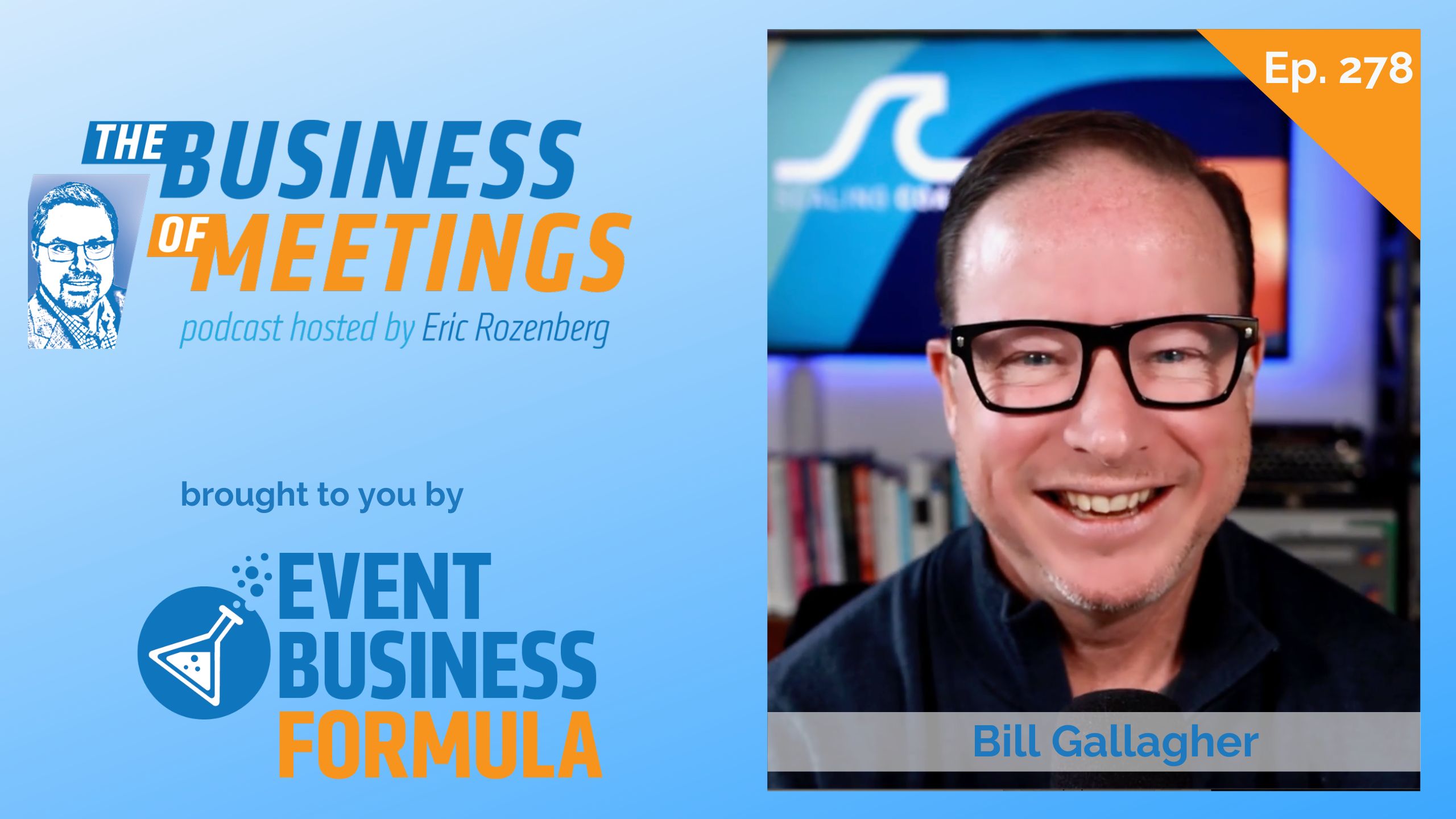
We are thrilled to welcome rockstar business coach Bill Gallagher, the founder of Scaling Coach, as our guest.
Bill has dedicated his career to helping entrepreneurs organize their lives, refine their leadership skills, and elevate their performance. He joins us today to share his journey, insights, and the story behind his impressive startup success.
Tune in to learn the strategies that have helped countless leaders scale with confidence, clarity, and purpose!
A Coach and Leader
Bill has spent over 13 years coaching companies globally, often through EO and EO Accelerator programs. He excels at planning, delivering value to clients, and creating content, but is not strong in sales or lead generation, so he has always relied on referrals and relationships. His deep involvement in AI keeps him current and curious. Despite not being in the ultra-wealthy crowd, Bill measures his success by the lives he has touched, the quality of his work, and the legacy he builds daily.
Using AI as a Daily Business Tool
Bill uses AI to enhance his efficiency and creativity, but not to replace human interaction or strategic judgment. He finds it most effective as a thinking partner, to support his ideation, drafting, and refinement, rather than something to hand over the reins to. He explains that AI can help build a first draft of an event plan or workshop structure, but a real coach or planner still needs to bring the nuance, customization, and connection.
Designing Events Around Outcomes
Events are not just about logistics, but about strategy. Event planners need to understand why the event is happening, what the client wants the attendees to experience, and how their success will be measured, as that informs every choice. For Bill, events are all about building memorable, emotionally resonant experiences that connect to the bigger picture and feel locally relevant and human. From the initial walkthrough to the final takeaway, every element should serve the outcome.
Types of Engagements
Business growth events fall into three categories: one-off workshops, multi-session programs like accelerators or university partnerships, and ongoing quarterly strategy meetings with clients. Each requires different prep and different energy. One-offs aim to create momentum or a spark that leads to change. Series-based programs get built over time. Recurring client sessions require both routine (quarterly review and planning) and creativity (changing formats to stay relevant and engaging).
Team and Time Management
Bill runs his business with a lean team of six- two employees and four consistent contractors. Most of his clients come through referrals, which makes relationships essential. He discovered that cold outreach to CEOs rarely works, so he focuses on deepening value for current clients and relying on word of mouth. Even though his work spans the globe and has been well-established, his goal has never been to amass outrageous wealth but to build a sustainable career with meaningful impact.
Defining Enough
Bill believes that financial success is relative. It is easy to get caught in comparison, especially when surrounded by people chasing billions. But having a great career, a decent income, and a life filled with impact can be more than enough. A message from a former client expressing gratitude years later served as a reminder that influence often happens quietly, and we usually have more impact than we realize.
Rethinking Growth
Not every company has to scale. Many business owners hit their ideal income range and stay there. Even though that is valid, Bill urges business owners not to believe that avoiding growth will spare them from stress. He explains that whether your business is small or huge, you will still wake up in the middle of the night thinking about it. Growth does not always mean going public or raising funds. It may mean improving systems, empowering people, or building something more resilient and enjoyable.
Stress Is Part of the Journey
Stress does not scale down with the size of your business. So, whether you are responsible for $1 million or $500 million, the emotional weight is real. What truly matters is delegating, empowering your team, and not trying to carry it all alone. Bill emphasizes that the CEO of a billion-dollar company has the same amount of time as you, but they have learned to delegate effectively. To scale successfully, you must stop micromanaging, avoid constant firefighting, and begin empowering the team you hired to drive growth.
Impact and Legacy
The legacy of your work lies not just in what you build, but in how you lead, who you influence, and what people remember. Just as personal mentors leave behind values, humor, or a sense of adventure, your leadership will leave a lasting imprint. So, even if your business does not sell for millions, it gives you a life and something to leave behind. That is what truly matters.
Nothing Lasts Forever
Every business has a life cycle. Even giants like Yahoo, AOL, and GE were once dominant before they faded. That is truly a failure, however. It is reality. So, build something as big as it can be, for as long as it can be. But do not cling to the idea that it has to be permanent. Remember, the measure of success is not how long something lasts but what it does while it is here.
Bio: Bill Gallagher
Bill Gallagher is a highly rated business coach whose passion is helping CEOs and entrepreneurs manage growth more effectively, restore order and sanity to their lives, and achieve greater growth or faster growth. With over 40 years of entrepreneurial and executive experience and 20 years of coaching and training leaders seeking to enhance their leadership and performance, he now works with leaders and teams in more than 31 cities across 15 countries. He has led four companies as CEO/owner and was a partner/executive in two others as they grew from startup to more than $550 million in annual revenue.
A former DJ and radio executive, Bill hosts the Scaling Up Podcast. In his free time, he is an avid surfer, sailor, skateboarder, pilot, scuba enthusiast, and recovering triathlete. Happily married for 30 years, he and his wife, Lori, live in the Oakland Hills and are parents to two very successful young adult entrepreneurs.
Connect with Eric Rozenberg
On LinkedIn
Listen to The Business of Meetings podcast
Subscribe to The Business of Meetings newsletter
Connect with Bill Gallagher
On his website
Scaling Up Business (Podcast)
Email: Bill@scalingcoach.com
Listen on: Apple Podcasts · Spotify · YouTube
“So hard work isn’t what helps. It’s learning to empower and work through others.”
Bill Gallagher
Full transcript of episode 278 of The Business of Meetings podcast, Eric Rozenberg with Tom O’Malley. Lightly edited for readability.
Eric Rozenberg: Hello and welcome to the Business of Meetings podcast. I’m your host, Eric Rozenberg. Over the years, I’ve had the privilege of helping businesses in the meetings and event industry grow and succeed. And I’m excited to share that experience with you. If you feel alone and overwhelmed, and if you’re looking to take your business to the next level, improve your strategy and sales, and connect with like-minded professionals, you are in the right place. I invite you to visit eventbusinessformula.com and join our community of event business owners dedicated to exponential growth.
Now let’s dive into today’s episode.
Hello and welcome to a new episode of the Business of Meetings podcast. Today I have the great pleasure of speaking with a rock star, somebody who works in many, many years in coaching, in scaling business, and who actually contribute to some of the program that I’m participating in. So it’s kind of when you meet your idol, and it is none others than the founder of Scaling Coach, the one and only Bill Gallagher. Bill, thank you so much for taking the time today. You have all the music and we’re going to talk about that and why you have so many sound. I just saw your setting before we start recording this and it’s just phenomenal. But let’s start with what is your journey and why do you have so many opportunities to put some sound in the Zoom right now?
Bill Gallagher: Yeah, I think my journey is accidental, a series of lucky or unfortunate events, right? Like one after another, something connects to something else and I have said yes, right? So, but I think that’s true of a lot of us. Sometimes it seems more traditional, a series of events that we said yes to that follows a more predictable path, and some like mine are maybe a little bit more unusual, thanks to my parents, thanks to my life, things like that. So, but just to give a picture, right? So, I know I look like a middle manager from a mainstream American company. I’m a very, like, normal-looking average white guy, right? But I grew up speaking four languages. I was born in LA, but I also lived in Switzerland and spoke Swiss German as a kid.
Eric Rozenberg: I can’t understand. That’s very…
Bill Gallagher: Yeah. I learned to speak Hebrew. I spoke Spanish, lived in Barcelona, right? I got beaten up for being white on the North Shore of Oahu, right where I surfed most of those big breaks. One of them I paddled out to and went back and forth, terrified the whole time, at about the age of 11, a place called Waimea Bay. On a smaller day at Waimea. Terrified me, but created a memorable lifelong experience, right?
So think about your experience, right? The journey that brought you there. We all have rich things, and some more unusual than others, some more typical. But I think if you look hard, there’s a lot of really surprising, powerful experiences, moments of triumph, moments of great setback, like all kinds of things, right? Moments of fear and despair when a bank or an economic situation threatens your business, family tragedies when you lose somebody that’s very close to you, personal crises, right? So, we all have a range of those things. Mine don’t quite fit the appearance I think that I have when I tell you that I got off a bus once coming back from school and then a terrorist bomb blew it all up. Really happened to me, in Jerusalem. Some more dramatic than others, but those are the kinds of things that made me who I am and got me to this place.
And so today, after running and growing a number of different companies and different industries, that kind of thing, as I approach the age of 50, I’m like, I think for the next chapter of my life, I want to be a coach full-time. So, I started the Scaling Coach business. I started coaching. I used the Scaling Up framework that I knew and had applied to my companies and I started in doing that, and then I’ve added to that clients all over the world, cuz I grew up all over the world. Why do I have clients there? When somebody said, “Would you go to this country?” I’m like, “Sure.” And other people are like, “Oh my God, you went there?” Yeah. I’m like, “Sure, I went there. I’m happy to go there. I’m fascinated, curious to go there.” So I said yes to things and that defined and created the journey. So today I coach companies really from the Middle East to Europe to Asia Pacific, across the US and Canada. I work on the EO Accelerator program. We have 2,000 companies in that program today, and I specifically train a few of the cities and I lead the train the trainer sessions and develop the curriculum on behalf of Verne for the program that’s based on the world of Scaling Up.
Eric Rozenberg: For those who would not know, you say Verne, it’s Verne Harnish.
Bill Gallagher: Verne Harnish, the founder of EO and the book Scaling Up.
Eric Rozenberg: Were your parents entrepreneurs?
Bill Gallagher: My dad definitely was. My mom definitely was not. My dad was a mixture of entrepreneur and college professor. So, he would sort of go back and forth between teaching. He was a linguistics professor and a hyperpolyglot. Like, he was somewhat conversational in about 17 languages.
Eric Rozenberg: So yeah, 17?
Bill Gallagher: About 17.
Eric Rozenberg: Wow.
Bill Gallagher: Could land somewhere and my dad would start speaking, right? Not that well. Some languages he was phenomenal in, like Portuguese and Spanish. Italian he was really great in. Others less so. But German he was fine in. French he could do a lot. On and on. So…
Eric Rozenberg: Wow, that’s very impressive. 17 I’ve never heard, actually.
Bill Gallagher: Yeah.
Eric Rozenberg: You’re talking about the serendipity of life, but also taking the opportunities that comes. And when people ask me, so how did you start in your first job? I said, I didn’t want to work in a large firm. I met a guy at the barbecue, and my second venture was people that I met on holidays. So, absolutely not classic, for sure. But one thing that I saw on your resume… I wanted to be a DJ and be on radio. I have a talk show and I was playing video games all the time, probably 30 years too early. But you work as a DJ. Was it during the studies or was it like professional, like the David, those people?
Bill Gallagher: Yeah, I had a couple jobs in radio. So the first one, beginning, was entirely an accident, and maybe everything is an accident in life, but I was at a radio station late one night. So I was working on creating events and starting a small newspaper, and I was closely collaborating with, aligned with this radio station and making friends there, and trying to ride in their wake, trying to get some of their momentum in starting this business. And I was there late when one of the DJs didn’t show up, and station manager, program director, whatever his role was at the time, got on the phone, as the other guy’s like, “I got to go,” and he’s like, “Bill, you know the thing. Like, you know the music. Like, Stan will show you what to do, and why don’t you just run this thing?” Like, so 2 a.m.
So I show up there at midnight and whatever the guy does. I’m hanging out. I’m young at the time. And so the guy doesn’t show up and Ken asked me to go on. Ken Jordan, who went on to be the co-founder, ran a group called The Crystal Method for years, of dance music. Pretty well known. Anyway, so Ken’s the guy. He asked me to go on, and so 2 to 6. And then at about 6:00 in the morning, Ken called me after I’ve been on for 4 hours playing music and talking, and he’s like, “Bill, it’s pretty good. Like, that other guy, he’s out of here. So, do you want that show?”
So, I was like, I filled in, auditioned, and got the gig like that. And so then I started running this show. It was like twice a week from 2 to 6:00 a.m. And then it got to be more days, then some better times and things like that. So, I did it for not that long, like a year or something. Then I also started to do some parties and nightclubs and that kind of thing with Ken and the other guys and from the station. We were a popular station at the time, and that was it. I did some events and things like that, and that produced a little bit more money, and never went fully formally into ad sales, and we were technically a nonprofit, but we sold sponsorships. And then I didn’t do much with it for many years, and I sort of drifted away from it. Thought about getting into it when I moved back to San Francisco, but then years later I got involved with a group of radio stations. I became one of the executives at a group of 14 radio stations. We were buying up stations, and so I was an executive and a director and shareholder in a group of 14 radio stations for a while. And then I was in charge of the programming and the marketing for the network of stations. All of our content. But I wasn’t on air then, not intentionally.
Eric Rozenberg: Now, I’ve seen as well in your resume something absolutely impressive, that you had a startup that went to $550 million in revenue.
Bill Gallagher: Maybe a little misleading, right?
Eric Rozenberg: But it is insane.
Bill Gallagher: So, I started a group within a bigger company. So, it was a new group within another company, an entrepreneur I was. And I helped start that group and then take that to over 550 million. And it was a highly, highly profitable piece. In fact, although it was only 10% of the revenue of the parent company, it was a majority operating profit for the company. So it was a very profitable thing and it was really, really great experience. It also swelled my head immeasurably, right? To grow a business over 500 million, even if you aren’t the owner of it, for the age of 30 is a very confidence-building, ego-swelling kind of a thing.
Eric Rozenberg: Absolutely. Now, when you were building that, were you already aware of systems and processes, or was just like figuring out the way it was going?
Bill Gallagher: Well, at that point, in that environment, I was exposed to all kinds of systems and processes. There was all kinds of executive trainings and things like that, and just the general, like, being a sponge. I took business classes at places like Kellogg and other places, but I didn’t really have any formal or much management training at that point.
Eric Rozenberg: Which is probably why you were so successful.
Bill Gallagher: I would say sometimes. I had a unique opportunity. So, I had an opportunity for something that there was a need for, that was new, not a lot of competition in yet, and was highly profitable. So, those two things gave me a lot of opening. And then I have a lot of chutzpah, right? Like, I would just go in and do stuff, cuz that’s my entrepreneurial nature, is to go mix it up and get started with things, to have an idea and then to start to work on it without hesitation. Those are some of my core strengths, right? You can actually see here on my coffee mug, right? Ideation and Activator and Command, like, coming into play. I don’t hesitate to jump in on whether or not I have the authority, right? So, and then along the way I had to develop skills, like figuring out how to influence thousands of people and get people, even if they didn’t directly report to me, became the next skill to learn afterwards.
Eric Rozenberg: I suppose in an exit at some stage from those businesses, right?
Bill Gallagher: So there were a number of different businesses. Some went well and some really didn’t go well. Some were kind of sucked. I shut down a couple. I got bought into another company. The big company, over 500 million, I essentially got fired from that business, and it was a deeply humbling experience, right? It was humiliating and humbling, and I kind of walked away with nothing but experience, right?
Eric Rozenberg: And why is it that I would say all, if not the biggest majority of all the entrepreneurs I know that have made an exit, somehow are depressed after making the exit? How do you explain that?
Bill Gallagher: So I think this is very related to being a parent or being anything, right? Your identity, your ego, your sense of yourself is so tied to your role. You birthed this business, right? Or maybe you bought it and grew it, but you start to develop some ownership of it. And then it becomes tied to you. You did it. It did you. And then it goes away and you’re like, who am I? And this is exactly the same thing parents do. It hits women, I think, much harder than men when their kids grow up and don’t need them anymore and go off to college or whatever they do. But it starts even in the high school years, and it affects us, and sometimes very, very deeply.
I had a dear friend in the big company years ago who got fired, and there was a lot of dysfunction around his area of the business, and his whole sense of himself crumbled, and he became deeply depressed, and then he tried to take his own life. He attempted suicide because he felt worthless, right? A lot of times our psychology and running our business gets so tied up in that kind of thing. If your sense of yourself is tied to the work that you do and not broader than that, then it can become a crisis when that changes.
Eric Rozenberg: One of the thing you told me, and I love it, says your hard work might be hurting your business.
Bill Gallagher: Yes. Yes.
Eric Rozenberg: Which I think it’s not only in terms of health and personal. Can you elaborate on that and why? Because you always hear you have to hustle, hustle, hustle.
Bill Gallagher: Language right now. Hustle and grind, right? Lean in. And here’s the thing, you for sure need to do some of that. What I want to say is you’re already doing enough. I have worked now with thousands of entrepreneurs and business leaders, thousands and thousands of them over the last 13 years. And let’s not forget the decades before that that I worked with other companies, and I’ve witnessed it, and I’ve taken a look in the mirror. I don’t need you to lean in or hustle or grind anymore. You’re going to do plenty of it on your own, and it’s not actually helping. Doing more of that, I say, isn’t helping you.
Now, let’s take it apart a little bit, right? So, it’s really obvious that it has personal and health impacts. Again and again, we notice, like, oh, I work too hard, I should spend a little more time with my family or with my relationship, or my fitness is declining or whatever. But stress, weight, fitness, fun, friendships, relationships, family time, all of that suffers as people apply themselves to their jobs. This is obvious. You and I know it. We don’t always take stock of it. We think, “Oh, we’re kind of managing it.” But if you’re honest and you look around, you can see it, right?
I remember going through a period where I was fielding, not only doing my work, but doing some extra work and taking calls all the time. And I’d be on a phone all the way home, and then I’d walk in the front door and I’d still be on a phone, and then I’d continue being on the phone for another 45-plus minutes. My kids are around and I’m ignoring them all. And my wife said to me, she said, “Maybe you should just not come home.” She said, “If you’re going to be on the phone, you’re not really with us, so just stay out and be honest about where you are.”
Eric Rozenberg: Wow. Wow.
Bill Gallagher: Right. That cut me deeply, because I didn’t want to be the disconnected dad, in many ways I often am. I’m off in my own head and doing my own thing even when I’m right with people sometimes. Like, it’s in our psychology in different ways. But I did take a wake-up, and I started managing those calls. So either I cut them back or I finished them before I pulled into the house. In fact, I can remember being parked at one of my neighbors’ house up the street a little ways, and she came out not knowing who I was and telling me to drive off, like, why are you sitting in front of my house, making her really anxious, right? She’s an older woman. That’s real, right? That’s real stuff. So, thinking about that and taking stock of it is useful.
But here’s the part you don’t notice. What’s the impact on your team? You’re like, is there an impact on my team? No, I think I’m doing what’s needed to fill in the company, and I just, like, my team doesn’t work hard enough, or I have the wrong team, or whatever. Nonsense. Here’s the deal. You work too hard. It shows up in, I don’t know, many different ways, right? But mostly it shows up in you’re meddling in things you shouldn’t meddle in. You’re keeping your people from rising up. You’re suppressing them. You’re in their business, right? If they don’t realize it, they don’t have an opportunity to rise up. They just feel, like, stifled, inhibited. You’re in everything. So you end up being the lid. And if you’re in everything and doing everything, then your capacity is the lid on things. You’re suppressing your people’s self-expression.
Eric Rozenberg: Yep.
Bill Gallagher: It’s an issue all the way around because of the way you operate.
Eric Rozenberg: So you micromanage, you are involved too much, you don’t give people an opportunity to step up, and you’re becoming the…
Bill Gallagher: You are the blocker. You are the lid. You are the bottleneck, right at the top of the…
Eric Rozenberg: You’re becoming the blocker of your own company. And that’s not the culture that you want to have. Now, you’re talking about your wife, Lori, if I’m not mistaken.
Bill Gallagher: Yeah.
Eric Rozenberg: How important you think it is for any entrepreneur to have not only a supportive spouse, and a spouse that is telling you the way it is, but also to surround themselves with people who are going to tell it the way it is instead of trying to tell you what they think you want to hear?
Bill Gallagher: That seems to be an allergy thing that’s killing me this time of year. But I think having partners in your team and letting people be your partners is really critical. So whether it’s a COO to your CEO, or whether you have somebody who’s working to orchestrate things while you are creating the strategy, right? Whatever it is that you’re doing, whether it’s your life partner to your work and whole self, like, having partners and giving people room to do what they need to do is really essential. Again and again we say, “God, I just need to clone myself.” And I think it’s complete nonsense. We don’t need to clone ourselves. We need to find complementary people to do the things that we don’t do well, that we aren’t.
So, I know that I’m a terrible operator. I know that I’m terrible with sort of managing and attending to relationships. I tend to take them for granted, and I don’t like routine. So, operations and relationships. Now, designing a system, a company, tweaking, evolving it, great. Operating it over time, refining it, I don’t have the patience for that. I don’t have the consistency for that. I’m wired differently, right? And I think a lot of our people are probably more wired like that than they’d like to admit. So, knowing that, then I want to hire and surround myself with people who have that other side.
My wife and I share many things in common, but that attending to the human relationship side, she does way better than I do. Way better, right? And you think about it, when she leaves a party, it’s like, in a breakneck rush, it’s a 30-minute process. More typically, it’s 45 to an hour to leave a party, cuz she has to go back around and talk to everyone else. I kind of finish the conversation I’m having with you, and then I walk towards the door. I look back at the room and I kind of wave in case anybody’s seeing me. I don’t want to be like I’m sneaking out. I’m like, “Hey, adios.” And then I’m out the door, right? That’s it. And I’m like, “If we talked, we talked. If we didn’t talk, and great, and I hope I see you next time.” And I like, that’s a whole lot of taking it for granted. She’s like…
Eric Rozenberg: That reminds me of the joke of the Jewish goodbye.
Bill Gallagher: Yeah.
Eric Rozenberg: The difference between a Jew and a non-Jew is that when the non-Jews say goodbye, they leave. [Laughter]
Bill Gallagher: Yeah. That my mother-in-law saying goodbye is like a whole second conversation. “Oh, it was really great talking to you, and I love you so much, and I remember that time when you flew us out and did that thing.” And I’m like, “Yeah, you tell me that every time.” Which is nice.
Eric Rozenberg: Which is nice. How did you meet Verne and how did you start working with each other?
Bill Gallagher: Yeah, I’m not 100% clear. The first time I met Verne, it was somewhere around 2000, so about 25 years ago, and he was a co-founder of, one of the original founders of the EO organization, one of the driving people behind the organization. And then within it, he created a program. It’s today known as EMP, or the Entrepreneurial Masters Program. Back then it was called Birthing of Giants, MIT, that led to the whole Scaling Up world and all that. And somewhere in the beginning of that is when I met him, with EO. So I joined the EO organization about ’99, and my wife joined about ’97, ’98, and then she went through, on our behalf, the BOG program. And so I have it, it’s on one of my bookshelves here, the white binder from the original program with all the Verne’s notes and things like that, that led to the Rockefeller Habits and led to the Scaling Up and that kind of thing, from that program from like 2001. And so somewhere in 2000, 2001, it would be when I bumped into him the first time. And then we didn’t really become close until I became a full-time coach and I started to do the whole thing. So then we started, and that would be about 2013, that we became closer.
Eric Rozenberg: And you work a lot with each other, or you using his content? How does that work?
Bill Gallagher: Well, so I’m a licensed partner in the coaching group, but then I also have, I work on the content version that we do for the Accelerator program, and I work with Verne on new contents, and I co-lead bigger events. Verne and I’ve done big, thousands of people Zoom events, and I do some MCing and some color, and set up some exercises. Also some of our big in-person stage events, where I’ll add color commentary, exercises, music, bump it up a little bit. And we do a boot camp once or twice a year together. So I’ll do a variety of things like that with him, and then from time to time I’ll work on new projects with him. Like, we’re working on a variety of AI projects right now for our Scaling Up coaching. So, like that.
Eric Rozenberg: We have a lot of thing in common. As you know, I’m coaching the small business owners only in the meetings and event industry, and when it comes to EO and EO Accelerator, for 6 years now I’ve had the pleasure of helping here in South Florida, and the content that you and Verne have created is absolutely amazing, and thank you for that. And to your point, using AI and all the different opportunities. But when you look at the future of coaching, and when you look at the future of businesses in general, about teams, we’re talking about helping people, where do you think that AI is not going to replace what is going on today? Obviously there’s a lot of things you can save time, but where is it not going to replace what some of the thing we’re doing?
Bill Gallagher: I think you’d be foolish to make a prediction there today. So I have no idea, and I think anybody who tries to be very definitive about use exactly this prompt and this is how it’s going to go, and use this engine and not that, like, that’s all changing rapidly right now. Really, really rapidly. And I’ve been especially connected to it, cuz my son did all the development work on one of the early leaders in the image space. He built Midjourney’s 2 through 7 versions as their principal AI scientist at the time. And I remember looking at the first versions of what would become that on our deck with Verne, actually. So I’ve watched that, and I’m hearing his thoughts about, well, Claude’s is better at this, and Gemini is good at that, and you want to use ChatGPT and use this version for this or that. And so we are experimenting with and talking about things on the regular. He networks for a company called Anysphere. Well, it’s Cursor is what you’re known as.
And so I’m unusually involved, and I would have this to say: we use AI multiple times a day, every day, for the coaching practice and with our clients. The first use I did of it, that was this morning around 7:00, and preparing for another podcast, getting my notes together and things like that, right? I’ll use it this afternoon several times for two different clients, right? And so, as a tool, as an aid for things, great. But if you think you’re going to replace customer service with it, you’re making a mistake. But if you want to complement something, like have your service use this to be smarter, great. If you want to have this to make your coaching work better, make your events better, great. But if you think, like, what are the steps I would need, or what are the things I need to manage to pull off a great event? I’ve never done one of this size in this place before. I am expecting this many people in this city and this kind of thing, and I want these elements, and I’m worried about this. Give me a 12-week plan. AI will do a great job at giving you a first pass, which will include some things that are very useful and some things that are completely, like, don’t matter at all to you, right? And you can even refine further, but it’s an aid to that whole kind of thing, right?
I think about events all the time, right? I’m speaking about, leading, participating in events all the time. Every quarter I’m doing, I don’t know, like 14 mini events. Actually more than that. Every quarter I’m probably doing about 18 mini events, some of which I’m very closely involved in producing, right? And many of them are like eight people. A handful of them, actually, no, it’s more than that. It’s more like 25 events per quarter, right? So, in 13 weeks, that’s an average of two a week. There’s some weeks I’m doing three. And some of them I’m very involved in, but they range anywhere from, a few of them are about eight people, quite a few of them. And then some are more like 30 people, and then a few are much larger, like 100 to 500 people. All of them, I need to get ready for them. I need to customize it. I need to be relevant. I need to know who I’m speaking to. I need to know what the regional issues and sensitivities are so that I localize whatever I’m doing. I need to think about the experience and the place. I need to think about, do we have outdoor space? When are the breaks? When is the food? What’s the whole thing? What do they walk in with and what are they left with at the end of it? What are the memories, the experiences, the takeaways? What resources? What’s the journey? I’m thinking about all that stuff. And AI, I’m using for that whole thing. But I can’t give it away. I just use it to aid all of the thinking.
Eric Rozenberg: Absolutely brilliant. And to your point, too many people, even before talking about AI, are so focused on only the logistics, and my whole point is always try to position yourself as a strategic partner, understanding why they’re doing it, understanding, to your point, what they want to achieve, how they going to measure success, what do they want the people to feel and remember after that. And so then you’re integrating into the strategy of the organization.
Bill Gallagher: I was taught by another organization years ago to think about the outcomes. So what’s the outcome? What are people left with? Where do we want to get, right? And then I think about who walks in the door, like, who shows up. So if I know the outcome and I know who walks in, then I have to start to design the experiences, the touches, the inquiries, the everything that goes from here to there, and all that makes that a rich, memorable experience, right? So there’s play, and there’s pleasure, and there’s biological needs, and, like, all of that, and there’s all the senses. What does it look like, sound like, smell like, feel like? What kind of chairs? What kind of room? How are things laid out, right? All that’s very experiential.
Eric Rozenberg: How are you preparing as an MC or as a speaker when it comes to helping an organization achieve their goal? And at this particular case, all the meetings that you’re doing, why are you doing them, and how are you preparing for each of them?
Bill Gallagher: Well, in helping companies grow, there’s a couple categories. So, the first category is just like a one-time event, like a standalone workshop or something like that, right? And that one, I want to create something that leaves them wanting more and maybe thinking about creating new habits and new routines. So, a one-time thing. I want to create some experience that opens up something, then leads to an ongoing thing, whatever, and whoever it’s for.
The second type is part of a series of events. That would be like the Accelerator group, or we’re designing a program with a major university overseas right now. Same thing, like an ongoing series of events. So, we’re thinking about building on something over time and creating successive learning experiences. But it’s not just learning. It’s like learning and engaging. We want to have you find the experience of growth of your business playful and have you see yourself in the process like that.
And then there’s the ones like with the companies that I’m engaged with, right? So I’m coaching a company or a group of companies. And now I’m thinking about what’s going on with them each quarter. So I’m creating meetings every three months where we review and plan and learn. So we’re going to review and plan the next quarter, and in between we’re going to learn or workshop some things that are needed now. So there’s always a thoughtful selection of what goes into the next meeting. So there’s standard things like review and plan. But even within the standard things, we might modify them. We’ve done it a bunch that way. Let’s mix it up. Let’s do it a different way this time. All with an outcome of, we want to continue advancing the company growing. We want to continue advancing the company dealing with what’s real in the world right now, in their competitive environment, in their community, etc. And we want to advance them to what they need for the next stage of growth, cuz now they’ve gone from 100 people to 500 people, or whatever the thing is, right?
Eric Rozenberg: Do you have a big team?
Bill Gallagher: No, I have a team of like six people, two of which are, like, salary, like regular W-2 employees, as we say here, and the others are contractors, but they’re regular contractors, like people I’ve worked with for five years or something.
Eric Rozenberg: Right. So how do you divide your time, and how do you pick your client? Because obviously there’s 24 hours in a day.
Bill Gallagher: Yeah, it’s a good question. I’m not sure I do it well. There’s times that I feel like I’m really winning and working at things, and times where I definitely don’t. So I know certain things, like the client engagement, the preparation, the follow-up, all that stuff, I’m really good at and reliable in. The planning of events, the creating of content, generating things out, I’m really good at that. The sort of lead generation, business building side, I’m terrible at. I don’t know how to get better at it. It’s an area of weakness. It’s been an area of weakness my whole career. I’ve always done best in anywhere I had, like, a source, a referring, a lead, a thing that gave, because I knew what to do with it.
But just like, I mean, it’s basic things, right? In the beginning, when I was in sales, walking down the street, I’ve done it a couple times, knocking on doors, walking down the street, walking in, “Hey, do you need a this or that?” I remember a couple times distinctly where I did it, but that isn’t a place that I consistently played, was comfortable in, went to. There’s people who do a much better job, and that aspect of it, I’ve always been weak in. And then it gets more complex with time. So now I’m like, well, I need to reach, really, CEOs are my decision maker, and I think they’re really not an easy group to just cold call and say, “Hey, are you thinking about growing your business? Hey, work with me.” But where does a CEO go to for something like that? They talk to their friends. So I really rely on that referral. And I’ve been at it for 13 years, and I work all over the world. So, I’m fairly good at it, but not, like, outrageously abundant at it, right? So, good enough to have a good career, but not, like, I am not worth $100 million, right?
Eric Rozenberg: That reminds me of the book The Psychology of Money, from Morgan Housel. Each chapter is a, there’s a story and there’s a moral of the story. And one of the chapter I remember is this top global CEO of the largest consulting firm, leaving the firm in 2004. He was worth $100 million. He wanted to be a billionaire because all his friends were a billionaire. Went into insider trading, went to jail. And so the moral of that chapter is how much is enough? So you look at…
Bill Gallagher: Good question, good question. Yeah, I frequently am like, “Wow, I haven’t made 100 million.” So many of my friends, so many people I know of are, I believe, until you know, but are worth a lot more. And a part of me wishes I was, right? But not the majority part of me. There are some days and moments where, like, ah, that would be easier. That would be like… But in truth, I don’t want it that badly. If this is all I got, if the level of success, the money that I have now is all I got, it’ll be okay.
Eric Rozenberg: That’s awesome.
Bill Gallagher: I can be proud. I can be satisfied with the work I did. When I think about, like, I have a level of comfort that is unusual on the planet, but I’m not in the top, whatever, 1% globally or whatever. Well, maybe globally, but I’m not the top, top, top. And yet when I think about the impact of my life, the number of people that I’ve touched, that I’ve shared a story with, that I’ve impacted, that I’ve coached in even a small way, it’s enormous. And it is in things that I am not aware of, but every now and then I get something.
Like, I don’t know, 2, 3 weeks ago, I got a message from somebody who says, “Bill, I’ve been watching your posts online for a long time.” I’m paraphrasing. “I’ve been following your social media, and I never told you that you’ve made an enormous difference in my life, and I think about you every week.” He’s like, “You led my Accelerator program some years ago and have been a constant. Like, I hear your voice. I see what you say, and I just want you to know I appreciate you, man. You’ve been a big deal in my life.” Right? I had no idea. I knew he was a fun guy. I knew he liked when I played music in the Accelerator session, but, like, I didn’t know that.
So, I think we all have bigger impacts than we realize. And if there’s someone impacting you, or who’s ongoingly impacting you, that you’re not involved with today, or maybe you are, you should tell them, cuz that is super empowering. That guy told me, and I took my work a little more seriously that week, cuz I’m like, I’m impacting people that I don’t even realize I’m impacting now.
Eric Rozenberg: Yeah. I love it. I love it. Now I have a question that you make me think of. I would never dare to ask that question to Verne, because he’s going to kill me. Is every company need to scale, or is growth okay?
Bill Gallagher: No. No. Well, listen. You’re either growing or you’re dying. So, think about plants, people, like, whatever. We grow, we come into existence, we go through periods, we face challenges that threaten us, and then we keep growing, and at some point we start to decline, and then we go out, right? There’s very little coasting. Now, there’s fast growth and there’s slow growth. There’s modest growth and there’s huge growth, and some of the things that grow very big also crash, right? A very fast-growing, super fast-growing thing may crash really hard. I know a company in the AI space that grew really fast the last couple of years, with billions of dollars, and I wonder if it’ll be worth much more in the next two years, right? Because I think it’ll be subsumed and competed with by everyone else, and I don’t know that it’ll stay relevant. So at one point in my life and career, Yahoo was, is, a really important company.
Eric Rozenberg: Yeah.
Bill Gallagher: So, Yahoo. So was America Online, AOL. You’ve got mail, right? That was like… And there were discs in every package of cereal and all over the place, and your mail, 24/7, for you to load their software and get going. All you needed was a modem, and you could get online and get on the… if your sibling was not using the phone somewhere in the house.
Eric Rozenberg: Yeah. They were.
Bill Gallagher: Right, because you were on that, and then at some point you upgraded. If you were fancy like me, you had an ISDN line and you could connect, and then on and on it went from there. You got your 56 and your 64k modems, and you were bumping up in the world, but it made that awful sound as it connected. But pretty soon nobody will remember that anymore. Then came your cable internets, right? Everything comes and goes. So things rise, things fall, and that’s true with our life, too. And then, at the end of it, right, at the end of it there’s like a spirit and intention. So my dad passed away in 2008.
Eric Rozenberg: I’m sorry.
Bill Gallagher: Right. And yeah, thanks. But I carry him with me now. Some days I miss him very much and I’m very emotional about it, and today not so much, but I was earlier today. And what do I carry with him now, right? I carry with me a memory of adventure, of just going for it, of having fun, of finding the play in life. I also remember sort of the tragic of the end of his life. Same thing with my grandmother, his mother. Like, there was just a joy for life and a spirit of adventure and playfulness and a really irreverent sense of humor that I have from her, right? Like, those are things that, and your business, and you as a boss, and all of that, like, there’s a legacy.
So you don’t have to grow your business. Make it small. Look, the vast, and ran this EO organization that we’re involved with, right? There’s an astonishing number of companies, and the owner gets themselves to about a half a million of personal income a year, and that’s enough. And maybe they get to a million. Half a million to a million. A lot of people, they get there, and there’s never a chance to sell the company, because it’s always, “Yeah, someday I’ll think about that later.” They just created a job, a super job, at a company they control, big enough for what they need, and now they have it and they run it, and they’re never going to sell it. By the time they go to sell it, it’s not going to be worth anything, cuz they’re too tired. The problems are gone. It’s been neglected now, cuz it’s 30 years too late. That’s okay. You don’t have to, like, it’s fine. It gave you a life. You raised your kids. You did whatever. You pursued your interest. You built something, and then maybe you’ll just shut it down one day. If you don’t want to do that, if you want to grow it, if you want to sell it, or you want to do that, that’s a different thing. That’s fine, too. And that’s the kind of work that I enjoy, because I think if something is powerful and I’m passionate about it, I want to be as big as it could possibly be.
Eric Rozenberg: Yeah, I agree.
Bill Gallagher: I want it to be as big as it can be for as long as it can be, but I don’t also relate to it that, like, it’s going to be forever, because who knows? Probably nothing. A really important company for a long time was GE.
Eric Rozenberg: Yep.
Bill Gallagher: That’s important today?
Eric Rozenberg: Absolutely. Well, the one thing I remember from Jack Welch is that he was interviewed by a journalist, asking him, when he was at the helm of GE, “Mr. Welch, with all your responsibilities, how do you sleep at night?” And his answer was, “Like a baby. I wake up every 3 hours and start screaming.” That’s what I don’t want to have in growing my business, especially when you go with VCs or PE, which is a wonderful choice, and there’s certain way to do it, but I don’t want to be in a situation where you commit to grow for 30% per year, and the third year you grow 28, and then suddenly there’s a big problem.
Bill Gallagher: All right, let’s roll it back and connect the dots now, cuz this is a fundamental thing that I think matters a lot. We were talking about working too hard and all that kind of thing. So, first of all, awake every 3 hours and screaming like a baby is amusing, but it’s a lie. Jack Welch definitely did not wake up and scream every 3 hours, right? Definitely didn’t have it. He had nights that he slept well. He had nights that he didn’t sleep well. That’s the real truth. Here’s the other truth. You will stress and wake up in the middle of the night, whether you have a million-dollar business, a $500,000 business, or a $5 billion business.
Eric Rozenberg: Absolutely.
Bill Gallagher: You will be stressed because it’s in your human nature to be stressed. And if you have no business at all, you will wake up in the middle of the night and be stressed about things. And some of you will sleep better than other people, cuz it’s just your nature. But to fool yourself that I’m not going to grow my company because it’s already hard is to really, really delude yourself and to put a lid on the possibility of your life.
So the possibility of your life, and the thing is, when I grew that business for division for another company over 500 million, I remember waking up with a hangover in Mexico. I’m like 27. I’ve been drinking all night in Mexico with some friends. I’m really hung over, and I have to deal with something the next day. And I thought, I’m responsible for this business today. What am I responsible for? And I did the math, and I’m like, 1.67 million today is what I’m accountable for. Like, I own that. I’m responsible for that and the profit and the cash that it represents. And whether I work on it or not, like, I’m not going to work on it. I’m going to deal with this thing and then I’m going to go to the beach. But I’m still accountable for it. But I will be stressed and wake up or not wake up, whether I have that or not. And the CEO of a business, like, a thousand times bigger than yours doesn’t have a thousand times more hours. They have the same number of hours. They have the same bodily needs. They need to eat, sleep, go to the bathroom, have relationships, etc., that you have to do. It’s just a shift.
So hard work isn’t what helps. It’s learning to empower and work through others. So learn to delegate. Learn to let the f go. Learn to stop micromanaging things. Stop being a control freak. Back off. Go surfing. Go dancing. Play with your kids. Like, have a life. Go golf. Like, do whatever. But chill the f out and let your team rise up. Now, is your team going to get it right? This team in particular, at this time, no. But more. They’re capable of more than you think, more than you realize. And if you would back off, not drop the baton, but pass the baton. “I want you to take this. Are you ready to take this? You got this. I’m going to watch you now. If you drop it, I’m going to come alongside. We’re going to help. We’re going to recover. We’re going to try it again.” Like, develop your team. Pass it on. Trust them a little bit. Let them shine up.
Don’t try to do… I had a client once, and really screwed up and delayed the results in their company. And that CEO was trying to tell me how to do a warm-up exercise with the team session. “Well, I want you to do it like this and say this and do that.” And then we agreed and worked it out, and then in the minute, like, jumped in and blew it all up. I’m like, and so now we’re 45 minutes behind, cuz they just improvised some crap that occurred to them is brilliant. And they’re trying to do my job, and I do this every day with people, year round, for 13 years, all over the world, and I’m really good at my job, right? And she’s trying to do my job. Like, back off. And it’s not just, like, with me personally. It’s not a person. She was doing it to everyone, all over the place. Like, getting into everybody’s business and doing it right. And that’s cuz she was, like, a control freak from grade school. Like, just stop.
Eric Rozenberg: Yeah. Stop working. So I’m listening to you, and I wish you were passionate when you’re speaking. So…
Bill Gallagher: Right. You know, it is funny. I was passionate, and then I had some corporate experience and I got really reserved, and I got feedback that I was too, like, boring. And then I got coaching, and they’re like, “Just let it go. Like, have some fun with it.” And the excitement when you’re able to help someone and you see the light in their eyes, and that’s awesome.
Eric Rozenberg: Bill, I would listen and talk to you for hours. Unfortunately, with the format of the podcast, it is what it is. I have a last question, but before I ask my question, how can people reach you, and what is the name of your podcast?
Bill Gallagher: So, scalingcoach.com is my website, and I’m bill@scalingcoach.com. So, really hard. Like, you can email me, bill@scalingcoach.com, or you can go to the website, scalingcoach.com, and we have all my stuff there, and I do workshops and things like that. And the podcast is called Scaling Up. So, Scaling Coach is me, Scaling Up. And there’s actually a few Scaling Up that have to do with water treatment and all kinds of other things. But you want to look for my face with the glasses and this Scaling Up sort of swoosh kind of colors, like a wave, colorful wave, and a guy with glasses. So, Scaling Up Business Podcast, and that’s me. Find it everywhere. We put it out all over the place.
Eric Rozenberg: Thank you. Now my last question is, when we meet a year from now with a bottle of champagne, what are we going to celebrate?
Bill Gallagher: That’s a good question, right?
Eric Rozenberg: Yeah.
Bill Gallagher: I hope we’re celebrating a more peaceful and prosperous world, that we are in a place of greater peace and security for people, and that that leads to better business and more fulfilling companies, and, like, that.
Eric Rozenberg: Amen. Bill, thank you so much, and I look forward to seeing you in person in the near future.
Bill Gallagher: Yeah. Hopefully I’ll get to come out to South Florida sometime and spend some time with you down there, and maybe with your Accelerator program.
Eric Rozenberg: Awesome.
Thank you for tuning in to the Business of Meetings podcast. I hope you found today’s episode valuable. If you enjoyed the show, the most important thing you can do is leave a review and share it with your colleagues. It really helps spread the word. I truly appreciate your support. And if you’re ready to take your business to the next level, don’t forget to visit eventbusinessformula.com to learn more about how we are helping event business owners like you. Thanks again for listening, and I’ll see you next time.