
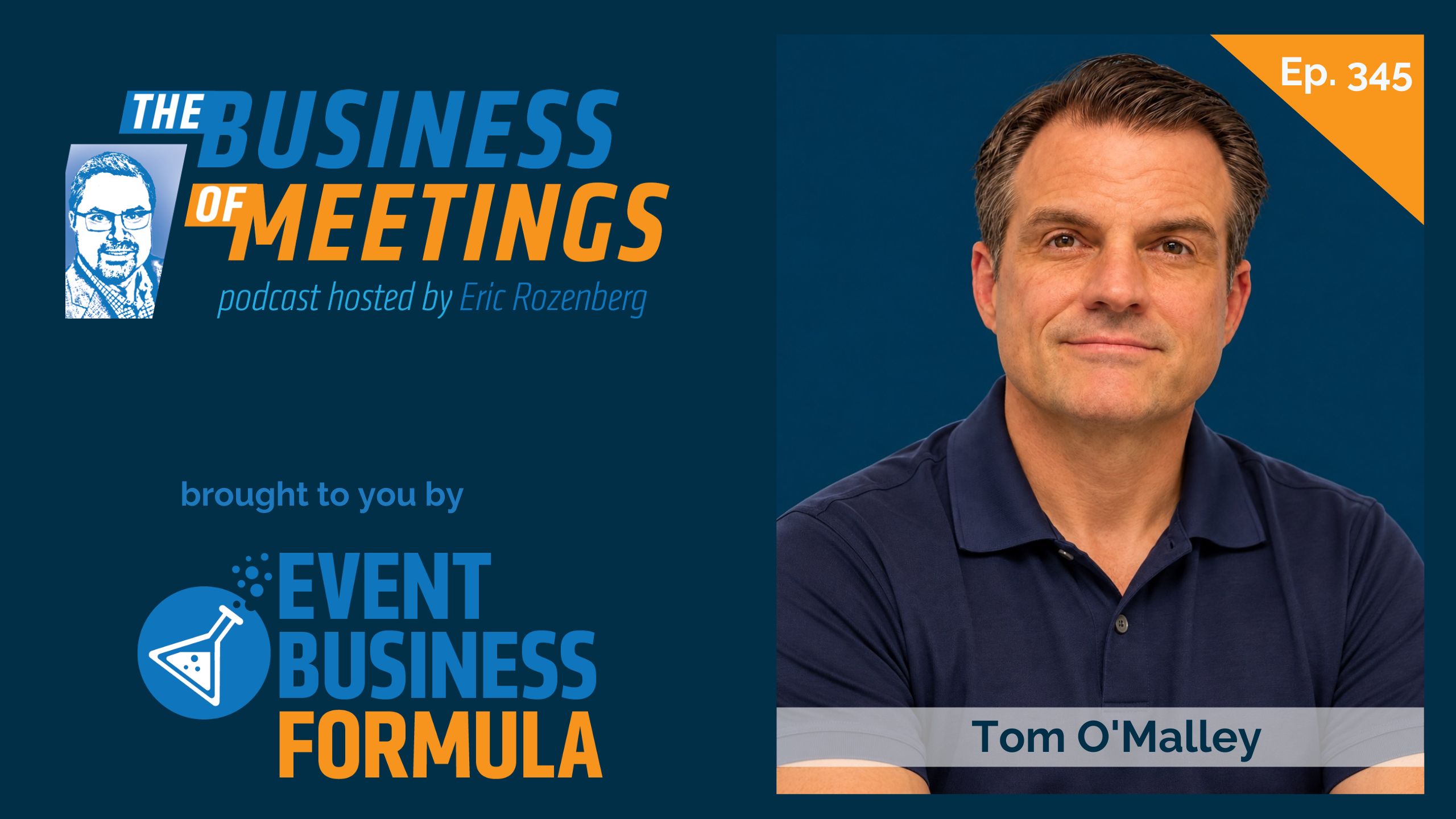
We’re delighted to welcome Tom O’Malley, the CEO and founder of Meshi, as today’s guest. Tom is a true tech entrepreneur. He spent more than 25 years in technology before moving into startups.
Stay tuned to learn about a new approach to AI-powered networking that Tom is developing at Meshi that could change how we connect at events, in communities, and throughout our careers.
Tom’s journey
Tom went to university in Japan to understand its successful economy and different culture. After working for a Japanese trading company, he coordinated the construction of six houses following the Kobe earthquake. He later moved to China, Singapore, and Madrid before returning to Silicon Valley, where he moved from corporate strategy at Oracle into startups.
Meshi is his fourth startup in 15 years. Tom has always been entrepreneurial. In high school, he ran a landscaping company employing 17 people. While working for large companies, he gravitated towards entrepreneurial projects and risky opportunities. After returning to the United States, he found his corporate role too narrow, with departments and people responsible for almost everything. So he decided to build his own technology.
Building Startups
While living in Madrid, Tom began building technology and learned through trial and error. After moving to Palo Alto, he found a mentor who helped him develop his skills, and a chance meeting with a Yahoo engineer who had built software for landscapers led to YardBook. They raised $1 million in two weeks, and the software eventually served 15% of all landscapers. Tom then built an engagement platform and secured his first $30,000 project through sales calls. The business grew rapidly, raising $5 million in its second year.
Technology Connects People
Tom believes technology does not only automate tasks. It also connects people. This belief shaped his move from operational software to platforms that bring people together to work on business-to-business innovation problems. He views connecting the right people as one of technology’s greatest opportunities.
Matching People
While running an expert focus-group platform, Tom began using AI to summarize reports and facilitate online engagements. When AI started predicting which experts would make good panelists, he recognized the potential for something much bigger. People are highly nuanced, and matching using only a few tags cannot capture who they really are. Deep personalization makes it possible to build a more detailed understanding of each person and reason about who should meet whom.
What Meshi does
Meshi builds an AI agent for each person and allows the agents to communicate with one another. This creates a people layer that can sit beneath an event app or alongside existing systems, without requiring another standalone app. Event organizers can use it to arrange table seating, balance groups by archetype, personalize newsletters, and help attendees identify the people they should meet.
Networking
Tom believes technology’s greatest long-term value lies in its ability to connect people. This led him to move beyond software that serves an operation and focus on bringing people together to solve business-to-business innovation problems and find the right connections.
AI agents
Meshi aims to let people use the same AI agent across events and communities. An agent gateway would connect personal agents such as Muse or Instinct with an event’s AI concierge, helping event attendees find relevant connections while allowing organizers to retain and build on their data.
Agentic Networking
Agentic networks could connect people across events, country clubs, meetup groups, and Substack communities based on their intent. The same technology could also help match products in supply chains and solve complex problems, such as matching organs with patients.
Better Matching
Tom wants to increase the number of meaningful connections people make. Better matching could help people find the right collaborators, mentors, and opportunities much faster.
How AI can preserve serendipity
AI recommendations would not force people to meet. Both parties would still need to opt in, and spontaneous encounters would continue in everyday settings. The greatest opportunity is large events, where thousands of attendees, multiple sessions, and extensive exhibition floors make it hard to know where to spend time. AI can help attendees identify valuable connections and improve their return on investment without removing the freedom to make their own choices.
From Attention to Intention
Young people are growing up with constant technological change, social media, and now, AI. Tom believes AI agents could shift technology away from competing for attention towards understanding people’s intentions, filtering information, and helping them focus on what truly matters.
Solving Problems
AI agents could act as digital advocates, helping people manage their information, remember their priorities, and identify steps towards their goals. Tom believes that although technology creates problems, it can also help solve them, and that younger generations may be better prepared for their future than older generations realize.
Connect with Eric Rozenberg
Listen to The Business of Meetings podcast
Subscribe to The Business of Meetings newsletter
Connect with Tom O’Malley
On LinkedIn
Listen on: Apple Podcasts · Spotify · YouTube
“We say we love networking. What we really love is connecting.”
Tom O’Malley
Full transcript of episode 345 of The Business of Meetings podcast, Eric Rozenberg with Tom O’Malley. Lightly edited for readability.
Eric Rozenberg: Hello and welcome to a new episode of the Business of Meetings podcast. Today I am delighted to speak with a true tech entrepreneur. He’s living in the mecca of tech in Palo Alto. He’s been more than 15 years with major companies, Oracle, has his own business. He’s now the CEO of Meshi. And you’re in for a ride because when he’s going to tell us what he’s doing, you would say, “Oh my god, that for the meetings and events industry is just amazing.” He’s involved in different projects, reach out to me out of the blue. And that’s what I love when people like you are doing that. Tom O’Malley, the CEO, founder of Meshi, thank you for reaching out and thank you for being with me today.
Tom O’Malley: Likewise, Eric. I really appreciate being here and all that you’ve done. It’s amazing, your track record, your consistency. It’s been fun to listen to.
Eric Rozenberg: Thank you very much. Before we get into what you’re doing today and Meshi and everything, tell us a little bit about your journey. What is Tom’s journey to be what you’re doing today?
Tom O’Malley: Yeah. Interesting. So, I’ve always saw myself as like a Huck Finn, a pioneer. I always wanted to be on the front edge. And what that meant growing up was get over to Asia because that’s where everything was happening. So I went to school in Japan, ended up in China in ’97 and then back over in Singapore in the early 2000s and then followed the tech stream back into Silicon Valley. But got into tech about 25 years ago with that same sort of curiosity and interest. My wife and two kids were with me when we came to Palo Alto and girls went to school here. Dad left the big tech companies. I was at Oracle as a strategy guy there in Asia, in Europe for a bit too out of Madrid, and then back to Silicon Valley. I got the itch to maintain that sort of pioneer status by doing startups. So 15 years later, this is startup number four.
Eric Rozenberg: That’s awesome. ’97 China, if I’m not mistaken, that’s when Britain gave back Hong Kong to China.
Tom O’Malley: Yeah. And I just went back there for the first time in 30 years this year and to see the difference. Not so much Hong Kong, but China, mainland China. When I was there, there were still a lot of dirt roads. There were no credit cards. Everything was cash. It was very much Old West feeling, very much frontier. And now it is no longer frontier. Is maybe leading the frontier on another measure.
Eric Rozenberg: Absolutely. And you said you study in Japan.
Tom O’Malley: Yeah, I studied in Japan. I went to university there and then it was in ’93 that it was just impossible to leave Japan because the economy was doing so well. I spoke Japanese and so I got a job with a Japanese trading company as their only bilingual. Kobe earthquake hit and they put me in charge of building some 2×4 style housing in Japan. So 2022 or so, I was picking up American contractors, carpenters, literally kicking their beds every morning to get them in the van so we could get over to what was called the genba, where you have the houses being built, and so they could get to work. And then I’d answer questions all day between HVAC guys and Japanese, what do you call it, foundation layers and whatnot, and getting all the contractors to work together to keep this project online. But we built six houses in about a year and a half. I guess that was, years were about ’95, ’96, right in there. I was building houses in Japan.
Eric Rozenberg: That’s very entrepreneurial for me. The fact that you decide to go and study in Japan. Was it because of family or you just said, “No, that’s what the economy is. I have to be there”?
Tom O’Malley: I’m sure there’s a handful of your listeners that remember Japan was kicking our ass back then, and they had methodologies, they had an economy that was just an engine. Edwards Deming was our economist that went there to rebuild Japan, and it was just a fascinating curiosity to go, what is it that those guys are doing? And so I wanted to get over there and learn about it. And plus, I’m sure if you’ve ever been to Japan, you would know it’s a fascinating culture. Just people are so not like the US in many ways. We have a lot of cultural opposites about each other, right? We celebrate individuality, they celebrate team. And that’s just scratching the surface. I would argue there’s a lot of opposites. And so that was just interesting to me. Let me go study the opposite, let me go study the thing that’s kind of anti-me at the time, because I was very much American individual. And so I just found it really interesting, and the language is beautiful actually, and the respect embedded in how people talk to each other. It’s, yeah, there’s not enough words to describe Japan actually.
Eric Rozenberg: It’s fascinating. I have to ask as well, in your career, when did you decide to say, you know what, corporate America, I’m done, I’m going on my own? What went into your mind at that moment? I had a lot of friends that doing the same thing or thinking about doing the same thing. But one day you have like 15 different assistants helping you, and the next day in the morning you go and see the client and then you go to Costco because there’s not enough water in the fridge. How was the transition for you?
Tom O’Malley: Yeah, it felt very natural in a way. I had a landscape company in high school. When I was in high school, I didn’t pay much attention to school itself. In fact, I graduated with a 1.8 GPA. But I also graduated with a landscape company where I had employed 17 guys. And so I was already an entrepreneur at a young age. And so I’ve always felt a little bit like a square peg in a round hole in corporate. And I always did sort of entrepreneurial things at these companies. It’s what gave me my special pass to move around the world. And I’d always stick my neck out for risky things inside these large businesses, which many people didn’t. And so I felt like I was still an entrepreneur those years that I was in corporate, and certainly moving over to, say, Singapore has a certain pioneer mentality as well. I think we were one of the last families to get an expat package to go over there. Was still considered frontier in 2005, which I’d say the trail was pretty beaten by then, but it was still an exciting time to be there. And then transferred to Madrid.
So large corporate was great for moving my family around, and then they moved us back to the States. But after that, I had a hard time justifying being in large corporate, because I got back to the States and, unlike Asia and less so Europe, you had to do a lot of things for yourself. There wasn’t that much support and infrastructure in those countries. When I got back to the States, somebody had a job for everything inside the company. So my role got very narrow, and then I was like, all right, it’s time to go.
But I started building technology when I was in Madrid, spending my money in India, wasting my money, that is, because I was just on a learning curve. I didn’t know what I was doing. But it took me years of building bad software before I moved to Palo Alto and finally had found a mentor here locally. I worked on nights and weekends building some software, learning from a mentor named Clarence Wooten. And then through that, I guess, what was cool was somebody came up to me, a Yahoo engineer came up to me, and he said, “I overheard that you had a landscape company.” I said, “Yeah.” He said, “I built some software for landscapers.” And we started talking. He says, “I just can’t raise money.” He says, “I’ve been at it and I don’t know how to tell my own story.” So, in two weeks, we went out and raised a million dollars for Yardbook. Today, Yardbook, software for landscapers, serves 15% of all landscapers use Yardbook. And they went through YC and everything. So, that was a smash hit. And that was my first like dabble at startup.
After that, I didn’t go with that team because I wanted to go create an engagement platform. And so I put myself in a small shared workspace. I remember the office was just like a closet, and I started banging on the phones for sales and I got my first hit. It was a $30,000 project, and at the time I was fine with any type of revenue. And then I thought, well, let me hire somebody to bang phones with me. And I remember in this startup, my little closet was next to like a row of six other offices. Within a year, we had taken over all six offices and we were growing. And we raised $5 million, I think, in our second year. Yeah, it was very exciting time.
But so the transition, I think for me, I’ve always been sort of itchy, and I do miss the corporate AMEX card, as you said. Walk into Costco and pick some things up was never a blink of an eye, or to pick up a bottle of wine at dinner or something. When you’re an entrepreneur, all that falls back on your shoulders. Your company’s money is your personal money in a way, and you start thinking about everything differently. Yeah.
Eric Rozenberg: Wonderful. How did the idea of what you’re doing today came about? Maybe first of all, tell us what Meshi is doing, and then we can come to the original.
Tom O’Malley: We’ll come back to this theme because I believe that all technology, its long-term value, its long-term legacy, is that it connects people. So when you think about like the train, the train absolutely automated the horse, and everybody focused on that when it came out. Well, this is going to take all the carriage jobs away, and yes, it will. But its long-term legacy is far greater than what it disrupted. It’s what it connected. And so, I think that’s the view I take when I build stuff. And that’s why I didn’t go with the Yardbook team. That wasn’t really connecting people. That was serving an operation.
So the platform I came out with after that was collecting expert focus groups, was bringing people together in teams to engage on problems of innovation, on B2B expert-related problems, and I ran that for eight years. As we were doing that, in ’22 we plugged AI in to handle some of the operations, and it did beautifully, like summarizing reports or even eventually facilitating an engagement, an online engagement. But then when we started using it to predict who would be a good panelist, then that’s when a light went on. And that light is this: people are highly nuanced.
To say that you’re going to understand somebody by a few tags is just, we’re going to look back and go, that’s insane. And unfortunately, that’s the way we match things today, is through tagging, right? And whether that’s me to a job or me to a person, right? Heck, even a dating app is just using tags, right? And I’d argue that matching people is the most powerful thing we do as humans. Meaning the one introduction can change your life. True. We’ve all touched that moment.
Eric Rozenberg: Absolutely. As I was telling you before we started recording, serendipity of life, Eric AI now is built thanks to somebody I met by coincidence, and that has now the best technology in the world. So, absolutely.
Tom O’Malley: Well, and you had told me that that was like months of onboarding.
Eric Rozenberg: Yes.
Tom O’Malley: Right. And that wasn’t just them putting a few tags in about you. They were learning you. They were studying you, right? And then training something, right? Let’s call it a bot about you. And that’s the opportunity we have now, is that all your nuance as Eric, maybe not all, but a lot of it can be captured now and understood. And if you can do that, then you can do that with a Tom and a Sarah and a Mike and a Larry. And then you can ask these bots to reason, should they meet? Right? So this is the first time that, in the biz it’s called recommender engines. And recommender engines have been using neurographs, knowledge graphs, for years trying to figure this out. Google’s definitely at the cusp. Netflix is also, I’d say, at the cusp as well. Amazon as well. They’re matching products to people. They’re trying to understand people more, right? Facebook, you remember Cambridge Analytica, they were starting to dabble in deep personalization.
So, in order to do matching, you first have to do deep personalization. And that genre is getting, every time you hear a new model came out, that means deeper personalization just became possible. And so, that’s the frontier I believe we’re on. People are so, I think, distracted with the disruption and automation. I don’t think it’s all that cool that AI can automate writing a book or something. I mean, it’s cool, don’t get me wrong, but it’s not going to change our lives. People are talking about like, oh, it’s going to do all the work. I don’t care. That doesn’t matter.
What matters is, for the first time in human history, we have a way to scale highly contextualized matches. It’s like this, Eric: when you go into a parking garage, and if you’re lucky, they have those lights above that show you where an empty spot is. Okay. So helpful, right? Google Maps, so helpful. Being able to know where to go and take that. And now imagine that that spot is your next job, and your AI can just say, “Hey, Eric, let me go find you a job today. Here, I found it. And I’ve convinced the job, because the job can be an agent as well, a reasoning body, that you are the best person for it. Your final interview is tomorrow.” That’s where we’re heading. We’re heading into the Uber of everything, because that distance between a highly nuanced entity and another highly nuanced entity is about to shrink immensely, because bots can reason at scale. Who should you meet?
And this gets into this, if you’ve ever seen Black Mirror, there’s an episode called Hang the DJ, where it’s about your dating life and that the AI reasons that you must be dating this person for 3 months before you’re ready to meet this next person, before you’re ready to meet this person, that finally you meet the love of your life. And it’s a society that is just given up to that and trust the AI to do it. I don’t think that’s too far off from the truth. When you think about career pathing, we’re going to put you in this job. Your destination’s here. So, you want, or so you think, and so you train your AI and want to get there. It will help you find those steps that you need to take, both in learning content, who you should meet, mentors. It’s going to be a fantastic journey for us.
Eric Rozenberg: Which movie is that?
Tom O’Malley: So, Black Mirror.
Eric Rozenberg: Black Mirror. Oh, no. I haven’t seen
Tom O’Malley: Oh no, you have to. And that one in particular, it’s called Hang the DJ. It’s one, I think it’s season 1 or season two. It’s very early.
Eric Rozenberg: So I’m listening to you and I try to imagine what it mean. So for instance, we both going to the same conference, and let’s say we don’t know each other. If I understand you well, then your AI agent and my AI agent will be talking with each other, and we will say, “Tom and Eric, you should be meeting.”
Tom O’Malley: Yeah, that’s right. So, you nailed it. I think the opportunity to play it back is event organizers. When you go into an event or community organizer today, you say, “What is the number one reason why people are going to your event?” And stats show that it’s about networking, right? Learning is very close, and some of them, learning might out-edge, but generally speaking, people go to events to network. And then you ask them, okay, well, I see you have a head of catering and a head of logistics and a head of content. Who’s in charge of networking? And the room will always get silent. Networking has been sort of a serendipitous thing that just happens when you get people together. So, no one needs to be in charge of it, right? But now, when you have a system or a way to systemize serendipity, when the tech is now here, then someone needs to own that. So there’s a new function coming to all events and communities that is like chief of networking, and it is a different layer than an event app. An event app is the what. It really isn’t the who.
Eric Rozenberg: Yeah.
Tom O’Malley: The who has to be a much more sophisticated layer that can do this deep reasoning, or deep personalization reasoning, and matching. And that’s the layer that Meshi is. And we call it Meshi because we essentially build an agent for each person, and then we let them all talk to each other, which is called meshing. And so when you mesh that layer, now you have a single layer that you as the organizer have an interface to. You just talk to it and you say, “Hey, I want to do a table seating for a thousand people and I’m optimized for this.” Or, “Break this group of people into five archetypes and make sure they’re equally represented at each table.” Or, “Here’s my newsletter, and I want you to rewrite it for each of those archetypes or for each person.” So this cloud of who, you might say, this layer sits in between your systems of record, your applications. It can sit under your event app and power it. So it doesn’t need to be an app, but I as the user, I can pick up my phone and talk to my agent. I can text it. I don’t need to go into the app. I can attach my Claude to it. Or you’re hearing words like Muse and Instinct right now, which
Eric Rozenberg: Absolutely. I was going there to ask you that.
Tom O’Malley: Connect those to it. Yeah. That’s right.
Eric Rozenberg: One of the thing I’m helping people with is how to organize themselves better and define their priorities and ideal week and things like that. And one of the guy I’m helping was telling me that he’s actually using Instinct to have a reminder of analyzing his time and what he’s doing and if it’s in line with his priority, which is phenomenal. So to come back to Meshi, is it going to be something that is created like, for instance, let’s take three example: MPI World Education Congress, PCMA Convening Leaders, and IMEX.
Tom O’Malley: Yeah.
Eric Rozenberg: Okay. I’m going to the three of them.
Tom O’Malley: Yeah.
Eric Rozenberg: Am I going to have an AI agent per conference, or is it going to be like my AI agent that I’m actually reusing whatever I do and wherever I go?
Tom O’Malley: Yeah. So, it’s definitely going to become one agent, but it may not be on the back end. So, here’s one way to think about it. All three of those, MPI, PCMA, and IMEX, if they all were to deploy Meshi, then yes, you would have the same agent, because when you log in to Meshi, it’s with your phone number. There’s no password. You’re just texting it and you’re immediately talking to it. So, there’s no download. There’s no password. And therefore also there’s no end. So when I speak with IMEX, Carina and her team, we’re in, as we do with South By, and the message we’re promoting right now is that events are communities, and there’s no reason why people should delete the app and delete their experience at the airport. What they should be doing is staying connected via their agents.
So, agentic networks is something we’ll have to dig into a little bit. But to answer your question, what’s more likely to happen than the whole world using Meshi, what’s more likely is you’re going to want to use your Instinct or Muse to enter the event. And so, these events are going to need to present you, today it’s called an MCP gateway or an MCP server, for your agent to talk to the event. Okay. But they have a dilemma right now. The dilemma is, on their side, if they let you come in with your Instinct or your Muse, it’s just going to take all the data and walk out, and it’ll do its own reasoning, right? And then MPI, IMEX, these organizations didn’t learn very much at all about what you liked or what you didn’t. Their data did not compound.
So, what the world doesn’t know yet, and we’re out working with those teams and beyond, is to create a standard. Let’s create an agentic gateway standard. And you can do this with Meshi. Once you have a people layer, what you’re doing is you’re saying, “Okay, Eric, when you come in, your outside agent is going to talk to the inside agent we created for you.” So instead of you coming into a raw port and going roughshod across all the data, no, we’re going to give you an AI concierge on this side. And so your Instinct or your Muse is going to connect with the IMEX AI concierge for Eric. And that way, we’re not going to hand you data. We’re going to answer questions together. So if you say, “Who should I meet?” we’ll reason and tell you. If you say, “What’s my ideal itinerary?” we’ll reason and tell you. And then if you want to challenge it or ask more questions or change it, we’ll learn from that exchange.
So it’s important that organizers are going to need to build some sort of agent gateway on their side. And that’s what Meshi is. So Meshi is not only this ability to personalize deeper to every person, but it’s a way for events and communities to maintain control of their data and grow it. It’s a huge opportunity for both sides right now. But without that middle layer, it’s just going to be a data rape and pillage, and the agents are going to get what they want and reason among themselves even. So then now your Muse has talked to my Muse, because we both figured out we’re at IMEX and we know each other. We’re not going to have to go back to the event.
So that’s the world we’re in. I think it’s tons of opportunity, and it’s going to be better for organizer, better for attendee. But even defining these problems and making people aware that these problems are coming has been my challenge in the past two years.
Eric Rozenberg: Well, if only you were passionate about that.
Tom O’Malley: Sorry. Feel free to edit what you want out of this. I know I get
Eric Rozenberg: No, I’m not going to edit anything, actually. I just love it. But what you just described is what you call the agentic network.
Tom O’Malley: Yeah. So agentic networking is the era that we’re coming into. So AI has been interesting. Generative, it’s necessary. You need to have generative first, because generative builds all the data. I mean, when they built your profile, Eric, on that bot, not only did they capture data about you, but they let the AI fill in the blanks. So, that’s called inferencing, right? So, it inferred more about you, right?
Eric Rozenberg: Right.
Tom O’Malley: And so you have to have that layer. That’s how you get into deep personalization. But then once you can create a high-fidelity Eric and a high-fidelity Tom, the next thing is to network them.
Eric Rozenberg: Yeah.
Tom O’Malley: And I believe that literally every organization, formal or informal, your country club, your Meetup group, your Substack, we’re working with some Substack groups to connect all their followers into networks. All of these, what I would call hub and spoke or spamless, are going to become networked via agents, so that people can find each other for reasons of why they, per their intent. So yeah, agentic networks won’t just stop with people. You can imagine a supply chain. Every product could be represented by an agent.
Eric Rozenberg: Wow.
Tom O’Malley: So it gets into matching organs and patients. It gets into really solving some very complex problems that a static database can’t solve for.
Eric Rozenberg: I have to tell you, in a simple way, but Eric AI, it’s me. It’s just insane. And I use it as well, because it knows obviously everything I’ve done and I’ve trained it, but it goes faster, and some of the thing might not remember. I have a friend who was asking me, “I’m becoming CEO of a company, what you advise me to do my first 90 days?” And we’re like, holy moly, that’s a great question. And sure enough, 10 seconds later, boom, everything start going, and the interaction was just phenomenal. Now, there’s two things I want to talk about. I want to talk about the next generation and our children and that world. But before that, what you were mentioning about this networking, this agent, to me it sounds like this is only going to reinforce the will of the human beings to come in person. What do you say about that?
Tom O’Malley: I agree 100%. I think this is all about network less, connect more. We say we love networking. What we really love is connecting. I call it like golfing. Like, you could have 99 bad shots. If you have one good shot, you’ll be back out there next Sunday. And that’s what, I use the 99 and the one because that’s more representative where my score is. But yeah, I think that’s just it. I think, imagine if we could take that. And this is why we’re not starting with organs and patients matching there. We’re starting with matching people in networking, because actually it’s very rare to have a bad match. Like, there’s a lot of interesting, oh, it was good, I had nice chat there. There’s a lot of that middle ground that doesn’t deplete us, but it doesn’t achieve our goals either. But we all know when we meet that one. Meaning, if you get a match wrong, no one dies. So applying this technology first to networking makes a lot of sense.
And even if we can move it from one in a 100 to, we could 5x or 10x it, 10 out of a hundred meetings give you that holy cow, this is a life-changing thing, this is exactly the person I needed to meet. If we could 10x it, that would be amazing. If we could move that needle to 30%, 30x it, 30% of the people you meet are oh my god, right? I think that’s a fantastic goal to wake up and try to work on every day, just because how many lives would that, how many people could you accelerate their life, and before they quit, before they give up on a goal, help them achieve it faster? I just think it would change everything about humanity. Like, it would just change everything, because we think about productivity being doing something faster. I think we spend a lot more time in search of people than we realize. I would argue it’s about 60% of our lives we’re actually searching to find the right person rather than doing some task. Like, let the tasks go away. Let humans do what they do best, which is connecting.
Eric Rozenberg: What about serendipity?
Tom O’Malley: This is still serendipitous, meaning you’re not forced to take the AI’s recommendation. You still have to opt in, right? And in fact, both sides do. And it is still serendipitous that you pursued that career, but it’s kind of like no one’s missing Thomas Guide maps. Remember the maps in your car, and the book, and you’d be driving down the road trying to manage a book and figure out things, and stopping at a gas station to get the next map because you drove off the edge. It was insane. Nobody’s missing that. No one’s going to miss not knowing who to meet, and have a sense of confidence of where you want to get to. Like, I know that there’s fear around AI, but on this one, gang, we’re just going to love knowing that we’re with the right person at the right time in the right place. So we can be more present instead of that FOMO. Ever been in a conversation with somebody, overhearing another one and going, “God, I really want to meet that person before they leave, but I got to get out of this conversation first”? That’s managing maps. So I think it’s a wonderful era coming.
Eric Rozenberg: I hear you. I agree with you. There is still something for me that I have challenged to comprehend, when it says that the AI agent is going to tell you what to do or what is ideal for you in your career. My first job, I met a guy at the barbecue. My first partnership, I met a couple on ski holidays.
Tom O’Malley: Yeah.
Eric Rozenberg: And those things would have not happened if I was trusting somebody else, let alone technology, to decide for me. And I think, unfortunately, a human being learns only by making mistakes. But that’s also part of life and learning. So how do you combine both?
Tom O’Malley: Yeah. I don’t think that that idea to go to the barbecue, I don’t think you’re going to be consulting with AI to go to that barbecue. Chances are you were invited by somebody to go to that barbecue, and you like them, and you went to their barbecue, and there were only 15 other people there, and you don’t need an AI in small surroundings like that. Or you’re on the ski slopes, and there’s no way to systemize who you’re going to be sitting next to on the ski lift. So the serendipity is still going to happen. I think the challenge is in the room of 10,000 people. You’re paying money to go attend something for the purpose of networking. Do you really want to just wing it, or do you want some ROI?
Eric Rozenberg: I mean, absolutely.
Tom O’Malley: Honestly, going to IMEX is one of the most exciting things every year, but it is overwhelming. That showroom floor is about eight football fields, and everybody’s walking around just trying to figure out where they should be. And then you throw in the fact that there’s sessions and so many choices on sessions. Am I in the right one? I think all events and communities, quite frankly, they have this problem of it’s just more math than the brain can handle, and we need some assistance with that. And you would want the best assistance on the planet, and that’s what I’m describing, is sort of state-of-the-art right now.
Eric Rozenberg: Absolutely. No, it’s definitely going to increase the ROI for sure. Tom, I’d speak with you hours, and I’m looking forward to meeting you in person to do that. But I’d like to finish this podcast episode talking about our children. You’re a dad. I’m a dad. I’m looking at the world they’re living in now, the technology and all the opportunities that they have, but also, if I had to be single, god forbid, in my life today, I wouldn’t know how to do. It’s just those dating app, the way they’re corresponding. My 16 years old, she’s texting her friends, and say, “What do you do, darling?” And she said, “I’m talking to my friends.” You’re not talking, you’re texting. And it’s all this world, this technology they’re leveraging. What is the frontier between using, leveraging technology and creating humans that are basically not suitable anymore? They don’t know how to relate to others and to engage with other human beings.
Tom O’Malley: Yeah. Wow. They call it the anxious generation, right? That your kids, my kids are
Eric Rozenberg: Yeah.
Tom O’Malley: There’s a big
Eric Rozenberg: Yeah, there you go. The Anxious Generation.
Tom O’Malley: And it’s because they experienced so much change. They were the first to have iPads, iPhones, social media, a mass of content. They were the first to have access, or first to confront COVID. That was something our generation wasn’t necessarily impacted by, right? And then they’re the first to now, they’re finally like minoring college now, and now they’re living the AI curve, where there’s tension. So there’s just been tension and discovery and learning all the way through their lives. And you think like, oh, that’s an anomaly. That’s just this generation. No, change is going to keep continuing. Like, change is actually coming faster. That’s why we’re seeing this.
So, but I will say this, is that what I say is, I think we’re at the end of the attention era. And what I mean by that is everything in media, advertising, up until now has been focused on attention. How much I need to get a person’s attention, because I don’t know who they are. I have to guess and shout a message out to everybody. And so we’re inundated with messaging. Social media is built on attention. We get notifications. We see streams. They’re getting more curated for us, right? So algorithms are being built based on our usage, which makes it more highly addictive. And right, that’s not great. But there’s nothing until now. There hasn’t been anything that digitally represents our intention.
Meaning, AI agents are going to become a filter for us. So we don’t have to be so bombarded, and we can be more reassured that we’re seeing the things that we need to see, right? Or we want to see, or that we should see based on our career path. So it can even be predictive, right? And it won’t ever be an either-or. There’ll be the attention-based models, and then you’re going to start having these intention-based models, such as matchmaking, networking, agentic networks, because they’re all based on intent. And so I think we finally have a chance to cut out some of this noise, which will return hopefully some sanity and also bring some discipline back into our lives, because we just need some assistance to rebuild the discipline. As you had said, you can go back to your agent to help you remember what your answer would be for this first thing to do in 90 days question, or your friend that has the Instinct being reminded what fits their priorities. We’re finally getting an assistant or an advocate, a digital advocate, on our side to help us manage the noise and manage the onslaught.
But I can’t say that that answers your complete question. I just tend to believe that technology, while it creates problems, solves them faster. And to our generation, looks like our kids are ill-prepared for the future. I’d argue that they’re more prepared for their future than we are. And so, even if it looks like this next generation is going astray, realize every generation thought that about the next generation, but really what it’s doing is it’s readying them for the next level of human evolution. And so I give faith to that, that I may not understand what’s coming. I argue, for the last five years, I’m more befuddled every year, wondering, “God, I didn’t see that coming.” So I think we have to have a little bit of faith that we’ve seen this trajectory of generations morphing for the purpose of preparation for their next generation.
Eric Rozenberg: I love the way you think. There’s one thing, though, I’m disputing with my daughters, is going to a concert without a phone. I enjoy very much listening to the artist and not filming everything. But yeah, that’s another story.
Tom O’Malley: I’m not saying we need to go into the future without brakes. I think if I were to even do it all over again, meaning raise my kids in the social media era, I would have put more brakes on it. So, I’m not discouraging parents to put the guardrails on. I think we need the guardrails, but I’d say, in the big picture, don’t fight the direction, but maybe just the path that they can, how narrow the path is on that direction.
Eric Rozenberg: That’s awesome, Tom. Thank you very much for sharing your thought. I really enjoyed this conversation. How do people get in touch with you?
Tom O’Malley: Well, Eric, I’m really excited about addressing your community, because we just partnered with a book partner called Innovate, and they have done these Innovate books all throughout the world. Innovate Dubai, Innovate Ottawa, Innovate Toronto. We’re now working on Innovate Silicon Valley. So I’ve partnered with them to help them tell that story. But I’ve also convinced them that there is much more innovation happening in the communities, meetings, and event space that people are aware of. It’s just more scattered. It’s just not in one geography.
So, I’ve convinced them to do a book on Innovate Communities and Events, and it’s folks like you, Eric, that I hope can participate in it. But through you, I’ll share a website where people can nominate people in the event meeting community space to be featured in the book. And so, we’ll do one to two pages on each person. We’re going to collect a hundred stories, and we’re also going to collect a thousand voices talking to Meshi agents and being interviewed. And we’re going to pull that all into a research piece and include that in the book. So yeah, that’s a great way to stay in touch, is they can reach out to me via Innovate Communities and Events, or tom@meshi.io.
Eric Rozenberg: Wonderful. And my last question for today, when we meet
Tom O’Malley: Yes.
Eric Rozenberg: October 27, let’s say at IMEX.
Tom O’Malley: Yeah.
Eric Rozenberg: In October 27, in one year, with a bottle of champagne. What are we going to celebrate?
Tom O’Malley: Wow, that is so good. I think we’re going to celebrate a, okay, so all celebrations on the anchor of gratitude, I would say. And I think we’re just going to be grateful that, number one, we made it. We made it another year around the sun. And that some of these positive elements, some of the fear has been let out of AI, and people are starting to see how this technology is a gift to humanity and that it’s connecting us better. And if we’re raising a glass, the toast would probably be centered around human connection.
Eric Rozenberg: Love it. Tom O’Malley, Meshi, thank you so much, and I look forward to meeting you in real life.
Tom O’Malley: I can’t wait. Thanks, Eric.
Eric Rozenberg: Thank you for tuning in to the Business of Meetings podcast. I hope you found today’s episode valuable. If you enjoyed the show, the most important thing you can do is leave a review and share it with your colleagues. It really helps spread the word. I truly appreciate your support. And if you’re ready to take your business to the next level, don’t forget to visit eventbusinessformula.com to learn more about how we are helping event business owners like you. Thanks again for listening, and I’ll see you next time.