
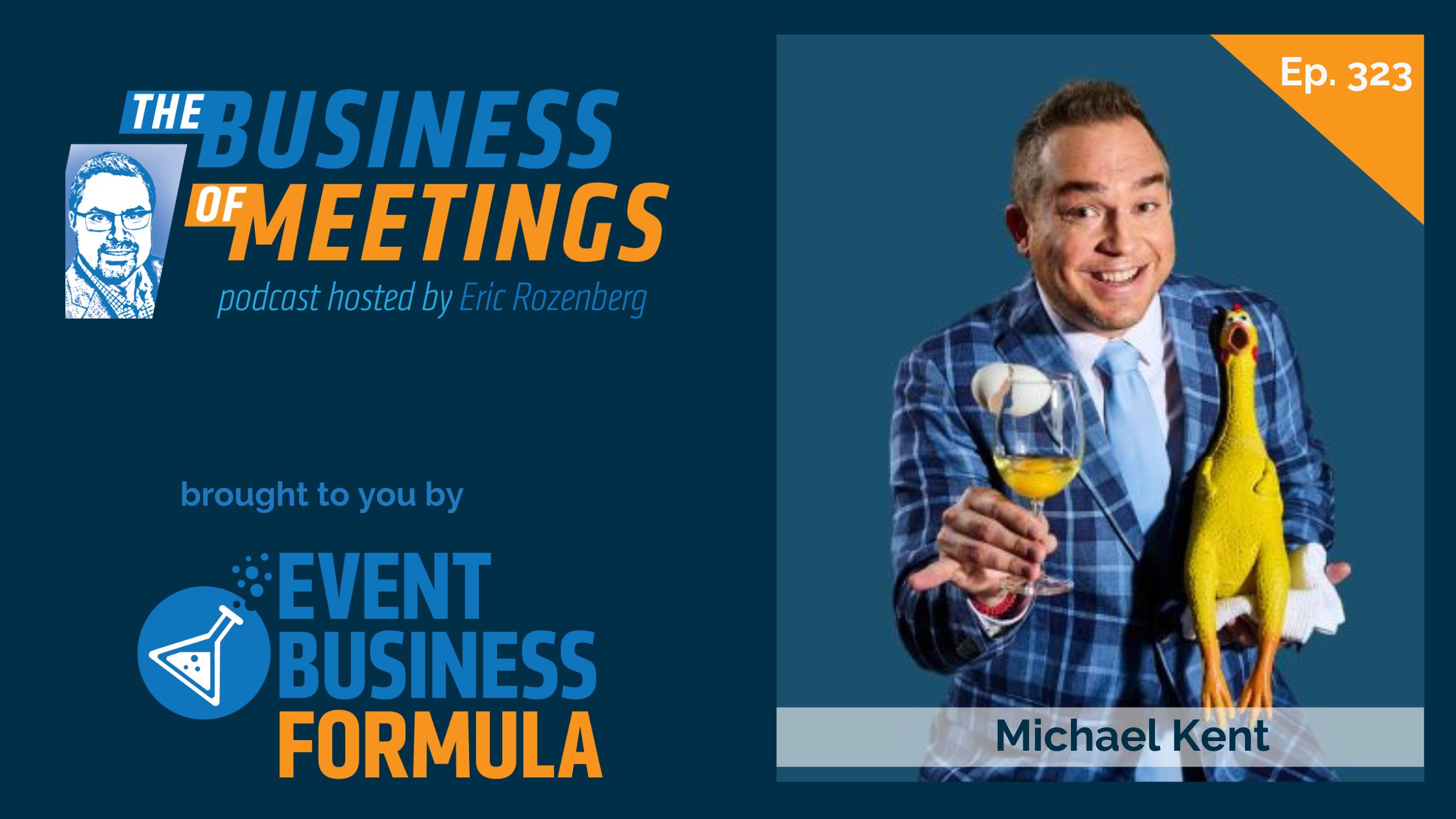
We’re delighted to welcome audience engagement specialist Michael Kent as our guest today.
In this episode, Michael speaks with Eric about audience engagement, corporate events, comedy, magic, workplace culture, and the growing role of AI in live experiences.
Stay tuned as Michael shares how years of performing around the world shaped his approach to helping companies create meaningful events that bring people together, reduce stress, and strengthen workplace relationships.
Michael’s Journey
Michael has been entertaining people since he was six years old. After discovering magic at Walt Disney World, he became known as “Magic Mike” throughout school and college. He later worked as a marketing director while continuing to perform magic shows on the side. Once the numbers made sense financially, he left his day job and moved into entertainment full-time. Over the last 23 years, he has toured internationally as a comedian and magician, performing in 21 countries and 49 states. Over time, he came to realize that his real role was to engage audiences to help companies connect with their people through experiences that are fun, positive, memorable, and meaningful.
A Clear Goal
Entertainment should support the broader purpose of an event rather than exist separately from it. Michael believes many companies only hold annual events because they have always done so. But that is not enough. Before planning entertainment, it’s essential to define exactly what the event aims to accomplish, as different goals require different approaches.
Early Involvement
Michael prefers to be included early in the planning process rather than hired at the last minute, as he needs to understand why the company chose the venue, who will attend, whether spouses are included, and what challenges the organization is facing.
Audience Engagement
Audiences become more engaged when they share experiences. Michael’s role is often about helping people who do not know each other feel connected. By bringing people on stage, creating audience participation, and encouraging interaction, he helps attendees build familiarity and trust. That matters because people remember shared experiences long after the event, helping their workplace communication feel more comfortable.
Matching Entertainment Style To The Audience
After being brought in late to an event, Michael discovered a major language barrier with the audience, as most attendees spoke very little English, forcing him to rely on visual aids rather than his usual interactive comedy style. That experience reinforced how important it is to match the entertainment style to the audience and to include performers early enough in the planning process to allow for proper adaptation.
Safe Comedy for Corporate Events
Michael always guarantees that his performances will contain nothing objectionable. He avoids political, racial, or offensive material because his goal is to bring people together, not make anyone uncomfortable. For him, even one person feeling alienated at an event matters. While college audiences sometimes expect slightly edgier material, most organizations today simply want clean, trustworthy entertainment that creates a positive shared experience.
Stage Fright
Michael feels that nervousness before speaking is healthy because it means you care. He always focuses on the mission of the event rather than his own anxiety. Before his performances, he thinks about how to help people relax, reconnect, and enjoy themselves together.
Workplace Relationships Matter
Workplace friendships can significantly improve productivity and retention. Events give employees a chance to see each other outside their normal work roles, creating a more human connection. He recommends seating arrangements that combine new hires, long-term employees, executives, and people from different departments, as this helps younger employees feel included while allowing experienced staff to serve as mentors and support systems naturally.
A Simple Engagement Strategy
A simple idea companies can use at events is to have attendees wear color-coded wristbands or name tags linked to their years of service or departments without them initially knowing their meaning, to create curiosity and conversation. Later during the event, the system is explained, and leaders can use it to highlight employee experience levels and connections across the company. Small details like this encourage interaction and help audiences become more engaged.
How Michael Views AI and Authenticity
Michael believes many people currently feel more stress than opportunity around AI, although he expects that to change. One major problem is that people use AI to bypass authenticity. He has attended company events where executive speeches clearly sounded AI-generated, which immediately reduced the feeling of connection in the room. Michael believes AI should function as a tool rather than replace human communication. At the same time, he expects AI to increase demand for live experiences because people still crave authentic, in-person interaction and shared laughter.
Live Events Still Matter
Live events provide something that screens and AI cannot fully replace. Hearing hundreds of people laugh together creates a shared emotional experience that people deeply miss in a screen-focused world. Michael believes companies that invest in meaningful in-person experiences will continue to see value in stronger workplace culture, better communication, and improved employee relationships.
Michael’s Approach to Success
Fame has never been Michael’s main goal. He prefers to focus on helping people, creating meaningful experiences, and leaving audiences happier than when they arrived.
BIO: Michael Kent
Michael Kent is an Audience Engagement Specialist. Through more than 2 decades of experience as a Comedy Magician working with corporations, colleges, and military installations, he has mastered the art of one thing:
Connecting companies to their people in a way that’s good, fun, positive, memorable – but more than that – meaningful.
He’s been named Entertainer of the Year by Campus Activities Magazine, Magician of the Year by the Association for the Promotion of Campus Activities. He has appeared on the television show Penn & Teller: Fool Us.
Michael enhances company events and is passionate about ensuring they have a real-world impact by improving employee retention, reducing absenteeism, promoting a positive corporate culture, and fostering the inspiration that leads to a healthy, profitable organization.
Connect with Eric Rozenberg
On LinkedIn
Listen to The Business of Meetings podcast
Subscribe to The Business of Meetings newsletter
Connect with Michael Kent
On his Website
Podcast:The Internet Says It’s True
Listen on: Apple Podcasts · Spotify · YouTube
“I connect groups, companies to their people in a way that’s good, fun, positive, memorable, but more than all that, meaningful.”
Michael Kent
Full transcript of episode 323 of The Business of Meetings podcast, Eric Rozenberg with Michael Kent. Lightly edited for readability.
Eric Rozenberg: Hello and welcome to a new episode of the Business of Meetings podcast. Today we’re going to talk about a topic that is very dear to our hearts in this industry. We’re talking about AI, we’re talking about in person, we’re talking about bringing people together, but at the end of the day, the core of it is the audience engagement. And so today, I’m delighted to speak with an audience engagement specialist, Michael Kent. Michael, thank you for taking the time to speak with me today.
Michael Kent: It’s my pleasure, Eric. It’s great to be here.
Eric Rozenberg: So you have a fascinating journey, you have fascinating tattoos and you have a fascinating title. So first thing first, what is your journey that brought you to what you’re doing today?
Michael Kent: So since I was six years old, I’ve been entertaining people, and for the last 23 years of my life, I’m 47 years old, so for the last 23 years of my life, I have toured the world literally as a comedian and magician. And I realized, just in the last few years, I realized I do one thing. We can talk about comedy, we can talk about magic, we can talk about events and entertainment, but I’m really doing one thing. I am a specialist in engaging audiences. And that happens in so many, in a multitude of ways. But my passion is I really do one thing. I connect groups, companies to their people in a way that’s good, fun, positive, memorable, but more than all that, meaningful. That’s the most important thing, how can we inject meaning into these events that we’re spending a lot of money on conducting.
And I’ve been in a really interesting situation in that I have attended literally thousands of events and seen how different companies do it all over the place, and seen things that go wrong and things that go right, and, from the role that I play at the event, which is to be sort of the company’s goodwill ambassador at these events, I get sort of an inside look and an outside look at the same time, if that makes sense. So I can work with these groups leading up to the event, but I can see the event and how their associates are reacting to it, how they’re interplaying, and whether or not they’re engaged. It’s a really weird spot to be in, to be sort of a player that’s not going to work every day with these folks, but I’m still very much a part of the company on that night and on multiple nights. A lot of companies will have me for multiple events, and so they get to know me, but almost like a consultant. It’s a lot of fun what I do. I’m up to 21 countries now in 49 states where I’ve worked with groups, and this has been the busiest, we’re recording this in April, it’s been the busiest April I’ve had in my life. It’s been fantastic.
Eric Rozenberg: That’s awesome. Congratulations.
Michael Kent: Thank you.
Eric Rozenberg: Now you said something that is really music to my ears, that companies are investing a lot of money and trying to bring people together. I always advise anyone in our industry, first thing first is define why people are coming together. What is the objective? What are they trying to achieve? Now in your craft, how are you involved in the process, from the last minute to the beginning, and what is your input in terms of designing the whole event?
Michael Kent: Well, it’s my hope when I work with a company that I am right there at the beginning. I want to ask that question that you just asked. I want to know what it is that they’re trying to accomplish. A lot of companies, you’ve seen it, they hold that event every year because they always do, and that’s their reason. We have this annual party because we have this annual party. Great. What do you hope to gain from that? Well, we just hope that people have a good time. That’s not an answer. That’s not going to affect anything when you get back to work on Monday. And so I want to know what it is that they’re trying to accomplish, because what I do might change based on that. What I am offering to them might be completely different if they say, well, we’re trying to really limit our turnover and we’re having a lot of problems with absenteeism. Okay, well that’s something that I can focus on during the event.
If the problem is, well, like for instance, in two days I’m performing on a military base, and I spoke with the commander a few weeks ago, and his mention to me was that these folks are working really hard and they’ve dealt with a lot this year. There have been a lot of changes and they’re stressed out, and normally they have a keynote speaker that gives them information about their mission and what they’re doing. And he said, “This year we just want to have a shared experience of fun.” And that lets me know right away what my job is when I go there. I’m not going to go there to try to motivate them or inspire them. They might take that away, and that’s awesome, and there definitely are moments of meaning in my performance. But my goal is, I’ve got 40 minutes in front of them to make them forget about all the stress in their lives, and to make them look at each other in the midst of it and realize that they’re having a good time with each other, and that that’s possible. And when they go back to their jobs after this event, hopefully there’s some team building that’s happened as a result, and there’s a little bit less stress. So every event has a unique goal, and I need to know what that is.
So to answer your question, I want to be in on the ground floor of an event. That said, there are many times when someone calls me and says, we’ve got an event coming up in a month, we’ve got everything planned, we just haven’t chosen the entertainment. And yes, I’m happy to be the entertainment for that event, but we’ve got a lot of work to do now, because now I’ve got to make up some time and talk to them about what was in their mind when they chose this venue. Why did they choose this location? Why are we doing this event in the first place? Who’s going to be there? Are their spouses coming? There are so many things that we need to know now, and backtrack. So when you’re bringing in someone like me to be the entertainment at an event, possibly a host or an MC at the event, bring them in early so they know exactly what the goal is.
Eric Rozenberg: Yeah, absolutely. I couldn’t help but smile when you give the example of that person doing the same event every year. Back in, I want to say 2008, 2009, with my business partner in Belgium, we developed a new methodology which, by the way, helped us drive even during the subprime crisis, and the beginning of it was, I came back one day from a sales call and I told him, “George, I don’t get it.” I asked the sales director why they do this sales meeting, and the answer is, “Because we do it every year.” How would you justify that in front of your executive team or in front of your board, that you’re doing this investment? So it’s totally insane, and quite frankly, that’s how I coach people, including with my own AI, is to ask the right question to bring people like you to understand the goal, to see what are the key messages. Now, when you say you had great experience, you had less great experience, give us maybe one example of something that didn’t go well, could have gone better in the preparation, and another example of something that’s the landmark that you want to share with people.
Michael Kent: Yeah, there was an event, this was two years ago, where they brought me in, and I knew a little bit about what the event was, but they brought me in pretty late in the planning process. It was clear that this was one of the last decisions that they made. And once I got there, it was worse than they had told me, in that there was almost a total language barrier between me and the audience. These were executives from five or six different countries, mostly Asian countries, didn’t speak a lot of English, and they told me this ahead of time. So I had created a show that was more visual than talking, which is not something that I’m great at. I’m best when I can speak. I do a light-hearted, fun comedy show that involves a lot of audience participation and things. And so it was a challenge to get them to react and to engage with me, because it was 100% visual with a lot of those folks. And that’s tough. That’s really tough. Was I the right choice for that event? Maybe not. Maybe, maybe not. And if they came to me and said, “We want you to do this exact event again,” I might tell them, “Hey, listen, here’s something that might work better than that.”
But that said, there was an event where there’s a large company that’s based here in Columbus that brought in, it was a similar deal. They were bringing in executives from different offices all over the country. So these folks don’t know each other, and an audience, a crowd in an event that’s not cohesive is always more of a challenge than a bunch of people that know each other and laugh and have inside jokes and everything like this. And so my job was to bring them together, and that’s what we did, and it was a huge success. We left with, you know, people from this state getting information from these people in this state when they were just standing around me watching me entertain them. And you bring one person on stage, interview them on stage as you’re having fun with them. Now everyone knows this person. So when they get the email from that person six months from now, they know they have something, this shared experience that they can engage with and hang on to. And that’s super important, that those things are really important.
Eric Rozenberg: I love that. I also love comedy and humor. I love laughing, telling jokes, things like that. But it seems to me that now it’s almost Good Morning America, what are we going to be offended by today?
Michael Kent: Yeah, it’s difficult.
Eric Rozenberg: For the last, how do you prepare for the show, and how do you create new material? Are you thinking about this from the beginning, or is it, “This, I’m not going to use it now”?
Michael Kent: Yeah, there are very few things in my act that would even be considered, nothing in my act, in terms of like, for these types of shows that would ever, and in fact it’s in my contract when I send you a proposal, that I guarantee, I promise, there will be nothing objectionable. I’m not going to get your meeting planners and your HR people in trouble. Nothing.
Eric Rozenberg: Then I don’t want to work with you.
Michael Kent: Yeah, right, exactly right. Nothing blue, nothing offensive. Obviously gender, race, anything dealing with that, not going to happen. Now that said, I performed for 20 years on college campuses all over the country, and that’s a different thing. They want a little bit of edge. And now you’re walking that razor blade, right? You’re walking that line of what is going to be seen as offensive. And it’s not what is going to be seen as offensive by the whole group, it’s what’s going to be seen as offensive by any one person in the room. Any one person being offended is too much.
Eric Rozenberg: And good luck.
Michael Kent: Exactly. And it’s harder for standup comedy than it is for what I do, because what I do is not just straight standup comedy. And so I don’t have to be talking about current events and things like that, and neither do comedians. There are plenty of clean comedians that do tons of corporate work and they do great. There are so many things that we can talk about that don’t have anything to do with something that’s going to offend someone. But the general rule is, if you are making fun of something or someone, they’ve almost got to be in on the joke and part of it and be there, or it’s got to be someone that, comics call it, punching up instead of punching down, and that’s just as a reference to the status of the person.
That said, there’s no punching at all in my show. I’m not going to be talking about, you know, this military group that I’m speaking to in a couple days, we’re going to have fun with them. They told me to pull no punches and do my full out, like I would do in a comedy club or something like that. That said, I’m obviously not going to be up there talking about anything political or racial or anything like that, because we’re here, the purpose of this is to come together. The purpose of this is for all of us to be having a great time. And in terms of a corporate meeting, I don’t know who’s in that audience. If it’s a group of 400 in the room, chances are there are at least two people in there that are on the fence about maybe not feeling like this company is their home. I do not want to give them the reason to make that decision and say, “Yeah, I don’t feel in place here. I don’t like this, this is uncomfortable.” I’m not going to be that reason. I’m going to be the reason that they say, they see, they look around and they now have a joke that they can share with their friends. I’m supposed to be a catalyst. I’m there to bring us together. And I’m not going to do something, this is my career, I’m not going to do something that’s going to jeopardize the great folks that I work with.
Eric Rozenberg: Got it.
Michael Kent: So there is the Michael Kent corporate and the Michael Kent comedy club, to an extent. But anymore, most of my shows are all squeaky clean. The difference is, sometimes in a comedy club or in a college, you might use some language that’s a little bit more free, but in terms of content, there’s not going to be anything that wouldn’t fly at the workplace.
Eric Rozenberg: Got it.
Michael Kent: And even in the colleges, it’s sort of a misnomer about performing in colleges, that everyone wants this edgy, dirty show, and anymore, it’s just not that way. They just want a good show that is safe. It’s not going to get anyone in trouble. And so, yeah, the show is really sort of just the same no matter where I go, in terms of the level of trustworthy content, if that makes sense.
Eric Rozenberg: Yeah, absolutely. Now, you jump from six years old, where you like to entertain people, to 47 years old, but in between you’re also using magic. Everybody that I know that is using magic somehow, someday, met a mentor, a guy that interested them in that. What’s the story for you?
Michael Kent: Well, when I was six, it was Disney World. Disney World in Orlando used to have a magic shop on Main Street. Disneyland still has one, and that was my first experience seeing magic in person. I had seen Doug Henning and David Copperfield on television, and I was always interested in it, but when I went to that magic shop, I was hooked. And then that was the thing that I came back to school and showed all my friends, and everyone knew me as this kid who did magic. Even in college, all my friends knew me as Magic Mike. This was before those films. And everyone knew me as Magic Mike. I’m still, I’m sure I’m still in some of my college friends’ phones as Magic Mike.
I went and got a day job after, because I wanted to get married and I wanted my wife’s parents to know that there was some stability here, and the entertainment industry is somewhat scary for someone who’s marrying their daughter. And so I worked in marketing, I was a marketing director for an electronics company. And I was still doing magic shows. We’re talking in my twenties now. I was still doing magic shows, I was using all my vacation time to travel and do magic. And I waited until I looked at it on paper and I said, “If I had the whole year to do magic, and I could at least match my income plus the benefits and the retirement and everything on top of that, then I would do it.” And I did. It all made sense financially. And so I made the leap.
And for those first 10 years of it, I did great, but I made a mistake. I was doing the show for me. There was ego involved, and my sales were fine, my sales were great, but after a while that becomes, there’s something, there’s a void with that, right? Like, this isn’t for me, this is for them. And that’s when things really took off, when I realized this is about them, it’s not about me. And that changed everything, and it became so much more enjoyable. It’s more fulfilling. We all feel better when we feel like we’re of service.
Eric Rozenberg: So right when, especially in the corporate event space, all I want to know is, what can we do to promote your goals? If it’s just employee engagement, let’s talk about your engagement, not only before, but I want to hear about after the event. I want you to do surveys after the event, and I want to hear what worked. I want to hear, see what numbers are being affected by this one event and this series of events that we’re doing. What was the moment, because you say for 10 years, sales were great that you’re doing the show, what was the moment where you shifted the approach into more all about them? Is that the conversation? Did somebody give you feedback, or were sales going down?
Michael Kent: I have a couple of great mentors that really helped to guide me in my career. They helped a ton. On top of that, David Hira is my mentor in terms of the direction that I take with this. He’s done a fantastic job of looking at what it is that I do and helping me make sure that I’m fulfilled in my career, but also serving people in the best way that I can serve people. And so that was a big change. But also, after doing it, I sort of got sick of myself. I would be a horrible celebrity, because you can only promote yourself so much before you get sick of seeing your name. And in this business, there’s a lot of self-promotion. There’s a lot of, here’s what I’m doing, here are the events that I’m going through. It’s so much more rewarding when I can say, here’s how this company received what I did, here’s what they got out of what I can offer. And that is something, it’s honestly why I started a podcast during the pandemic. And when I did this podcast, I said, it’s not going to be about events, it’s not going to be about magic, it’s not going to be about Michael Kent, it’s going to be about something completely different. So it’s a history podcast, and then it took off, and it blew up. It’s called The Internet Says It’s True. I’m not here to promote that, but—
Eric Rozenberg: No, please say that.
Michael Kent: Yeah, The Internet Says It’s True. And it’s, every week is just a weird story from history that sounds fake but is really true. But what was so rewarding from it is that it’s fun to really create a conversation and a product that has nothing to do with your ego, and it’s all about the content and what we’re trying to get out of this. And all I want out of that podcast is for people to have fun stories to tell at parties. And so now we’re on week 279, recording the next week’s episode when we finish up this one.
So, that’s the thing, it wasn’t any one particular thing. There were definitely huge influences to make this switch, but also it was going to events and seeing, and leaving feeling like, yeah, they enjoyed the show, but did they get what they wanted out of this event? Did the meeting planners get what they wanted out of this event, which was more than, the goal isn’t to have a show, the goal is whatever it might be for that event. The goal might be to reduce absenteeism or turnover, or, I’m sure you’ve talked about this, that the number one cost to any company is losing employees, and events are a great way to retain your employees, because you get to see what people are outside of work, and there’s some more humanity involved with your interactions than there is at the workplace. It’s still the workplace, everyone’s not going to be exactly like they are at home, but it’s a little window into the culture of the company outside of when you’re sitting in your offices and sending emails to each other.
Eric Rozenberg: Very interesting. I also started a podcast during the pandemic, and at the end of the day, I like it because I can speak to people from completely different backgrounds, always learning something. And to your point about interviewing people, telling stories, there is one story that I love you to tell because I’m very curious. And being a recovering introvert, I’m always a little shy somehow, even if that doesn’t look like that. So I have two questions. The first one, I want to know the story about the tattoos, because I first saw the card, and the story you told me is very interesting, and everyone I know that has a tattoo tells a story. And the second thing, and you can start with that if you want, but every time I’m speaking, whether it’s to 10 people or 300 people, I’m somehow always stressed, because I want to deliver, I want to do good. How do you manage that? Whether it’s to perform in front of a certain number of people, or it’s to sell a proposal to an executive board, how do you manage the stress of the action?
Michael Kent: Sure. Let me talk about the second thing first, which is the public speaking part of it. I had a coach in college, a teacher in college who was a speech coach, specifically an organizational comm speech coach. The class, I believe, was called Presenting to the Organization. And this guy had the coolest analogy for stage fright. He said it’s like a beer, and beer is supposed to have a certain amount of head on the beer, the foam at the top, you’re supposed to have a certain amount to make the perfect pour. And he compared that, speech, that presentation, as the full glass of beer. And you want to fill that beer with as much content as possible. And the foam, the head on top of the beer, is all the extra stuff that we think about that’s in our head. It’s, are they listening to me? Are they liking what I’m saying? Do they like what I’m wearing? Is this too similar to stuff that they’ve heard in the past? There are all these questions that pop into our head, and if we’re thinking about those questions, that’s where stage fright creeps in. But if we’re constantly thinking about the content, what it is, the goal, what it is that we’re trying to get across, it’s really hard for that stuff to creep in.
Now that said, I think having nerves when you’re in front of people is a good, healthy, normal thing. It means that you care.
Eric Rozenberg: Agree.
Michael Kent: It’d be weird if you didn’t. And thousands and thousands of shows I’ve done, I still get nervous when I’m backstage and the show’s about to start now, because I’ve done it. Once I walk on stage, it’s a little bit different, I fall into that comfortable place for me. But I still get those nerves beforehand, and all I do when that happens is I think about what my goal is for this show. If it’s a group that’s been in sales meetings since 3 p.m. this morning, I look at that group as a bunch of lamps that have gone dim, and my job is to brighten those lamps one by one, just pull the little strings on each lamp and light them back up. And so that’s what’s in my head when I’m backstage and I’m nervous, because that’s something I can do, it’s something I can control, and it doesn’t feel like this nebulous thing that’s, “Oh my god, what if everything goes wrong?” I have a goal and a mission in mind now. And so when I get out there, I look at the crowd and I make sure we’re engaged, and I make sure that people’s pupils are on my pupils, and that we’re mirroring, people match energy a lot. And so if they see the energy from me, their energy will rise as a result. So yeah, that’s how I think about stage fright. And I think it’s the number one fear, the phobia that people have, is speaking in front of other people. I think it’s higher than spiders and sharks and all the other things that people are scared of. I think public speaking, I think, is still the number one thing. So it’s a totally normal thing. When you know it’s normal, that’s also a sign of sort of, once you acknowledge it, it helps relieve it as well, to tell yourself this is a normal thing.
The tattoo is a completely different thing. When you’re a magician and you’ve studied magic your whole life, it sort of turns you into a skeptic about a lot of things. I have been asked to create fake ghosts in Airbnbs to make people book them more. So every time I see ghost stories and psychics and astrology and all these things, I look at it from an intense skeptical point of view. And part of that is that I am not superstitious at all. I just have no superstitions. I don’t believe in it, and I think they’re silly. I’m not knocking people who do, if it serves you in some sort of way, great. But as part of that, I had this idea years ago that I was just going to get a bunch of bad luck icons tattooed on me, just to sort of thumb my nose at the idea of superstition. And so my entire left arm is filled with bad luck icons. We’ve got snake eyes and an upside-down horseshoe, broken clock, broken mirror, the dead man’s hand, which is supposedly the deck, or the hand of cards that Wild Bill Hickok was holding when he was shot, there’s a black cat. And anyway, it’s just a fun thing. One day I might get good luck on my other arm, I don’t know. I promised my dad when I was younger that I would never get tattoos until I knew that it was not going to affect my job prospects. And so I’ve been doing this job for 23 years now, I think we’re okay. I’m pretty sure we’re okay. I don’t perform in many places where, I guess sometimes I do perform in Japan, and there are certain places in Japan where you do have to cover up your tattoos, but I don’t do anything, this is really just for me, the tattoos, that’s just for me. I don’t do anything on stage with them or anything like that.
Eric Rozenberg: So what’s Michael Kent’s dream?
Michael Kent: Oh gosh, my dream is to retire one day knowing that I helped a bunch of people and I made a bunch of people happy. That’s sort of the overall goal. Fame doesn’t interest me that much. I’ve been on national TV, it’s great, but the nerves associated with that type of thing are crazy. I did Penn & Teller: Fool Us, and that’s on the CW Network, and filming it was fun. The night it aired, I was a nervous wreck, because it feels like it’s out of your control. So, that money, obviously I just want to be comfortable. I’m really doing this to be fulfilled as a person and help other people, and let other people know that there are ways to embrace wonder as adults, and mystery as adults, and it’s okay to not know the answers to everything. And that’s sort of why I think wonder is so important in events. It’s really a fun way to kind of let everyone know that there are things that we aren’t supposed to understand.
Eric Rozenberg: Interesting. Are there any organizations that you dream one day to be able to perform for?
Michael Kent: That’s a great question. And I try to, you may notice, I try to refrain from naming organizations that I work with or will be working with. But one of them, which is here in town, is a giant company, and I’ll be doing my first event for them in two weeks. So I’ll finally be able to perform for them. Another one, which I don’t mind mentioning, is the Disney Corporation. That was a dream. And they’ve had me down to perform, sometimes they’ll do what they call the Disney Institute, they’ll bring groups of like a thousand interns at a time, and I’ll get to perform for them, and I’ve done that a handful of times, it is a dream. There is very little in terms of, I don’t really think of my job in that way, like I really hope I can perform for this company, I really hope I perform for that company. I want to perform for the companies that need my help. It might not be a company that anyone’s heard of, but they might be struggling. And the magic bullet is, if we can just improve their events, if we can increase their productivity through an event by 20%, my god, wouldn’t that be of value to you? Isn’t that the best feeling ever? I think productivity is one of those measurable things. Engagement is not as easily measured. Engagement is sort of a buzzword that everyone throws around. And I was recently asked, what is engagement? And if I were to ask you that, Eric, what’s engagement? What would you say?
Eric Rozenberg: It’s people reacting, interacting, whether you’re speaking about something or you’re providing a service. And that, for instance, with my Eric AI, where I’m coaching and mentoring people in 77 languages, 24/7, it’s the number of times they’re using it, that’s how I measure the engagement.
Michael Kent: Yeah, most engagement, it’s really hard to find metrics, and that’s like a very black and white metric that you can look at. I recently spoke to a great group of HR managers. I did a presentation about the magic of engagement, and we spent the whole time pretty much talking about how can we measure engagement, what is it that when you go back after this event, that you can look on a piece of paper and say this number has gone up, this number has gone down. And we came up with more than a dozen ways of measuring engagement, whether they be through polls, just doing surveys with your companies, looking at the response rate of the poll, first of all, is huge. Would you like to go to an event like this in the future? What would you like to see in these events? There was a Gallup poll, it was like 2020, but it said only, I think it’s like 32% of US employees feel engaged at work.
Eric Rozenberg: I mean, that feels crazy low.
Michael Kent: Now, that is people who say they’re engaged, so the real number of engagement might be a little higher than that. That’s the number of people who say they’re engaged, but still, there’s a reason they’re saying they’re not engaged.
Eric Rozenberg: Yeah, I don’t know if it was engaged or if it was they enjoy working in that company.
Michael Kent: Yeah, the text I saw was they feel engaged at work. There are other, for instance, workplace relationships, and I don’t mean workplace relationships like you need to go talk to HR, I mean like friends with the people that you work with can increase productivity by 25%. And I was talking earlier about these events, and it’s a window into who people are, the humanity that might be lacking when you’re really concentrating on doing your job at work. But if we can let loose, have dinner together, sit with, oh, here’s another big one, Eric, mixed seating is so important to me.
Eric Rozenberg: Yeah.
Michael Kent: At an event, and I don’t mean just through, okay, well, we need to make one person from marketing, one person from your C-suite, one person from accounting all at one table, that’s important, but also give me a table with one person who’s been at the company for 20 years, one person who’s been at the company for five years, and a new hire, put them at the table together.
Eric Rozenberg: Totally.
Michael Kent: That’s so important, because that’s really how those young people form friendships and feel at home, and it’s how the folks who have been there, your veteran people, create sort of a mentor mindset and feel like there’s a reason for them to still be at this company. They still have a job to do that might even be outside of engineering or accounting, it might be just simply being a friend to the people at work, and answering questions, and being there when someone’s having a hard day, and these things.
Eric Rozenberg: To your point, I had an incentive trip when I still had my corporate event agency, where we went to New York, and we rented the [unclear] studio, and it has four different studios. And we had four groups of people, where we had people that were in the company for 20 years, people that were in the company for two years, and that creates a lot of links and engagement, which was absolutely phenomenal.
Michael Kent: I’ll give your listeners something cool here, something that I do at events, and you can have this for free. You can buy packages of different colored wristbands. So get a few packages of those wristbands, color code your attendance list when people check in at the event based on how many years they’ve been at the company, and give them a wristband that corresponds to that, but do not tell them why. Just say, “Please put this on.” They don’t know what it means. And not only does this speak to, I was talking about how important mystery and wonder is at these events, they’re going to go throughout that whole event wearing these wristbands and seeing that the people that they’re sitting with are wearing different colors, and they might notice, “Oh, you’ve got a red one too.” Yeah, we’re, let them try to figure it out. They might figure it out, they might not. But then later, when your executive is speaking to the company, that’s the first time that executive can tell them, “You might be wondering what the wristbands mean,” and they can tell them what they are. I wouldn’t leave it to never know.
And I would recommend the paper ones, because they will wear them, because they’ll feel like they need to wear that to get access to the room or access to the bar or whatever it might be. If you get those little rubber ones, like the LiveStrong bracelets, they just think it’s a promotional item, a giveaway, and they might just take it and put it in their pocket. So that’s a freebie. I think you can do the same thing with name tags too. You can color code name tags based on departments or based on years of service. And these are things that help me when I’m interacting with folks to know who I’m talking to, but they really help each other to know too, because if I’m that new hire at the company and I’m having a conversation, it’s nice to know that I’m talking with someone who is in HR, or is in my department, who maybe I’ve never met, things like that.
Eric Rozenberg: As case in point, last week I was at my favorite conference of the year, which is called MMT, Mastermind Talks, that Jayson Gaignard from Toronto started over 11 years ago, I think now. And not only do they give you a bracelet in a different color with one of the values that they have in the community, so that you see it and it reminds you of leaning in, for instance, but what they do is absolutely phenomenal. You have to fill in an intake form weeks before the conference, and the form takes at least 15, 20 minutes, if not more. So it’s very comprehensive. And then he’s going to seat people next to each other at dinner during the plenary, but you don’t know why. You just know there is a common point that you have. So you know that you have a common point, that’s why you’re seated next to each other.
Michael Kent: Yeah, but you don’t know what. And in terms of engagement, it’s absolutely phenomenal.
Eric Rozenberg: I love that, I love that. Michael, this is also something that I want to ask, because you’re a comedian, so I’m sure you’re a good observer of people, and because you’re interacting with a lot of different organizations, you see that as well. What is your point of view now of how people are reacting with AI, and the stress, but also the opportunities it is creating?
Michael Kent: Yeah, in my observation, at this moment, and I think this will change, but at this moment there’s a lot more stress that people are observing than opportunity. I think the reality is that there is more opportunity than need for stress. And the moments that are causing stress is the fact that a lot of people are using AI to bypass authenticity. I went to, I will say, probably four holiday parties that I performed at in December last year, where I’m invited by these companies to be there for whatever their goals might be. And I can name four of them where, just in listening to the executive address the company, it was apparent to me that that was written with AI.
Having used it enough, I, and I think anyone who uses ChatGPT enough, or Claude, or Grok, or whatever it might be, can recognize speech patterns that are really only used in AI. And the moment I heard that, there’s like an authenticity meter in my head that I’m like, “Oh,” and it probably wasn’t this person who used it, it was probably one of their assistants or things that prepared that for them. But there’s a place and a time for AI, and there’s a place where AI should just be a tool to help.
Eric Rozenberg: Correct.
Michael Kent: And I think not enough people realize that, they see AI the same way that I’m sure people saw computers when they first came out, or my generation, I’m Gen X, I grew up with my teachers telling me that you need to learn this math thing because you’ll never have a calculator in your pocket all the time, right? There’s always pushback to technology, and I think the real pushback that we need to be looking at are probably more involved with the resources and the data centers that AI needs to do what it does. That’s probably where the conversation should be. But a lot of it, I think a lot of the fear, is focused on, is this picture real, is this picture fake, is this video real, is this video fake. And I see a lot of that. I think that if you want to be successful in the next decade, you’re going to have to embrace AI. You’re going to have to, but learning how to use it is important. Now, that said, I think there’s also some pushback that’s helping me as a live entertainer. I think there’s going to be a craving for in-person experiences that cannot be replicated, and events on the whole, right? You can’t AI an event. You can have AI help your event, but you can’t fake, this is something they’re watching in person. And I hear it so much, that people really enjoy hearing a room full of a hundred people laugh.
Eric Rozenberg: Yep.
Michael Kent: Because, and this isn’t necessarily related to AI, but it’s more related to our dependence on consuming our entertainment on screens.
Eric Rozenberg: Oh, yeah. But also to AI, I’m convinced as well, the more people use AI, the more they will want to come in person.
Michael Kent: Yeah, they definitely will, they definitely will. AI is one of those things that, man, it’s going to make our lives a lot easier in a lot of ways, but we cannot let it replace our humanity and our authenticity and our voice. So when you’re writing those emails and it’s generated by AI, when I get them, I can tell, I can just read it and tell, because there are all these weird segues that don’t exist in real life. Like, “and here’s what that will tell us,” and, “but wait, the next thing that happened is super exciting,” these aren’t things that people say in real life. So there are tells. Now, as AI gets better, those tells won’t be there, and that’ll be a different discussion. But with that said, the core message, I think that I’m saying, is that we need to promote people as people, humans as humans, sharing experiences and having stories to tell each other through those good, fun, positive, memorable, and meaningful experiences.
Eric Rozenberg: Absolutely. I can see you having a lot of work for the next hundred years, so that’s perfect.
Michael Kent: I’m thinking 15 or 16 more years for me.
Eric Rozenberg: And that, if that, we’ll see. Michael, I’d love to conclude today with my three last questions.
Michael Kent: Sure.
Eric Rozenberg: The first one, can you remind us the name of your podcast?
Michael Kent: Yeah, sure, it’s called The Internet Says It’s True, and that’s available on NPR, but it’s also available wherever you listen to podcasts.
Eric Rozenberg: Perfect, thank you. The second question is, how do people get in touch with you?
Michael Kent: Sure, the best way is to Google my name, Michael Kent, and you’ll find my website, which is michaelkentlive.com. When you go to michaelkentlive.com, you’ll be able to watch videos of what I’ve done, but there’s a little contact form, fill that out with the event that you’re having that’s coming up, and let me know as many details as possible, and we’ll schedule just a quick, I just want to talk to you for less than 10 minutes on the phone and see if this is a good fit, and see and learn about your events. I want to know what you’re struggling with and what has been successful for you, and see if maybe I can come and be this goodwill ambassador at your next event and just help things run more smoothly, make sure everyone comes away with the right message.
Eric Rozenberg: Awesome. And my last question is, when we meet in one year with a bottle of champagne, what are we going to celebrate?
Michael Kent: We’re going to celebrate the fact that AI has, everyone just stopped using it. No, I’m just kidding. Oh my gosh, that’s such a great question, Eric, I need a second to think about this one. Honestly, I’ve always been a big fan of setting goals for myself, but all of the best things that have happened in my life have happened so organically. Some of the craziest experiences, quick story before we go, last year I was scheduled to perform on a cruise ship for two weeks, and that’s another thing I do, I just got off of one, but at the last minute the cruise ship cancelled, and I was upset, the agent was upset, and the next day my agent called me and said, “Hey, I’ve got another ship for you, it’s not a cruise ship.” And in less than two weeks, I was on a flight to the Middle East. They flew me onto an active aircraft carrier in the Red Sea, and I spent three days on the USS Eisenhower in the Red Sea while they were active, and I did magic shows for three days on the ship, and the whole goal there was morale, right? These folks had been at sea for five and a half months without any sort of shore leave, and they just needed some stress relief, and that was one of those moments that I was talking about earlier, where I felt of service.
So to get back to your question, I think that the thing that we’ll be celebrating in a year with a bottle of champagne will be something that I don’t even know is going to happen. And I hope it’s that way, because that’s the way my entire career has been. All of these amazing things, I don’t think it’s fate, I just think that we, if you’re doing good work and you’re a good person, those opportunities will come to you. And I hope that we’ll have some sort of interesting story to talk about at that point. Bad thing, good thing, you never know.
Eric Rozenberg: Yeah, yeah, we might have a little of each. Michael Kent, thank you very much.
Michael Kent: Absolutely, Eric. It’s been a pleasure.
Eric Rozenberg: Thank you for tuning in to the Business of Meetings podcast. I hope you found today’s episode valuable. If you enjoyed the show, the most important thing you can do is leave a review and share it with your colleagues, it really helps spread the word. I truly appreciate your support. And if you’re ready to take your business to the next level, don’t forget to visit eventbusinessformula.com to learn more about how we are helping event business owners like you. Thanks again for listening, and I’ll see you next time.